
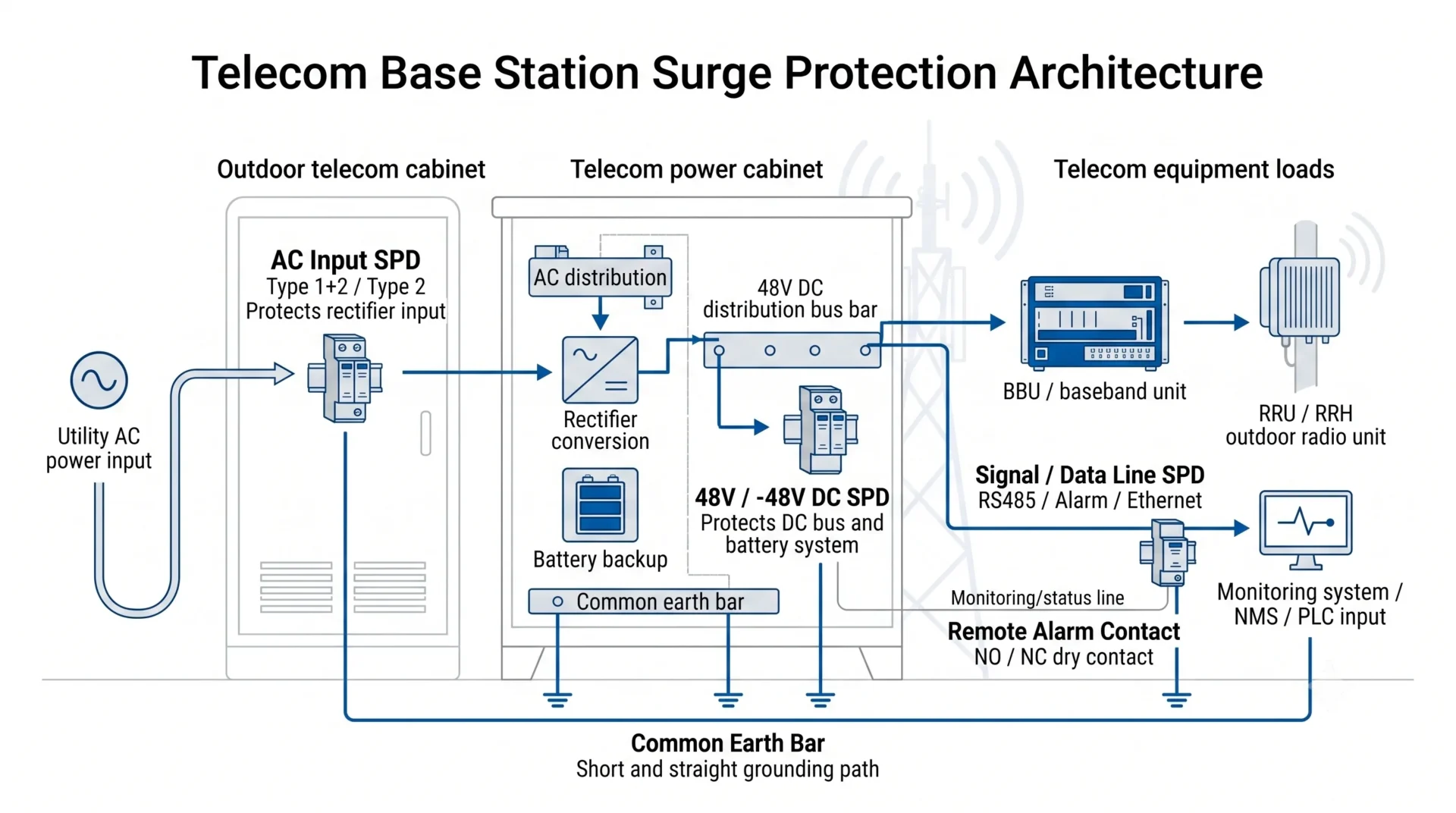
A telecom base station SPD solution is not a single surge protector. It is a coordinated protection structure for AC input, -48V DC power, signal/data lines, grounding, remote alarm monitoring, and replaceable SPD modules.
For telecom cabinets, tower sites, outdoor shelters, and -48V DC power systems, surge current may enter through several conductive paths. If only the AC input is protected, the rectifier, battery bus, BBU, RRU/RRH power feed, monitoring lines, and communication ports may still remain exposed.
This guide explains how to build a practical surge protection structure for telecom base stations and 48V / -48V DC power systems, especially for telecom equipment suppliers, cabinet integrators, maintenance teams, engineering contractors, stocking distributors, and OEM buyers.
Table of Contents
Quick Answer: What SPD Is Needed for a Telecom Base Station?
A telecom base station normally needs layered surge protection. The exact SPD model depends on the site risk, power system, cable routing, grounding quality, and monitoring requirement.
| Protection point | Typical SPD choice | What it protects | Buyer should confirm |
|---|---|---|---|
| AC input | Type 1+2 or Type 2 AC SPD | Utility input, AC distribution, rectifier input | Single-phase or three-phase system, grounding type, site exposure level |
| 48V / -48V DC telecom power | Low-voltage DC SPD for telecom power circuits | Rectifier output, battery bus, DC distribution, BBU or RRU/RRH DC feed | Nominal DC voltage, maximum continuous voltage, polarity, DIN rail space |
| Signal and monitoring lines | Signal SPD matched to voltage and protocol | RS485, alarm line, sensor line, BMS or rectifier monitoring line | Signal voltage, line pairs, terminal type, shield and grounding method |
| Ethernet / PoE line | RJ45 / network SPD where copper data lines enter the cabinet | Network ports, monitoring equipment, transmission devices | Data rate, PoE requirement, cable category, installation position |
| RF / antenna feeder | Coaxial surge protector matched to connector and frequency | Antenna feeder path and RF equipment interface | Connector type, frequency range, insertion loss, grounding point |
| Grounding and bonding | Short bonding to common earth bar | Provides surge current discharge path | Earth bar position, conductor length, equipotential bonding |
| Remote alarm | SPD with NO/NC dry contact | Maintenance monitoring for failed SPD modules | NMS, PLC, RTU, alarm logic, normally open or normally closed contact |
| Module replacement | Pluggable SPD cartridge | Faster maintenance without changing the complete base | Same model, same voltage rating, same pole structure, same discharge rating |
Need help matching SPDs for a telecom cabinet or -48V DC power system?
Send us your AC input voltage, DC system voltage, cabinet layout, grounding method, and signal line type. LEEYEE can help review the protection points before bulk supply or OEM integration.
Why Telecom Base Stations Need Layered Surge Protection
A telecom base station is usually exposed to more surge paths than a normal indoor distribution board. The site may include a tower, outdoor cabinet, AC power input, rectifier, 48V DC battery system, remote radio equipment, signal cables, monitoring devices, and grounding network.
Lightning does not need to strike the cabinet directly to damage the system. A nearby strike can induce high transient voltage on long metal cables. Switching transients from the grid or power equipment can also stress the rectifier and DC distribution system over time.
That is why the protection strategy should not stop at the incoming AC line. A practical telecom SPD design should check every conductive path that enters or leaves the cabinet.
1. AC Input Protection for Telecom Sites
The AC input is the first protection layer for most telecom sites. It protects the incoming power line before the power is converted by the rectifier into 48V DC.
For exposed tower sites, rural stations, mountain stations, rooftop sites, or cabinets supplied by long overhead lines, a Type 1+2 AC SPD is often considered at the main input. For lower-risk indoor cabinets or sub-distribution positions, a Type 2 AC SPD may be suitable.
What to confirm for AC input SPD
- AC system voltage: single-phase or three-phase
- Grounding system: TN-S, TN-C-S, TT, or project-specific arrangement
- Installation position: main input, AC distribution box, or cabinet inlet
- Required SPD type: Type 1+2 or Type 2
- Discharge rating: Iimp, In, Imax according to site risk
- Remote alarm requirement for unmanned sites
- Available DIN rail space and backup protection arrangement
For AC-side product options, see AC Surge Protective Device and Type 2 DIN Rail Surge Protector.
2. 48V / -48V DC Telecom Power Protection
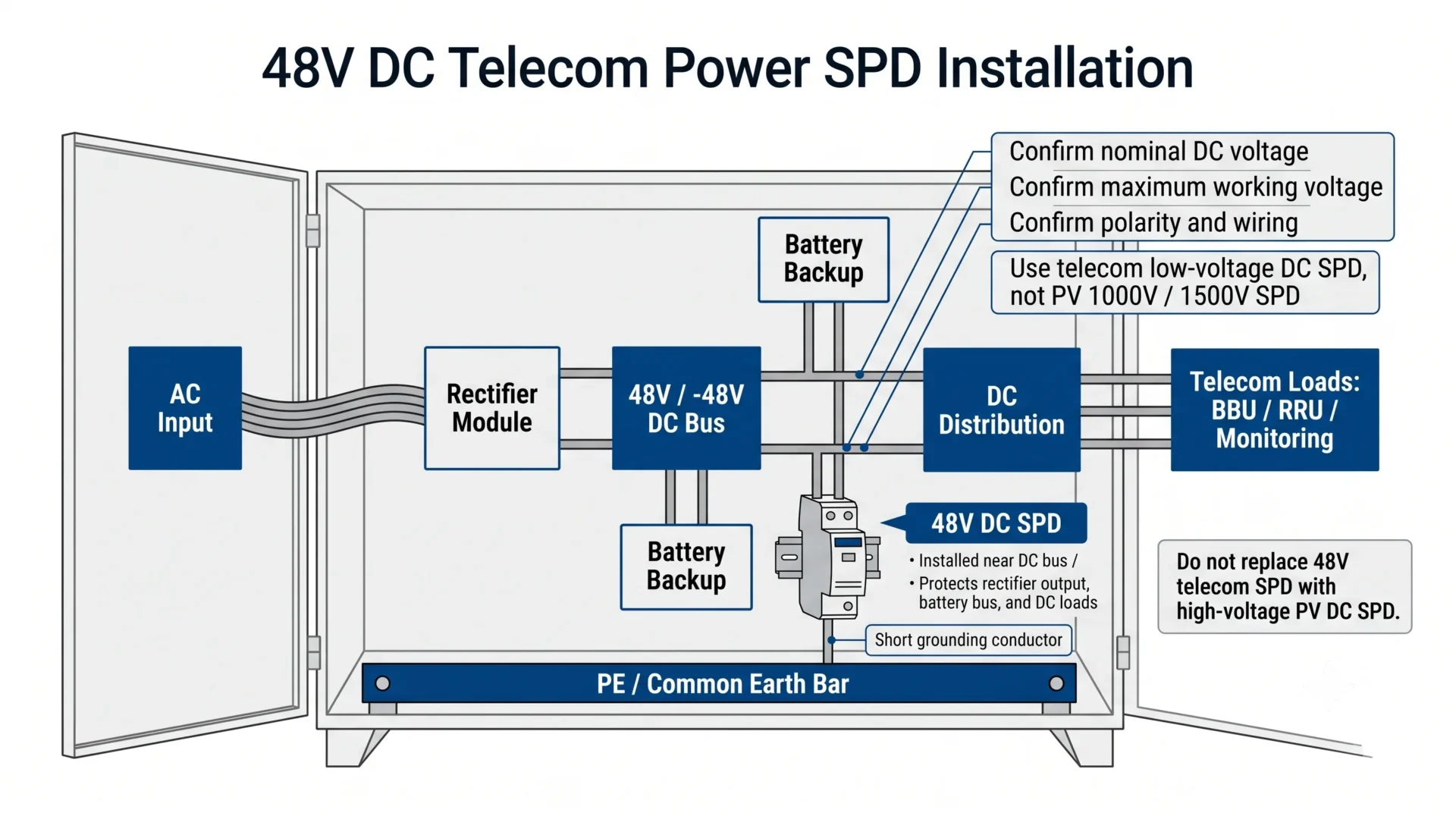
The 48V DC power system is the core of many telecom cabinets and base stations. It may include rectifiers, battery strings, DC distribution, BBU power supply, and DC feeds to remote radio equipment.
In telecom projects, the system is often described as 48V or -48V DC. However, the SPD should not be selected by the name “48V” only. The actual DC bus voltage during charging and operation can be higher than the nominal value. The DC SPD must be selected according to the real maximum continuous operating voltage of the power system.
Common 48V DC SPD installation points
Rectifier DC output
Protects the DC side after AC-to-DC conversion. This position helps reduce surge stress before transients spread into the DC distribution system.
Battery bus
Used where the battery system and DC bus may be exposed to transient overvoltage through the cabinet wiring or external DC lines.
DC distribution output
Protects branch circuits supplying telecom equipment, control equipment, or remote units.
RRU / RRH DC feed
Long outdoor DC cable runs can pick up induced surges. Protection may be needed near the cabinet output and near the equipment side, depending on site design.
How to think about -48V DC SPD voltage selection
For a -48V telecom power system, the nominal system name is only the starting point. The actual DC bus voltage, charging condition, battery configuration, and maximum continuous voltage should all be checked before confirming the SPD rating.
| Telecom DC point | What to check | SPD selection meaning | Why it matters |
|---|---|---|---|
| -48V nominal system | Actual operating voltage, float voltage, and maximum continuous voltage | Select by real system voltage, not only by the “48V” name | A DC SPD with too low a continuous voltage rating may age faster or fail early |
| Rectifier output | Output voltage range and control setting | Confirm that SPD Uc is suitable for continuous operation | The rectifier output is a common protection point for telecom DC power |
| Battery bus | Charging mode, backup battery arrangement, and wiring distance | Choose a DC SPD suitable for the battery bus environment | Battery systems may be exposed to transients through cabinet wiring |
| DC distribution output | Load side cable length and outdoor cable routing | Add DC SPD where long external DC lines increase exposure | Long DC feeders can pick up induced surge energy |
What to confirm for 48V DC SPD
- Nominal DC system voltage: 48V, -48V, or another telecom DC voltage
- Maximum continuous DC voltage during float charging or system operation
- Polarity and wiring structure
- Installation position: rectifier output, battery bus, DC distribution, or feeder output
- Required discharge capacity
- DIN rail space and terminal size
- Visual indicator and remote alarm requirement
- Whether a pluggable module is required for maintenance
For DC-side product direction, see DC Surge Protective Device. If the requirement is specifically for telecom 48V DC, send the system voltage and cabinet layout before confirming the final model.
3. Signal and Data Line Protection
Telecom cabinets often include more than power cables. Monitoring, control, alarm, communication, and sensor lines can also carry surge energy into sensitive electronics.
Signal SPDs must be selected differently from power SPDs. A signal SPD should match the working voltage, line pair, signal type, transmission rate, and grounding method. A wrong signal SPD may protect poorly or interfere with communication.
| Line type | Typical risk | SPD selection point | Common buyer mistake |
|---|---|---|---|
| RS485 monitoring line | Induced surge on long control cable | Match voltage, A/B line, shield, and grounding | Using a power SPD instead of a signal SPD |
| Dry contact alarm line | Transient entering alarm input or monitoring module | Confirm signal voltage and contact logic | Ignoring low-voltage alarm circuits |
| 24V sensor line | Surge from outdoor sensors or cabinet accessories | Match working voltage and wiring pairs | Only protecting AC input |
| Ethernet / PoE | Surge through copper network cable | Confirm data rate and PoE power requirement | Installing a protector that affects network performance |
| RF coaxial feeder | Lightning current or induced surge through antenna feeder | Match connector type, frequency range, and insertion loss | Choosing only by connector appearance |
For RS485 applications, see RS485 SPD Wiring and Selection Guide. For signal SPD product reference, see LY10 Data Signal DC Surge Protective Device.
4. Grounding and Bonding: The Part Many Buyers Underestimate
An SPD does not make surge energy disappear. It diverts surge current to earth or to an equipotential reference path. If the grounding conductor is too long, too thin, badly routed, or connected to a poor earth bar, the protection result can be much weaker.
For telecom sites, grounding is especially important because there may be multiple conductive systems: tower structure, cabinet earth bar, utility power earth, DC negative reference, signal cable shield, and antenna feeder grounding.
Good grounding practice for telecom SPD installation
- Use a common earth bar where possible.
- Keep SPD grounding conductors short and straight.
- Avoid large wiring loops between SPD, protected equipment, and earth bar.
- Bond cabinet, power system, signal protection, and cable shield according to the project grounding design.
- Do not assume that installing more SPDs can solve a poor grounding problem.
5. Remote Alarm Contact for Unmanned Telecom Sites
Many telecom sites are unmanned. A failed SPD module may not be noticed until the next maintenance visit unless the SPD has a remote alarm contact.
A remote alarm contact is usually a dry contact output, such as NO or NC. It can be connected to a monitoring system, PLC, RTU, NMS, or cabinet alarm input. When the SPD cartridge fails or disconnects, the monitoring system can receive a status change.
This function does not increase surge protection capacity. Its value is maintenance visibility.
What to confirm before ordering remote alarm SPDs
- Does the site require remote monitoring?
- Should the alarm logic be normally open or normally closed?
- What monitoring input will receive the dry contact?
- Is the remote signal terminal required on AC SPD, DC SPD, signal SPD, or all of them?
- Does the maintenance team need a visual indicator plus remote alarm?
For wiring logic, see How to Connect SPD Remote Alarm Contact to PLC or Monitoring System.
6. Pluggable Module Replacement and Maintenance
Telecom cabinets often need fast maintenance. A pluggable SPD module allows the failed cartridge to be replaced without changing the complete base, provided the replacement module matches the original specification.
For stocking importers, cabinet integrators, and maintenance contractors, this matters because one telecom project may use many similar cabinets across different sites. A clear spare module list can reduce maintenance mistakes.
When should a telecom SPD module be replaced?
- The visual indicator shows failure, often changing from green to red.
- The remote alarm reports SPD failure.
- The module has experienced a severe surge event and project maintenance rules require replacement.
- The SPD has visible damage, deformation, burn marks, or abnormal smell.
- The module no longer matches the required specification after cabinet modification.
For replacement guidance, see SPD Cartridge Replacement Guide.
Telecom SPD Selection by Site Scenario
Different telecom sites have different risk levels. A rooftop cabinet in an urban area, a remote tower on open ground, and an outdoor shelter with long cable runs should not be treated exactly the same.
| Site scenario | Main surge risk | Recommended protection focus | Commercial meaning |
|---|---|---|---|
| Outdoor telecom cabinet | AC input, DC feeder, signal cable, grounding difference | AC SPD + 48V DC SPD + signal SPD + remote alarm | Good fit for cabinet integrators and OEM supply |
| Remote tower site | High lightning exposure and long cable runs | Higher-risk AC input protection, DC feeder protection, strong bonding | Need project-level selection, not only catalogue matching |
| Rooftop base station | Building grounding, AC supply, antenna feeder, monitoring line | Coordinate with building lightning protection and cabinet SPDs | Useful for contractors and maintenance teams |
| Indoor telecom room | Power distribution and network/data line surge | AC distribution SPD + 48V DC bus SPD + data line protection if copper lines enter | Often selected by equipment supplier or system integrator |
| Battery backup cabinet | DC bus transient and cabinet wiring surge | Low-voltage DC SPD matched to actual bus voltage | Important for 48V power system suppliers |
For Telecom Cabinet Integrators and OEM Buyers
For telecom cabinet integrators, the main challenge is not only choosing one correct SPD. The bigger issue is matching AC SPD, -48V DC SPD, signal SPD, remote alarm logic, spare modules, datasheets, and labels as one consistent cabinet protection package.
If different SPD types are sourced separately without technical coordination, the project may face model mismatch, inconsistent alarm logic, wrong replacement cartridges, incomplete datasheets, or unclear spare part lists.
AC input SPD, -48V DC SPD, signal SPD, and remote alarm versions can be reviewed together for one cabinet design.
Model labels, wiring references, datasheets, and certificate scope can be prepared for distributor or private label projects.
Pluggable cartridges and replacement rules can be listed clearly, reducing maintenance mistakes across multiple telecom sites.
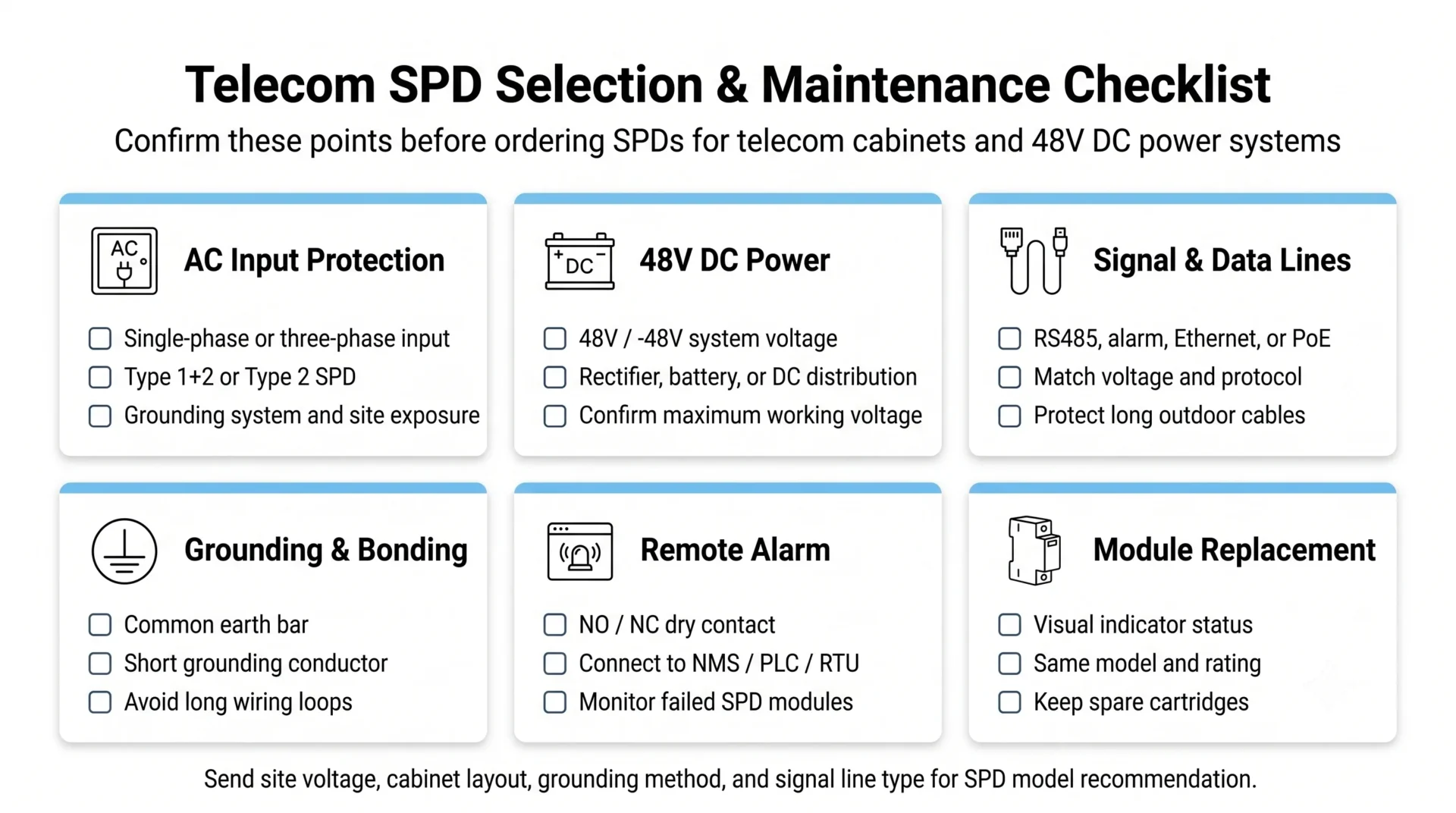
Before Ordering Telecom SPDs, Confirm These Details
For telecom projects, the fastest way to select the right SPD is to send the protection points and system parameters together. This avoids choosing one product correctly while leaving another path unprotected.
Common Mistakes in Telecom SPD Selection
Only protecting the AC input
AC input protection is important, but it does not protect every path. 48V DC lines, monitoring cables, Ethernet cables, and feeder-related paths may still carry surge energy into the cabinet.
Using PV DC SPD for telecom 48V DC systems
A high-voltage PV DC SPD is not automatically suitable for a 48V telecom power system. The voltage range, system behavior, cabinet space, and project requirement may be different.
Choosing DC SPD only by the word “48V”
The nominal 48V system name is not enough. The buyer should confirm the maximum continuous operating voltage of the DC bus and select a suitable SPD rating for real operating conditions.
Ignoring remote alarm
For unmanned telecom cabinets, a failed SPD without remote alarm may remain unnoticed. This increases maintenance risk after the next surge event.
Choosing signal SPD only by voltage
Signal SPD selection should also consider signal type, line pairs, capacitance, transmission rate, shield connection, terminal type, and grounding method.
Using long grounding wires
A long or badly routed grounding conductor can reduce SPD effectiveness. The discharge path should be short, straight, and bonded to the correct earth reference.
Related LEEYEE Pages
FAQ: Telecom Base Station SPD and -48V DC Surge Protection
What is the correct SPD for a telecom base station?
A telecom base station usually needs coordinated SPDs for AC input, 48V / -48V DC power, signal/data lines, and sometimes RF/coaxial feeder paths. The final selection depends on voltage, site exposure, grounding, cable routing, and monitoring requirements.
What SPD should be used for a -48V telecom power system?
A -48V telecom power system should use a low-voltage DC SPD matched to the actual maximum continuous DC bus voltage, polarity, installation position, and discharge capacity. It should not be selected only by the nominal “48V” system name.
Is AC SPD enough for a telecom base station?
No. AC SPD protects the power input and rectifier input side, but it does not automatically protect the -48V DC bus, DC distribution, outdoor DC feeders, signal lines, Ethernet lines, or alarm circuits.
Where should a 48V DC SPD be installed in a telecom cabinet?
Common installation points include the rectifier DC output, battery bus, DC distribution output, and long DC feeder output. The exact position depends on cabinet layout, cable routing, and project risk level.
Can I use a PV DC SPD for a 48V telecom system?
Not blindly. PV DC SPDs and telecom 48V DC SPDs may have different voltage ratings, application scopes, standards, and cabinet requirements. The SPD should be confirmed for the actual telecom DC power circuit.
Why are signal line SPDs needed in telecom cabinets?
Monitoring, RS485, alarm, sensor, Ethernet, and PoE lines can carry transient overvoltage into sensitive electronics. If only the power line is protected, these signal paths may still cause failures.
Do telecom SPDs need remote alarm contacts?
For unmanned telecom cabinets, remote alarm contacts are highly useful. A NO/NC dry contact can send SPD failure status to a PLC, RTU, NMS, or cabinet monitoring input.
Can the SPD module be replaced without replacing the whole device?
If the SPD uses a pluggable design, the cartridge can usually be replaced while keeping the base. The replacement module must match the original series, voltage rating, pole structure, discharge rating, and remote signal version.
What information is needed for a telecom SPD BOM?
Send the AC input voltage, DC system voltage, grounding design, cabinet layout, cable entry points, signal line types, remote alarm requirement, certification requirement, spare module requirement, and whether OEM label or private label supply is needed.
Need a Telecom SPD Selection for Your Cabinet or -48V DC System?
LEEYEE supports surge protection selection for AC input, DC power, signal lines, remote alarm, and OEM cabinet integration. Send your system voltage, wiring structure, and cabinet requirement for model recommendation.