
Not sure whether to order a 3P+N SPD or a 4P SPD for a three-phase distribution board?
This is a common question for panel builders, electrical distributors, OEM buyers, and project engineers. The two products may look similar from the outside. Both can have four modules. Both may be used in three-phase systems with neutral.
But internally, they may use different protection structures. The key difference is not only the number of poles. The key difference is often the protection path between neutral and earth, also called N-PE protection.
Table of Contents
Quick Answer: What Is the Difference Between 3P+N SPD and 4P SPD?
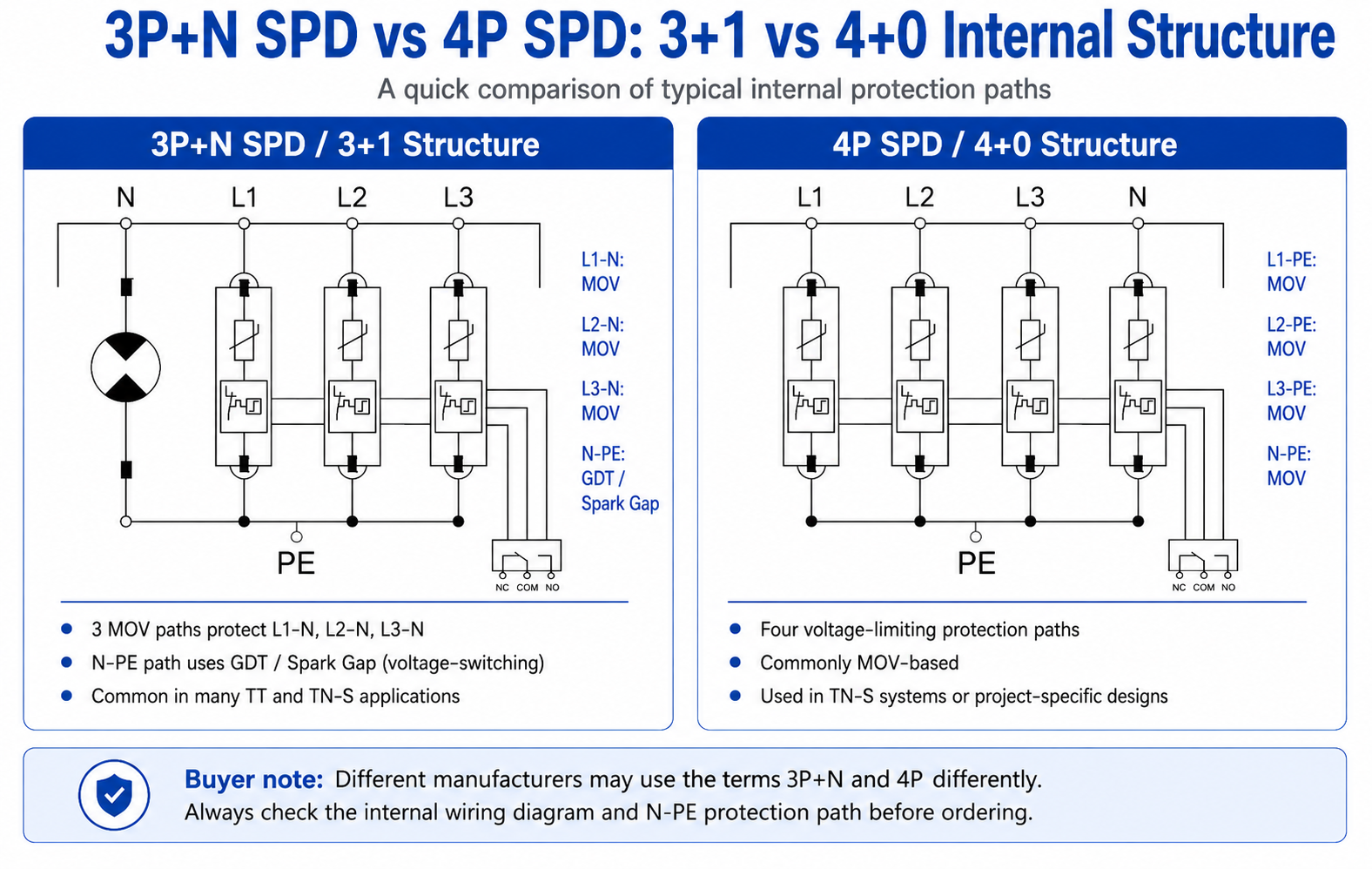
A 4P SPD usually refers to a 4+0 structure. In this design, L1-PE, L2-PE, L3-PE, and N-PE protection paths are commonly voltage-limiting paths, often MOV-based.
A 3P+N SPD usually refers to a 3+1 structure. In this design, L1-N, L2-N, and L3-N use MOV protection paths, while the N-PE path often uses a voltage-switching component such as a GDT or spark gap.
| Item | 3P+N SPD | 4P SPD |
|---|---|---|
| Common structure | 3+1 | 4+0 |
| Phase protection | L1-N, L2-N, L3-N MOV paths | L1-PE, L2-PE, L3-PE voltage-limiting paths |
| N-PE protection | Usually GDT / spark gap | Usually MOV-based, depending on design |
| Common use | TT, TN-S, TN-C-S after PEN split | TN-S or project-specific designs |
| Buyer warning | Confirm the N-PE module type | Confirm the internal wiring diagram |
Simple rule: do not choose only by the words “3P+N” or “4P” on the product name. Always check the grounding system and the manufacturer’s wiring diagram.
What Does 3P+N SPD Mean?
A 3P+N SPD is commonly used for three-phase power systems with neutral.
It is also called a 3PN SPD, 3+1 SPD, three-phase SPD with neutral, or SPD with N-PE protection.
In a typical 3+1 design, the SPD protects:
- L1 to N
- L2 to N
- L3 to N
- N to PE
The phase paths are usually protected by voltage-limiting components such as MOVs. The N-PE path is often protected by a voltage-switching component such as a GDT or spark gap.
This design is important because the neutral conductor can rise in potential during surge or fault conditions. The N-PE module helps discharge this overvoltage to earth during surge events.
What Does 4P SPD Mean?
A 4P SPD means four-pole surge protective device.
In many product ranges, a 4P SPD refers to a 4+0 structure. It uses four voltage-limiting protection paths, commonly MOV-based.
A 4P SPD may protect four conductors in a three-phase system with neutral. But the name alone is not enough.
Different manufacturers may use “4P” differently. Some suppliers use 4P for a 4+0 structure. Some buyers use 4P to mean any four-module SPD. In some markets, a 3P+N product may also be called a four-pole SPD because it has four physical modules.
Buyer note: before ordering, check the internal circuit diagram. This is more reliable than the pole name.
3P+N vs 4P SPD: Main Comparison
| Selection Point | 3P+N SPD | 4P SPD |
|---|---|---|
| Also called | 3PN SPD, 3+1 SPD | 4-pole SPD, 4+0 SPD |
| Internal concept | Three phase-to-neutral paths plus one N-PE path | Four voltage-limiting protection paths |
| N-PE protection | Usually voltage-switching | Usually voltage-limiting, depending on design |
| Typical N-PE component | GDT or spark gap | MOV, depending on the manufacturer design |
| Common grounding systems | TT, TN-S, TN-C-S after PEN split | TN-S or project-specific systems |
| Best for | Systems where neutral-to-earth protection matters | Systems where the drawing requires 4+0 protection |
| Main risk if selected wrongly | Wrong N-PE protection design | Wrong earthing connection or unsuitable internal structure |
| Buyer should confirm | N-PE module type | Circuit diagram and application system |
Why the N-PE Protection Path Matters
The most important difference is the N-PE path.
In a three-phase system with neutral, surge voltage may appear not only between phase and neutral. It may also appear between neutral and protective earth.
This is especially important in TT systems and some TN-S or TN-C-S installations.
A 3P+N SPD normally uses a special N-PE module. This module is often a spark gap or GDT. It stays insulated during normal operation and conducts during surge events.
This helps reduce leakage current during normal operation. It also helps handle neutral-to-earth overvoltage during surge conditions.
A 4P SPD may use MOV-based protection on all four paths. This can be suitable for some systems, but it is not automatically better.
The real question is simple:
What does your system need between N and PE?
Is 3P+N SPD the Same as 4P SPD?
No, not always.
They may look similar. Both may have four modules. Both may be installed in a three-phase distribution board with neutral.
But electrically, they can be different.
A 3P+N SPD usually means a 3+1 circuit. A 4P SPD usually means a 4+0 circuit.
The difference is the fourth protection path.
In a 3P+N SPD, the fourth path is usually N-PE protection with a switching component. In a 4P SPD, the fourth path is usually another voltage-limiting protection path.
Do not ask only: “Do you have 4P SPD?”
Ask instead: “Is this a 4+0 SPD, or is it a 3P+N / 3+1 SPD with N-PE spark gap protection?”
Which SPD Should Be Used in TT Systems?
For many three-phase TT systems, a 3P+N SPD / 3+1 SPD is commonly preferred.
In TT systems, neutral and protective earth are separate. The N-PE path can become important during surge events.
A 3+1 design gives specific surge protection between neutral and earth.
For a 230/400V TT distribution board, buyers often ask for:
- Type 2 3P+N SPD
- Type 1+2 3P+N SPD
- 275V, 320V, or 385V Uc depending on system voltage and grid condition
- Remote signal contact if required
- DIN rail mounting
- IEC 61643-11 compliance
For TT systems, do not choose a 4P SPD only because it has four modules. Confirm whether the design is suitable for TT use and whether the N-PE path is correct.
Which SPD Should Be Used in TN-S Systems?
In TN-S systems, neutral and PE are separate conductors.
Both 3P+N and 4P configurations may appear in the market. The correct choice depends on the project design, local practice, and SPD circuit diagram.
For many buyers, a 3P+N SPD is a common choice when the board has L1, L2, L3, N, and PE.
But a 4P SPD may also be specified in some TN-S distribution boards.
The important point is this:
TN-S does not automatically mean 4P. TN-S also does not automatically mean 3P+N.
You need to confirm whether the project requires a 3+1 or 4+0 structure.
Which SPD Should Be Used in TN-C-S Systems?
TN-C-S systems need more attention.
In a TN-C-S system, PEN is combined at one part of the system and separated into PE and N at another point.
Before the PEN is separated, there is no independent neutral and PE. After the PEN is separated, the system behaves more like a TN-S section.
So the SPD selection depends on the installation point.
| Installation Point | Common SPD Choice | Reason |
|---|---|---|
| Before PEN separation | 3P SPD | L1, L2, and L3 are protected to PEN. N and PE are not separated yet. |
| After PEN separation | 3P+N or 4P SPD | N and PE are available as separate conductors. Treat this section more like TN-S. |
| Inside final distribution board | Confirm project drawing | The correct structure depends on N-PE path, RCD arrangement, and project requirement. |
This is a common source of mistakes. A buyer may say, “My system is TN-C-S, please give me 4P SPD.” But the supplier still needs to know where the SPD will be installed.
Which SPD Should Be Used in TN-C Systems?
In a TN-C system, neutral and protective earth are combined as PEN.
There is no separate N and PE conductor at the installation point.
For this reason, a three-pole SPD is commonly used for L1, L2, and L3 protection to PEN.
A 3P+N SPD is normally not used before PEN separation because there is no separate N-PE path.
Selection Table: TT vs TN-S vs TN-C-S vs TN-C
| Earthing System | Neutral Available? | PE Separate? | Common SPD Choice | Buyer Note |
|---|---|---|---|---|
| TT | Yes | Yes | 3P+N / 3+1 | N-PE surge protection is important |
| TN-S | Yes | Yes | 3P+N or 4P | Check 3+1 or 4+0 design |
| TN-C-S before PEN split | No separate N/PE | No | 3P | Protect L1, L2, L3 to PEN |
| TN-C-S after PEN split | Yes | Yes | 3P+N or 4P | Treat like TN-S section |
| TN-C | PEN only | No | 3P | Do not assume 4P is needed |
| IT | Depends | Depends | Project-specific | Ask engineer or supplier |
Wiring Difference: 3P+N SPD vs 4P SPD
For this topic, the wiring diagram is very important.
A text explanation is not enough for many buyers. A panel builder needs to see the real protection paths.
3P+N SPD Typical Concept
A common 3P+N / 3+1 SPD structure uses:
- L1 to N
- L2 to N
- L3 to N
- N to PE
The first three paths are usually MOV-based. The N-PE path is often GDT or spark-gap based.
4P SPD Typical Concept
A common 4P / 4+0 SPD structure uses four voltage-limiting protection paths.
The actual wiring path depends on the product design and the manufacturer’s circuit diagram.
This is why the drawing must be checked before ordering.
Common Applications
3P+N and 4P SPDs are widely used in low-voltage three-phase distribution systems.
| Application | Common Requirement |
|---|---|
| Main distribution board | Type 1+2 or Type 2 SPD depending on lightning risk |
| Sub-distribution board | Type 2 SPD |
| Commercial building panel | 3P+N or 4P depending on earthing system |
| Industrial control cabinet | Type 2 SPD with clear wiring diagram |
| OEM electrical panel | Confirm 3+1 or 4+0 before production |
| Solar AC combiner / AC distribution side | Confirm grid system and SPD type |
| Telecom or equipment room panel | Often requires remote signal contact |
Common Buying Mistakes
Mistake 1: Thinking 4P Is Always Better Than 3P+N
More poles do not always mean better protection.
A 4P SPD may be correct for one system. A 3P+N SPD may be better for another.
The right choice depends on the earthing system and internal circuit.
Mistake 2: Treating 3P+N and 4P as the Same Product
They may both have four modules. But the protection structure may be different.
A 3P+N SPD often has a special N-PE module. A 4P SPD may not.
Always check the circuit diagram.
Mistake 3: Ignoring TT / TN-S / TN-C-S Differences
A product that works in TN-S may not be the best choice for TT.
A product selected after PEN separation may not be correct before PEN separation.
The grounding system is not a small detail. It decides the SPD structure.
Mistake 4: Choosing Only by Uc Voltage
Uc is important. But Uc alone does not decide whether you need 3P+N or 4P.
For example, 275V, 320V, and 385V SPDs may all exist in different pole configurations.
You need to confirm both the electrical rating and the internal wiring structure.
Mistake 5: Not Confirming RCD Position
In some installations, RCD coordination can affect SPD selection and wiring.
This is especially important in TT systems.
Before ordering, confirm whether the RCD is upstream or downstream of the SPD. If you are not sure, send the panel drawing to the supplier.
How to Choose: Simple Decision Process
Step 1: Confirm the Earthing System
Check whether the system is TT, TN-S, TN-C-S, TN-C, or IT. Do not guess.
Step 2: Confirm N and PE
Check whether neutral and PE are separate, or whether PEN is still combined.
Step 3: Confirm the Circuit
Ask whether the project requires 3+1, 4+0, N-PE spark gap, or another structure.
Step 4: Confirm SPD Type
Choose Type 1+2 or Type 2 according to the installation position and project requirement.
Recommended Selection for Buyers
For most B2B buyers, the product name is not enough.
A better inquiry format is:
We need an SPD for a three-phase distribution board.
System: TT / TN-S / TN-C-S.
Voltage: 230/400V.
Required configuration: 3P+N / 3+1 or 4P / 4+0.
SPD Type: Type 2 or Type 1+2.
Uc: 275V / 320V / 385V.
Remote signal: yes / no.
Please recommend a suitable DIN rail SPD with wiring diagram.
This gives the supplier enough information to recommend the correct model.
Before Ordering Checklist
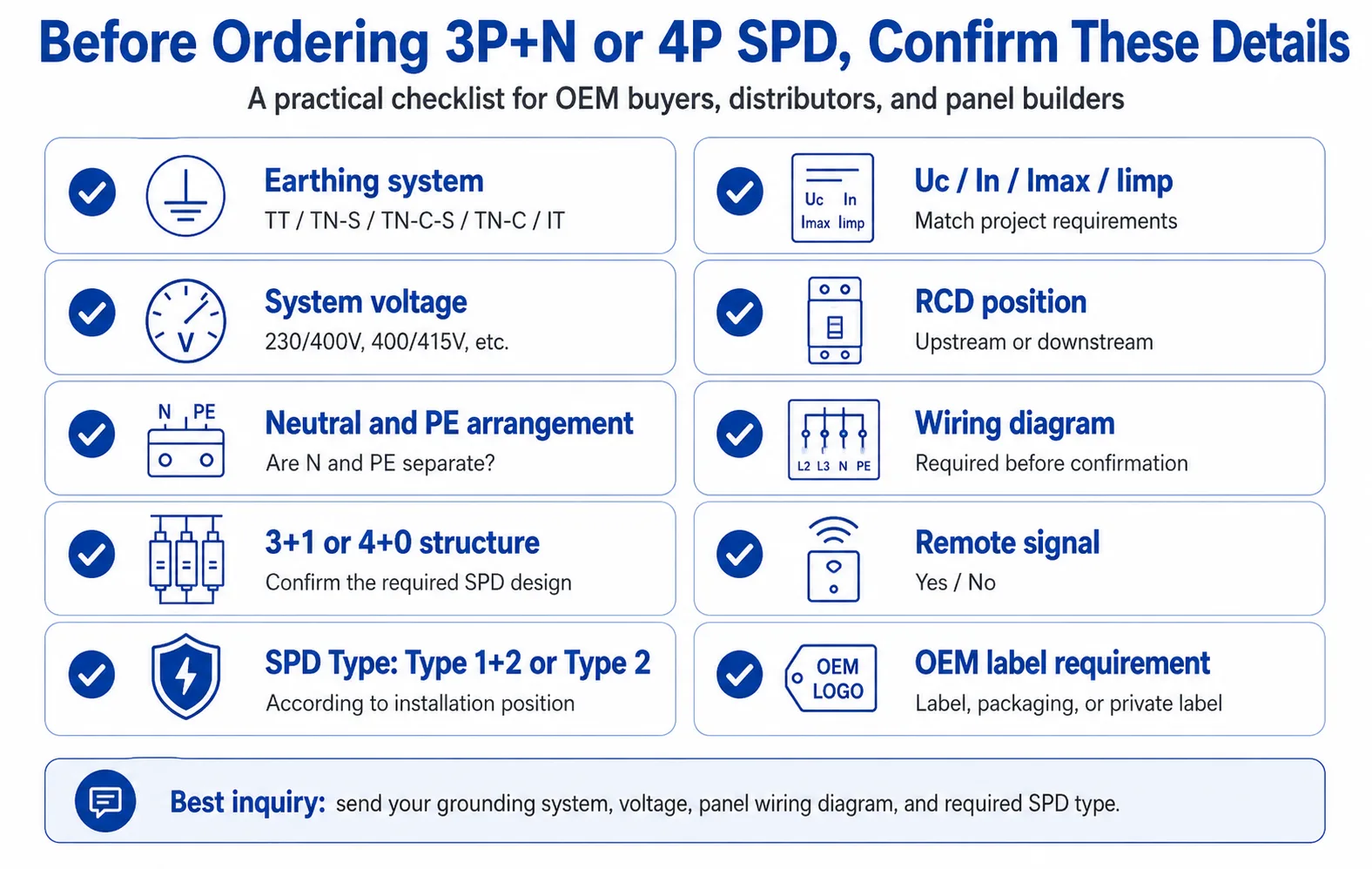
Before choosing 3P+N or 4P SPD, confirm these details:
- Earthing system: TT, TN-S, TN-C-S, TN-C, or IT
- Whether neutral is available
- Whether PE is separate from neutral
- Whether PEN has already been split
- Installation position in the panel
- SPD type: Type 1, Type 1+2, or Type 2
- Required structure: 3+1 or 4+0
- N-PE protection requirement
- Uc voltage
- In, Imax, and Iimp rating
- Backup fuse requirement
- Remote signal contact
- RCD position
- DIN rail space
- Required standard or certificate
- OEM label or private label requirement
Product Recommendation Direction
Option 1: 3P+N Type 2 SPD
Suitable for many TT and TN-S distribution boards where Type 2 protection is required.
Common for commercial distribution boards, sub-distribution panels, OEM electrical panels, and building power distribution.
Option 2: 3P+N Type 1+2 SPD
Suitable for installations with higher lightning exposure or main distribution boards where lightning current discharge capacity is required.
Common for main incoming panels, buildings with external lightning protection, overhead line supply, and industrial power distribution.
Option 3: 4P Type 2 SPD
Suitable where the project drawing specifies a 4-pole / 4+0 design.
Common for TN-S distribution boards, project-specific panel designs, and markets where 4P SPD is the standard naming practice.
Option 4: 3P SPD
Suitable for TN-C systems or TN-C-S systems before PEN separation.
Common for three-phase systems without separate neutral, L1/L2/L3 to PEN protection, and industrial boards with combined PEN at the installation point.
FAQ
Is 3P+N SPD the same as 4P SPD?
No. They may look similar, but they may have different internal circuits. A 3P+N SPD usually means a 3+1 design with a special N-PE protection module. A 4P SPD usually means a 4+0 design with four voltage-limiting protection paths. Always check the wiring diagram.
What is the difference between 3+1 and 4+0 SPD?
A 3+1 SPD usually has three phase-to-neutral protection paths and one N-PE voltage-switching path. A 4+0 SPD usually has four voltage-limiting protection paths. The biggest difference is how neutral-to-earth protection is handled.
Which SPD should I use for a TT system?
For many three-phase TT systems, a 3P+N / 3+1 SPD is commonly selected because N-PE surge protection is important. However, the final choice should follow the project design, local standard, and manufacturer wiring diagram.
Which SPD should I use for a TN-S system?
For TN-S systems, both 3P+N and 4P configurations may be used depending on the design. The buyer should confirm whether the project requires a 3+1 circuit or a 4+0 circuit.
Can I use 4P SPD instead of 3P+N SPD?
Not always. A 4P SPD may not have the same N-PE protection structure as a 3P+N SPD. If the project requires 3+1 protection, do not replace it with a 4P SPD without checking the circuit diagram.
Is 4P SPD better than 3P+N SPD?
No. 4P is not automatically better. 3P+N and 4P are different structures for different systems. The better choice depends on the earthing system, neutral arrangement, and wiring requirement.
What should I send to the supplier before ordering?
Send the earthing system, system voltage, panel wiring diagram, SPD type, Uc voltage, discharge current rating, remote signal requirement, and whether you need OEM label or private label service.
Need Help Choosing 3P+N or 4P SPD?
If you are not sure which SPD structure is suitable for your three-phase distribution board, send us your system voltage, grounding system, and panel wiring diagram.
LEEYEE can help recommend a suitable SPD configuration for distribution boards, OEM electrical panels, and private label SPD orders.