
Nicht sicher, ob das SPD in einer Verteilung, OEM-Schalttafel oder einem Solar-Combiner-Box ausgefallen ist? Dieser Leitfaden zeigt einen praktischen Prüfablauf für Instandhaltungsteams, After-Sales-Teams von EPCs, Schaltschrankbauer und SPD-Distributoren.
Das Ziel ist nicht nur, ein rotes Anzeigefenster abzulesen. Eine sachgerechte Überprüfung eines SPD-Fehlers sollte die Sichtanzeige, den Fernmeldekontakt, den Zustand des Gehäuses, die Klemmen, jüngste Blitzereignisse, Unterschiede zwischen AC-/DC-Anwendungen und die Bestätigung der Ersatzparameter umfassen.
Sicherheitshinweis: Die Prüfung und der Austausch von SPDs sollten von qualifiziertem Elektrofachpersonal durchgeführt werden. Entfernen Sie keine steckbare SPD-Kartusche, öffnen Sie keine Combiner-Box und berühren Sie keine Klemmen, solange der Stromkreis unter Spannung steht.
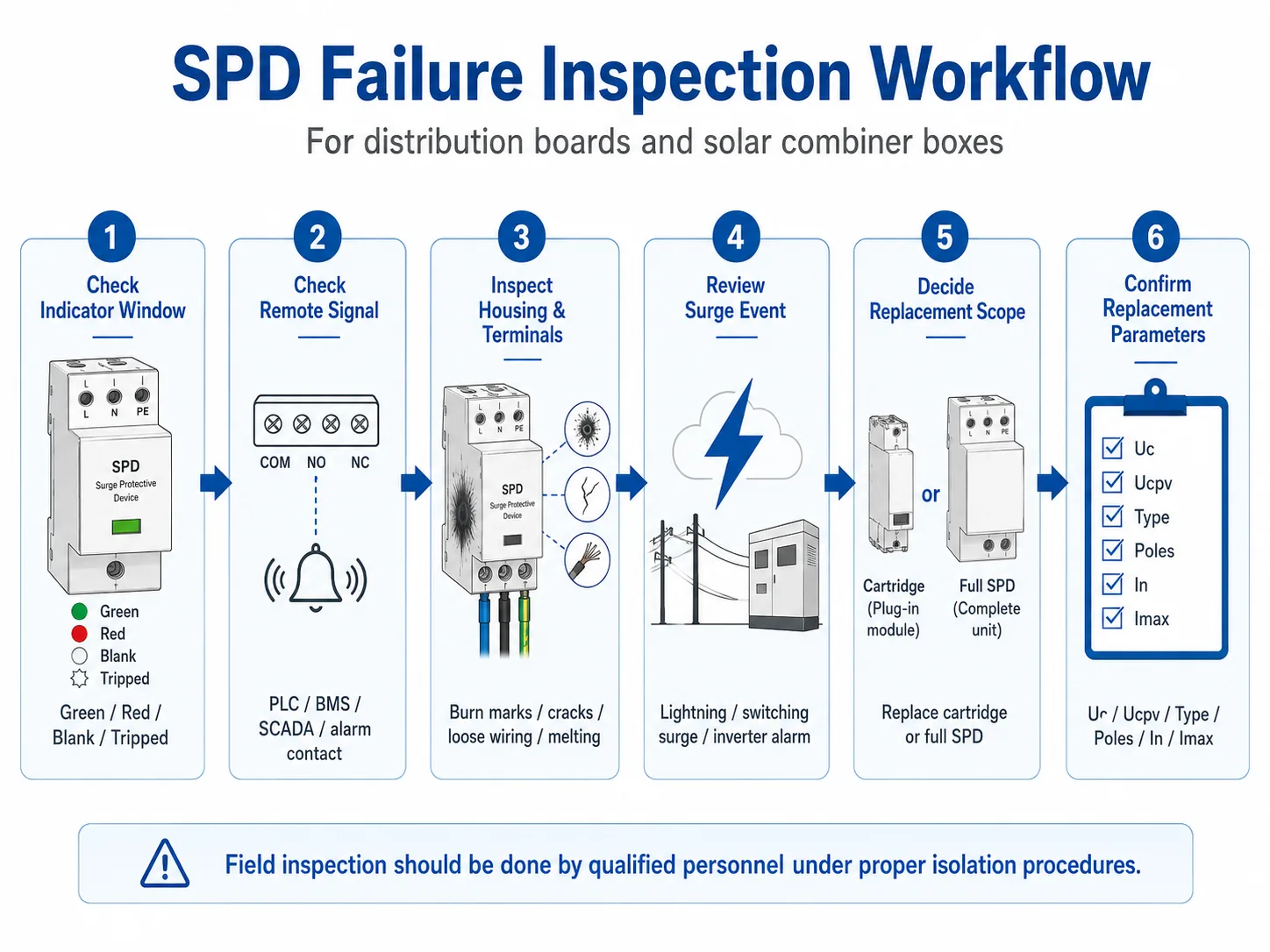
Prüfen Sie zunächst das Statusfenster des SPD. Wenn die Anzeige gemäß dem Produktetikett rot, ausgelöst, leer oder abnormal ist, sollte das SPD-Modul geprüft und in der Regel ersetzt werden. Prüfen Sie anschließend den Fernmeldekontakt, sichtbare Schäden, den Zustand der Klemmen, die vorgeschaltete Sicherung oder den Leistungsschalter sowie, ob es am Standort kürzlich Blitz- oder Schaltüberspannungen gab.
| Prüfpunkt | Worauf Sie achten sollten | Was es normalerweise bedeutet | Empfohlene Maßnahmen |
|---|---|---|---|
| Anzeigefenster | Rot, ausgelöst, leer oder abnormer Status | Der interne Trennschalter ist möglicherweise geöffnet worden | Planen Sie den Austausch des Moduls und bestätigen Sie das Modell |
| Fernsignal | Der Alarmkontakt ändert seinen Zustand oder der BMS/PLC-Alarm ist aktiv | Die SPD kann bereits offline sein, bevor jemand das Bedienfeld überprüft | Öffnen Sie das Bedienfeld sicher und überprüfen Sie den SPD-Status |
| Gehäuse und Anschlussklemmen | Brandspuren, Risse, Schmelzspuren, Verfärbungen, Geruch, lose Leitungen | Mögliche Überspannungsschäden, Überhitzung oder schlechte Verbindung | Vor dem Wiedereinschalten die Stromversorgung trennen und prüfen |
| Nach einem Blitzereignis | Mehrere SPDs zeigen an derselben Anlage oder in derselben Combiner-Box-Gruppe Alarme an | Die Anlage erfordert möglicherweise eine Sammelinspektion statt eines einzelnen Modulaustauschs | Alle frei zugänglichen Schaltschränke prüfen und die Austauschhistorie dokumentieren |
| Austauschparameter | Uc, Ucpv, Typ, Pole, In, Imax, Fernsignal, Modulgröße | Ein falscher Ersatz kann vorzeitig ausfallen oder das System unzureichend geschützt lassen | Bestätigen Sie die Bemessung, bevor Sie Ersatzmodule oder neue SPDs bestellen |
Inhaltsübersicht
Die SPD-Fehlerprüfung umfasst mehr als nur das Ablesen eines roten Anzeigefensters
Ein rotes Anzeigefenster ist das sichtbarste Zeichen für einen SPD-Ausfall. Es ist jedoch nicht die gesamte Prüfung.
In einer Fabrikverteilungstafel kann das Problem durch langfristige Überspannung, falsche Uc-Auswahl, lose Klemmen oder wiederholte Schaltüberspannungen verursacht werden. In einem Solar-Combiner-Box kann das Problem durch Blitzeinwirkung, falsche Ucpv-Bemessung, mangelhafte Erdung auf der DC-Seite, eindringende Feuchtigkeit oder Modulalterung nach wiederholten Überspannungen verursacht werden.
Aus diesem Grund konzentriert sich diese Seite auf den vollständigen Prozess der Fehlerprüfung. Wenn Sie nur verstehen möchten, was eine rote SPD-Anzeige bedeutet, lesen Sie unseren zugehörigen Leitfaden über SPD-Statusanzeige.
Schritt-für-Schritt-Verfahren zur Inspektion von SPD-Fehlern
Verwenden Sie dieses Verfahren während der routinemäßigen Wartung, nach Gewitteraktivität, nach einem Fernalarm oder bevor Sie Ersatz-SPD-Module bestellen.
- Prüfen Sie zuerst das SPD-Anzeigefenster. Grün bedeutet in der Regel, dass das Modul weiterhin im normalen Betrieb ist. Rot oder ausgelöst bedeutet in der Regel, dass der interne Trennschalter geöffnet hat und das Modul diesen Stromkreis nicht mehr schützt. Bestätigen Sie die Bedeutung immer anhand des Produktetiketts oder Datenblatts, da sich die Anzeigekonzepte je nach Hersteller unterscheiden können.
- Überprüfen Sie das Fernsignal oder den potenzialfreien Kontakt. Viele Industrie-SPDs und PV-SPDs verfügen über einen Fernmeldekontakt. Dieser Kontakt kann an eine PLC, ein BMS, ein SCADA-System, eine Alarmlampe oder eine Überwachungseinheit angeschlossen werden. Wenn der Fernalarm aktiv ist, inspizieren Sie das SPD, auch wenn der Schaltschrank noch nicht visuell überprüft wurde.
- Inspizieren Sie das Gehäuse und die Umgebung. Achten Sie auf schwarze Flecken, geschmolzenen Kunststoff, Risse, Verfärbungen, ungewöhnliche Gerüche, Feuchtigkeit, Korrosion oder beschädigte Etiketten. Diese Anzeichen können auf Überspannungsbelastung, Überhitzung, mangelhafte Gehäuseabdichtung oder einen schwerwiegenden Defekt hindeuten.
- Überprüfen Sie Klemmen, Verdrahtung und den vorgeschalteten Schutz. Lose Klemmen und schlechte Verbindungen können Hitze erzeugen und das SPD vorzeitig ausfallen lassen. Prüfen Sie zudem, ob die vorgeschaltete Sicherung, der Leitungsschutzschalter oder der SPD-Backupschutz ausgelöst hat. Setzen Sie den Schutzschalter nicht einfach zurück, ohne die Ursache zu finden.
- Überprüfen Sie kürzliche Überspannungs- oder Blitzereignisse. Wenn am Standort ein Gewitter, ein Netzumschaltereignis, ein Wechselrichteralarm oder wiederholte Geräte-Resets auftraten, inspizieren Sie alle zugehörigen SPDs im betroffenen Verteiler oder der Generatoranschlusskasten-Gruppe. Ein ausgefallenes Modul ist möglicherweise nur ein Teil des Problems.
- Entscheiden Sie, ob nur das Schutzmodul oder das gesamte SPD ausgetauscht werden muss. Bei steckbaren SPDs kann das defekte Schutzmodul oft ausgetauscht werden, während das Unterteil verdrahtet bleibt. Bei fest verbauten SPDs muss in der Regel das gesamte Gerät ausgebaut und neu verdrahtet werden. In beiden Fällen sind eine Netztrennung und entsprechende Sicherheitsmaßnahmen vor Ort erforderlich.
- Bestätigen Sie die Austauschparameter vor der Bestellung. Überprüfen Sie AC- oder DC-Anwendung, Uc oder Ucpv, Typ 1 / Typ 2 / Typ 1+2, Polkonfiguration, In, Imax, Fernmeldekontakt-Anforderung und Modulkompatibilität. Bestellen Sie nicht nur nach dem äußeren Erscheinungsbild.
Checkliste für die Feldinspektion von SPD-Fehlern
Verwenden Sie diese Checkliste bei der Überprüfung von ÜSS in Verteilerkästen, PV-Generatoranschlusskästen, Industrieschaltschränken oder OEM-Schalttafeln. Sie hilft Wartungsteams dabei, normale Zustände von Warnzeichen für einen Ausfall zu unterscheiden.
| Prüfpunkt | Normalzustand | Ausfallwarnung | Nächste Schritte |
|---|---|---|---|
| Anzeigefenster | Grüne oder normale Statusanzeige | Rote, leere, ausgelöste oder anormale Anzeige | Status protokollieren und Austauschprüfung vorbereiten |
| Fernsignalschalter | Normaler Kontaktzustand, kein Alarm | Alarmkontakt gewechselt oder BMS/PLC meldet ÜSS-Fehler | Schaltschrank sicher öffnen und ÜSS-Zustand prüfen |
| ÜSS-Gehäuse | Sauberes Gehäuse, keine Risse oder Verformungen | Brandspuren, Schmelzspuren, Risse, dunkle Flecken, anormaler Geruch | Spannung freischalten und Installation vor dem Austausch prüfen |
| Anschlüsse und Verkabelung | Feste Anschlüsse, keine Verfärbungen, ordnungsgemäße Leitungsführung | Lose Drähte, geschwärzte Anschlüsse, Überhitzung, beschädigte Isolierung | Drehmoment, Kabelquerschnitt, Wärmequelle und Vorsicherung prüfen |
| Erdung / PE-Anschluss | Sichere PE-Verbindung und sauberer Erdungspfad | Loser PE, Korrosion, fehlende Erdung, beschädigter Erdungsleiter | Erdung korrigieren, bevor ein neuer ÜSS installiert wird |
| Nach Blitzschlag oder Überspannungsereignis | Kein Alarm und keine sichtbaren Schäden nach Vor-Ort-Prüfung | Mehrere ÜSS-Alarme im selben Schaltschrank oder Standortbereich | ÜSS stapelweise prüfen, statt nur ein Modul auszutauschen |
| Modellbezeichnung | Modell, Spannung, Typ, In/Imax und Norm sind lesbar | Etikett beschädigt, unleserlich oder abweichend von den Projektdokumenten | Fotos machen und das korrekte Ersatzmodell bestätigen |
Wichtig: Ein optisch einwandfreier Überspannungsschutz (SPD) ist nicht zwangsläufig voll funktionsfähig. Nach einem starken Blitzschlag oder Überspannungsereignis kann der interne MOV bereits geschwächt sein, auch wenn die Anzeige noch nicht umgeschlagen ist. An kritischen Standorten sollte die Inspektion nach einem Ereignis nicht erst bis zum nächsten routinemäßigen Wartungstermin warten.
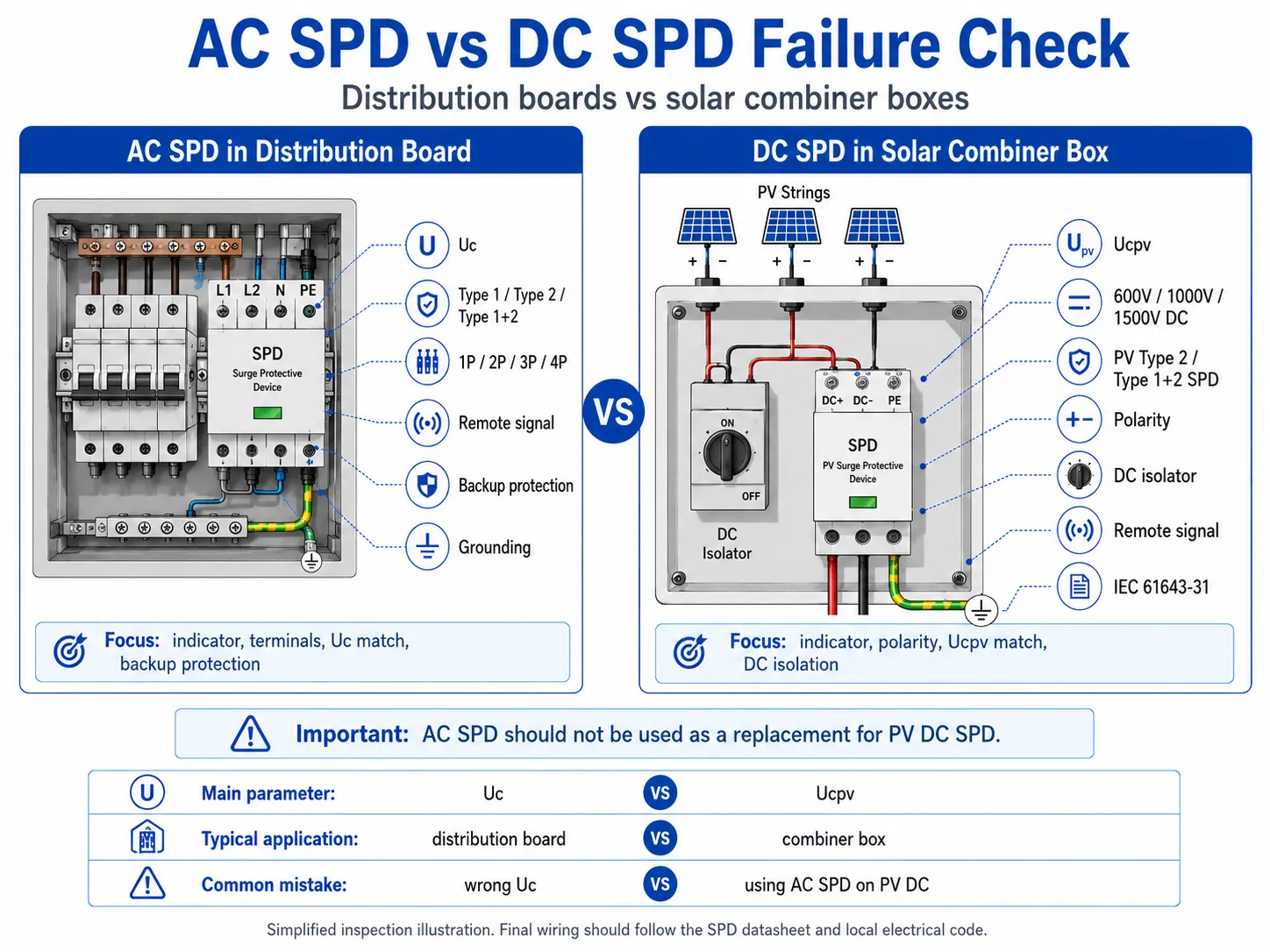
SPD-Fehlerprüfung am AC-Verteilerfeld im Vergleich zum SPD im DC-Solar-Combiner-Box
AC- und DC-SPDs werden nicht auf exakt dieselbe Weise geprüft. Der visuelle Prozess mag ähnlich erscheinen, doch die Auslegungslogik ist unterschiedlich.
| Artikel | AC-SPD im Verteilerschrank | DC-SPD in der PV-Generatoranschlussbox |
|---|---|---|
| Häufige Anwendung | Hauptverteilung, Unterverteilung, OEM-Schaltschrank, industrieller Steuerschrank | PV-Generatoranschlussbox, DC-Eingang des Wechselrichters, Schutz der Solarfeld-Strings |
| Hauptspannungsparameter | Uc, abgestimmt auf die AC-Netzspannung und Netzschwankungen | Ucpv, abgestimmt auf die maximale PV-Leerlaufspannung und DC-Systemspannung |
| Typische Systemspannung | 230/400V, 400/415V AC-Systeme | 600V, 1000V, 1500V DC PV-Systeme |
| Normreferenz | IEC 61643-11 für Niederspannungs-AC-Ableiter | IEC 61643-31 für Ableiter in Photovoltaik-Systemen (DC-Seite) |
| Inspektionsfokus | Anzeige, Fernmeldekontakt, Uc-Abstimmung, Anschlüsse, Vorsicherung, Erdung | Anzeige, Fernmeldekontakt, Ucpv-Abstimmung, Polarität, DC-Trennung, Feuchtigkeit, Exposition der PV-Strings |
| Häufiger Austauschfehler | Austausch mit falscher Uc, falscher Polkonfiguration oder ohne Fernmeldekontakt | Verwendung eines AC-SPDs anstelle eines PV-DC-SPDs oder Wahl einer falschen Ucpv für die Stringspannung |
Wann sollten Wartungsteams SPDs in größerem Umfang prüfen?
Im B2B-Bereich und bei Projekten sollte die Prüfung von SPDs nicht immer nur einzeln nach einem sichtbaren Ausfall erfolgen. Manche Situationen erfordern eine Sammelinspektion.
Kann man einen SPD-Ausfall mit einem Multimeter testen?
Ein Multimeter kann dabei helfen, offensichtliche Fehlerzustände wie eine kurzgeschlossene Komponente oder Durchgangsprobleme zu erkennen. Es kann jedoch nicht nachweisen, dass ein SPD noch über die volle Schutzleistung gegen Stoßspannungen verfügt.
SPDs sind dafür ausgelegt, auf hochenergetische transiente Überspannungen zu reagieren. Ein herkömmliches Handmultimeter kann weder Blitzstoßströme noch Schaltüberspannungen oder das vollständige Schutzverhalten eines SPD simulieren.
| Methode oder Hilfsmittel | Hilfreich bei der Prüfung von | Kann nicht bestätigen | Beste Verwendung bei der Feldwartung |
|---|---|---|---|
| Visuelle Kontrolle | Indikatorstatus, Brandspuren, Risse, Verfärbungen, lose Anschlüsse | Verbleibende Lebensdauer des MOV oder volle Schutzkapazität | Erste Prüfung bei Routineinspektionen oder nach einem Alarm |
| Fernmeldekontakt / potentialfreier Kontakt | Ob der Alarmkontakt des SPD seinen Zustand geändert hat | Der genaue elektrische Degradationsgrad innerhalb des SPD | Unbemannte Standorte, BMS/PLC-Überwachung, Solar-O&M |
| Multimeter | Offensichtliche Kurzschlüsse, Unterbrechungen oder anormale Durchgangszustände | Impulsverhalten, verbleibendes Schutzniveau oder reales Blitzschutzverhalten | Nur als unterstützende Prüfung durch qualifiziertes Personal |
| Spezial-SPD-Tester | Gewisses Leckstrom- oder Schwellwertverhalten je nach Tester-Typ | Volles Blitzstoßstrom-Verhalten unter realer Stoßenergie | Fortgeschrittenere Wartung, nicht immer vor Ort verfügbar |
| Labortest | Detailliertere technische Untersuchung unter kontrollierten Testbedingungen | Schnelle Entscheidung vor Ort während der routinemäßigen Feldwartung | Fehleranalyse, Qualitätsuntersuchung oder technische Begutachtung |
Verlassen Sie sich bei kritischen Installationen nicht allein auf eine Multimeterprüfung. Für Verteilerschränke, Solar-Anschlusskästen, Telekommunikationsanlagen oder industrielle Schaltschränke sind der visuelle Status, Fernalarme, Installationsbedingungen, Überspannungshistorie und Austauschprotokolle wichtiger für Entscheidungen bei der Vor-Ort-Wartung.
Sollte ein ausgefallener SPD vor dem Wiedereinschalten ersetzt werden?
Wenn die SPD-Anzeige einen Defekt anzeigt, der Fernmeldekontakt einen Alarm meldet oder sichtbare Anzeichen von Verbrennungen, Schmelzungen, Rissen oder einer Überhitzung der Anschlüsse vorliegen, sollte der betroffene SPD als unsicher oder offline betrachtet werden, bis er von qualifiziertem Personal überprüft wurde.
Bei steckbaren SPDs kann das Modul (Kartusche) ohne Neuverdrahtung der Basis gewechselt werden. Dies ist nützlich für Wartungsteams und Händler, die Ersatzmodule vorrätig halten. Vor dem Entfernen des Moduls muss der Stromkreis jedoch gemäß den Sicherheitsvorschriften vor Ort ordnungsgemäß isoliert werden.
Bei nicht steckbaren SPDs bedeutet ein Austausch in der Regel das Entfernen der gesamten Einheit, das Abklemmen der Leitungen, die Installation eines neuen SPD und die erneute Überprüfung des festen Sitzes der Anschlüsse.
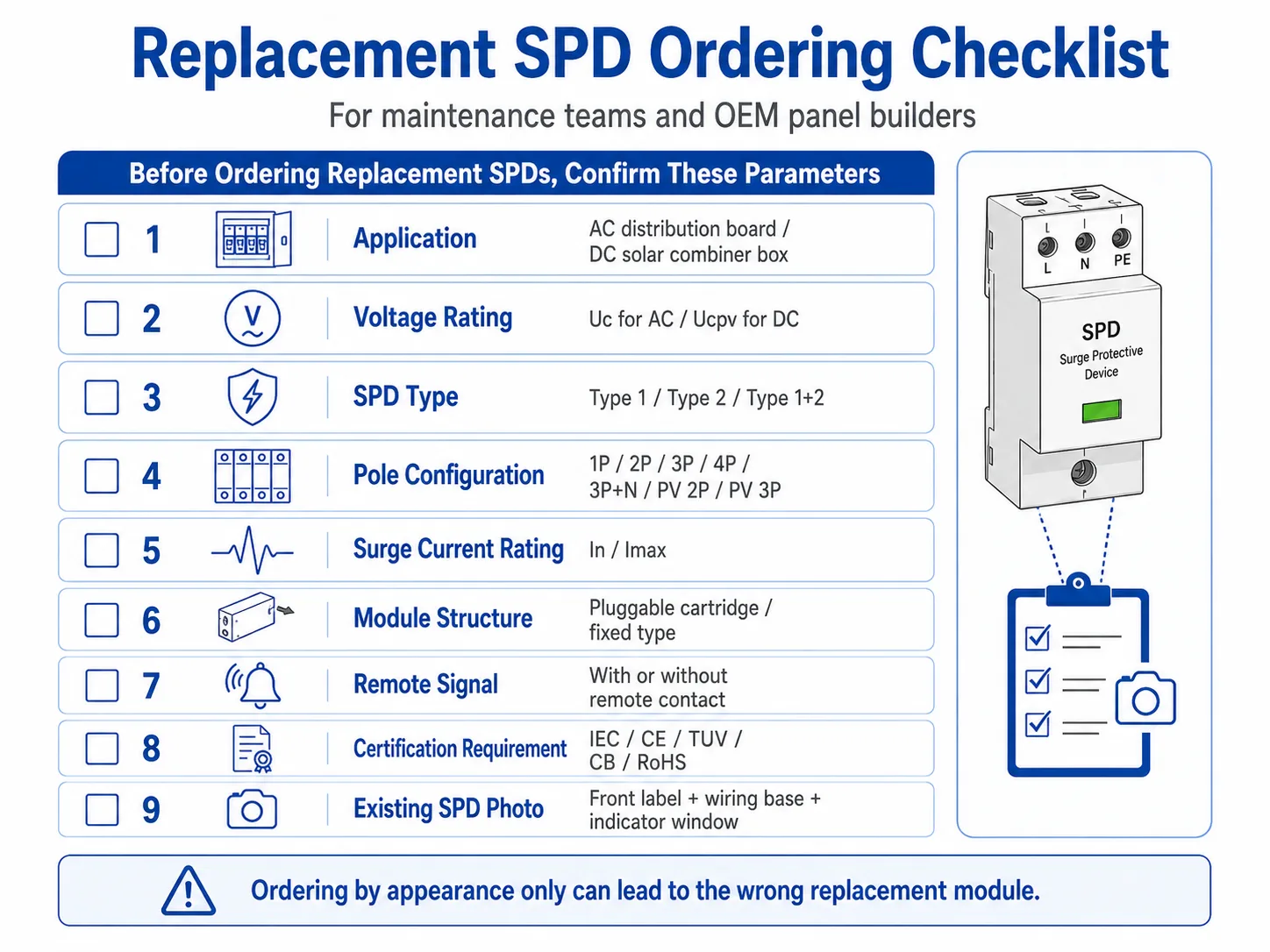
Checkliste für die Bestellung eines Ersatz-SPD
Viele Probleme bei einem frühzeitigen Austausch entstehen durch die Bestellung des falschen SPD-Moduls. Bestätigen Sie vor der Bestellung eines Ersatzteils die folgenden Informationen.
| Informationen zur Bestätigung | Warum es wichtig ist | Beispiel |
|---|---|---|
| AC- oder DC-Anwendung | AC-SPD und PV-DC-SPD folgen einer unterschiedlichen Bemessungslogik. | AC-SPD für Verteilerschränke / DC-SPD für Solar-Anschlusskästen |
| Uc oder Ucpv | Eine falsche Spannungsbemessung kann zu vorzeitigem Ausfall oder unzureichendem Schutz führen. | 275V, 320V, 385V AC / 600V, 1000V, 1500V DC |
| SPD-Typ | Der Installationspunkt bestimmt, ob Typ 1, Typ 2 oder Typ 1+2 erforderlich ist. | Haupteinspeisungsschrank / Unterverteilung / PV-Anschlusskasten |
| Polkonfiguration | Der Ersatz muss zum System und zur Verdrahtungsbasis passen. | 1P, 2P, 3P, 4P, 3P+N, PV 2P, PV 3P |
| In und Imax | Die Ableitstoßstrom-Bemessung sollte zur Belastung vor Ort und zur Projektspezifikation passen. | In 20kA, Imax 40kA pro Pol |
| Kompatibilität steckbarer Module | Ein ähnlich aussehendes Modul passt möglicherweise nicht oder ist nicht mit der Basis kompatibel. | Gleiche Serie, gleiche Spannung, gleiche Pol-/Modulstruktur. |
| Fernsignalsignal-Anforderung | Einige Anlagen erfordern eine alarmausgebende Schnittstelle zu SPS, GLT oder SCADA. | Mit Fernmeldekontakt / ohne Fernmeldekontakt |
| Zertifizierungs- oder Projektanforderung | Der Austausch sollte den Projektdokumenten und Beschaffungsrichtlinien entsprechen. | IEC-Standard, CE, TUV, CB, RoHS oder kundenspezifische Anforderungen. |
Benötigen Sie Hilfe beim Prüfen der Parameter des Ersatz-SPD?
Senden Sie uns das Foto des SPD, den Status der Anzeige, die Systemspannung, den Schaltschranktyp und das Typenschild des bestehenden Modells. LEEYEE kann Sie dabei unterstützen festzustellen, ob Sie einen AC-SPD, PV-DC-SPD, ein steckbares Ersatzmodul oder eine komplett neue Einheit für Verteilerschränke, Solar-Anschlusskästen und OEM-Schaltschränke benötigen.
Häufige Fehler beim Prüfen eines SPD-Ausfalls
Nur das rote Sichtfenster prüfen
Die Anzeige ist wichtig, erklärt jedoch nicht die Ursache. Wenn derselbe SPD wiederholt ausfällt, überprüfen Sie Spannung, Erdung, Temperatur, Verdrahtung und Überspannungsbelastung.
Ignorieren von Fernalarmsignalen
Ein Fernmeldekontakt kann einen Fehler bereits vor dem nächsten Vor-Ort-Besuch melden. Bei unbemannten Schaltschränken und Solaranlagen sollte das Fernsignal Bestandteil des Wartungsprozesses sein.
Verwendung von AC-SPD für PV-DC-Systeme
Solar-Anschlusskästen benötigen DC-geeignete PV-Überspannungsschutzgeräte (SPD) mit passendem Ucpv. Ersetzen Sie niemals ein PV-DC-SPD durch ein standardmäßiges AC-SPD.
Bestellung nur nach Aussehen
Viele SPD-Steckmodule sehen sich ähnlich. Überprüfen Sie vor der Bestellung immer die Spannungsbemessung, die Polkonfiguration, die Kompatibilität der Serien sowie die Ausführung für Fernsignalisierung.
Was sollte nach der SPD-Prüfung erfasst werden?
Für Fabriken, EPC-Serviceteams, OEM-Schaltschrankbauer und Distributoren hilft ein SPD-Inspektionsprotokoll dabei, wiederholte Ausfälle und falsche Ersatzteilbestellungen zu vermeiden.
- Inspektionsdatum und Standort
- Schaltschrankbezeichnung oder Anschlusskasten-Nummer
- SPD-Modell und Nennparameter
- Status der Anzeige vor dem Austausch
- Status der Fernsignalisierung, falls vorhanden
- Fotos von sichtbaren Schäden
- Kürzliche Blitzschläge, Schaltvorgänge oder Alarmereignisse
- Modell und Menge der Ersatzmodule
- Techniker-Notizen und Datum der nächsten Inspektion
Welche Fotos und Parameter sollten Sie vor dem Austausch senden?
Für eine schnellere Bestätigung des Ersatzbedarfs senden Sie bitte nicht nur ein allgemeines Foto des Schaltschranks. Ein klarer Satz Fotos und grundlegende elektrische Parameter helfen dem Lieferanten zu bestätigen, ob Sie dasselbe Steckmodul, ein komplettes SPD oder ein anderes Modell benötigen.
FAQ
Wie kann ich feststellen, ob ein SPD ausgefallen ist?
Überprüfen Sie zunächst das Anzeigenfenster. Ein roter, ausgelöster, leerer oder abnormaler Status bedeutet normalerweise, dass der SPD überprüft oder ausgetauscht werden muss. Überprüfen Sie auch den Status des Fernsignals, Brandspuren, Risse, den Zustand der Anschlüsse und kürzliche Blitzereignisse.
Bedeutet ein roter SPD-Indikator immer Blitzschaden?
Nein. Ein rotes Indikatorlicht bedeutet, dass das SPD-Modul nicht mehr im normalen Betrieb ist, aber die Ursache könnten wiederholte Überspannungen, Alterung, falsche Spannungseinstellungen, thermische Belastung, Vibration oder ein starkes Überspannungsereignis sein.
Kann ich nur die steckbare SPD-Kartusche ersetzen?
Ja, wenn die SPD ein steckbares Modulsystem ist und die Ersatzpatrone zur gleichen Serie, Spannungsklasse, Polstruktur und Fernsignalspezifikation passt. Eine Spannungsisolierung und Sicherheitsverfahren vor Ort sind weiterhin erforderlich.
Wie sollte ich einen DC SPD in einer Solar-Verteilerdose überprüfen?
Überprüfen Sie den Statusindikator, das Remote-Signal, den Zustand des DC-Isolators, die Anschlüsse, die Feuchtigkeit, die Polarität, die PV-Spannungsbewertung und ob die SPD Ucpv mit der maximalen PV-String-Spannung übereinstimmt. Verwenden Sie keinen Standard-AC-SPD als DC-Ersatz.
Kann ein Multimeter nachweisen, dass ein SPD noch in Ordnung ist?
Nein. Ein Multimeter kann nur einige offensichtliche abnormale Zustände anzeigen. Es kann die Impuls-Überspannungsfestigkeit nicht simulieren oder die verbleibende Lebensdauer des MOV bestätigen. Für die Wartung vor Ort sollten Sichtprüfung, Fernsignal, Ereignisverlauf und Austauschprotokolle kombiniert werden.
Welche Informationen muss ich vor der Bestellung eines Ersatz-SPD bereitstellen?
Bitte senden Sie ein Foto des alten SPD-Frontetiketts, ein Foto des Anzeigefensters, ein Foto der Verdrahtungsbasis oder der Polkonfiguration, die Systemspannung, die Anwendung (AC oder DC), den Uc- oder Ucpv-Wert, die In/Imax-Nennleistung, Anforderungen an die Fernsignalisierung, die Stückzahl sowie Angaben zum Einsatz in Schaltschränken oder Combiner-Boxen.
Senden Sie Fotos für eine schnellere Überprüfung des Austauschs
Für Wartungsteams und Distributoren ist der schnellste Weg zur Bestätigung eines Austauschs das Senden klarer Fotos des vorderen SPD-Typenschilds, der Verdrahtungsbasis, des Anzeigefensters und der Schaltschrankanwendung.