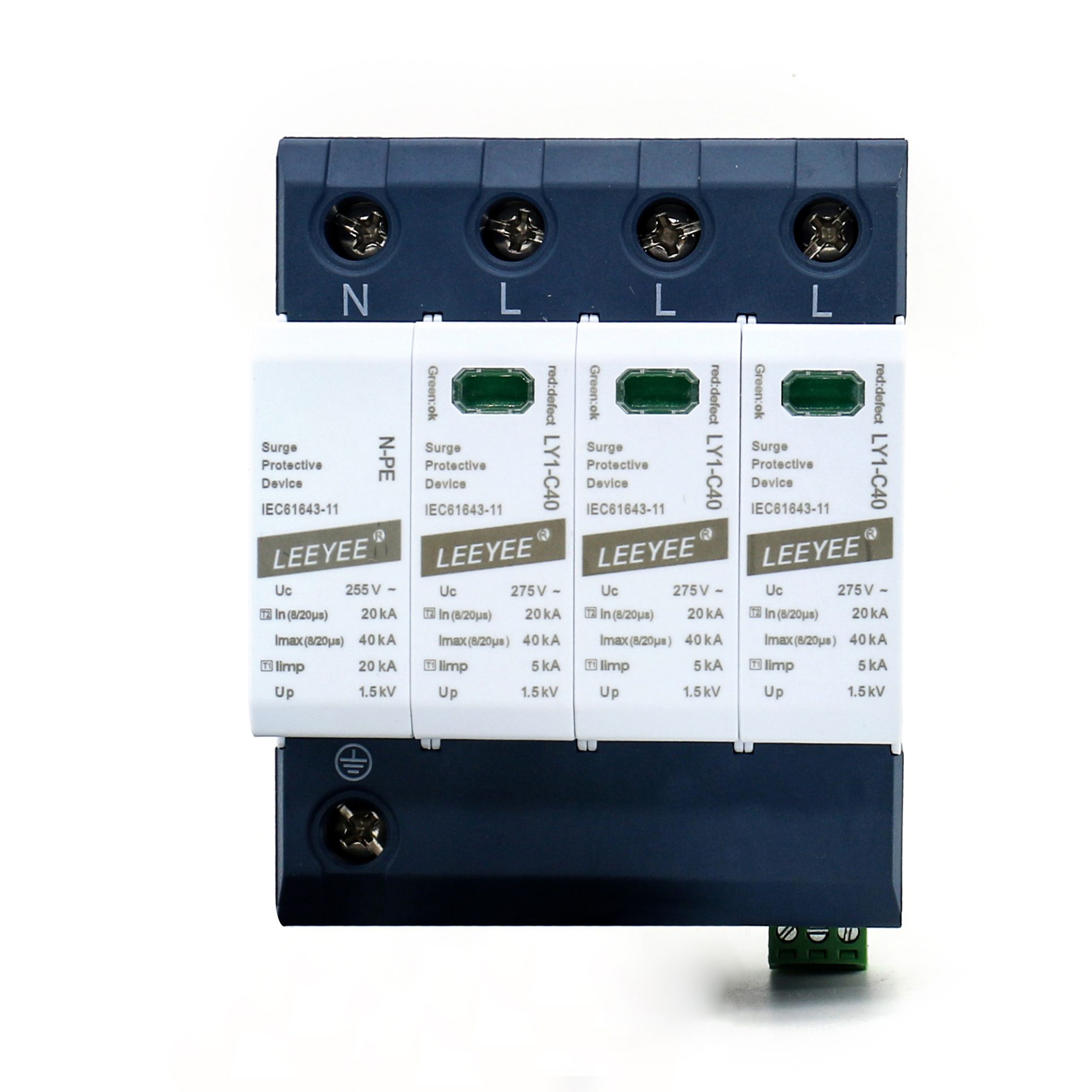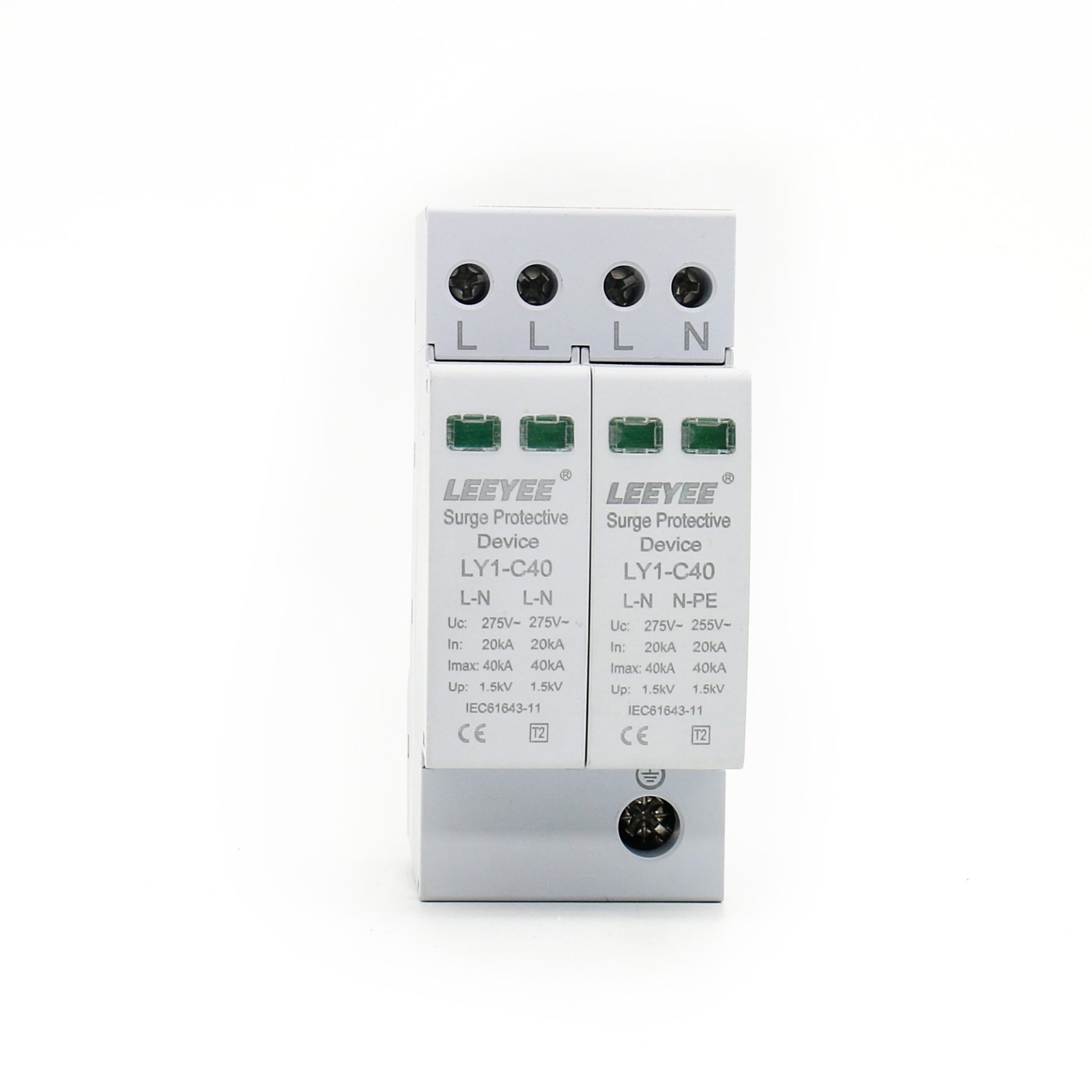
Un parafoudre triphasé est utilisé pour protéger les systèmes électriques industriels et commerciaux triphasés contre les surtensions transitoires.
Il est couramment installé dans des tableaux de distribution principaux, des panneaux de sous-distribution, des armoires de contrôle, des panneaux de machine, des systèmes CVC, des panneaux AC d'onduleurs PV et des armoires électriques OEM.
Le point important est simple : un parafoudre triphasé ne doit pas être sélectionné uniquement par la tension ou le nombre de pôles. Le parafoudre correct dépend du système électrique complet.
Table des matières
Réponse rapide : Comment choisissez-vous un parafoudre triphasé ?
Pour un tableau de distribution triphasé standard, confirmez d'abord la tension du système et système de mise à la terre. Ensuite, choisissez le type de SPD et la configuration des pôles.
Les tableaux principaux d'arrivée peuvent nécessiter une protection de type 1 ou de type 1+2. Les tableaux de sous-distribution standard utilisent couramment la protection de type 2. Les systèmes TN-S, TN-C-S, TT, IT et triphasés 3 fils peuvent nécessiter différentes configurations de SPD.
| Application | Choix courant de SPD | Note de l'acheteur |
|---|---|---|
| Tableau principal d'arrivée avec exposition élevée aux éclairs | SPD de type 1 ou de type 1+2 | Vérifiez Iimp et la protection de sauvegarde. |
| Tableau de sous-distribution standard | DOCUP de type 2 | Commun pour les tableaux industriels et commerciaux. |
| Système triphasé TN-S 4 fils | SPD 4P ou 4 pôles approprié | Protège L1, L2, L3, N et PE selon la conception. |
| Système triphasé TT 4 fils | SPD 3P+N / 3+1 | Le chemin de protection N-PE doit être pris en compte. |
| Système triphasé 3 fils | SPD 3P | Utilisé lorsque le neutre n'est pas disponible. |
| Armoire électrique OEM | Dépend du plan du projet | Confirmez la tension, la mise à la terre, le nombre de pôles et la certification. |
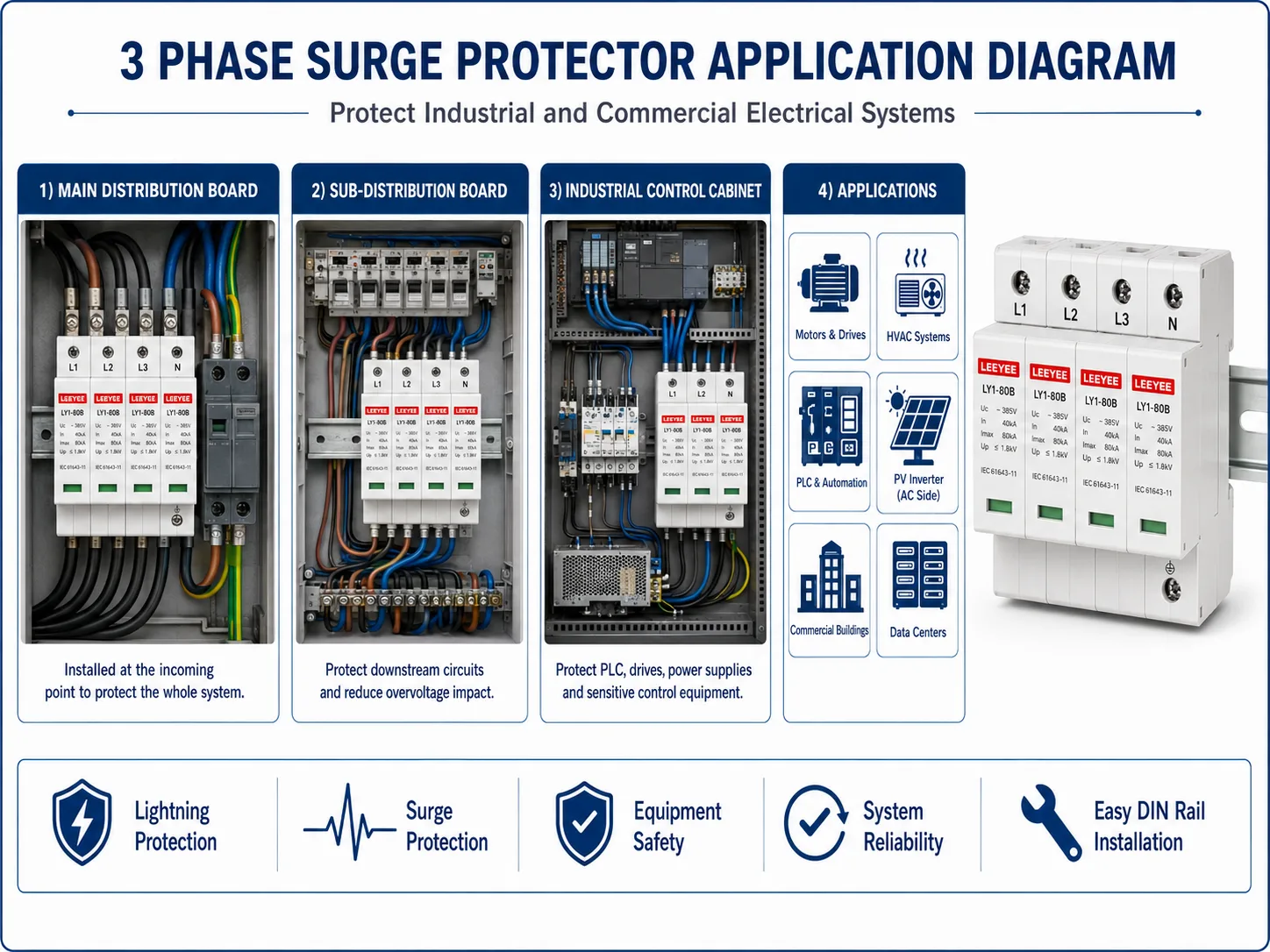
Une évaluation en kA plus élevée ne signifie pas automatiquement que le SPD est meilleur pour chaque panneau. Un SPD correct est celui qui correspond au véritable système électrique, à la position d'installation et aux exigences de protection.
Qu'est-ce qu'un parafoudre triphasé ?
Un protecteur de surtension triphasé, également appelé dispositif de protection contre les surtensions triphasé ou SPD triphasé, est conçu pour limiter les surtensions transitoires dans les systèmes électriques triphasés.
Une surtension peut provenir d'une activité de foudre, de la commutation du réseau électrique, du démarrage et de l'arrêt des moteurs, de la commutation de transformateurs, de la commutation de banques de condensateurs, de l'opération VFD, de défauts à proximité ou de la commutation de charges industrielles.
Le SPD fournit un chemin de décharge contrôlé pour le courant de surtension. Lorsqu'une surtension transitoire apparaît, le SPD limite la tension à un niveau plus sûr et aide à décharger l'énergie de surtension à la terre.
Cela aide à protéger les équipements en aval tels que les PLC, les variateurs, les alimentations, les capteurs, les cartes de contrôle, les équipements de communication et les machines industrielles.
Pourquoi les systèmes triphasés nécessitent-ils une sélection différente de parafoudres ?
Un système triphasé est plus complexe qu'un circuit monophasé. Des surtensions peuvent apparaître entre différents conducteurs.
- Ligne à la terre : L-PE
- Ligne au neutre : L-N
- Neutre à la terre : N-PE
- De ligne à ligne : L-L
C'est pourquoi la sélection des SPD triphasés doit prendre en compte la structure du système. Le terme “ triphasé ” n'est pas suffisant pour sélectionner le SPD.
Où les parafoudres triphasés sont-ils utilisés ?
Les SPD triphasés sont couramment utilisés dans les systèmes électriques B2B, notamment :
- Tableaux de distribution industriels
- Panneaux de bâtiments commerciaux
- Systèmes de distribution électrique d'usine
- Armoires de contrôle de machine
- Panneaux de contrôle HVAC
- Centres de contrôle des moteurs
- Armoires de PLC et d'automatisation
- Panneaux électriques de centre de données
- Systèmes de distribution de charge pour VE
- Panneaux de sortie CA d'onduleur PV
- Armoires électriques OEM
- Projets de construction de panneaux électriques
Pour les acheteurs OEM, les importateurs et les fabricants de panneaux, le SPD doit s'adapter à la fois à l'exigence technique et à la conception du produit final.
Cela inclut l'espace de câblage, le montage sur rail DIN, le type de module enfichable, le contact de signal à distance, la certification, la conception de l'étiquette, et la stabilité d'approvisionnement à long terme.
Type 1, Type 2 et Type 1+2 parafoudre triphasé
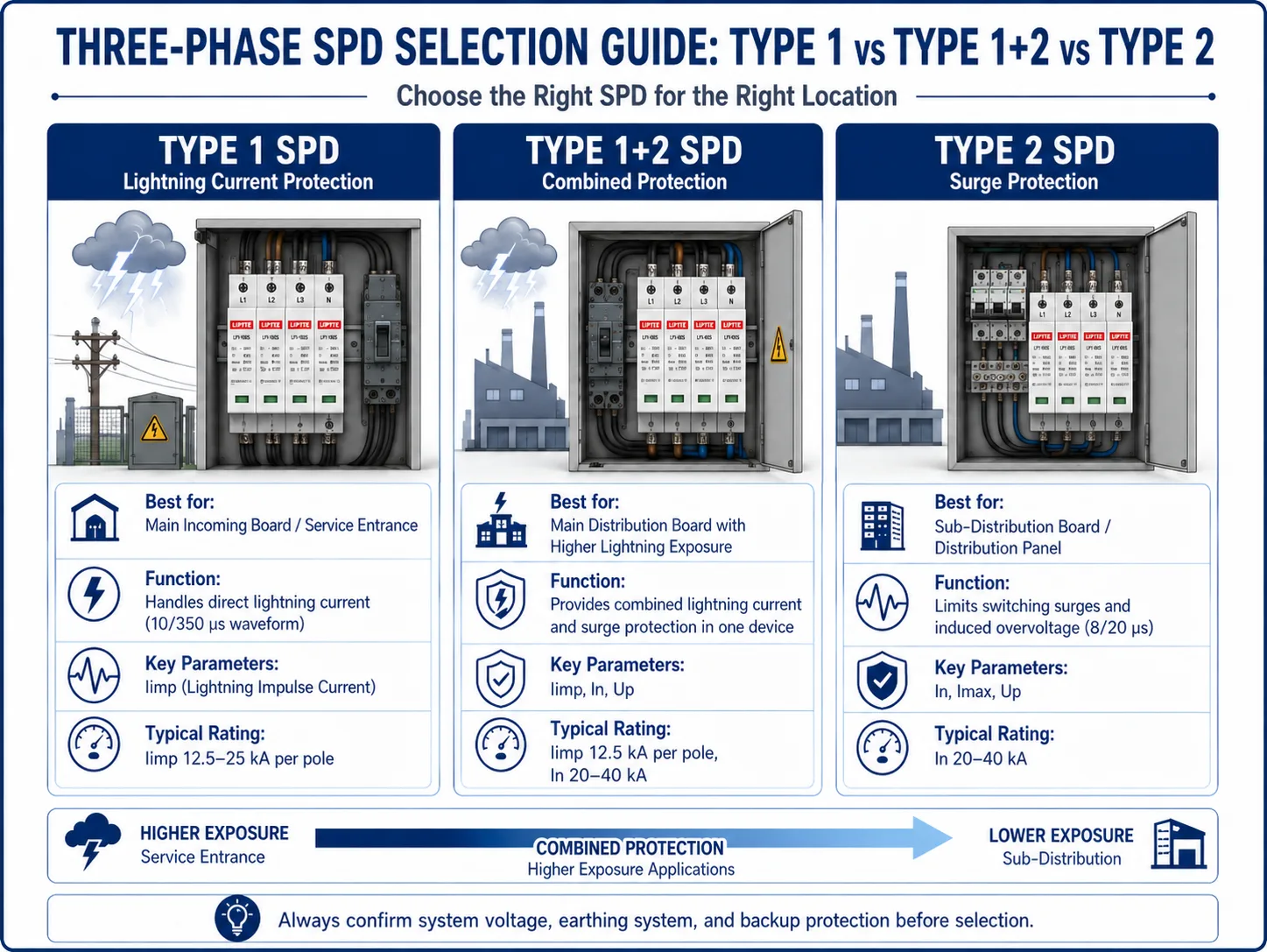
Le type de SPD doit correspondre à la position d'installation et au niveau d'exposition aux surtensions. Un SPD de Type 2 ne doit pas être utilisé à l'aveugle là où une protection de Type 1 est requise. Mais le Type 1 n'est pas automatiquement requis dans chaque panneau.
| Type de DOCUP | Position d'installation courante | Fonction principale | Note de l'acheteur |
|---|---|---|---|
| DOCUP de type 1 | Panneau principal d'entrée, entrée de service | Gère le courant de foudre partiel | Vérifiez la valeur Iimp. |
| Type 1+2 SPD | Tableau de distribution principal avec une exposition plus élevée | Protection contre les courants d'éclair et les surtensions | Utile là où une protection combinée compacte est nécessaire. |
| DOCUP de type 2 | Tableau de sous-distribution, panneau de contrôle | Limite les surtensions de commutation et les surtensions induites | Courant pour les panneaux industriels. |
| DOCUP de type 3 | Proche des équipements sensibles aux terminaux | Protection fine près de l'équipement | Utilisé généralement après la coordination de Type 2. |
Le bon choix dépend de l'exposition aux éclairs, de la protection en amont, de la conception électrique locale, de la position d'installation et des exigences du projet.
3P, 4P et 3P+N : quelle est la différence ?
De nombreux acheteurs choisissent un SPD triphasé en fonction du nombre de pôles. Cela peut entraîner des erreurs.
La configuration des pôles doit correspondre au câblage et à l'agencement de mise à la terre du système.
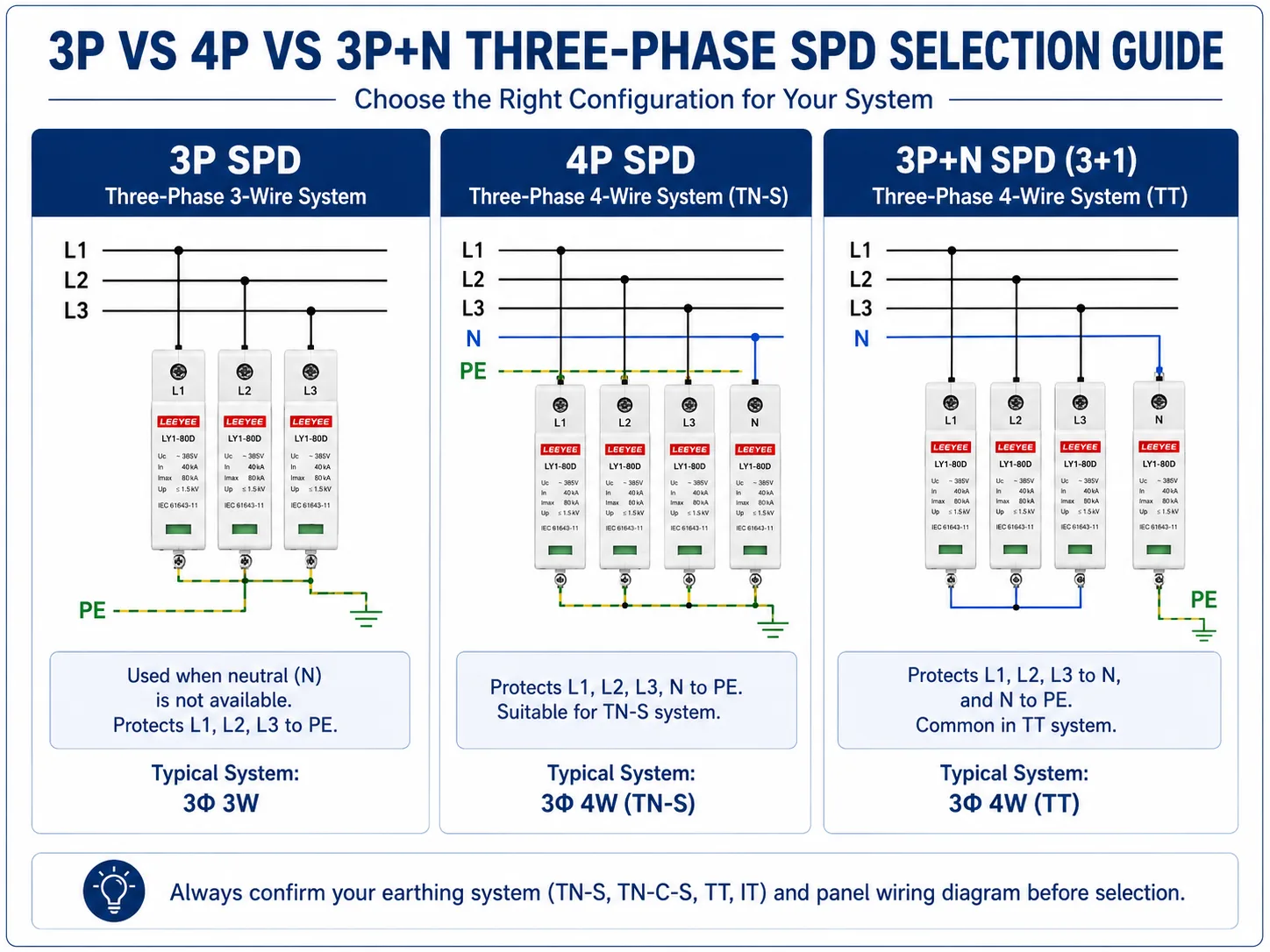
| Configuration des SPD | Utilisation Courante | Ce que cela signifie | Note importante. |
|---|---|---|---|
| SPD 3P | Systèmes triphasés 3 fils | Protection L1, L2, L3 | Utilisé lorsque le neutre n'est pas présent. |
| 4P SPD | Systèmes triphasés 4 fils | Protection L1, L2, L3, N | La logique de câblage dépend de la conception du système. |
| 3P+N SPD | Fréquemment utilisé dans la conception de protection 3+1 | L1/L2/L3 à N, N à PE | Commun dans la conception de protection liée à TT. |
| Configuration 4+0 | Souvent utilisé dans les systèmes TN-S | L1, L2, L3, N protégés à PE | Vérifiez la conception du produit et le diagramme de câblage. |
| Configuration 3+1 | Souvent utilisé dans les systèmes TT | L1/L2/L3 à N, N à PE | Le chemin N-PE est critique. |
Un SPD 4P et un SPD 3P+N ne devraient pas être considérés comme la même chose dans chaque projet. Un SPD 3P n'est pas automatiquement adapté à tous les systèmes triphasés. Un SPD 3P+N n'est pas automatiquement requis pour chaque système avec neutre.
Avant de commander, confirmez le dessin du projet, le système de mise à la terre et le schéma câblé SPD. Pour des schémas de câblage détaillés, consultez notre Guide de câblage du SPD triphasé.
Comment les systèmes de mise à la terre affectent-ils la sélection des parafoudres triphasés ?
Le système de mise à la terre est l'un des facteurs les plus importants dans le choix d'un SPD. Différents systèmes de mise à la terre peuvent nécessiter différents modes de protection.
Systèmes TN-S
Dans un système TN-S, le neutre et la terre de protection sont des conducteurs séparés. Un panneau typique TN-S triphasé a L1, L2, L3, N et PE.
Dans de nombreux tableaux de distribution TN-S, un SPD 4P ou une protection adéquate à 4 pôles est utilisée. La connexion exacte dépend de la conception du SPD et du câblage du panneau.
Systèmes TN-C-S
Dans un système TN-C-S, le conducteur PEN est séparé en N et PE à un certain point. Le choix du SPD dépend de l'endroit où le SPD est installé.
Pour les systèmes TN-C-S, ne choisissez pas le SPD en regardant uniquement le nombre de fils. Confirmez d'abord le dessin du panneau.
Systèmes TT
Dans un système TT, l'installation a sa propre électrode de terre locale. La relation neutre-terre est différente de celle des systèmes TN-S.
Les systèmes TT utilisent souvent une logique de protection 3P+N ou 3+1. Le chemin de protection N-PE doit être considéré avec soin.
Systèmes informatiques
Les systèmes IT nécessitent une attention particulière. Ils peuvent avoir un neutre isolé ou mis à la terre par impédance.
Le choix du SPD pour les systèmes IT doit suivre la conception électrique du projet, l'exigence de surveillance de l'isolation et le code local. Ne pas utiliser une recommandation standard de SPD TN ou TT sans vérifier la conception du système.
Paramètres clés pour un parafoudre triphasé
Uc / MCOV
Uc, également appelé MCOV, est la tension de service continue maximale. Elle doit être supérieure à la tension nominale du système, mais ne doit pas être choisie trop haut sans réflexion.
Si Uc est trop bas, le SPD peut vieillir plus rapidement ou échouer plus tôt. Si Uc est trop élevé, le niveau de protection peut devenir moins sensible.
En
In est le courant nominal de décharge. Il montre la capacité du SPD à gérer des courants de surtension répétés, généralement avec une forme d'onde de 8/20 μs.
Imax
Imax est le courant de décharge maximal. Il montre la capacité de décharge de surtension unique maximale du SPD dans des conditions de test spécifiées.
Iimp
Iimp est le courant d'impulsion de foudre. Il est important pour les SPDs de type 1 et de type 1+2.
Haut de la page
Up est le niveau de protection en tension. Un Up plus bas signifie généralement une meilleure performance de limitation de tension.
Fusible de secours ou MCB
Un SPD triphasé nécessite généralement une protection contre les surintensités de secours appropriée. Cela peut être un MCB, un MCCB ou un fusible. La capacité doit suivre la fiche technique du SPD.
Tableau de sélection des parafoudres triphasés
Utilisez ce tableau comme point de départ rapide avant d'envoyer une demande.
| Système ou application | Direction de sélection recommandée | Ce qu'il faut confirmer |
|---|---|---|
| Tableau de distribution TN-S 230/400V | Type 2, 4P ou SPD 4 pôles approprié | Uc, In, Imax, protection de secours. |
| Panneau industriel 400/415V | Type 2 ou Type 1+2 selon la position | Tension du système et niveau d'exposition. |
| Tableau principal d'arrivée | Type 1 ou Type 1+2 peut être requis | Iimp, protection en amont, code d'installation. |
| Tableau de sous-distribution | DOCUP de type 2 | In, Imax, Up, fusible de secours. |
| Système TT | 3P+N / 3+1 peut être requis | Chemin N-PE et adéquation du produit. |
| Système triphasé 3 fils | SPD 3P | Pas de neutre, tension du système, mise à la terre. |
| Armoire OEM | SPD spécifique au projet | Étiquette, certification, espace de câblage, signal à distance. |
| Panneau de surveillance à distance | SPP avec contact de signal à distance | Type de contact d'alarme et câblage. |
Ce tableau n'est pas un remplacement du plan de projet. C'est un outil de sélection rapide pour les acheteurs, les distributeurs et les fabricants de tableaux.
Position d'installation : tableau principal vs tableau de sous-distribution
Un parafoudre triphasé doit être installé selon la zone de protection et la fonction du panneau.
- Tableau de distribution principal entrant
- Tableau de sous-distribution
- Armoire de contrôle de machine
- Armoire PLC
- Panneau de sortie CA de l'onduleur PV
- Panneau de contrôle HVAC
- Panneau d'alimentation du centre de données
Au point d'entrée principal, le Type 1 ou le Type 1+2 peut être requis en fonction de l'exposition aux éclairs et de la conception de protection du bâtiment. Aux tableaux de sous-distribution, le Type 2 est couramment utilisé pour protéger les circuits en aval.
Le câblage et la longueur des fils sont importants
Un bon SPD peut mal fonctionner s'il est mal câblé. Lors d'une surtension, le courant monte très rapidement. Des fils longs ajoutent de l'inductance et peuvent augmenter la tension vue par l'équipement en aval.
Pour des schémas de câblage TN-S, TN-C-S, TT, 3P, 4P et 3P+N détaillés, voir le Guide de câblage du SPD triphasé.
Erreurs courantes lors du choix d'un parafoudre triphasé
1. Choisir uniquement par le nombre de pôles
Certains acheteurs demandent uniquement “3P” ou “4P” sans confirmer le système de mise à la terre. Cela peut conduire au mauvais produit.
2. Ignorer le système de mise à la terre
Les systèmes TN-S, TN-C-S, TT et IT peuvent nécessiter une logique de câblage SPD différente. Ne pas traiter tous les panneaux triphasés de la même manière.
3. Utiliser le Type 2 là où le Type 1 ou le Type 1+2 est requis
Le SPD de Type 2 est courant pour les tableaux de distribution. Mais si le panneau est au point d'entrée principal avec une forte exposition aux éclairs, le Type 1 ou le Type 1+2 peut être requis.
4. Sélectionner un Uc trop bas
Si Uc est trop bas pour la tension d'exploitation réelle, le SPD peut vieillir plus rapidement ou échouer plus tôt. Vérifiez toujours la tension nominale et la fluctuation de la tension.
5. Regarder uniquement Imax
Imax est important, mais ce n'est pas toute l'histoire. Vérifiez In, Iimp, Up, Uc, fusible de secours et certification.
6. Ignorer la protection de secours
Le SPD doit être protégé conformément à sa fiche technique. Le MCB ou le fusible de secours permet une déconnexion sûre en fin de vie ou en cas de conditions de défaut.
7. Ignorer l'exigence de signal à distance
Pour les équipes de maintenance industrielle, le contact de signal à distance peut aider à surveiller l'état du SPD. Si le panneau nécessite une sortie d'alarme, confirmez-le avant de passer commande.
Quelles informations devez-vous envoyer avant de commander ?
Avant de demander un devis, préparez ces détails. Cela aide le fournisseur à recommander plus rapidement le bon protecteur de surtension triphasé.
| Information | Pourquoi c'est important |
|---|---|
| Tension nominale du système | Détermine la sélection Uc / MCOV. |
| Système de mise à terre | TN-S, TN-C-S, TT, IT ou 3 phases 3 fils. |
| Position d'installation | Alimentation principale, sous-tableau, panneau machine, armoire OEM. |
| Type de SPD | Type 1, Type 2, Type 1+2, ou Type 3. |
| Configuration des pôles | 3P, 4P, ou 3P+N. |
| Exigence en / Imax / Iimp | Détermine la capacité de décharge. |
| Fusible ou disjoncteur de secours | Nécessaire pour une coordination sûre. |
| Exigence de signal à distance | Nécessaire pour l'alarme ou la surveillance de maintenance. |
| Exigence de certification | CE, TUV, CB ou documents spécifiques au projet. |
| Exigence d'étiquette OEM | Important pour les distributeurs et les acheteurs de marque de distributeur. |
| Schéma de câblage du panneau | Aide à confirmer la configuration correcte du SPD. |
Besoin d'aide pour choisir un parafoudre triphasé ?
Envoyez-nous la tension de votre système, le type de mise à la terre, la position d'installation, le schéma de câblage du panneau, l'exigence de fusible de secours et l'exigence de certification. Notre équipe peut recommander un modèle SPD adapté pour votre tableau de distribution, votre panneau de contrôle ou votre armoire électrique OEM.
Produits recommandés de parafoudres triphasés pour les acheteurs B2B
LEEYEE fournit des dispositifs de protection contre les surtensions montés sur rail DIN pour les systèmes électriques triphasés industriels et commerciaux. Pour les tableaux de distribution triphasés, les tableaux de contrôle et les armoires électriques OEM, les pages de produits suivantes peuvent vous aider à comparer les options SPD appropriées.
FAQ
Qu'est-ce qu'un parasurtenseur triphasé ?
Un survolteur triphasé est un SPD utilisé pour protéger les systèmes électriques triphasés contre les surtensions transitoires. Il est couramment utilisé dans les panneaux industriels, les tableaux de distribution commerciaux, les armoires de machines et les systèmes électriques OEM.
Comment choisir un SPD à 3 phases ?
Confirmer la tension du système, le système de mise à la terre, la position d'installation, le type de SPD, la configuration des pôles, le courant de surtension, la protection de secours et les exigences de certification. Ne pas sélectionner uniquement en fonction du nombre de pôles ou de la cote Imax.
Quelle est la différence entre 3P et 4P SPD ?
Un SPD 3P est couramment utilisé pour les systèmes triphasés à 3 fils sans neutre. Un SPD 4P est utilisé pour les systèmes triphasés à 4 fils où L1, L2, L3 et N nécessitent une protection selon la conception du système.
Quelle est la différence entre 4P et 3P+N SPD ?
Un SPD 4P et un SPD 3P+N ne sont pas toujours les mêmes. Un SPD 3P+N fait souvent référence à une logique de protection 3+1, où les trois phases sont protégées vers le neutre et le neutre est protégé vers la terre. Le choix correct dépend du système de mise à la terre.
Quel SPD est utilisé pour un système TN-S triphasé ?
De nombreux tableaux de distribution triphasés TN-S utilisent une protection SPD 4P ou 4 pôles appropriée. La connexion exacte dépend de la conception du panneau, du type de SPD et des exigences du projet.
Quel SPD est utilisé pour un système TT triphasé ?
Les systèmes TT utilisent souvent une logique de protection 3P+N ou 3+1. Le chemin de protection N-PE doit être considéré avec soin. Toujours confirmer la fiche technique du produit et le plan de projet avant la sélection.
Ai-je besoin d'un SPD de type 1 ou de type 2 pour un panneau triphasé ?
Le type 1 ou type 1+2 peut être requis au point d'entrée principal avec exposition à la foudre. Le type 2 est couramment utilisé dans les sous-tableaux de distribution et les panneaux de contrôle. Le choix correct dépend de la position d'installation et du niveau d'exposition.
Un parasurtenseur triphasé a-t-il besoin d'un fusible de secours ou d'un disjoncteur (MCB) ?
Dans la plupart des installations, oui. Le fusible de secours ou le MCB aide à déconnecter le SPD en toute sécurité s'il atteint sa fin de vie ou échoue dans des conditions de défaut. La cote doit suivre la fiche technique du SPD.
Puis-je utiliser trois SPDs monophasés au lieu d'un SPD triphasé ?
Il peut être techniquement possible dans certains designs, mais un parafoudre triphasé dédié est généralement préféré pour une installation coordonnée, une surveillance plus facile et une conception de panneau plus propre. Suivez le plan du projet et les recommandations du fournisseur.
Quelles informations devrais-je envoyer pour obtenir une recommandation SPD correcte ?
Envoyez la tension du système, le système de mise à la terre, la position d'installation, l'exigence de mât, le type de SPD, le schéma de câblage du panneau, l'exigence de fusible de secours, l'exigence de certification et si un contact de signal à distance est nécessaire.