
Les systèmes d’ascenseur modernes reposent sur des panneaux de commande électroniques, des variateurs de fréquence (VFD), des interfaces de communication et de longs parcours de câbles entre les salles des machines, les gaines et les dispositifs de terrain. Ces composants peuvent être sensibles aux surtensions transitoires causées par les surtensions induites par la foudre, les opérations de commutation et les perturbations des systèmes électriques du bâtiment.
Ce guide explique la protection contre les surtensions des ascenseurs d’un point de vue technique et OEM, en mettant l’accent sur les tableaux de commande, les systèmes à variateur de fréquence (VFD), les interfaces de communication, les considérations d’installation et les informations requises avant le choix du SPD.
La protection contre les surtensions des ascenseurs ne doit pas être envisagée comme un seul SPD sur l’alimentation entrante. Une évaluation complète prend généralement en compte plusieurs points de protection, notamment le raccordement électrique du bâtiment, le tableau de commande de l’ascenseur, l’entrée du VFD, les circuits d’alimentation de commande et les interfaces de communication.
| Point de protection | But Principal |
|---|---|
| Alimentation de distribution du bâtiment | Réduire l’énergie transitoire entrante qui pénètre dans le système d’ascenseur. |
| Tableau de commande de l’ascenseur | Protéger les électroniques sensibles du contrôleur et les circuits internes. |
| Entrée VFD / variateur | Réduire les contraintes transitoires sur les composants de l’électronique de puissance. |
| Interfaces de signal et de communication | Réduire l’exposition aux surtensions sur les circuits de données connectés. |
La configuration finale des SPD doit être confirmée en fonction de la tension du système, du schéma de mise à la terre, des exigences du fabricant de l’ascenseur et des conditions du projet.
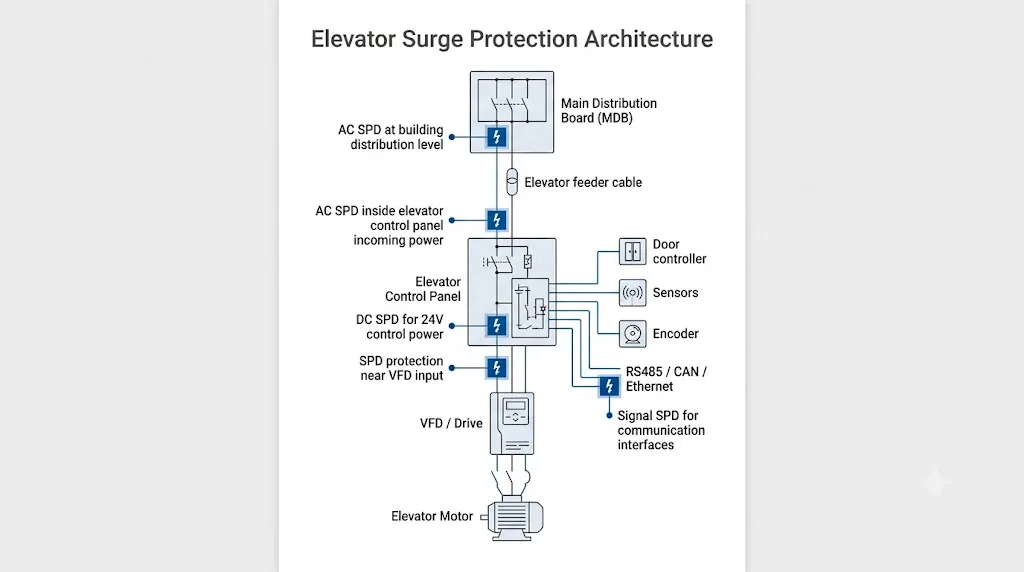
Architecture de protection contre les surtensions d’un ascenseur montrant la relation entre les circuits d’alimentation, les systèmes de commande, les variateurs et les interfaces de communication.
Table des matières
1. Par où les surtensions peuvent-elles pénétrer dans un système d’ascenseur ?
Une installation d’ascenseur comporte plusieurs voies possibles pour les surtensions. Outre l’alimentation CA entrante, les câbles longs, les circuits de commande et le câblage de communication peuvent également devenir des voies pour les perturbations transitoires.
| Zone du système | Risque potentiel | Considération technique |
|---|---|---|
| Alimentation électrique principale | Surtension transitoire externe | Évaluer les exigences relatives aux SPD CA en fonction de l’installation électrique. |
| Armoire de commande d'ascenseur | Dommages au contrôleur et à la carte PCB | Sélectionnez le SPD en fonction de la conception du panneau et du système d'alimentation. |
| Système d'entraînement | Contrainte sur l'électronique de puissance | Coordonnez la sélection du SPD avec les exigences du VFD. |
| Circuits de signal | Interruption de communication | Confirmez le type d'interface et l'état des câbles. |
2. Protection contre les surtensions du panneau de commande de l’ascenseur
Le panneau de commande d'ascenseur constitue le point de connexion central entre l'alimentation d'entrée, l'électronique de commande, les circuits d'entraînement et les interfaces de communication.
Pour les panneaux de commande OEM, la sélection du SPD doit prendre en compte davantage que la tension nominale. Les informations importantes peuvent inclure :
- Tension du système et configuration des phases
- Schéma de mise à la terre
- Type de SPD et mode de protection
- Exigences en matière de protection de secours
- Emplacement d'installation et longueur de câble
Une tension nominale de SPD plus élevée n'offre pas automatiquement une meilleure protection. Si les paramètres du SPD ne correspondent pas au système électrique réel, les performances de protection peuvent ne pas répondre aux exigences du projet.
3. Considérations relatives à la protection contre les surtensions des variateurs de fréquence (VFD) de l’ascenseur
De nombreux ascenseurs modernes utilisent des variateurs de fréquence pour piloter le fonctionnement du moteur. Les systèmes VFD contiennent des dispositifs semi-conducteurs sensibles et des circuits de commande électroniques qui nécessitent une coordination de protection soigneuse.
| Zone liée au VFD | Considération de protection |
|---|---|
| Puissance d'entrée du VFD | Évaluez le choix du SPD AC et sa position d'installation. |
| Électronique du variateur | Tenez compte de l'exposition aux surtensions transitoires et des recommandations du fabricant. |
| Interface de commande | Confirmez les exigences de communication et de circuit de commande. |
Le choix du SPD doit soutenir la stratégie de protection du VFD. Il ne remplace pas les exigences d'installation du fabricant du variateur ni les autres mesures de protection requises.
4. Sélection du point de protection du SPD de l’ascenseur
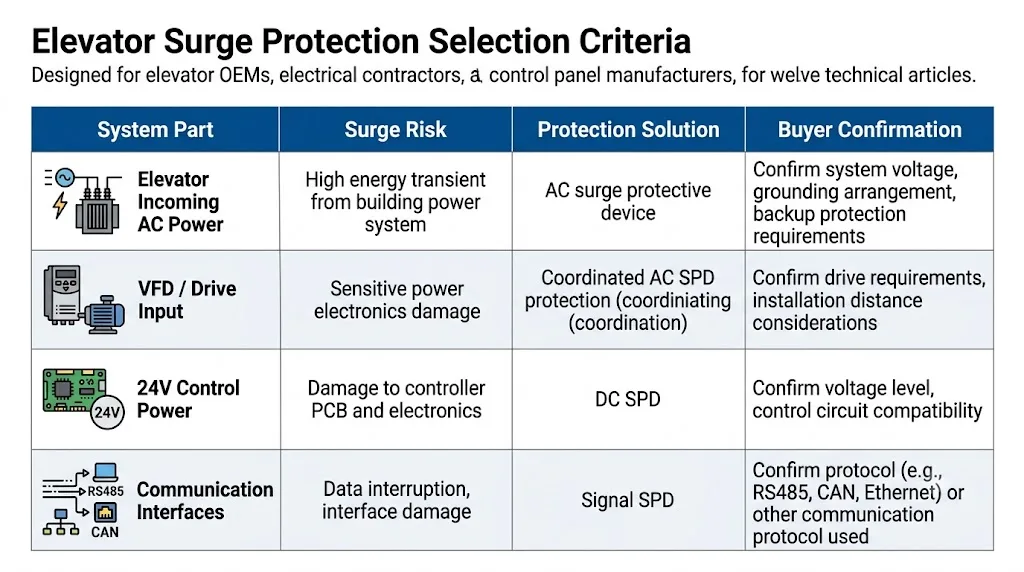
Comparaison des points de protection de l'ascenseur pour aider les OEM et les ingénieurs à identifier les zones appropriées d'évaluation des SPD.
| Localisation | Axes de protection typiques | Confirmation de l'acheteur |
|---|---|---|
| TGBT du bâtiment | Réduction de l'énergie des surtensions entrantes | Tension du système, mise à la terre et exigences d'installation. |
| Tableau de commande de l’ascenseur | Protection d'alimentation du contrôleur | Conditions de conception du panneau et de câblage interne. |
| Entrée du variateur de fréquence | Coordination de la protection du variateur | Spécifications du variateur et recommandations du fabricant. |
| Circuits de commande 24V | Protection des circuits électroniques | Exigences de tension de commande et d'interface. |
| Lignes de communication | Protection des signaux | RS485, CAN, Ethernet ou autres détails de protocole. |
5. Un système d’ascenseur a-t-il besoin de plus d’un SPD ?
Il n'existe pas de nombre universel de SPD requis pour chaque installation d'ascenseur. La quantité appropriée dépend de la conception électrique du bâtiment, du routage des câbles, de la sensibilité des équipements et des exigences du projet.
Une solution complète peut nécessiter l'évaluation de différentes zones de protection plutôt que la sélection d'un seul SPD sans tenir compte de l'architecture du système.
6. Risques de surtension dans la gaine d’ascenseur et les longs câbles
Les gaines d'ascenseur contiennent souvent de longs parcours de câbles reliant les salles des machines, les contrôleurs, les capteurs et les équipements de palier. Des trajets de câbles plus longs peuvent augmenter l'exposition aux perturbations transitoires induites.
Pour les installations avec de longues lignes de communication ou des dispositifs de terrain exposés, la conception de la protection doit être examinée en fonction de l'environnement d'installation réel.
7. Ce qu’un SPD ne peut pas remplacer
Le SPD n'est qu'une partie d'une stratégie de protection électrique. Il ne remplace pas :
- Une conception appropriée de mise à la terre et de liaisons équipotentielles.
- Pratiques correctes d’installation électrique.
- Exigences du fabricant de l’ascenseur.
- Conception du circuit de sécurité et examen de conformité.
8. Flux de travail de sélection du SPD pour ascenseur
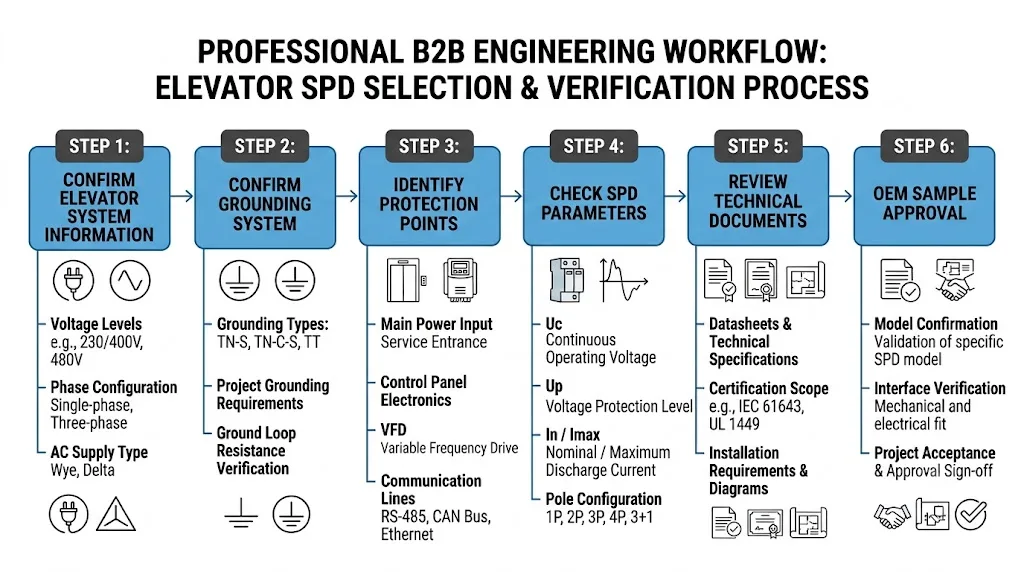
Flux de validation technique, de la collecte des informations système à l’approbation du modèle SPD.
- Tension d’alimentation de l’ascenseur et configuration des phases
- Système de mise à la terre
- Informations du tableau de commande
- Exigences du VFD ou du variateur
- Interfaces de communication
- Position d'installation
- Normes ou certificats requis
- Exigence de quantité
- Exigences relatives à l’étiquette et à la documentation OEM
9. Erreurs courantes lors du choix d’un SPD pour ascenseur
- Choisir uniquement en fonction de la tension : La sélection d’un SPD nécessite des conditions système, pas seulement la tension nominale.
- Installer le SPD loin de l’équipement : L’agencement des connexions influence l’efficacité de la protection.
- Négliger la protection des communications : Les systèmes électroniques peuvent avoir plusieurs voies d’entrée des surtensions.
- Supposer que le SPD remplace la mise à la terre : La protection contre les surtensions dépend de la conception globale de l'installation.
Besoin d'aide pour examiner une exigence de protection contre les surtensions d'ascenseur ? Partagez la tension de votre système, les informations sur le coffret de commande et les détails de l'application avec LEEYEE pour une évaluation technique.
Demande de recommandation de modèleFAQ
Où le SPD doit-il être installé dans un système d'ascenseur ?
Les points d'installation du SPD dépendent de l'architecture électrique de l'ascenseur. Les points d'évaluation courants comprennent les circuits d'alimentation entrants, les coffrets de commande, les entrées d'entraînement et les interfaces de signal.
Le SPD peut-il protéger les systèmes VFD d'ascenseur ?
Le SPD peut contribuer à réduire l'exposition aux surtensions transitoires, mais l'agencement final de la protection doit être coordonné avec les exigences du VFD et les conditions du projet.
Les lignes de communication d'ascenseur doivent-elles utiliser une protection contre les surtensions ?
Une protection des communications peut être requise selon le type d'interface, la longueur du câble, l'environnement d'installation et la conception du système.
Quelles informations les acheteurs OEM d'ascenseurs doivent-ils fournir ?
Les acheteurs OEM doivent fournir les paramètres électriques, les conditions d'installation, les exigences d'interface et les exigences de documentation avant la confirmation finale du modèle.
Références
- [1] Série IEC 61643, dispositifs de protection contre les surtensions pour installations basse tension.
- [2] IEC 60364-5-534, Installations électriques basse tension — Protection contre les surtensions.
- [3] Série IEEE Std C62.41, pratique recommandée pour la caractérisation des surtensions dans les circuits d'alimentation en courant alternatif basse tension.
- [4] IEC 60204-1, Sécurité des machines — Équipement électrique des machines.
- [5] Instructions d'installation et fiches techniques officielles du fabricant de SPD pour la vérification de l'application.