
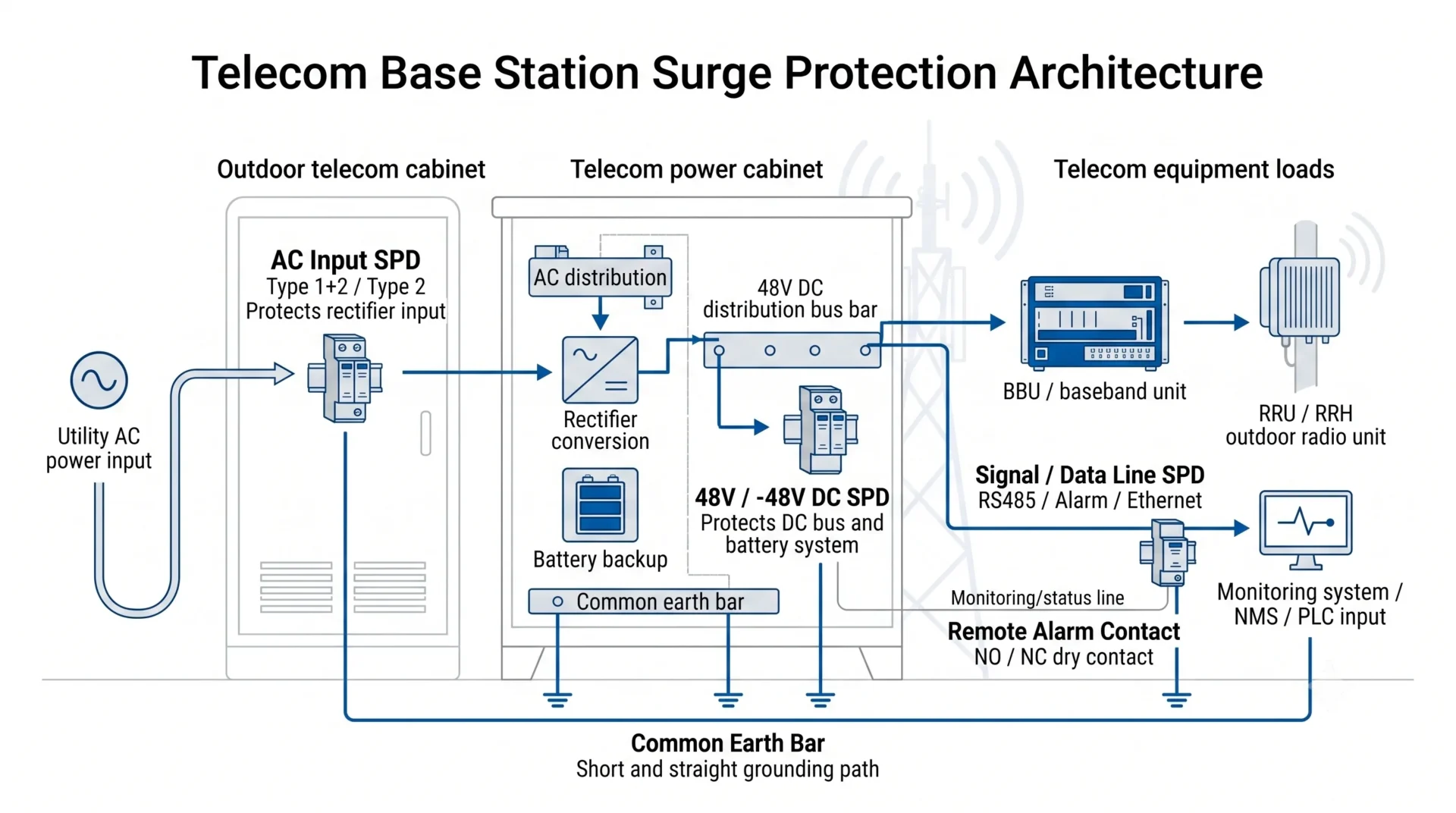
Une solution SPD pour station de base de télécommunications ne se résume pas à un simple parasurtenseur. Il s'agit d'un système de protection coordonné couvrant l'alimentation en courant alternatif, l'alimentation en courant continu de -48 V, les lignes de signaux et de données, la mise à la terre, la surveillance d'alarme à distance et les modules SPD remplaçables.
Dans les armoires de télécommunications, les sites de pylônes, les abris extérieurs et les systèmes d'alimentation en -48 V CC, les courants de surtension peuvent pénétrer par plusieurs voies conductrices. Si seule l'entrée CA est protégée, le redresseur, le bus de batterie, l'unité BBU, l'alimentation des unités RRU/RRH, les lignes de surveillance et les ports de communication peuvent rester exposés.
Ce guide explique comment mettre en place une solution pratique de protection contre les surtensions pour les stations de base de télécommunications et les systèmes d'alimentation en courant continu 48 V / -48 V. Il s'adresse tout particulièrement aux fournisseurs d'équipements de télécommunications, aux intégrateurs d'armoires, aux équipes de maintenance, aux prestataires d'ingénierie, aux distributeurs stockistes et aux acheteurs OEM.
Table des matières
Réponse rapide : Quelle SPD faut-il pour une station de base de télécommunications ?
Une station de base de télécommunications nécessite généralement une protection contre les surtensions à plusieurs niveaux. Le modèle précis de dispositif de protection contre les surtensions (SPD) dépend des risques liés au site, du réseau électrique, du tracé des câbles, de la qualité de la mise à la terre et des exigences en matière de surveillance.
| Point de protection | Choix typique de SPD | Ce qu'elle protège | L'acheteur doit confirmer |
|---|---|---|---|
| Entrée AC | SPD CA de type 1+2 ou de type 2 | Entrée secteur, distribution CA, entrée du redresseur | Système monophasé ou triphasé, type de mise à la terre, niveau d'exposition du site |
| Alimentation télécom 48 V / -48 V CC | Dispositif de protection contre les surtensions (SPD) à courant continu basse tension pour circuits d'alimentation des télécommunications | Sortie du redresseur, bus de batterie, distribution CC, alimentation CC de la BBU ou de la RRU/RRH | Tension continue nominale, tension continue maximale, polarité, encombrement sur rail DIN |
| Lignes de signal et de surveillance | Signal SPD adapté à la tension et au protocole | RS485, ligne d'alarme, ligne de capteur, ligne de surveillance du BMS ou du redresseur | Tension du signal, paires de lignes, type de borne, blindage et méthode de mise à la terre |
| Ligne Ethernet / PoE | RJ45 / SPD réseau au niveau de l'entrée des câbles de données en cuivre dans l'armoire | Ports réseau, équipements de surveillance, dispositifs de transmission | Débit de données, exigences PoE, catégorie de câble, position de montage |
| RF / câble d'alimentation d'antenne | Parafoudre coaxial adapté au connecteur et à la fréquence | Chemin d'alimentation de l'antenne et interface avec les équipements RF | Type de connecteur, gamme de fréquences, perte d'insertion, point de mise à la terre |
| Mise à la terre et liaison | Court-circuit vers la barre de terre commune | Fournit un chemin de décharge pour les courants de surtension | Position de la barre de terre, longueur du conducteur, liaison équipotentielle |
| Alarme à distance | SPD avec contact sec NO/NC | Suivi de maintenance des modules SPD défaillants | NMS, PLC, RTU, logique d'alarme, contact normalement ouvert ou normalement fermé |
| Remplacement du module | Cartouche SPD amovible | Une maintenance plus rapide sans avoir à remplacer l'ensemble de la base | Même modèle, même tension nominale, même nombre de pôles, même intensité nominale de décharge |
Vous avez besoin d'aide pour choisir les SPD adaptés à une armoire de télécommunications ou à un système d'alimentation en -48 V CC ?
Veuillez nous communiquer la tension d'entrée CA, la tension du système CC, la configuration de l'armoire, la méthode de mise à la terre et le type de câble de signal. LEEYEE peut vous aider à passer en revue les points de protection avant la fourniture en gros ou l'intégration OEM.
Pourquoi les stations de base de télécommunications ont besoin d'une protection contre les surtensions à plusieurs niveaux
Une station de base de télécommunications est généralement exposée à davantage de voies de surtension qu'un tableau de distribution intérieur classique. Le site peut comprendre une tour, une armoire extérieure, une alimentation en courant alternatif, un redresseur, un système de batteries de 48 V CC, des équipements radio à distance, des câbles de signal, des dispositifs de surveillance et un réseau de mise à la terre.
Il n'est pas nécessaire que la foudre frappe directement l'armoire pour endommager le système. Un coup de foudre à proximité peut induire une tension transitoire élevée sur de longs câbles métalliques. Les transitoires de commutation provenant du réseau électrique ou des équipements d'alimentation peuvent également, à la longue, mettre à rude épreuve le redresseur et le système de distribution en courant continu.
C'est pourquoi la stratégie de protection ne doit pas se limiter au câble d'alimentation CA entrant. Une conception pratique d'un parafoudre pour télécommunications doit prendre en compte tous les chemins conducteurs qui entrent ou sortent de l'armoire.
1. Protection de l'alimentation CA pour les sites de télécommunications
L'entrée CA constitue le premier niveau de protection pour la plupart des sites de télécommunications. Elle protège la ligne d'alimentation entrante avant que le courant ne soit converti en 48 V CC par le redresseur.
Pour les sites de tours exposés, les stations rurales, les stations de montagne, les sites installés sur les toits ou les armoires alimentées par de longues lignes aériennes, on envisage souvent l'installation d'un parafoudre CA de type 1+2 au niveau de l'entrée principale. Pour les armoires intérieures ou les points de sous-distribution présentant moins de risques, un parafoudre CA de type 2 peut convenir.
Éléments à vérifier pour un SPD d'entrée CA
- Tension du système CA : monophasée ou triphasée
- Système de mise à la terre : TN-S, TN-C-S, TT ou configuration spécifique au projet
- Emplacement d'installation : entrée principale, coffret de distribution CA ou entrée d'armoire
- Type de SPD requis : Type 1+2 ou Type 2
- Caractéristiques de décharge : Iimp, In, Imax en fonction du niveau de risque du site
- Exigence relative aux alarmes à distance pour les sites sans personnel
- Espace disponible sur le rail DIN et dispositif de protection de secours
Pour les options de produits côté courant alternatif, voir Dispositif de protection contre les surtensions en courant alternatif et Protecteur de surtension DIN Rail Type 2.
2. Protection de l'alimentation 48 V / -48 V CC pour les télécommunications
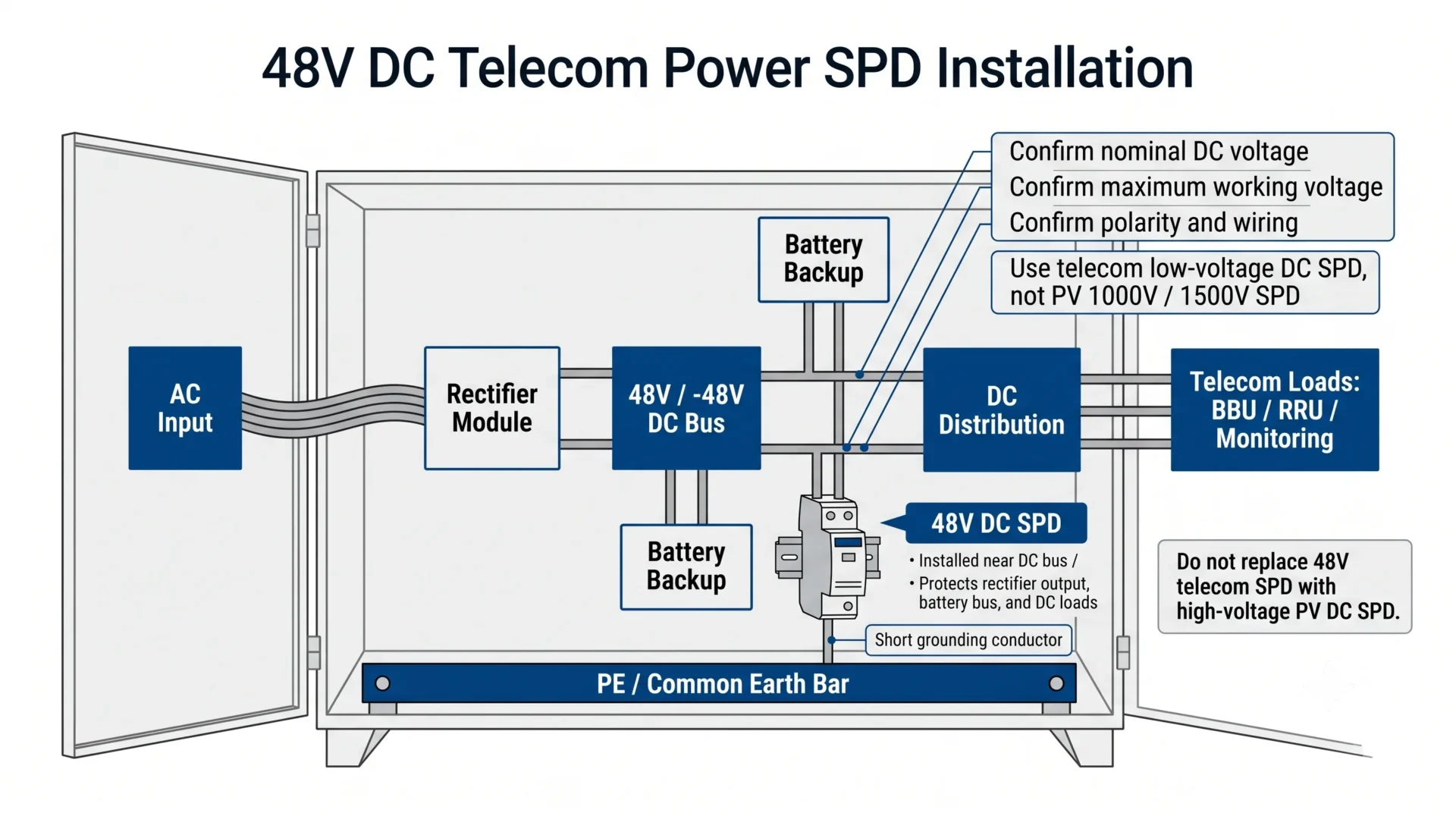
Le système d'alimentation en courant continu de 48 V constitue le cœur de nombreuses armoires de télécommunications et stations de base. Il peut comprendre des redresseurs, des chaînes de batteries, un réseau de distribution en courant continu, l'alimentation de la BBU et des lignes d'alimentation en courant continu vers les équipements radio distants.
Dans les projets de télécommunications, le système est souvent désigné comme étant en 48 V ou -48 V CC. Cependant, le SPD ne doit pas être choisi uniquement en fonction de la mention « 48 V ». La tension réelle du bus CC pendant la charge et le fonctionnement peut être supérieure à la valeur nominale. Le SPD CC doit être choisi en fonction de la tension de fonctionnement continue maximale réelle du système d'alimentation.
Points d'installation courants des SPD 48 V CC
Sortie CC du redresseur
Protège le circuit continu après la conversion CA-CC. Cette disposition permet de réduire les contraintes dues aux surtensions avant que les transitoires ne se propagent dans le réseau de distribution en courant continu.
Bus de batterie
À utiliser lorsque le système de batteries et le bus CC sont susceptibles d'être exposés à des surtensions transitoires provenant du câblage de l'armoire ou de lignes CC externes.
Sortie de distribution CC
Protège les circuits dérivés alimentant les équipements de télécommunications, les équipements de commande ou les unités distantes.
Alimentation en courant continu des RRU / RRH
Les longs câbles CC installés à l'extérieur peuvent subir des surtensions induites. Une protection peut s'avérer nécessaire à proximité de la sortie de l'armoire et du côté des équipements, en fonction de la configuration du site.
Comment choisir la tension d'un SPD à -48 V CC ?
Pour un système d'alimentation télécom de -48 V, la tension nominale du système ne constitue qu'un point de départ. La tension réelle du bus CC, l'état de charge, la configuration des batteries et la tension continue maximale doivent tous être vérifiés avant de confirmer la capacité nominale du SPD.
| Point d'accès Telecom DC | Ce qu'il faut vérifier | Signification de la sélection SPD | Pourquoi c'est important |
|---|---|---|---|
| - Système à tension nominale de -48 V | Tension de fonctionnement réelle, tension de maintien et tension maximale en continu | Choisissez en fonction de la tension réelle du système, et pas uniquement en fonction de la mention « 48 V » | Un SPD CC dont la tension nominale en service continu est trop faible peut vieillir plus rapidement ou tomber en panne prématurément |
| Sortie du redresseur | Plage de tension de sortie et réglage de commande | Vérifiez que le SPD Uc est adapté à un fonctionnement en continu | La sortie du redresseur constitue un point de protection courant pour l'alimentation en courant continu dans le secteur des télécommunications. |
| Bus de batterie | Mode de recharge, configuration de la batterie de secours et longueur du câblage | Choisissez un SPD CC adapté à l'environnement du bus de batterie | Les systèmes de batteries peuvent être exposés à des transitoires par le biais du câblage de l'armoire |
| Sortie de distribution CC | Longueur du câble côté charge et acheminement du câble à l'extérieur | Ajouter des SPD CC là où les longues lignes CC externes augmentent le risque d'exposition | Les longues lignes d’alimentation en courant continu peuvent capter l’énergie des surtensions induites |
Éléments à vérifier pour un SPD 48 V CC
- Tension nominale du système en courant continu : 48 V, -48 V ou toute autre tension continue de télécommunications
- Tension continue maximale en continu pendant la charge d'entretien ou le fonctionnement du système
- Polarité et schéma de câblage
- Emplacement d'installation : sortie du redresseur, bus de batterie, réseau de distribution CC ou sortie d'alimentation
- Capacité de refoulement requise
- Espace sur rail DIN et dimensions des bornes
- Exigences relatives aux indicateurs visuels et aux alarmes à distance
- Un module enfichable est-il nécessaire pour la maintenance ?
Pour les orientations relatives aux produits côté courant continu, voir Dispositif de protection contre les surtensions en courant continu. Si la spécification concerne spécifiquement une alimentation 48 V CC pour les télécommunications, veuillez nous communiquer la tension du système et le schéma d'agencement de l'armoire avant de valider le modèle définitif.
3. Protection des lignes de signaux et de données
Les armoires de télécommunications ne contiennent souvent pas uniquement des câbles d'alimentation. Les lignes de surveillance, de commande, d'alarme, de communication et de capteurs peuvent également transmettre des pics de tension aux composants électroniques sensibles.
Les SPD de signaux doivent être choisis différemment des SPD de puissance. Un SPD de signaux doit être adapté à la tension de service, à la paire de lignes, au type de signal, au débit de transmission et au mode de mise à la terre. Un SPD de signaux inadapté peut offrir une protection insuffisante ou perturber les communications.
| Type de ligne | Risque typique | Point de sélection SPD | Erreur courante commise par les acheteurs |
|---|---|---|---|
| Ligne de surveillance RS485 | Pique de tension induite sur un long câble de commande | Adapter la tension, la ligne A/B, le blindage et la mise à la terre | Utilisation d'un SPD de puissance à la place d'un SPD de signal |
| Ligne d'alarme à contact sec | Module d'entrée d'alarme ou de surveillance des transitoires | Vérifier la tension du signal et la logique des contacts | Ignorer les circuits d'alarme de basse tension |
| Ligne de capteurs 24 V | Surtensions provenant de capteurs extérieurs ou d'accessoires d'armoire | Faire correspondre la tension de fonctionnement et les paires de câbles | Protection réservée à l'entrée CA |
| Ethernet / PoE | Surtension sur un câble réseau en cuivre | Vérifier le débit de données et les besoins en alimentation PoE | Installation d'un dispositif de protection qui affecte les performances du réseau |
| Câble coaxial RF | Courant de foudre ou surtension induite par le câble d'alimentation de l'antenne | Adapter le type de connecteur, la gamme de fréquences et la perte d'insertion | Choisir uniquement en fonction de l'aspect du connecteur |
Pour les applications RS485, voir Guide de câblage et de sélection des SPD RS485. Pour les références des produits SPD de signal, voir Dispositif de protection contre les surtensions en courant continu pour signaux de données LY10.
4. Mise à la terre et liaison : un aspect que de nombreux acheteurs sous-estiment
Un dispositif de protection contre les surtensions (SPD) ne fait pas disparaître l'énergie de la surtension. Il détourne le courant de surtension vers la terre ou vers un chemin de référence équipotentiel. Si le conducteur de mise à la terre est trop long, trop fin, mal acheminé ou raccordé à une barre de terre de mauvaise qualité, l'efficacité de la protection peut être considérablement réduite.
Pour les sites de télécommunications, la mise à la terre revêt une importance particulière, car il peut y avoir plusieurs systèmes conducteurs : la structure de la tour, la barre de terre de l'armoire, la terre du réseau électrique, la référence négative en courant continu, le blindage des câbles de signal et la mise à la terre du câble d'alimentation de l'antenne.
Bonnes pratiques de mise à la terre pour l'installation de SPD dans le secteur des télécommunications
- Utilisez si possible une barre de mise à la terre commune.
- Veillez à ce que les conducteurs de mise à la terre SPD soient courts et droits.
- Évitez les boucles de câblage trop longues entre le dispositif de protection contre les surtensions (SPD), l'équipement protégé et la barre de mise à la terre.
- Armoire de raccordement, système d'alimentation, protection des signaux et blindage des câbles conformément au schéma de mise à la terre du projet.
- Ne partez pas du principe que l'installation d'un plus grand nombre de SPD peut résoudre un problème de mise à la terre déficiente.
5. Contact d'alarme à distance pour les sites de télécommunications sans personnel
De nombreux sites de télécommunications ne sont pas surveillés. Une défaillance d'un module SPD peut passer inaperçue jusqu'à la prochaine intervention de maintenance, à moins que le SPD ne soit équipé d'un contact d'alarme à distance.
Un contact d'alarme à distance est généralement une sortie à contact sec, de type NO (normalement ouvert) ou NC (normalement fermé). Il peut être raccordé à un système de surveillance, à un automate programmable (PLC), à une unité de télégestion (RTU), à un système de gestion du réseau (NMS) ou à l'entrée d'alarme d'une armoire électrique. En cas de défaillance ou de déconnexion de la cartouche SPD, le système de surveillance peut recevoir une notification de changement d'état.
Cette fonction n'augmente pas la capacité de protection contre les surtensions. Son intérêt réside dans la visibilité sur la maintenance.
Éléments à vérifier avant de commander des SPD à alarme à distance
- Le site nécessite-t-il une surveillance à distance ?
- La logique de l'alarme doit-elle être de type « normalement ouverte » ou « normalement fermée » ?
- Quel signal de surveillance sera transmis au contact sec ?
- La borne de signal à distance est-elle nécessaire sur les SPD CA, les SPD CC, les SPD de signal, ou sur tous ces modèles ?
- L'équipe de maintenance a-t-elle besoin d'un indicateur visuel et d'une alarme à distance ?
Pour le câblage logique, voir Comment connecter un contact d'alarme à distance SPD à un PLC ou à un système de surveillance.
6. Remplacement et maintenance des modules enfichables
Les armoires de télécommunications nécessitent souvent une intervention rapide. Un module SPD enfichable permet de remplacer la cartouche défectueuse sans changer l'ensemble de la base, à condition que le module de remplacement soit conforme aux spécifications d'origine.
Pour les importateurs de baies, les intégrateurs de baies et les prestataires de maintenance, cet aspect est important car un même projet de télécommunications peut nécessiter l'utilisation de nombreuses baies similaires sur différents sites. Une liste claire des modules de rechange permet de réduire les erreurs de maintenance.
Quand faut-il remplacer un module SPD de télécommunications ?
- L'indicateur visuel signale une défaillance, passant souvent du vert au rouge.
- L'alarme à distance signale une défaillance du SPD.
- Le module a subi un pic de courant important et les règles de maintenance du projet imposent son remplacement.
- Le SPD présente des dommages visibles, des déformations, des traces de brûlure ou une odeur inhabituelle.
- Suite à la modification de l'armoire, le module ne répond plus aux spécifications requises.
Pour obtenir des conseils sur le remplacement, consultez Guide de remplacement des cartouches SPD.
Sélection des SPD de télécommunications en fonction du scénario de site
Les différents sites de télécommunications présentent des niveaux de risque variables. Une armoire installée sur un toit en zone urbaine, une tour isolée en pleine campagne et un abri extérieur relié à de longues liaisons par câble ne doivent pas être traités exactement de la même manière.
| Scénario du site | Risque principal lié aux surtensions | Axes prioritaires en matière de protection recommandés | Signification commerciale |
|---|---|---|---|
| Armoire de télécommunications pour l'extérieur | Alimentation CA, ligne d'alimentation CC, câble de signal, différence de mise à la terre | SPD CA + SPD 48 V CC + SPD de signal + alarme à distance | Une solution idéale pour les intégrateurs d'armoires et les fournisseurs OEM |
| Site de tour distant | Exposition élevée à la foudre et longues longueurs de câbles | Protection des entrées CA à haut risque, protection des alimentations CC, mise à la terre solide | Il faut une sélection au niveau du projet, et pas seulement une correspondance avec le catalogue |
| Station de base installée sur un toit | Mise à la terre du bâtiment, alimentation en courant alternatif, câble d'alimentation d'antenne, ligne de surveillance | Assurer la coordination avec le système de protection contre la foudre du bâtiment et les parafoudres des armoires électriques | Utile pour les entrepreneurs et les équipes de maintenance |
| Local technique de télécommunications intérieur | Distribution électrique et surtensions sur les réseaux et les lignes de données | Protection contre les surtensions (SPD) du réseau de distribution CA + protection contre les surtensions (SPD) du bus 48 V CC + protection des lignes de données en cas de présence de câbles en cuivre | Souvent choisi par un fournisseur d'équipements ou un intégrateur de systèmes |
| Armoire de secours à batterie | Transitoires sur le bus CC et surtensions dans le câblage de l'armoire | SPD basse tension CC adapté à la tension réelle du bus | Information importante à l'attention des fournisseurs de systèmes d'alimentation 48 V |
À l'attention des intégrateurs d'armoires de télécommunications et des acheteurs OEM
Pour les intégrateurs d'armoires de télécommunications, le principal défi ne réside pas seulement dans le choix d'un seul SPD adapté. Le véritable enjeu consiste à coordonner les SPD CA, les SPD -48 V CC, les SPD de signal, la logique d'alarme à distance, les modules de rechange, les fiches techniques et les étiquettes afin de constituer un ensemble cohérent de protection de l'armoire.
Si différents types de SPD sont achetés séparément sans coordination technique, le projet risque de se heurter à des problèmes tels qu’une incompatibilité des modèles, une logique d’alarme incohérente, des cartouches de rechange inadaptées, des fiches techniques incomplètes ou des listes de pièces de rechange peu claires.
Les versions avec SPD d'entrée CA, SPD -48 V CC, SPD de signal et alarme à distance peuvent être étudiées conjointement dans le cadre d'une même conception d'armoire.
Les étiquettes de modèle, les références de câblage, les fiches techniques et le champ d'application des certificats peuvent être préparés pour des projets destinés aux distributeurs ou aux marques de distributeur.
Les cartouches enfichables et les règles de remplacement peuvent être répertoriées de manière claire, ce qui permet de réduire les erreurs de maintenance sur plusieurs sites de télécommunications.
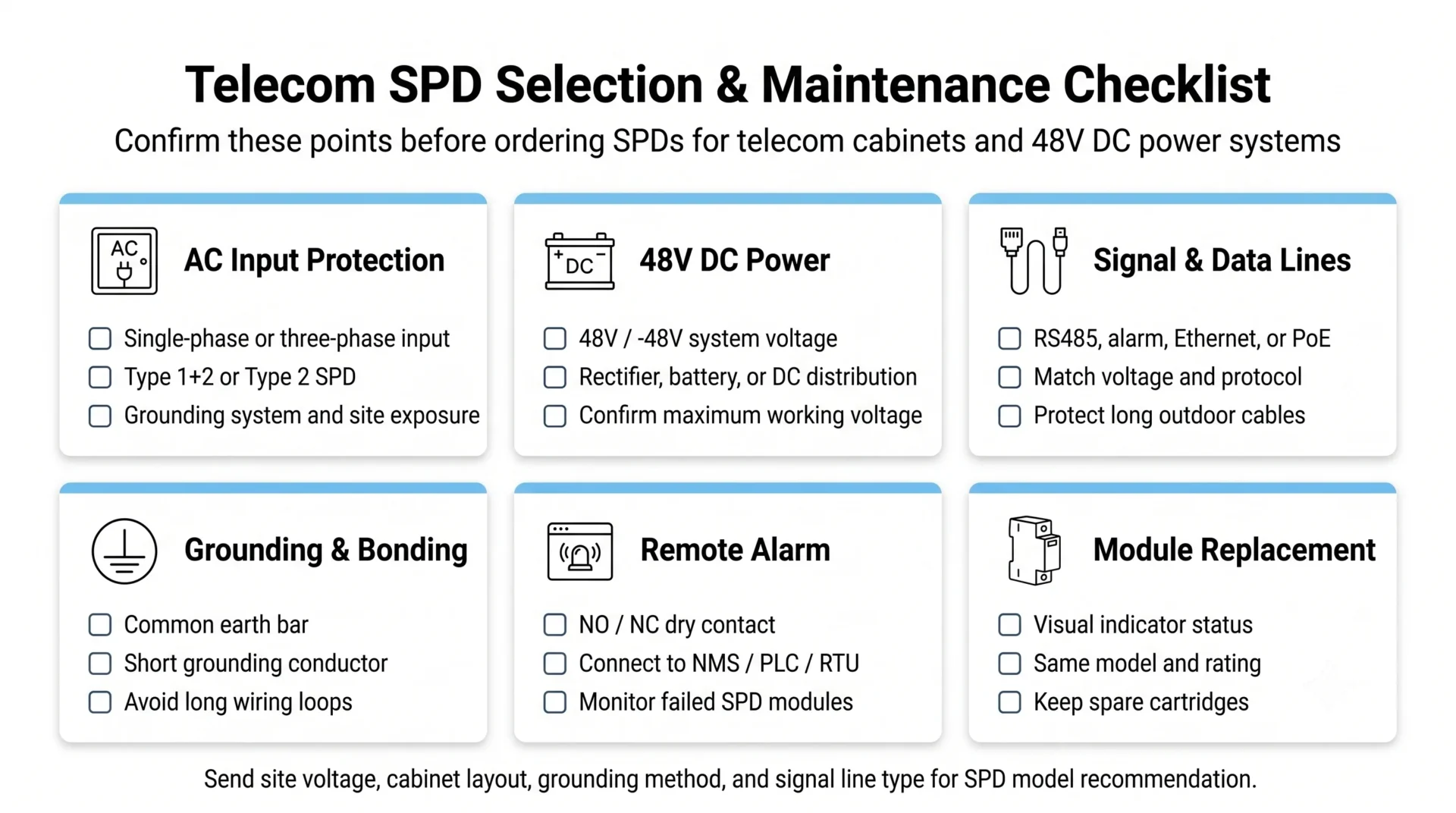
Avant de commander des SPD pour les télécommunications, vérifiez bien ces informations
Pour les projets de télécommunications, le moyen le plus rapide de choisir le SPD adapté consiste à fournir à la fois les points de protection et les paramètres du système. Cela permet d'éviter de choisir correctement un produit tout en laissant un autre circuit sans protection.
Erreurs courantes dans le choix des SPD pour les télécommunications
Protection réservée à l'entrée CA
La protection de l'entrée CA est importante, mais elle ne protège pas tous les circuits. Les lignes 48 V CC, les câbles de surveillance, les câbles Ethernet et les circuits liés aux alimentations peuvent toujours acheminer de l'énergie de surtension vers l'armoire.
Utilisation d'un SPD CC photovoltaïque pour les systèmes de télécommunications en 48 V CC
Un parafoudre CC photovoltaïque haute tension n'est pas automatiquement adapté à un système d'alimentation télécom de 48 V. La plage de tension, le comportement du système, l'espace disponible dans l'armoire et les exigences du projet peuvent varier.
Choisir un SPD CC uniquement en se basant sur la mention « 48 V »
La simple mention « système 48 V nominal » n'est pas suffisante. L'acheteur doit vérifier la tension de fonctionnement continue maximale du bus CC et choisir un dispositif de protection contre les surtensions (SPD) adapté aux conditions réelles d'exploitation.
Ignorer une alarme à distance
Dans le cas des armoires de télécommunications sans personnel de surveillance, une défaillance du SPD non signalée par une alarme à distance peut passer inaperçue. Cela augmente le risque lié à la maintenance après le prochain événement de surtension.
Choix du SPD de signal uniquement en fonction de la tension
Le choix d'un SPD doit également tenir compte du type de signal, du nombre de paires de conducteurs, de la capacité, du débit de transmission, du raccordement du blindage, du type de borne et de la méthode de mise à la terre.
Utilisation de longs fils de mise à la terre
Un conducteur de mise à la terre trop long ou mal acheminé peut réduire l'efficacité des parafoudres. Le chemin de décharge doit être court, rectiligne et relié à la référence de terre appropriée.
Pages LEEYEE associées
FAQ : Protection contre les surtensions (SPD) et protection contre les surtensions à -48 V CC pour les stations de base de télécommunications
Quelle est la SPD correcte pour une station de base de télécommunications ?
Une station de base de télécommunications nécessite généralement des dispositifs de protection sur tension (DPST) coordonnés pour l'alimentation AC, l'alimentation CC 48V / -48V, les lignes de signal / données, et parfois les chemins d'alimentation RF / coaxiaux. La sélection finale dépend de la tension, de l'exposition du site, de la mise à la terre, du routage des câbles et des exigences de surveillance.
Quel SPD faut-il utiliser pour un système d'alimentation télécom de -48 V ?
Un système d'alimentation télécom de -48 V doit être équipé d'un dispositif de protection contre les surtensions (SPD) à courant continu basse tension adapté à la tension maximale continue réelle du bus, à la polarité, à la position d'installation et à la capacité de décharge. Il ne doit pas être choisi uniquement en fonction de la tension nominale « 48 V » indiquée sur le système.
Un SPD CA est-il suffisant pour une station de base de télécommunications ?
Non. Le dispositif SPD CA protège l'entrée d'alimentation et le côté entrée du redresseur, mais il ne protège pas automatiquement le bus -48 V CC, le réseau de distribution CC, les lignes d'alimentation CC extérieures, les lignes de signal, les lignes Ethernet ni les circuits d'alarme.
Où faut-il installer un SPD 48 V CC dans une armoire de télécommunications ?
Les points d'installation courants comprennent la sortie CC du redresseur, le bus de batterie, la sortie de distribution CC et la sortie d'alimentation CC longue distance. L'emplacement exact dépend de la disposition de l'armoire, du cheminement des câbles et du niveau de risque du projet.
Puis-je utiliser un SPD CC photovoltaïque pour un système de télécommunications de 48 V ?
Pas à l'aveuglette. Les SPD photovoltaïques en courant continu et les SPD de télécommunications en 48 V CC peuvent présenter des tensions nominales, des domaines d’application, des normes et des exigences en matière d’armoires différents. Il convient de vérifier que le SPD est bien adapté au circuit d’alimentation CC de télécommunications concerné.
Pourquoi faut-il installer des SPD de ligne de signal dans les armoires de télécommunications ?
Les lignes de surveillance, RS485, d'alarme, de capteurs, Ethernet et PoE peuvent transmettre des surtensions transitoires aux composants électroniques sensibles. Si seule la ligne d'alimentation est protégée, ces voies de signal peuvent tout de même provoquer des pannes.
Les SPD destinés aux télécommunications doivent-ils être équipés de contacts d'alarme à distance ?
Pour les armoires de télécommunications sans personnel, les contacts d'alarme à distance s'avèrent très utiles. Un contact sec NO/NC peut transmettre l'état de défaillance d'un parafoudre à un automate programmable (PLC), à une unité de télégestion (RTU), à un système de gestion du réseau (NMS) ou à une entrée de surveillance de l'armoire.
Est-il possible de remplacer le module SPD sans remplacer l'appareil dans son intégralité ?
Si le SPD est de conception enfichable, la cartouche peut généralement être remplacée tout en conservant la base. Le module de remplacement doit correspondre à la série d'origine, à la tension nominale, à la configuration des pôles, à la capacité de décharge et à la version du signal à distance.
Quelles sont les informations nécessaires pour établir une nomenclature SPD dans le secteur des télécommunications ?
Veuillez nous communiquer la tension d'entrée CA, la tension du système CC, le schéma de mise à la terre, la disposition de l'armoire, les points d'entrée des câbles, les types de lignes de signal, les exigences en matière d'alarme à distance, les exigences de certification, les besoins en modules de rechange, ainsi que si vous souhaitez une fourniture sous marque OEM ou sous marque propre.
Vous avez besoin d'un SPD de télécommunications pour votre armoire ou votre système -48 V CC ?
LEEYEE vous aide à choisir des dispositifs de protection contre les surtensions pour les entrées CA, l'alimentation CC, les lignes de signal, les alarmes à distance et l'intégration dans des armoires OEM. Indiquez-nous la tension de votre système, la configuration du câblage et les exigences relatives à l'armoire pour obtenir des recommandations sur les modèles adaptés.