
Uma solução de SPD para estação base de telecomunicações não é um único protetor contra surtos. É uma estrutura de proteção coordenada para entrada CA, energia DC de -48V, linhas de sinal/dados, aterramento, monitoramento remoto de alarme e módulos SPD substituíveis.
Para gabinetes de telecomunicações, sites de torres, abrigos ao ar livre e sistemas de energia DC de -48V, a corrente de surto pode entrar por várias vias condutoras. Se apenas a entrada CA estiver protegida, o retificador, o barramento da bateria, alimentação BBU, RRU/RRH, linhas de monitoramento e portas de comunicação ainda podem ficar expostos.
Este guia explica como construir uma estrutura prática de proteção contra surtos para estações base de telecomunicações e sistemas de energia de 48V / -48V DC, especialmente para fornecedores de equipamentos de telecomunicações, integradores de gabinetes, equipes de manutenção, contratantes de engenharia, distribuidores de estoque e compradores OEM.
Índice
Resposta Rápida: Qual SPD é Necessário para uma Estação Base de Telecomunicações?
Uma estação base de telecomunicações normalmente precisa de proteção contra surtos em camadas. O modelo exato de SPD depende do risco do site, sistema de energia, roteamento de cabos, qualidade do aterramento e requisitos de monitoramento.
| Ponto de proteção | Escolha típica de SPD | O que protege | O comprador deve confirmar |
|---|---|---|---|
| entrada CA | Tipo 1+2 ou Tipo 2 AC SPD | Entrada de utilidade, distribuição AC, entrada de retificador | Sistema monofásico ou trifásico, tipo de aterramento, nível de exposição do local |
| 48V / -48V DC energia de telecomunicações | SPD de baixa tensão DC para circuitos de energia de telecomunicações | Saída de retificador, barramento de bateria, distribuição DC, alimentação DC de BBU ou RRU/RRH | Tensão DC nominal, tensão contínua máxima, polaridade, espaço em trilho DIN |
| Linhas de sinal e monitoramento | SPD de sinal compatível com tensão e protocolo | RS485, linha de alarme, linha de sensor, linha de monitoramento BMS ou de retificador | Tensão de sinal, pares de linhas, tipo de terminal, método de blindagem e aterramento |
| Linha Ethernet / PoE | RJ45 / SPD de rede onde as linhas de dados de cobre entram no gabinete | Portas de rede, equipamentos de monitoramento, dispositivos de transmissão | Taxa de dados, requisito PoE, categoria de cabo, posição de instalação |
| RF / alimentador de antena | Protetor de surto coaxial compatível com conector e frequência | Caminho do alimentador de antena e interface de equipamento RF | Tipo de conector, faixa de frequência, perda de inserção, ponto de aterramento |
| Aterramento e ligação | Ligação curta ao barramento de terra comum | Fornece caminho de descarga de corrente de surto | Posição do barramento de terra, comprimento do condutor, ligação equipotencial |
| Alarme remoto | SPD com contato seco NA/NC | Monitoramento de manutenção para módulos SPD com falha | NMS, PLC, RTU, lógica de alarme, contato normalmente aberto ou normalmente fechado |
| Substituição de módulo | Cartucho SPD substituível | Manutenção mais rápida sem substituir a base completa | Mesmo modelo, mesma tensão nominal, mesma estrutura de polos, mesma capacidade de descarga |
Precisa de ajuda para encontrar SPDs para um armário de telecomunicações ou sistema de energia -48V CC?
Envie-nos a sua tensão de entrada CA, tensão do sistema CC, disposição do armário, método de ligação à terra e tipo de linha de sinal. A LEEYEE pode ajudar a rever os pontos de proteção antes do fornecimento em massa ou da integração OEM.
Por que Estações Base de Telecomunicações Precisam de Proteção contra Surto em Camadas
Uma estação base de telecomunicações está normalmente exposta a mais caminhos de sobretensão do que um quadro de distribuição interior normal. O local pode incluir uma torre, armário exterior, entrada de energia CA, retificador, sistema de bateria de 48V CC, equipamento de rádio remoto, cabos de sinal, dispositivos de monitorização e rede de ligação à terra.
Não é necessário que um relâmpago atinja diretamente o armário para danificar o sistema. Uma descarga próxima pode induzir uma alta tensão transitória em cabos metálicos longos. Os transitórios de comutação da rede elétrica ou de equipamentos de energia também podem sobrecarregar o retificador e o sistema de distribuição de CC ao longo do tempo.
É por isso que a estratégia de proteção não deve limitar-se à linha de entrada de CA. Um projeto prático de SPD para telecomunicações deve verificar todos os caminhos condutores que entram ou saem do armário.
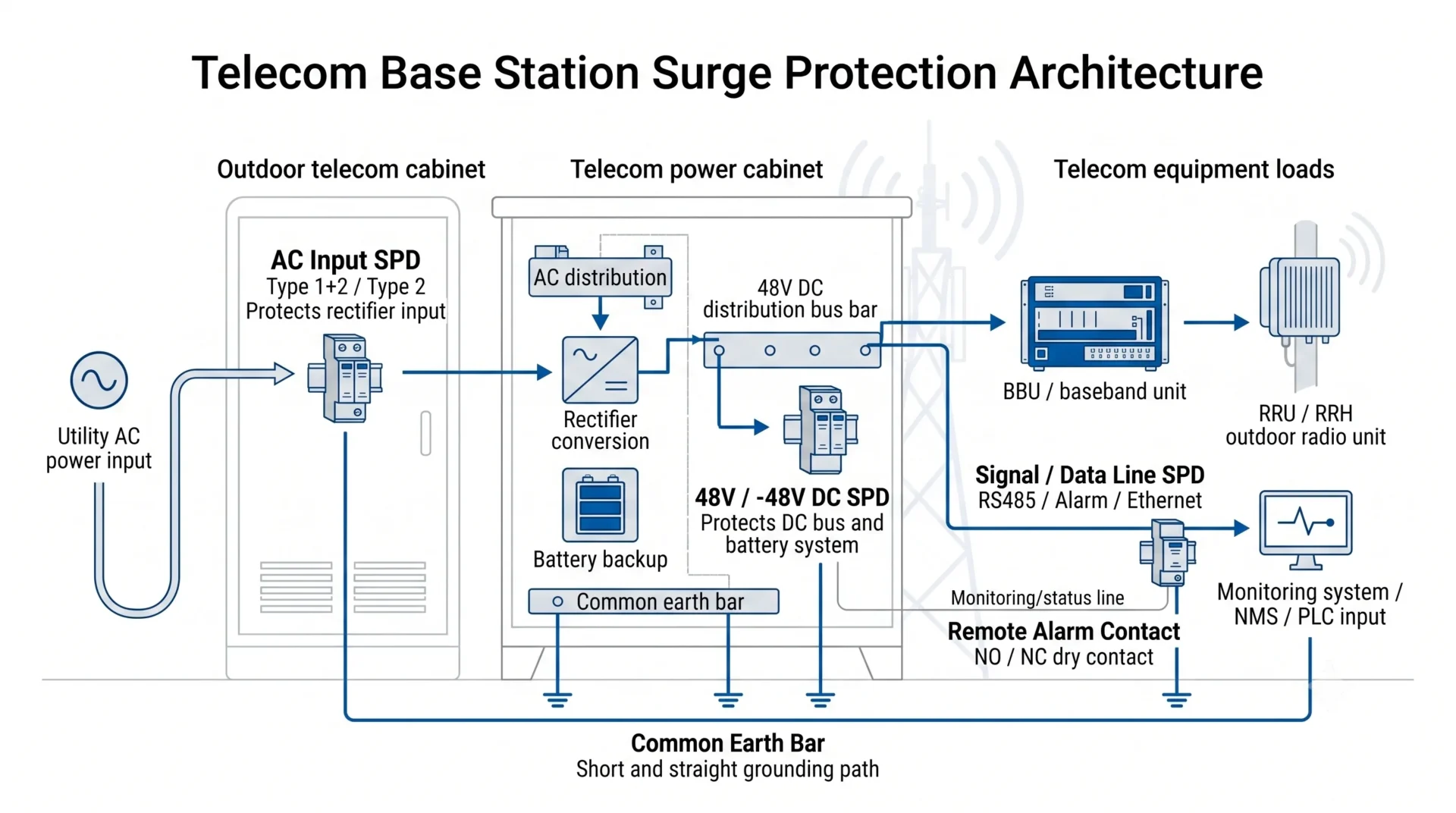
1. Proteção de Entrada CA para Sites de Telecomunicações
A entrada de CA é a primeira camada de proteção para a maioria dos locais de telecomunicações. Protege a linha de energia de entrada antes de a energia ser convertida pelo retificador em 48V CC.
Para locais com torres expostas, estações rurais, estações de montanha, locais em coberturas ou armários alimentados por longas linhas aéreas, um SPD de CA do Tipo 1+2 é frequentemente considerado na entrada principal. Para armários interiores de menor risco ou posições de subdistribuição, um SPD de CA do Tipo 2 pode ser adequado.
O que confirmar para o SPD de entrada de CA
- Tensão do sistema de CA: monofásico ou trifásico
- Sistema de ligação à terra: TN-S, TN-C-S, TT ou disposição específica do projeto
- Posição de instalação: entrada principal, caixa de distribuição de CA ou entrada do armário
- Tipo de SPD necessário: Tipo 1+2 ou Tipo 2
- Capacidade de descarga: Iimp, In, Imax de acordo com o risco do local
- Requisito de alarme remoto para locais não tripulados
- Espaço disponível em calha DIN e disposição de proteção de reserva
Para opções de produtos do lado da CA, consulte Dispositivo de proteção contra sobretensões CA e Protetor contra surtos Tipo 2 Montável em Trilho DIN.
2. Proteção de Energia DC de 48V / -48V para Telecomunicações
O sistema de energia de 48V CC é o núcleo de muitos armários de telecomunicações e estações base. Pode incluir retificadores, cadeias de baterias, distribuição de CC, fonte de alimentação BBU e alimentações de CC para equipamentos de rádio remotos.
Em projetos de telecomunicações, o sistema é frequentemente descrito como 48V ou -48V CC. Contudo, o SPD não deve ser selecionado apenas pelo nome "48V". A tensão real do barramento de CC durante o carregamento e funcionamento pode ser superior ao valor nominal. O SPD de CC deve ser selecionado de acordo com a tensão de funcionamento contínuo máxima real do sistema de energia.
Pontos de instalação comuns para SPD de 48V CC
Saída de CC do retificador
Protege o lado da CC após a conversão de CA para CC. Esta posição ajuda a reduzir a sobrecarga de sobretensão antes que os transitórios se espalhem pelo sistema de distribuição de CC.
Barramento de bateria
Utilizado onde o sistema de bateria e o barramento de CC podem estar expostos a sobretensão transitória através da cablagem do armário ou linhas de CC externas.
Saída de distribuição de CC
Protege os circuitos de derivação que alimentam equipamentos de telecomunicações, equipamentos de controlo ou unidades remotas.
Alimentação de CC de RRU / RRH
Cabos de CC longos no exterior podem captar sobretensões induzidas. A proteção pode ser necessária perto da saída do armário e perto do lado do equipamento, dependendo do projeto do local.
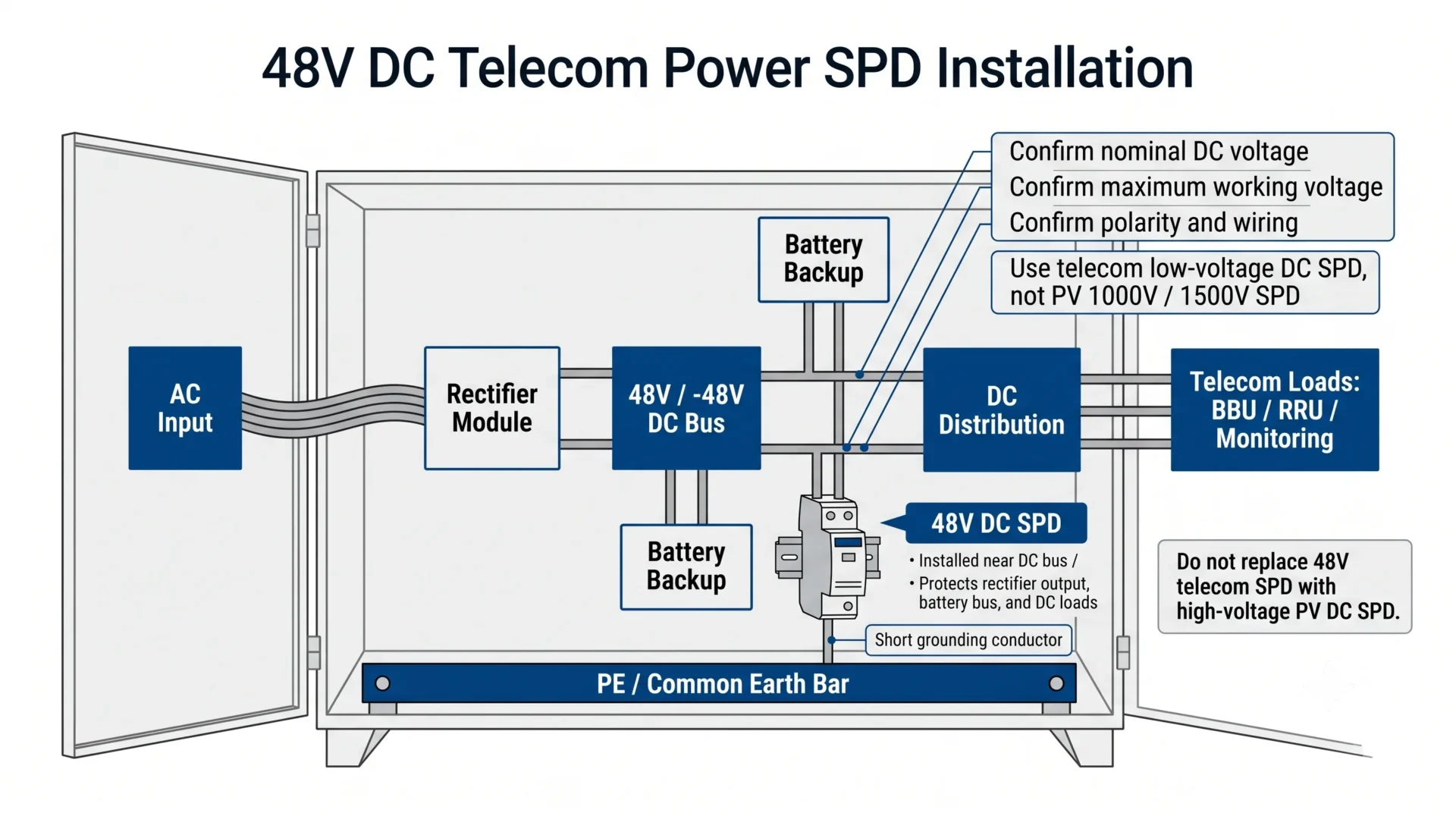
Como pensar na seleção da tensão do SPD de -48V CC
Para um sistema de energia de telecomunicações de -48V, o nome nominal do sistema é apenas o ponto de partida. A tensão real do barramento de CC, as condições de carga, a configuração da bateria e a tensão contínua máxima devem ser todas verificadas antes de confirmar a classificação do SPD.
| Ponto de CC de telecomunicações | O que verificar | Significado da seleção de SPD | Por que isso importa |
|---|---|---|---|
| Sistema nominal de -48V | Tensão de funcionamento real, tensão de flutuação e tensão contínua máxima | Selecione pela tensão real do sistema, não apenas pela designação "48V" | Um SPD de CC com uma tensão contínua nominal demasiado baixa pode envelhecer mais rapidamente ou falhar precocemente |
| Saída do retificador | Intervalo de tensão de saída e definição de controlo | Confirme se a Uc do SPD é adequada para funcionamento contínuo | A saída do retificador é um ponto de proteção comum para energia de CC de telecomunicações |
| Barramento de bateria | Modo de carregamento, disposição da bateria de reserva e distância da cablagem | Escolha um SPD de CC adequado para o ambiente do barramento da bateria | Os sistemas de bateria podem estar expostos a transientes através da cablagem do bastidor |
| Saída de distribuição de CC | Comprimento do cabo do lado da carga e encaminhamento de cabos exteriores | Adicione um SPD de CC onde as linhas externas longas de CC aumentam a exposição | Os alimentadores de CC longos podem captar energia de sobretensão induzida |
O que confirmar para um SPD de 48V CC
- Tensão nominal do sistema de CC: 48V, -48V ou outra tensão de CC de telecomunicações
- Tensão contínua máxima de CC durante a carga de flutuação ou funcionamento do sistema
- Polaridade e estrutura de cablagem
- Posição de instalação: saída do retificador, barramento da bateria, distribuição de CC ou saída do alimentador
- Capacidade de descarga necessária
- Espaço em calha DIN e tamanho do terminal
- Indicador visual e requisito de alarme remoto
- Se é necessário um módulo conectável para manutenção
Para a direção do produto do lado da CC, consulte Dispositivo de proteção contra sobretensões DC. Se o requisito for especificamente para 48V CC de telecomunicações, envie a tensão do sistema e a disposição do bastidor antes de confirmar o modelo final.
3. Proteção de Linhas de Sinal e Dados
Os bastidores de telecomunicações incluem frequentemente mais do que cabos de alimentação. Linhas de monitorização, controlo, alarme, comunicação e sensores também podem transportar energia de sobretensão para componentes eletrónicos sensíveis.
Os SPD de sinal devem ser selecionados de forma diferente dos SPD de potência. Um SPD de sinal deve ser compatível com a tensão de funcionamento, par de linhas, tipo de sinal, taxa de transmissão e método de ligação à terra. Um SPD de sinal incorreto pode oferecer uma proteção deficiente ou interferir na comunicação.
| Tipo de linha | Risco típico | Ponto de seleção de SPD | Erro comum do comprador |
|---|---|---|---|
| Linha de monitorização RS485 | Sobretensão induzida em cabo de controlo longo | Corresponder a tensão, linha A/B, blindagem e ligação à terra | Utilizar um SPD de potência em vez de um SPD de sinal |
| Linha de alarme de contacto seco | Transiente a entrar na entrada de alarme ou no módulo de monitorização | Confirmar tensão de sinal e lógica de contacto | Ignorar circuitos de alarme de baixa tensão |
| Linha de sensor de 24V | Sobretensão de sensores exteriores ou acessórios de armário | Corresponder a tensão de funcionamento e pares de cablagem | Apenas a proteger a entrada CA |
| Ethernet / PoE | Sobretensão através de cabo de rede de cobre | Confirmar taxa de dados e requisitos de energia PoE | Instalar um protetor que afeta o desempenho da rede |
| Alimentador coaxial de RF | Corrente de relâmpago ou sobretensão induzida através do alimentador da antena | Corresponder o tipo de conetor, gama de frequências e perda de inserção | Escolher apenas pela aparência do conetor |
Para aplicações RS485, ver Guia de fiação e seleção de SPD RS485. Para referência do produto SPD de sinal, ver Dispositivo de Proteção contra Sobretensões CC de Sinal de Dados LY10.
4. Aterramento e Conexão: A Parte que Muitos Compradores Subestimam
Um SPD não faz com que a energia da sobretensão desapareça. Este desvia a corrente de sobretensão para a terra ou para um caminho de referência equipotencial. Se o condutor de ligação à terra for demasiado longo, demasiado fino, mal encaminhado ou ligado a uma barra de terra fraca, o resultado da proteção pode ser muito mais fraco.
Para locais de telecomunicações, a ligação à terra é especialmente importante porque podem existir múltiplos sistemas condutores: estrutura da torre, barra de terra do armário, terra da rede elétrica, referência negativa de CC, blindagem do cabo de sinal e ligação à terra do alimentador da antena.
Boas práticas de ligação à terra para a instalação de SPD em telecomunicações
- Utilize uma barra de terra comum sempre que possível.
- Mantenha os condutores de terra do SPD curtos e direitos.
- Evite grandes laços de cablagem entre o SPD, o equipamento protegido e a barra de terra.
- Ligue o armário, o sistema de alimentação, a proteção de sinal e a blindagem do cabo de acordo com o projeto de ligação à terra.
- Não assuma que a instalação de mais SPDs pode resolver um problema de má ligação à terra.
5. Contato de Alarme Remoto para Sites de Telecomunicações Não Tripulados
Muitos locais de telecomunicações não têm vigilância. Um módulo SPD avariado pode não ser notado até à próxima visita de manutenção, a menos que o SPD tenha um contacto de alarme remoto.
Um contacto de alarme remoto é geralmente uma saída de contacto seco, como NO ou NC. Pode ser ligado a um sistema de monitorização, PLC, RTU, NMS ou entrada de alarme do armário. Quando o cartucho do SPD falha ou se desliga, o sistema de monitorização pode receber uma alteração de estado.
Esta função não aumenta a capacidade de proteção contra sobretensões. O seu valor reside na visibilidade da manutenção.
O que confirmar antes de encomendar SPDs com alarme remoto
- O local necessita de monitorização remota?
- A lógica do alarme deve ser normalmente aberta ou normalmente fechada?
- Que entrada de monitorização irá receber o contacto seco?
- O terminal de sinal remoto é necessário no SPD de CA, SPD de CC, SPD de sinal ou em todos eles?
- A equipa de manutenção precisa de um indicador visual além do alarme remoto?
Para a lógica de cablagem, consulte Como Conectar o Contato de Alarme Remoto SPD ao PLC ou Sistema de Monitoramento.
6. Substituição e Manutenção de Módulo Conectável
Os armários de telecomunicações necessitam frequentemente de manutenção rápida. Um módulo SPD de encaixe permite que o cartucho avariado seja substituído sem alterar a base completa, desde que o módulo de substituição corresponda à especificação original.
Para importadores, integradores de armários e empresas de manutenção, isto é importante porque um projeto de telecomunicações pode utilizar muitos armários semelhantes em diferentes locais. Uma lista clara de módulos sobressalentes pode reduzir os erros de manutenção.
Quando deve ser substituído um módulo SPD de telecomunicações?
- O indicador visual mostra a falha, mudando frequentemente de verde para vermelho.
- O alarme remoto comunica a falha do SPD.
- O módulo sofreu um evento de sobretensão severo e as regras de manutenção do projeto exigem a substituição.
- O SPD apresenta danos visíveis, deformação, marcas de queimadura ou odor anormal.
- O módulo já não corresponde à especificação exigida após a modificação do armário.
Para orientações de substituição, consulte Guia de substituição de cartucho SPD.
Seleção de SPD para Telecomunicações por Cenário do Site
Diferentes locais de telecomunicações têm diferentes níveis de risco. Um armário no telhado numa área urbana, uma torre remota em terreno aberto e um abrigo exterior com longas linhas de cabos não devem ser tratados da mesma forma.
| Cenário do local | Risco principal de sobretensão | Foco de proteção recomendado | Significado comercial |
|---|---|---|---|
| Armário de telecomunicações para exterior | Entrada CA, alimentador CC, cabo de sinal, diferença de ligação à terra | SPD CA + SPD 48V CC + SPD de sinal + alarme remoto | Ideal para integradores de armários e fornecimento OEM |
| Local de torre remota | Elevada exposição a raios e longos percursos de cabos | Proteção de entrada CA de maior risco, proteção de alimentador CC, ligação equipotencial forte | Necessita de seleção ao nível do projeto, não apenas correspondência de catálogo |
| Estação base em cobertura | Ligação à terra do edifício, alimentação CA, alimentador de antena, linha de monitorização | Coordenar com a proteção contra descargas atmosféricas do edifício e os SPD do armário | Útil para empreiteiros e equipas de manutenção |
| Sala de telecomunicações interior | Distribuição de energia e proteção contra sobretensões de linhas de rede/dados | SPD de distribuição CA + SPD de barramento 48V CC + proteção de linha de dados se houver linhas de cobre | Frequentemente selecionado pelo fornecedor de equipamento ou integrador de sistemas |
| Armário de bateria de reserva | Transitórios no barramento CC e sobretensões na cablagem do armário | SPD CC de baixa tensão compatível com a tensão real do barramento | Importante para fornecedores de sistemas de alimentação de 48V |
Para Integradores de Gabinetes de Telecomunicações e Compradores OEM
Para integradores de armários de telecomunicações, o principal desafio não é apenas escolher um SPD correto. A questão mais importante é combinar o SPD CA, o SPD -48V CC, o SPD de sinal, a lógica de alarme remoto, os módulos sobresselentes, as fichas técnicas e as etiquetas como um pacote de proteção de armário consistente.
Se diferentes tipos de SPD forem adquiridos separadamente sem coordenação técnica, o projeto poderá enfrentar incompatibilidade de modelos, lógica de alarme inconsistente, cartuchos de substituição incorretos, fichas técnicas incompletas ou listas de peças sobresselentes pouco claras.
As versões de SPD de entrada CA, SPD -48V CC, SPD de sinal e alarme remoto podem ser analisadas em conjunto para um único design de armário.
Etiquetas de modelos, referências de cablagem, fichas técnicas e âmbito da certificação podem ser preparados para distribuidores ou projetos de marca própria.
Os cartuchos encaixáveis e as regras de substituição podem ser listados claramente, reduzindo erros de manutenção em vários locais de telecomunicações.
Antes de Pedir SPDs de Telecomunicações, Confirme Estes Detalhes
Para projetos de telecomunicações, a forma mais rápida de selecionar o SPD correto é enviar os pontos de proteção e os parâmetros do sistema em conjunto. Isto evita escolher um produto corretamente e deixar outra via desprotegida.
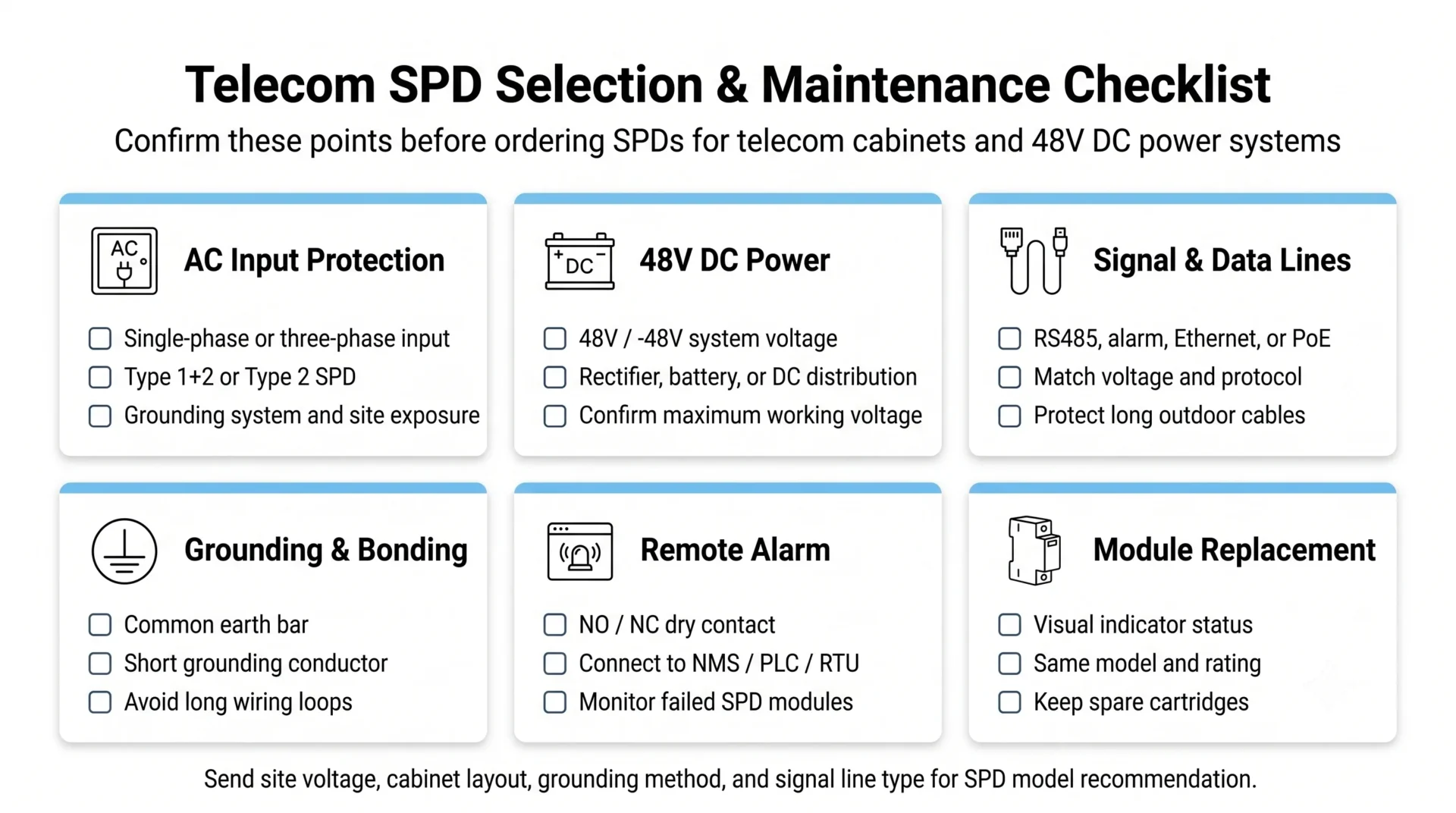
Erros Comuns na Seleção de SPD para Telecomunicações
Proteger apenas a entrada CA
A proteção da entrada CA é importante, mas não protege todos os caminhos. As linhas de 48V CC, os cabos de monitorização, os cabos Ethernet e os caminhos relacionados com o alimentador podem continuar a transportar energia de sobretensão para o interior do armário.
Utilização de SPD CC fotovoltaico para sistemas de telecomunicações de 48V CC
Um SPD CC fotovoltaico de alta tensão não é automaticamente adequado para um sistema de energia de telecomunicações de 48V. O intervalo de tensão, o comportamento do sistema, o espaço no armário e os requisitos do projeto podem ser diferentes.
Escolher um SPD CC apenas pela palavra “48V”
O nome do sistema nominal de 48V não é suficiente. O comprador deve confirmar a tensão máxima de operação contínua do barramento CC e selecionar uma classificação de SPD adequada para as condições reais de operação.
Ignorar o alarme remoto
Para armários de telecomunicações não assistidos, um SPD com falha sem alarme remoto pode passar despercebido. Isto aumenta o risco de manutenção após o próximo evento de sobretensão.
Escolher o SPD de sinal apenas pela tensão
A seleção do SPD de sinal deve considerar também o tipo de sinal, pares de linhas, capacitância, taxa de transmissão, ligação de blindagem, tipo de terminal e método de ligação à terra.
Utilizar fios de ligação à terra longos
Um condutor de ligação à terra longo ou mal encaminhado pode reduzir a eficácia do SPD. O caminho de descarga deve ser curto, direto e ligado à referência de terra correta.
Páginas Relacionadas da LEEYEE
FAQ: SPD de Estação Base de Telecomunicações e Proteção contra Surto de -48V DC
Qual é o SPD correto para uma estação base de telecomunicações?
Uma estação base de telecomunicações geralmente precisa de SPDs coordenados para entrada AC, alimentação DC de 48V / -48V, linhas de sinal/dados e, às vezes, caminhos de alimentação RF/coaxial. A seleção final depende da voltagem, exposição do local, aterramento, roteamento de cabos e requisitos de monitoramento.
Qual SPD deve ser utilizado para um sistema de energia telecom de -48V?
Um sistema de energia de telecomunicações de -48V deve utilizar um SPD CC de baixa tensão compatível com a tensão máxima de funcionamento contínuo do barramento CC, polaridade, posição de instalação e capacidade de descarga reais. Não deve ser selecionado apenas pelo nome do sistema nominal “48V”.
O SPD de CA é suficiente para uma estação base de telecomunicações?
O No. AC SPD protege a entrada de energia e o lado da entrada do retificador, mas não protege automaticamente o barramento de -48V CC, a distribuição CC, os alimentadores externos de CC, as linhas de sinal, as linhas de Ethernet ou os circuitos de alarme.
Onde deve ser instalado um SPD de 48V DC em um armário de telecomunicações?
Os pontos comuns de instalação incluem a saída DC do retificador, o barramento da bateria, a saída de distribuição DC e a saída de alimentação DC longa. A posição exata depende do layout do armário, do roteamento dos cabos e do nível de risco do projeto.
Posso usar um SPD DC de PV para um sistema de telecomunicações de 48V?
Não de forma cega. Os SPD DC PV e os SPD DC de telecomunicações de 48V podem ter diferentes classificações de tensão, escopos de aplicação, normas e requisitos de armário. O SPD deve ser confirmado para o circuito de potência DC de telecomunicações real.
Por que são necessários SPD de linha de sinal em armários de telecomunicações?
Monitoramento, RS485, alarme, sensor, linhas Ethernet e PoE podem transportar sobretensões transitórias para eletrônicos sensíveis. Se apenas a linha de energia estiver protegida, esses caminhos de sinal ainda podem causar falhas.
Os SPDs de telecom precisam de contatos de alarme remoto?
Para gabinetes de telecomunicações não tripulados, contatos de alarme remoto são extremamente úteis. Um contato seco NO/NC pode enviar o status de falha SPD para um PLC, RTU, NMS ou entrada de monitoramento do gabinete.
O módulo SPD pode ser substituído sem a necessidade de substituir todo o dispositivo?
Se o SPD usar um design plugável, o cartucho geralmente pode ser substituído mantendo a base. O módulo de substituição deve corresponder à série original, classificação de voltagem, estrutura de polos, classificação de descarga e versão do sinal remoto.
Que informações são necessárias para um BOM de SPD de telecomunicações?
Envie a tensão de entrada AC, a tensão do sistema DC, o design de aterramento, o layout do gabinete, os pontos de entrada de cabos, os tipos de linhas de sinal, a exigência de alarme remoto, a exigência de certificação, a exigência de módulo reserva e se é necessário o fornecimento com etiqueta OEM ou etiqueta privada.
Precisa de Seleção de SPD para Seu Gabinete ou Sistema de -48V DC?
A LEEYEE apoia a seleção de proteção contra sobretensões para entrada CA, energia CC, linhas de sinal, alarme remoto e integração de armários OEM. Envie a tensão do seu sistema, a estrutura de cablagem e os requisitos do armário para recomendação de modelos.