
Automatic transfer switch sizing starts with the current that will actually pass through the ATS, but it does not end there. A reliable selection must also consider maximum demand, continuous loading, motors and other inductive loads, generator capability, rated operational current, utilization category, protective-device coordination, available fault current, temperature, terminals and switchboard integration.
Need the basic operating principle, pole selection or difference between an ATS and a UPS first? Read Apa Itu Sakelar Transfer Otomatis? Cara Kerja ATS & Cara Memilihnya. This page stays focused specifically on ATS current sizing.
Daftar Isi
What Size ATS Do I Need?
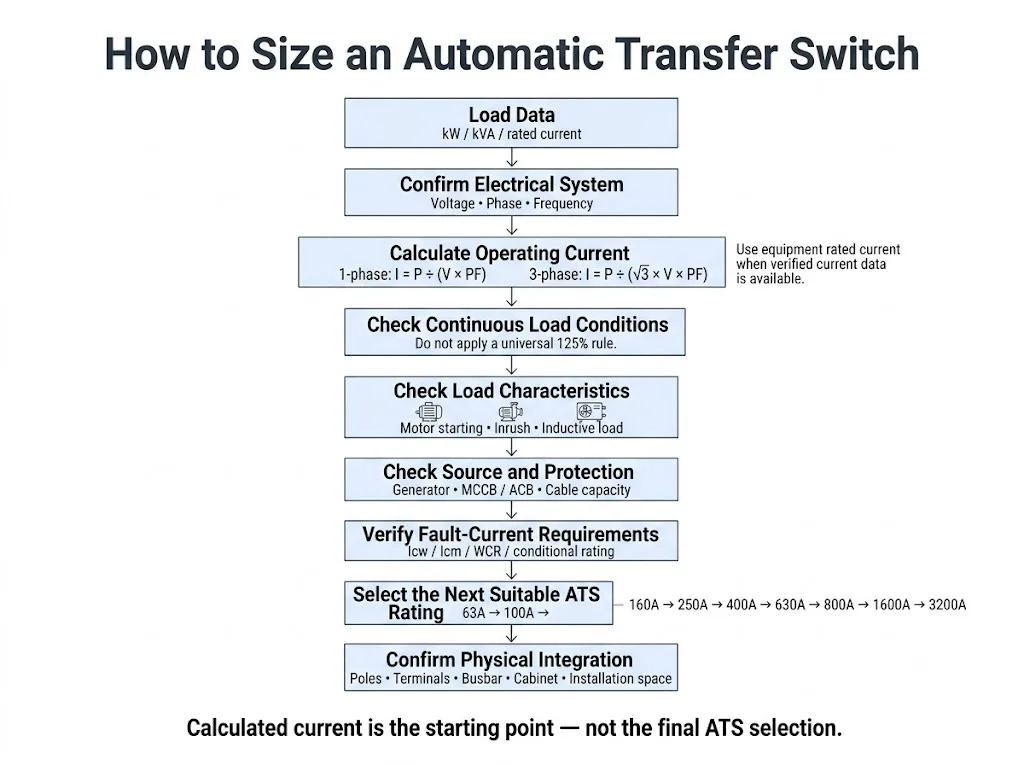
Choose an automatic transfer switch whose applicable rated operational current is not lower than the verified design current that the ATS must carry. If the load is given in kW or kVA, first convert it to line current using the correct voltage, phase and power factor.
Then verify maximum demand, continuous-load conditions, motor or HVAC duty, generator capability, breaker coordination, available fault current, utilization category, ambient conditions and the terminals of the proposed model. Finally, select an available ATS rating that satisfies all of those conditions.
A calculated load of about 144A may make a 160A ATS a reasonable preliminary candidate. A calculated load of about 321A may point toward 400A. Neither calculation alone proves that a particular model is suitable.
1. Connected Load, Maximum Demand and Source Capacity Are Not the Same
These three values are often mixed together during ATS selection. They answer different engineering questions.
Beban Terkoneksi
The total rating of equipment electrically connected downstream. It does not automatically mean that every load operates at full power at the same time.
Maximum Demand
The highest design load expected to operate simultaneously, based on the approved load schedule, demand factors or project study.
Source Capacity
The capability of the utility, generator or other source. It determines what the source can supply, not automatically what one ATS must carry.
For ATS current sizing, begin with the approved load or demand that can actually pass through the specific transfer switch. A generator can serve several ATS units, so the generator's complete kVA rating does not automatically become the ampere rating of every downstream ATS.
2. Convert kW or kVA to Current Correctly
If approved full-load current is already available from the equipment nameplate, load schedule or project design, use that current instead of converting power back to amperes with unnecessary assumptions.
If only power is available, distinguish kVA from kW. kVA represents apparent power. kW represents real power and therefore requires power factor when converted to AC line current.
Single-Phase Load
From kVA: I = kVA × 1000 ÷ V From electrical-input kW: I = kW × 1000 ÷ (V × PF)If a motor value is mechanical shaft-output kW rather than electrical input kW, motor efficiency must also be considered.
Three-Phase Load
From kVA: I = kVA × 1000 ÷ (√3 × V) From electrical-input kW: I = kW × 1000 ÷ (√3 × V × PF)Use the line-to-line voltage for a balanced three-phase calculation.
PF means power factor. A 200 kW three-phase load at PF 0.90 draws more current than the same 200 kW at PF 1.00. This is why a generic “power ÷ voltage” calculation is not a complete three-phase ATS sizing method.
3. Three Worked ATS Sizing Examples
Example A — 10 kW, 230 V, Single Phase
Assume the 10 kW value is electrical input power and PF = 0.95.
I = 10,000 ÷ (230 × 0.95) ≈ 45.8 AA 63A ATS may be a practical preliminary rating if the applicable continuous-current and duty requirements are also satisfied.
Example B — 100 kVA, 400 V, Three Phase
I = 100,000 ÷ (√3 × 400) ≈ 144 AIf the full 100 kVA is genuinely expected to pass through this ATS, 160A may be the next practical preliminary rating. Do not turn this into a universal rule that “100 kVA generator = 160A ATS.”
Example C — 200 kW, 400 V, Three Phase, PF 0.90
I = 200,000 ÷ (√3 × 400 × 0.90) ≈ 321 AA 400A ATS may appear to be the next suitable frame or rating. Before approving it, verify the proposed device's actual rated operational current, utilization category, continuous-loading conditions, upstream protection and fault-current capability.
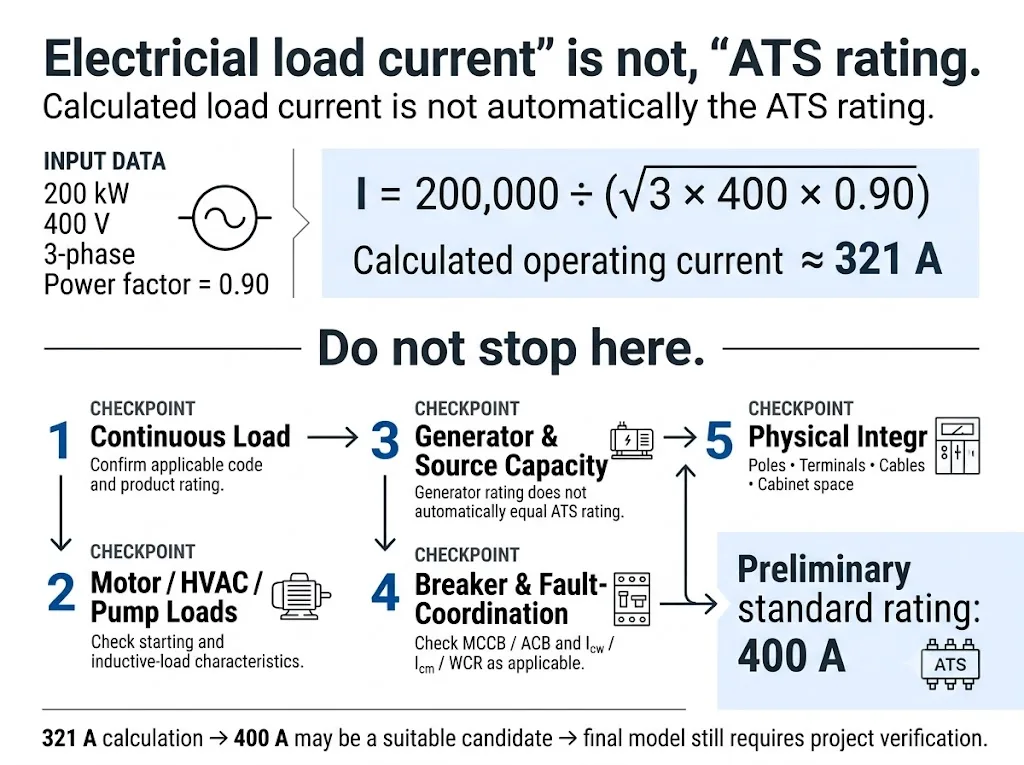
4. Calculated Current Is Not the Final ATS Rating
The next catalogue number is only a candidate. A model should not be approved until the electrical and mechanical conditions associated with its published rating have been checked.
- Identify the transferred loads. Confirm which feeders and equipment are downstream of this specific ATS.
- Confirm voltage, phase and frequency. Use actual project data rather than an assumed system voltage.
- Determine design current. Use approved current data or calculate from kVA or kW with the correct assumptions.
- Apply the correct demand and continuous-load rules. Follow the applicable code, design specification and manufacturer rating.
- Check motors, pumps, compressors and HVAC loads. Verify the switching duty rather than converting starting current directly into ATS ampere rating.
- Verify rated operational current and utilization category. Confirm that the proposed ATS rating applies at the project voltage and for the actual load type.
- Check both sources and upstream protective devices. Review generator capability, normal supply and MCCB, ACB or fuse coordination.
- Verify available fault current. Confirm that the ATS short-circuit or withstand-and-closing capability is adequate at its installation point.
- Confirm temperature, terminals and physical integration. Check conductor range, enclosure, ventilation, busbars or parallel cables, pole configuration and maintenance space.
5. Rated Operational Current Ie: The Missing Link Between Calculation and Model
A catalogue family or frame description such as “400A ATS” should not be treated as proof that every version of that product can carry 400A under every operating condition.
For IEC-based equipment, verify the manufacturer's declared rated operational current, Ie, together with rated operational voltage and the applicable utilization category. Load type matters because transfer switches have to make and break different kinds of current during transfer.
Cummins' transfer-switch application manual explains that IEC utilization categories distinguish non-inductive or slightly inductive loads from motor and mixed loads. It identifies AC-31 categories for non-inductive or slightly inductive duty and AC-33 categories for motor or mixed-load duty.[3]
6. Do You Need a 20% or 25% ATS Sizing Margin?
There is no responsible global rule that says every ATS should be selected at “calculated current × 1.20” or “calculated current × 1.25.”
A larger design value can result from different requirements: a continuous-load rule in the applicable electrical code, manufacturer limitations, future expansion, temperature, conductors, fault-current performance or the project specification. Those reasons should be identified separately.
Cummins states that most transfer switches are capable of carrying 100% of rated current at 40°C ambient, while transfer switches incorporating integral overcurrent protection may be limited to continuous loading not exceeding 80% of the switch rating. The manufacturer's own specification determines which condition applies.[3]
7. Can an ATS Run Continuously at Its Full Ampere Rating?
Sometimes yes, but this must be confirmed from the specific product data rather than assumed from the model name.
Continuous-current capability can depend on the switch design, integral protective device, ambient condition and installation instructions. Cummins specifically instructs designers to use the manufacturer's rating information when determining whether an ATS is 80% or 100% rated for continuous load.[3]
8. Motors, Pumps, Compressors and HVAC Loads
Motor starting current can be many times higher than normal running current. This affects generator behaviour, protection and transfer-switch duty, but it should not simply replace normal operating current as the ATS continuous-current rating.
IEC utilization categories and UL 1008 overload tests address switching duties that include motor and mixed loads. Cummins notes that transfer equipment must tolerate the electrical stresses associated with transferring such loads and explains that motor or mixed-load applications use different utilization duty from non-inductive loads.[3]
Generator transient performance is a separate system check. A switch can have an appropriate current rating while the generator still experiences unacceptable voltage or frequency dip when a large motor starts.
9. Published Engineering Example: 545A Load to a 600A ATS
A published U.S. Tri-Service Electrical Working Group calculation provides a useful example of the sizing logic. For a 208Y/120V three-phase circuit containing resistive heating, incandescent lighting and four motors, the document calculates a total continuous load of 545A and selects a 600A ATS, the next standard size in that example.[5]
Importantly, the same example separately instructs the designer to verify with the manufacturer that the ATS is acceptable for the expected motor inrush current.[5]
10. Should ATS Rating Match Generator Rating?
Belum tentu. Generator rating and ATS current rating describe related but different parts of the power system.
The generator indicates how much electrical power the standby source can provide. The ATS must safely carry and transfer the loads connected through that specific switch.
If one 500 kVA generator supplies several emergency feeders, each feeder can have a different transferred load and therefore a different ATS requirement. If one ATS carries the complete emergency bus, the relationship between generator current and ATS current can be much closer.
11. Should the MCCB, ACB and ATS Have the Same Ampere Rating?
Not as a universal rule. They must form a compatible protection and distribution system, but their nameplate ampere values do not always have to be identical.
Review the load current, conductor ampacity, ATS rated operational current, protective-device type and settings, and the available short-circuit current at the ATS location.
Cummins states that the transfer switch must supply the required load current and also withstand the available fault current at its point of interconnection.[3] Eaton likewise explains that Withstand and Closing Rating, or WCR, must be considered when applying UL 1008 transfer equipment in a distribution system.[4]
12. Available Fault Current Can Change the ATS Selection
An ATS can have enough continuous ampere capacity and still be unsuitable for the installation because the available fault current is too high.
Cummins notes that available fault current should be determined from each source at the transfer-switch location and that the ATS must be applied within its tested short-circuit or withstand-and-closing rating.[3]
Its application manual also explains that a larger switch can sometimes be required when the fault-current capability of a smaller switch is insufficient, even though the normal load current has not increased.[3]
For UL projects, review the applicable WCR and any conditions associated with the upstream breaker or fuse. For IEC projects, review the specific manufacturer's declared short-circuit characteristics and the project protection arrangement.
13. Does Ambient Temperature or Enclosure Design Change ATS Sizing?
It can. Product current ratings are published for defined conditions, so ambient temperature and installation arrangement should be checked before a high-current model is approved.
Do not invent a universal temperature-derating percentage. Use the manufacturer's current datasheet or derating information for the selected product.
Check the Installation Environment
- Expected ambient temperature inside the switchboard;
- Indoor, outdoor or sealed enclosure;
- Ventilation and heat dissipation;
- Altitude if the manufacturer specifies an altitude limit or derating;
- Dust, humidity or corrosive environmental requirements;
- Required enclosure or IP / NEMA construction.
Check the Terminals Before Increasing Cable Size
Oversized feeders can create a mechanical problem even when the current calculation is acceptable. Cummins notes that field-wiring lugs have a limited conductor-size range and that a larger switch may sometimes be required simply because the selected switch cannot accept an oversized conductor.[3]
At larger currents, also verify the number of parallel cables, lug quantity, cable bending space, busbar interface and the ability to terminate conductors without creating an impractical cabinet layout.
14. 63A to 3200A ATS Sizing Reference
The following current ratings are useful procurement reference points. They are not fixed power conversions and they are not universal manufacturer frame sizes.
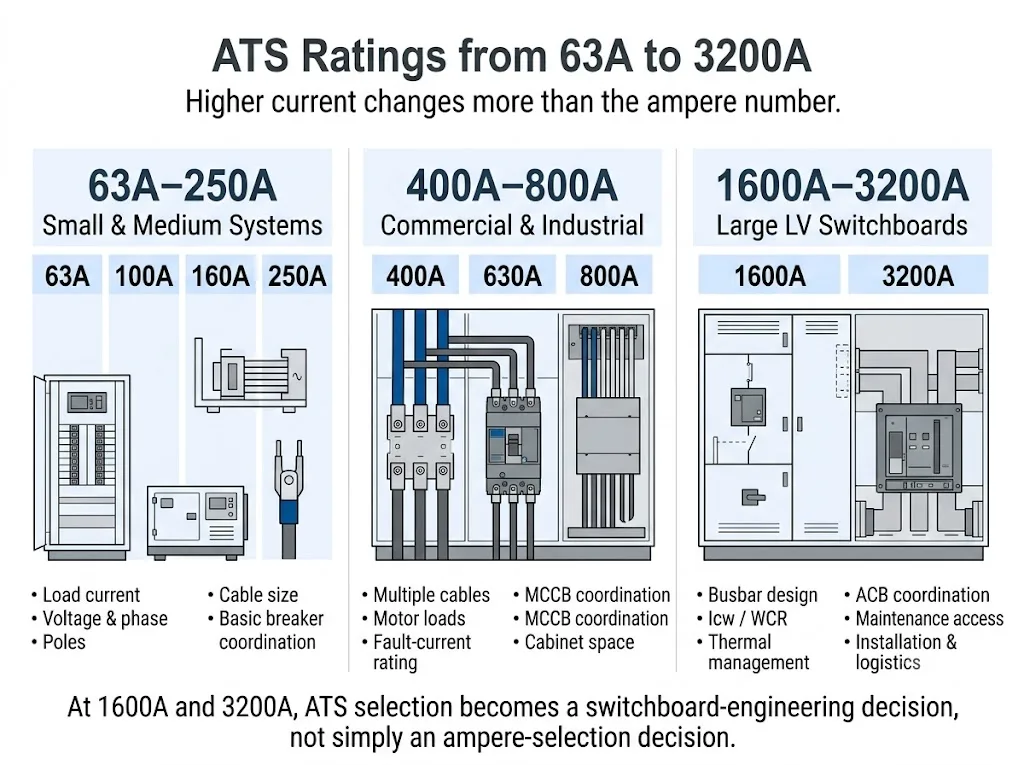
63A, 100A, 160A and 250A ATS Projects
| ATS Rating | Typical Project Context | Apa yang Harus Diverifikasi |
|---|---|---|
| 63A | Small distribution, control or selected-load system | Actual demand, voltage, poles, utilization duty and cable terminals |
| 100A | Small commercial or generator-backed feeder | Continuous demand, source current, breaker arrangement and enclosure |
| 160A | Commercial feeder or medium generator panel | Motor loads, Ie, utilization category, MCCB coordination and terminals |
| 250A | Medium distribution or industrial feeder | Conductors, available fault current, cabinet space and thermal conditions |
Kesimpulan pengadaan: in the lower and medium-current range, the calculation often identifies a likely rating quickly, but utilization duty, protection and connection details still determine whether the model is actually acceptable.
400A, 630A and 800A ATS Projects
| ATS Rating | Typical Project Context | What Becomes More Important |
|---|---|---|
| 400A | Commercial or industrial distribution | Motor duty, Ie, fault-current rating, protective coordination and cable space |
| 630A | Main feeder, generator system or industrial panel | Large terminals, conductor routing, thermal performance and enclosure layout |
| 800A | Large LV distribution or generator-backed main feeder | Parallel conductors or busbar interface, WCR / short-circuit rating, access and maintenance space |
Kesimpulan pengadaan: at 400A–800A, two quotations with the same ampere number can represent substantially different electrical and mechanical solutions.
1600A and 3200A ATS Projects
| ATS Rating | Typical Project Context | Engineering Impact |
|---|---|---|
| 1600A | Main low-voltage distribution or large standby system | Busbars or parallel cables, ACB/MCCB coordination, thermal performance, fault-current capability and service access |
| 3200A | Large industrial, infrastructure or main LV switchboard application | Full busbar design, protection study, enclosure integration, ventilation, lifting, transport and installation planning |
15. Why Two 400A ATS Units May Not Be Equivalent
“400A ATS” describes only part of the specification. Two switches with the same headline ampere rating can differ in electrical duty, short-circuit performance and construction.
Electrical Ratings
- Rated operational current Ie
- Rated operational voltage Ue
- Kategori pemanfaatan
- Continuous-current condition
- Short-circuit / WCR characteristics
- Frekuensi
- Jumlah kutub
Construction & Application
- PC, CB or other architecture
- Pengaturan 3P atau 4P
- Transition method
- Terminal or busbar arrangement
- Controller functions
- Enclosure and mounting design
- Akses pemeliharaan
IEC 60947-6-1:2026 is the current fourth edition of the international transfer-switching-equipment standard. It applies to transfer switching equipment including automatic transfer switching equipment and includes provisions covering areas such as bypass/isolation equipment, closed-transition ATSE and stand-alone ATS controllers.[1]
For projects requiring UL certification, UL Solutions identifies UL 1008 as the applicable standard for automatic transfer switches used in emergency and optional standby systems, as well as applicable nonautomatic transfer switches.[2]
16. What Happens If the ATS Is Too Small?
An undersized ATS can create excessive thermal stress, conductor or terminal problems, non-compliance with the required continuous-current condition or unsuitable switching performance for the load.
A switch can also be unacceptable even when its operating-current rating appears adequate if its short-circuit capability is insufficient for the installation. Cummins specifically notes that a larger transfer switch may sometimes be required when available fault current exceeds the capability of the smaller unit.[3]
17. Is an Oversized ATS Always Better?
No. A larger ATS can be justified by future expansion, continuous-load requirements, conductor size, fault-current performance or another documented design condition. But unnecessary oversizing can increase equipment cost and can affect enclosure dimensions, terminals, busbars, installation space, shipping and lead time.
Physical size does not always increase one-to-one with amperes. Manufacturers may use one frame for several current ratings, then move to a completely different mechanism or cabinet at a higher threshold.
18. How ATS Current Rating Affects Price and Lead Time
Current rating is one quotation driver, but it is not the only one. Poles, controller, switching mechanism, utilization category, transition type, short-circuit rating, enclosure, terminals, accessories and certification can all affect cost.
At higher currents, conductor or busbar arrangements, cabinet manufacturing, protection studies, transportation and site installation can become significant parts of the project.
For this reason, a generic “400A ATS price” or “3200A ATS price” cannot reliably compare two suppliers unless the configurations and required ratings are equivalent.
19. Final ATS Sizing Decision Table
| Keputusan | Apa yang Perlu Dikonfirmasi | Mengapa Ini Penting |
|---|---|---|
| Transferred load | Which loads pass through this ATS? | Prevents sizing from unrelated site or source capacity |
| Maximum demand | What load can operate simultaneously? | Avoids confusing connected load with real design demand |
| Sistem listrik | Voltage, phase and frequency | Defines the current calculation and product suitability |
| Operating current | Verified amps, kVA or kW + PF | Establishes the basic current requirement |
| Continuous loading | Applicable code and product declaration | Prevents misuse of universal 80%, 100% or 125% rules |
| Beban kerja | Motor, pump, HVAC, transformer or mixed load | Changes switching-duty requirements |
| Ie / utilization | Actual model rating at project voltage and duty | Connects the calculated current to a valid ATS model |
| Perlindungan | MCCB, ACB, fuse and settings | Required for coordinated protection |
| Arus gangguan | Available current at ATS location | Ensures WCR or other short-circuit ratings are adequate |
| Lingkungan | Ambient, enclosure, altitude and ventilation | Confirms rating conditions |
| Physical design | Poles, cables, busbars, terminals and access | Ensures the switch can actually be integrated |
| Final approval | Datasheet, standard, certificate and drawing | Turns a preliminary rating into an approved product |
20. Information to Send Before Requesting an ATS Recommendation
ATS Sizing / RFQ Checklist
Providing these details allows the supplier or project engineer to move beyond a simple ampere estimate.
- Total connected load
- Expected simultaneous or maximum demand
- Tegangan sistem
- Satu fase atau tiga fase
- Frekuensi
- Load power factor, if known
- Motor, pump, compressor or HVAC loads
- Nilai daya motor maksimum dan metode pengaktifan
- Generator kW / kVA
- Arus pengenal generator, jika tersedia
- Jenis dan nilai nominal pemutus arus sumber normal
- Jenis dan nilai nominal pemutus arus di sisi generator
- Arus gangguan yang tersedia, jika diketahui
- Diperlukan konfigurasi 2P / 3P / 4P
- Metode transisi yang diperlukan
- Kategori pemanfaatan yang wajib
- Standar atau sertifikasi yang diwajibkan
- Lingkungan sekitar dan lingkungan instalasi
- Ukuran kabel atau susunan busbar
- Jumlah yang dibutuhkan
- Persyaratan label OEM atau label merek sendiri
Butuh Bantuan untuk Memastikan Konfigurasi ATS yang Ringkas?
Rangkaian produk ATS-63 yang dipublikasikan oleh LEEYEE mencakup nilai arus 6A, 10A, 16A, 20A, 25A, 32A, 40A, 50A, dan 63A dalam konfigurasi 2P/4P. Kirimkan informasi tegangan, arus, fase, sumber cadangan, dan pengkabelan untuk konfirmasi model.
Untuk proyek ATS yang dirancang secara khusus yang melebihi rentang LEEYEE yang saat ini dipublikasikan, gunakan metode penentuan ukuran yang tercantum dalam panduan ini untuk menyusun spesifikasi proyek serta memverifikasi nilai-nilai teknis, dimensi, dan sertifikasi dari produsen yang diusulkan sebelum persetujuan.
21. Frequently Asked ATS Sizing Questions
Ukuran ATS apa yang saya butuhkan untuk generator berkapasitas 100 kVA?
Pada tegangan tiga fasa 400 V, 100 kVA setara dengan sekitar 144 A. Oleh karena itu, ATS 160 A dapat menjadi pilihan awal yang masuk akal jika daya penuh 100 kVA dapat mengalir melalui sakelar tersebut. Pemilihan akhir masih memerlukan pemeriksaan terhadap beban maksimum, arus kontinu, kategori pemanfaatan, perlindungan, dan arus gangguan.
Apakah saya bisa memilih ATS hanya berdasarkan nilai kVA generator saja?
Tidak. Nilai kVA pada generator menunjukkan kapasitas sumber daya. ATS harus dipilih berdasarkan arus dan beban listrik yang benar-benar mengalir melalui sakelar transfer tersebut.
Apa perbedaan antara beban terhubung dan beban puncak?
Beban terhubung adalah jumlah total peralatan yang terhubung pada bagian hilir. Beban maksimum adalah beban tertinggi yang diperkirakan terjadi secara bersamaan berdasarkan asumsi desain yang telah disetujui. Penentuan ukuran ATS sebaiknya didasarkan pada dasar desain proyek yang sesuai dengan instalasi tersebut, bukan dengan mengasumsikan bahwa setiap beban terhubung beroperasi pada kapasitas penuh secara bersamaan.
Apakah saya harus mengalikan arus ATS dengan 1,25?
Tidak secara otomatis. Faktor 125% dapat muncul akibat ketentuan kode tertentu atau persyaratan beban kontinu, namun faktor ini bukanlah faktor pengali penentuan ukuran ATS yang berlaku secara universal. Pastikan untuk memeriksa ketentuan kode yang berlaku, spesifikasi proyek, dan peringkat produk.
Apakah ATS 400A selalu memiliki arus operasional nominal sebesar 400A?
Jangan langsung berasumsi demikian hanya berdasarkan nama produknya saja. Pastikan untuk memeriksa arus operasional pengenal (Ie) dari pabrikan, tegangan pengenal, kategori pemakaian, serta kondisi lingkungan atau pemasangan untuk model yang bersangkutan.
Apakah saya harus menyesuaikan ukuran ATS dengan arus start motor?
Jangan hanya menggunakan arus start motor sebagai nilai nominal kontinu ATS. Mulailah dengan arus beban desain normal, kemudian verifikasi siklus kerja peralihan beban motor atau beban campuran, respons transien generator, dan koordinasi proteksi.
Apakah nilai ampere ATS harus sama dengan nilai pemutus arus utama?
Hal ini tidak berlaku sebagai aturan umum. ATS, konduktor, dan perangkat pelindung hulu harus dikoordinasikan untuk arus beban dan kondisi gangguan. Periksa arsitektur sistem yang sebenarnya serta dokumentasi pabrikan.
Apakah arus gangguan yang tersedia dapat memaksa saya untuk memilih ATS yang lebih besar?
Ya, pada beberapa kelompok produk. Jika ATS berukuran lebih kecil tidak memiliki kemampuan yang telah teruji secara memadai dalam hal ketahanan terhadap arus pendek atau ketahanan dan kemampuan menutup sirkuit, mungkin diperlukan rangka yang lebih besar atau pengaturan perlindungan yang berbeda, meskipun arus beban normalnya tidak meningkat.
Apakah suhu lingkungan yang tinggi memengaruhi penentuan ukuran ATS?
Itu bisa dilakukan. Gunakan nilai peringkat dan informasi penyesuaian beban yang dinyatakan oleh produsen yang dipilih. Jangan menerapkan satu faktor suhu universal untuk setiap ATS.
Apakah ATS 630A selalu berukuran lebih besar daripada ATS 400A?
Belum tentu. Beberapa produsen menggunakan satu rangka untuk beberapa nilai arus. Perubahan nilai arus lainnya mungkin memerlukan mekanisme atau wadah yang lebih besar. Pastikan untuk memeriksa dimensi dan terminal yang sebenarnya.
Apa saja yang berubah saat beralih dari 800A ke 1600A atau 3200A?
Proyek-proyek dengan arus tinggi biasanya memerlukan perhatian yang lebih besar terhadap busbar atau konduktor paralel, terminal, ukuran kotak penutup, desain termal, kinerja arus gangguan, koordinasi ACB/MCCB, akses pemeliharaan, dan logistik pemasangan.
Apakah 63A, 100A, 160A, 250A, 400A, 630A, 800A, 1600A, dan 3200A merupakan ukuran ATS universal?
Tidak. Angka-angka tersebut memang berguna sebagai acuan teknis dan pasar, namun tingkatan arus yang tersedia serta ukuran fisik rangka bervariasi tergantung pada produsen dan seri produk.
Apakah ATS yang lebih besar selalu lebih aman?
Tidak. ATS harus memiliki kapasitas arus dan kemampuan penanganan gangguan yang memadai, namun pemilihan ukuran yang berlebihan tanpa alasan yang jelas dapat meningkatkan biaya, ruang kabinet, dan persyaratan integrasi tanpa menyelesaikan masalah teknik yang sesungguhnya.
Referensi
- Komisi Elektroteknik Internasional. IEC 60947-6-1:2026, Peralatan sakelar dan pengatur tegangan rendah – Bagian 6-1: Peralatan multifungsi – Peralatan pengalih transfer, Edisi 4.0, diterbitkan pada 2 April 2026. Halaman publikasi resmi IEC.
- UL Solutions. Layanan Sertifikasi dan Evaluasi Switch. UL menetapkan standar UL 1008 untuk sakelar transfer otomatis yang digunakan dalam sistem darurat dan sistem siaga opsional, serta untuk sakelar transfer non-otomatis yang memenuhi syarat. Halaman resmi UL Solutions.
- Cummins Pembangkit Listrik. T-011, Panduan Penggunaan Sakelar Transfer, A048F226, Edisi 4. Bagian-bagian yang relevan meliputi arus kontinu, beban motor yang dapat dihidupkan dan dimatikan, kategori pemakaian IEC, pertimbangan terkait kabel dan terminal, serta perlindungan terhadap korsleting. Panduan Penggunaan Cummins dalam format PDF.
- Eaton. Dasar-dasar Sakelar Transfer Otomatis. Panduan teknis yang mencakup mekanisme ATS, penerapannya, serta pertimbangan terkait Nilai Ketahanan dan Nilai Penutupan. Eaton ATS fundamentals.
- Tri-Service Electrical Working Group / Whole Building Design Guide. TSEWG TP-1 Electrical Calculation Examples, ATS sizing example for a 208Y/120V three-phase circuit. The example calculates a 545A continuous load, selects a 600A ATS and separately calls for manufacturer verification of motor inrush suitability. WBDG / U.S. DoD calculation example PDF.
- LEEYEE. Sakelar Transfer Otomatis ATS-63 untuk Daya Cadangan. Current published product data includes 6A–63A rated operational current options and 2P / 4P configurations. Halaman produk LEEYEE ATS-63.
Standards, national adoptions, certification records and product data can be revised. Confirm the applicable edition, local requirements, project specification and exact manufacturer model documentation before final engineering approval, procurement or installation.
LEEYEE · Built to Protect. Trusted to Last. CNSPD is LEEYEE's surge-protection-focused technical and product platform for global buyers. ATS recommendations must be confirmed against the actual project and the specific product documentation submitted for approval.