
Non sono sicuro se ordinare un SPD 3P+N o un SPD 4P per un quadro elettrico trifase?
Questa è una domanda comune per i costruttori di quadri, i distributori elettrici, gli acquirenti OEM e gli ingegneri di progetto. I due prodotti possono sembrare simili dall'esterno. Entrambi possono avere quattro moduli. Entrambi possono essere utilizzati in sistemi trifase con neutro.
Ma internamente, potrebbero utilizzare strutture di protezione diverse. La principale differenza non è solo il numero di poli. La principale differenza è spesso il percorso di protezione tra neutro e terra, chiamato anche protezione N-PE.
Indice dei contenuti
Risposta Veloce: Qual è la differenza tra 3P+N SPD e 4P SPD?
A SPD 4P si riferisce solitamente a una struttura 4+0.. In questo design, i percorsi di protezione L1-PE, L2-PE, L3-PE e N-PE sono comunemente percorsi di limitazione della tensione, spesso basati su MOV.
A SPD 3P+N si riferisce solitamente a una struttura 3+1.. In questo design, L1-N, L2-N e L3-N utilizzano percorsi di protezione MOV, mentre il percorso N-PE utilizza spesso un componente di commutazione della tensione come un GDT o gap di scintilla..
| Elemento | SPD 3P+N | SPD 4P |
|---|---|---|
| Struttura comune | 3+1 | 4+0 |
| Protezione di fase | Percorsi MOV L1-N, L2-N, L3-N | Percorsi di limitazione della tensione L1-PE, L2-PE, L3-PE |
| protezione N-PE | Di solito GDT / gap di scintilla | Di solito basati su MOV, a seconda del design |
| Uso comune | TT, TN-S, TN-C-S dopo la suddivisione PEN | Progetti TN-S o specifici per il progetto |
| Avviso per il compratore | Confermare il tipo di modulo N-PE | Confermare il diagramma di cablaggio interno |
Regola semplice: non scegliere solo in base alle parole “3P+N” o “4P” nel nome del prodotto. Controllare sempre il sistema di messa a terra e il diagramma di cablaggio del produttore.
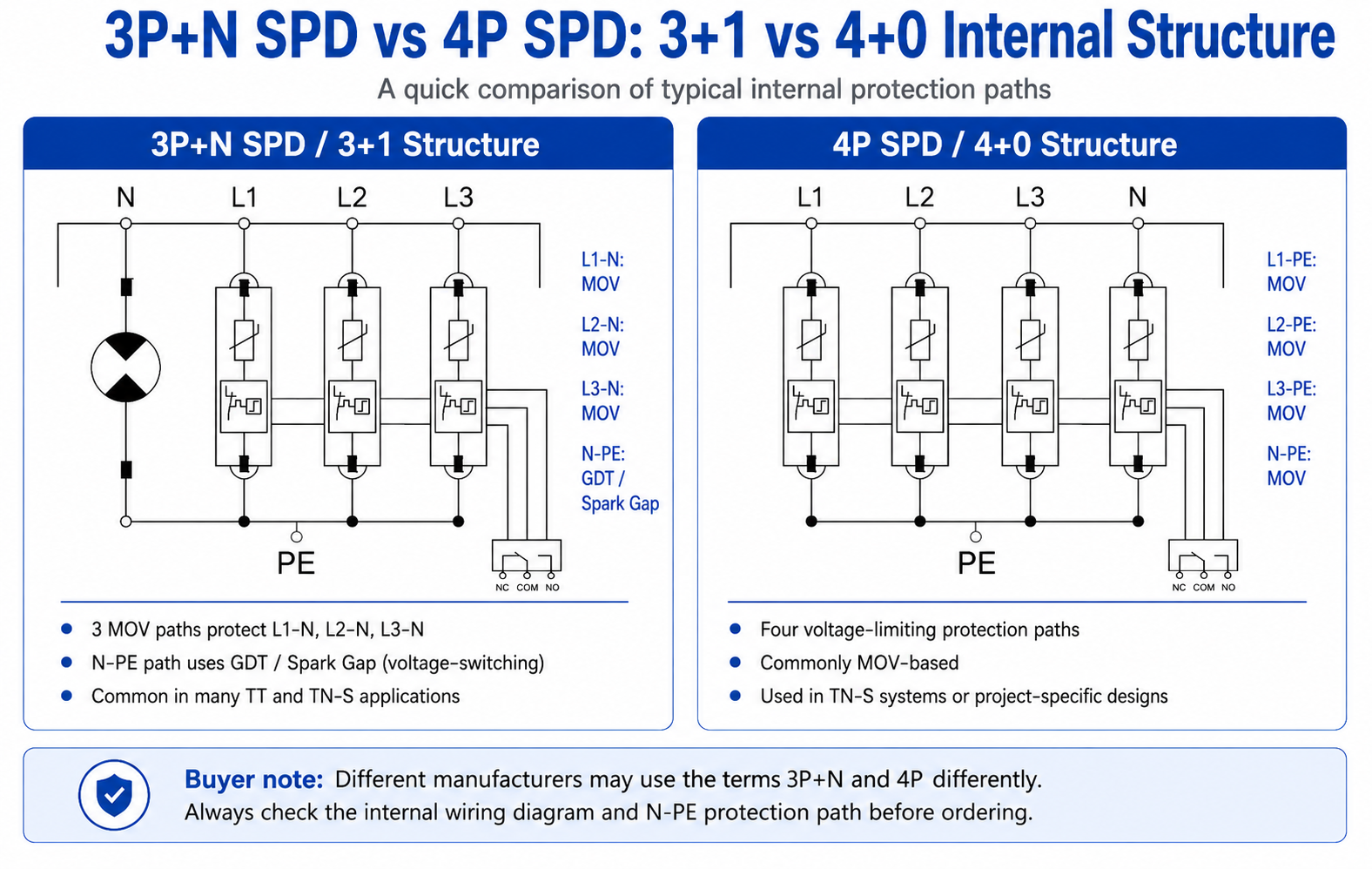
Cosa significa 3P+N SPD?
A SPD 3P+N è comunemente utilizzato per sistemi di alimentazione trifase con neutro.
È anche chiamato SPD 3PN, SPD 3+1, SPD trifase con neutro, o SPD con protezione N-PE.
In un design tipico 3+1, l'SPD protegge:
- L1 a N
- L2 a N
- L3 a N
- N a PE
I percorsi di fase sono solitamente protetti da componenti di limitazione della tensione come i MOV. Il percorso N-PE è spesso protetto da un componente di commutazione della tensione come un GDT o uno spazio di scarica.
Questo design è importante perché il conduttore neutro può aumentare in potenziale durante condizioni di sovratensione o di guasto. Il modulo N-PE aiuta a scaricare questa sovratensione a terra durante eventi di sovratensione.
Cosa significa 4P SPD?
A SPD 4P significa dispositivo di protezione contro le sovratensioni a quattro poli.
In molte gamme di prodotti, un SPD 4P si riferisce a un. struttura 4+0.. Utilizza quattro percorsi di protezione contro la tensione, comunemente basati su MOV.
Un SPD 4P può proteggere quattro conduttori in un sistema trifase con neutro. Ma il nome da solo non è sufficiente.
Diversi produttori possono utilizzare “4P” in modo diverso. Alcuni fornitori usano 4P per una struttura 4+0. Alcuni acquirenti usano 4P per indicare qualsiasi SPD a quattro moduli. In alcuni mercati, un prodotto 3P+N può anche essere chiamato SPD a quattro poli perché ha quattro moduli fisici.
Nota dell'acquirente: prima di ordinare, controllare lo schema elettrico interno. Questo è più affidabile del nome del polo.
3P+N vs 4P SPD: confronto principale
| Punto di selezione | SPD 3P+N | SPD 4P |
|---|---|---|
| Chiamato anche | SPD 3PN, SPD 3+1 | SPD a 4 poli, SPD 4+0 |
| Concetto interno | Tre percorsi fase-neutro più un percorso N-PE | Quattro percorsi di protezione contro la tensione |
| protezione N-PE | Di solito commutazione della tensione | Di solito limitazione della tensione, a seconda del design |
| Componente N-PE tipico | GDT o gap di scintilla. | MOV, a seconda del design del produttore |
| Sistemi di messa a terra comuni | TT, TN-S, TN-C-S dopo la suddivisione PEN | Sistemi TN-S o specifici per progetto |
| Ideale per | Sistemi in cui la protezione neutro-terra è importante | Sistemi in cui il disegno richiede protezione 4+0 |
| Rischio principale se selezionato erroneamente | Design di protezione N-PE errato | Collegamento di messa a terra errato o struttura interna inadatta |
| L'acquirente deve confermare | Tipo di modulo N-PE | Schema elettrico e sistema di applicazione |
Perché è importante il percorso di protezione N-PE
La differenza più importante è Percorso N-PE.
In un sistema trifase con neutro, la sovratensione può apparire non solo tra fase e neutro. Può anche apparire tra neutro e terra di protezione.
Questo è particolarmente importante nei sistemi TT e in alcune installazioni TN-S o TN-C-S.
Un SPD 3P+N utilizza normalmente un modulo N-PE speciale. Questo modulo è spesso un gap di scintilla o GDT. Rimane isolato durante il normale funzionamento e conduce durante eventi di sovratensione.
Questo aiuta a ridurre la corrente di dispersione durante il normale funzionamento. Aiuta anche a gestire la sovratensione neutro-terra durante le condizioni di sovratensione.
Un SPD 4P può utilizzare protezione basata su MOV su tutti e quattro i percorsi. Questo può essere adatto per alcuni sistemi, ma non è automaticamente migliore.
La vera domanda è semplice:
Di cosa ha bisogno il tuo sistema tra N e PE?
3P+N SPD è uguale a 4P SPD?
No, non sempre.
Possono sembrare simili. Entrambi possono avere quattro moduli. Entrambi possono essere installati in un quadro di distribuzione trifase con neutro.
Ma elettricamente, possono essere diversi.
A SPD 3P+N di solito significa un circuito 3+1.. Un SPD 4P di solito significa un circuito 4+0..
La differenza è il quarto percorso di protezione.
In un SPD 3P+N, il quarto percorso è solitamente protezione N-PE con un componente di commutazione. In un SPD 4P, il quarto percorso è solitamente un altro percorso di protezione contro le sovratensioni.
Non chiedere solo: “Hai SPD 4P?”
Chiedere invece: “Si tratta di un SPD 4+0, oppure di un SPD 3P+N / 3+1 con protezione a scaricatore N-PE?”
Quale SPD dovrebbe essere utilizzato nei sistemi TT?
Per molti sistemi TT trifase, un SPD 3P+N / SPD 3+1 è spesso la scelta preferita.
Nei sistemi TT, neutro e terra di protezione sono separati. Il percorso N-PE può diventare importante durante gli eventi di sovratensione.
Un design 3+1 offre una protezione specifica contro le sovratensioni tra neutro e terra.
Per un quadro di distribuzione TT 230/400V, gli acquirenti spesso richiedono:
- SPD Tipo 2 3P+N
- SPD Tipo 1+2 3P+N
- 275V, 320V o 385V Uc a seconda della tensione di sistema e delle condizioni della rete
- Contatto di segnalazione remota, se richiesto
- Montaggio su guide DIN
- Conformità a IEC 61643-11
Per i sistemi TT, non scegliere un SPD 4P solo perché ha quattro moduli. Verificare se il design è adatto all’uso in TT e se il percorso N-PE è corretto.
Quale SPD dovrebbe essere utilizzato nei sistemi TN-S?
Nei sistemi TN-S, neutro e PE sono conduttori separati.
Sia le configurazioni 3P+N sia quelle 4P possono comparire sul mercato. La scelta corretta dipende dal progetto, dalla pratica locale e dallo schema elettrico dello SPD.
Per molti acquirenti, uno SPD 3P+N è una scelta comune quando il quadro dispone di L1, L2, L3, N e PE.
Ma in alcuni quadri di distribuzione TN-S può essere specificato anche uno SPD 4P.
Il punto importante è questo:
TN-S non significa automaticamente 4P. TN-S non significa neppure automaticamente 3P+N.
È necessario confermare se il progetto richiede una configurazione 3+1 o 4+0.
Quale SPD dovrebbe essere utilizzato nei sistemi TN-C-S?
I sistemi TN-C-S richiedono maggiore attenzione.
In un sistema TN-C-S, il PEN è combinato in una parte del sistema e separato in PE e N in un altro punto.
Prima della separazione del PEN, non esistono neutro indipendente e PE. Dopo la separazione del PEN, il sistema si comporta più come una sezione TN-S.
Pertanto, la selezione dello SPD dipende dal punto di installazione.
| Punto di installazione | Scelta comune dello SPD | Motivo |
|---|---|---|
| Prima della separazione del PEN | SPD 3P | L1, L2 e L3 sono protette verso il PEN. N e PE non sono ancora separati. |
| Dopo la separazione del PEN | SPD 3P+N o 4P | N e PE sono disponibili come conduttori separati. Trattare questa sezione più come TN-S. |
| All'interno del quadro di distribuzione finale | Confermare il disegno di progetto | La struttura corretta dipende dal percorso N-PE, dalla disposizione degli RCD e dai requisiti del progetto. |
Questa è una fonte comune di errori. Un acquirente può dire: “Il mio sistema è TN-C-S, fornitemi uno SPD 4P.” Ma il fornitore deve comunque sapere dove sarà installato lo SPD.
Quale SPD dovrebbe essere utilizzato nei sistemi TN-C?
In un sistema TN-C, neutro e terra di protezione sono combinati nel PEN.
Non vi è alcun conduttore N e PE separato nel punto di installazione.
Per questo motivo, uno SPD a tre poli è comunemente utilizzato per la protezione di L1, L2 e L3 verso il PEN.
Uno SPD 3P+N normalmente non viene utilizzato prima della separazione del PEN, perché non esiste un percorso N-PE separato.
Tabella di Selezione: TT vs TN-S vs TN-C-S vs TN-C
| Sistema di messa a terra | Neutro disponibile? | Sezione PE separata? | Scelta comune dello SPD | Nota dell'acquirente |
|---|---|---|---|---|
| TT | Sì | Sì | 3P+N \/ 3+1 | La protezione contro le sovratensioni N-PE è importante |
| TN-S | Sì | Sì | 3P+N o 4P | Verificare la configurazione 3+1 o 4+0 |
| TN-C-S prima della separazione del PEN | N/PE separati non presenti | No | 3P | Proteggere L1, L2, L3 verso PEN |
| TN-C-S dopo la separazione del PEN | Sì | Sì | 3P+N o 4P | Trattare come sezione TN-S |
| TN-C | Solo PEN | No | 3P | Non dare per scontato che sia necessario il 4P |
| IT | Dipende | Dipende | Specifico per il progetto | Chiedi all'ingegnere o al fornitore |
Differenza di Cablaggio: 3P+N SPD vs 4P SPD
Per questo argomento, lo schema elettrico è molto importante.
Una spiegazione testuale non è sufficiente per molti acquirenti. Un quadrista ha bisogno di vedere i reali percorsi di protezione.
Concetto tipico di SPD 3P+N
Una comune struttura SPD 3P+N / 3+1 utilizza:
- L1 a N
- L2 a N
- L3 a N
- N a PE
I primi tre percorsi sono solitamente basati su MOV. Il percorso N-PE è spesso basato su GDT o spinterometro.
Concetto tipico di SPD 4P
Una comune struttura SPD 4P / 4+0 utilizza quattro percorsi di protezione a limitazione di tensione.
Il percorso di cablaggio effettivo dipende dal design del prodotto e dallo schema elettrico del produttore.
Ecco perché il disegno deve essere verificato prima di effettuare l'ordine.
Applicazioni Comuni
Gli SPD 3P+N e 4P sono ampiamente utilizzati nei sistemi di distribuzione trifase a bassa tensione.
| Applicazione | Requisito comune |
|---|---|
| Quadro di distribuzione principale | SPD di Tipo 1+2 o Tipo 2 a seconda del rischio di fulminazione |
| Quadro di sub-distribuzione | DOCUP di tipo 2 |
| Quadro per edifici commerciali | 3P+N o 4P a seconda del sistema di messa a terra |
| Mobile di controllo industriale | SPD di Tipo 2 con schema di cablaggio chiaro |
| Pannello elettrico OEM | Confermare 3+1 o 4+0 prima della produzione |
| Combinatore AC solare / lato distribuzione AC | Confermare il sistema di rete e il tipo di SPD |
| Quadro per telecomunicazioni o sala apparati | Richiede spesso un contatto di segnalazione remota |
Errori Comuni nell'Acquisto
Errore 1: Pensare che il 4P sia sempre migliore del 3P+N
Più poli non significano sempre una protezione migliore.
Un SPD 4P potrebbe essere corretto per un sistema. Un SPD 3P+N potrebbe essere migliore per un altro.
La scelta giusta dipende dal sistema di messa a terra e dal circuito interno.
Errore 2: Trattare 3P+N e 4P come lo stesso prodotto
Potrebbero avere entrambi quattro moduli, ma la struttura di protezione può essere diversa.
Un SPD 3P+N ha spesso un modulo N-PE speciale. Un SPD 4P potrebbe non averlo.
Controllare sempre lo schema elettrico.
Errore 3: Ignorare le differenze tra TT / TN-S / TN-C-S
Un prodotto che funziona nel TN-S potrebbe non essere la scelta migliore per il TT.
Un prodotto selezionato dopo la separazione del PEN potrebbe non essere corretto prima della separazione del PEN.
Il sistema di messa a terra non è un dettaglio trascurabile: determina la struttura dell'SPD.
Errore 4: Scegliere solo in base alla tensione Uc
La Uc è importante, ma da sola non determina se è necessario un 3P+N o un 4P.
Ad esempio, possono esistere SPD da 275V, 320V e 385V in diverse configurazioni di poli.
È necessario confermare sia il valore nominale elettrico che la struttura del cablaggio interno.
Errore 5: Non confermare la posizione dell'RCD
In alcune installazioni, il coordinamento dell'RCD può influenzare la selezione e il cablaggio dell'SPD.
Ciò è particolarmente importante nei sistemi TT.
Prima di ordinare, confermare se l'RCD è a monte o a valle dell'SPD. In caso di dubbi, inviare il disegno del quadro al fornitore.
Come Scegliere: Processo Decisionale Semplice
Passaggio 1: Confermare il sistema di messa a terra
Verificare se il sistema è TT, TN-S, TN-C-S, TN-C o IT. Non andare a tentativi.
Passaggio 2: Confermare N e PE
Verificare se il neutro e il PE sono separati o se il PEN è ancora combinato.
Passaggio 3: Confermare il circuito
Chiedere se il progetto richiede 3+1, 4+0, spinterometro N-PE o un'altra struttura.
Passaggio 4: Confermare il tipo di SPD
Scegliere Tipo 1+2 o Tipo 2 in base alla posizione di installazione e ai requisiti del progetto.
Selezione Raccomandata per gli Acquirenti
Per la maggior parte degli acquirenti B2B, il nome del prodotto non è sufficiente.
Un formato di richiesta migliore è:
Abbiamo bisogno di un SPD per un quadro di distribuzione trifase.
Sistema: TT / TN-S / TN-C-S.
Tensione: 230/400V.
Configurazione richiesta: 3P+N / 3+1 o 4P / 4+0.
Tipo di SPD: Tipo 2 o Tipo 1+2.
Uc: 275V / 320V / 385V.
Segnalazione remota: sì / no.
Si prega di consigliare un SPD su guida DIN adatto con schema elettrico.
Ciò fornisce al fornitore informazioni sufficienti per consigliare il modello corretto.
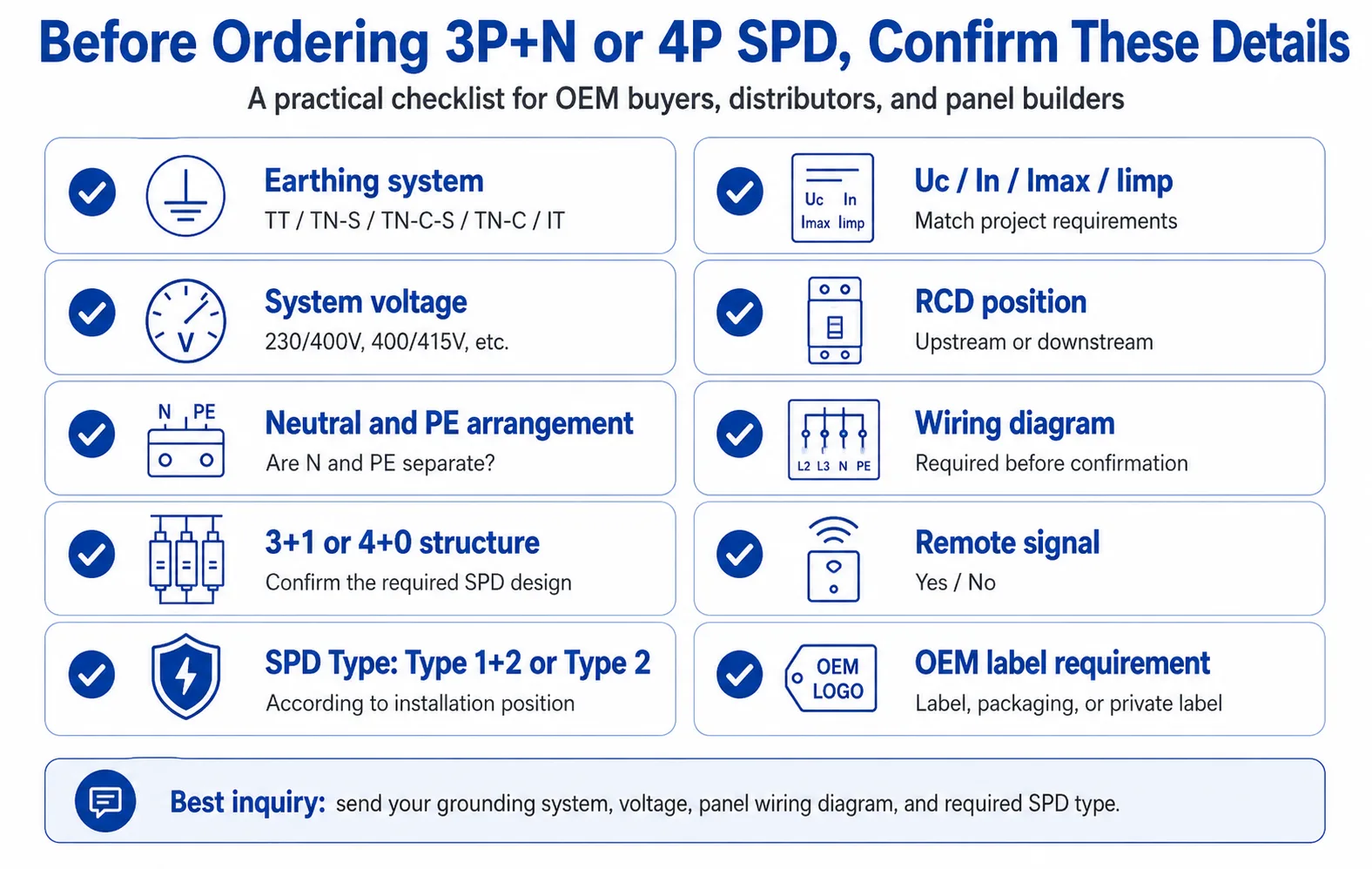
Checklist Prima di Ordinare
Prima di scegliere un SPD 3P+N o 4P, confermare i seguenti dettagli:
- Sistema di messa a terra: TT, TN-S, TN-C-S, TN-C o IT
- Presenza del neutro
- Se il PE è separato dal neutro
- Se il PEN è già stato separato
- Posizione di installazione nel quadro
- Tipo di SPD: Tipo 1, Tipo 1+2 o Tipo 2
- Configurazione richiesta: 3+1 o 4+0
- Requisito di protezione N-PE
- Tensione Uc
- Valori nominali In, Imax e Iimp
- Requisito del fusibile di backup
- Contatto del segnale remoto
- Posizione dell'RCD
- Spazio su guida DIN
- Standard o certificato richiesto
- Requisito di etichetta OEM o etichetta privata
Direzione Raccomandazione Prodotto
Opzione 1: SPD 3P+N Tipo 2
Adatto a molti quadri di distribuzione TT e TN-S dove è richiesta una protezione di Tipo 2.
Comune per quadri di distribuzione commerciali, quadri di sotto-distribuzione, quadri elettrici OEM e distribuzione di energia negli edifici.
Opzione 2: SPD 3P+N Tipo 1+2
Adatto per installazioni con maggiore esposizione ai fulmini o quadri di distribuzione principali dove è richiesta una capacità di scarica della corrente di fulmine.
Comune per quadri principali di ingresso, edifici con protezione esterna dai fulmini, alimentazione da linea aerea e distribuzione di energia industriale.
Opzione 3: SPD 4P Tipo 2
Adatto dove il disegno del progetto specifica un design a 4 poli / 4+0.
Comune per quadri di distribuzione TN-S, design di quadri specifici per progetto e mercati in cui l'SPD 4P è la convenzione di denominazione standard.
Opzione 4: SPD 3P
Adatto per sistemi TN-C o sistemi TN-C-S prima della separazione del PEN.
Comune per sistemi trifase senza neutro separato, protezione da L1/L2/L3 a PEN e quadri industriali con PEN combinato nel punto di installazione.
FAQ
È 3P+N SPD lo stesso di 4P SPD?
No. Possono sembrare simili, ma potrebbero avere circuiti interni diversi. Un SPD 3P+N di solito significa un design 3+1 con un modulo di protezione N-PE speciale. Un SPD 4P di solito significa un design 4+0 con quattro percorsi di protezione che limitano la tensione. Controlla sempre il diagramma di cablaggio.
Qual è la differenza tra 3+1 e 4+0 SPD?
Un SPD 3+1 di solito ha tre percorsi di protezione fase-neutro e un percorso di commutazione tensione N-PE. Un SPD 4+0 di solito ha quattro percorsi di protezione limitante della tensione. La principale differenza è come viene gestita la protezione neutro-terra.
Quale SPD dovrei utilizzare per un sistema TT?
Per molti sistemi trifase TT, si sceglie solitamente un SPD 3P+N / 3+1 perché la protezione dalle sovratensioni N-PE è importante. Tuttavia, la scelta finale dovrebbe seguire il progetto, lo standard locale e lo schema elettrico del produttore.
Quale SPD dovrei utilizzare per un sistema TN-S?
Per i sistemi TN-S, possono essere utilizzate sia configurazioni 3P+N che 4P a seconda del progetto. L'acquirente dovrebbe confermare se il progetto richiede un circuito 3+1 o un circuito 4+0.
Posso usare un SPD 4P invece di un SPD 3P+N?
Non sempre. Un SPD 4P potrebbe non avere la stessa struttura di protezione N-PE di un SPD 3P+N. Se il progetto richiede una protezione 3+1, non sostituire con un SPD 4P senza controllare lo schema del circuito.
È meglio un SPD 4P rispetto a un SPD 3P+N?
Il numero 4P non è automaticamente migliore. 3P+N e 4P sono strutture diverse per sistemi diversi. La scelta migliore dipende dal sistema di messa a terra, dalla disposizione del neutro e dai requisiti di cablaggio.
Cosa dovrei inviare al fornitore prima di effettuare un ordine?
Invia il sistema di messa a terra, la tensione di sistema, il diagramma di cablaggio del pannello, il tipo di SPD, la tensione Uc, la classificazione della corrente di scarica, i requisiti del segnale remoto e se hai bisogno del servizio di etichetta OEM o di etichetta privata.
Hai bisogno di aiuto per scegliere tra 3P+N o 4P SPD?
Se non sei sicuro di quale struttura SPD sia adatta al tuo quadro di distribuzione trifase, inviaci la tensione del tuo sistema, il sistema di messa a terra e lo schema elettrico del quadro.
LEEYEE può aiutare a consigliare una configurazione SPD adatta per quadri di distribuzione, quadri elettrici OEM e ordini SPD con private label.