
Un SPD può avere un'elevata capacità di corrente di scarica e risultare comunque non idoneo per la corrente di cortocircuito disponibile all'interno di un quadro di distribuzione o di un quadro di comando industriale. Questa guida spiega come i costruttori di quadri e gli acquirenti OEM debbano verificare SCCR, Isccr, protezione a monte e il valore nominale complessivo del quadro prima di approvare un modello.
Indice dei contenuti
Risposta Veloce
La corrente di guasto disponibile nel punto di installazione dell'SPD non deve superare l'SCCR o l'Isccr dichiarato dell'SPD.
Questo confronto è valido solo quando l'SPD viene utilizzato alla tensione dichiarata e con il fusibile, l'interruttore automatico, la disposizione del cablaggio e le altre condizioni indicate nella documentazione tecnica.
Cosa significano SCCR e Isccr su un SPD?
Il valore nominale della corrente di cortocircuito, o SCCR, indica la corrente di guasto simmetrica RMS massima dichiarata a cui un dispositivo di protezione contro le sovratensioni (SPD) in corrente alternata è idoneo all'uso alla tensione dichiarata e nelle condizioni valutate. [1]
La documentazione orientata alla norma IEC può utilizzare Isccr. Rappresenta la massima corrente di cortocircuito di rete presunta per la quale l'SPD è classificato insieme al dispositivo di protezione da sovracorrente a monte indicato. [2]
Entrambi i valori riguardano la sicurezza in caso di cortocircuito. Non descrivono la quantità di corrente di fulmine che l'SPD può scaricare.
Valore lato progetto
La corrente di guasto disponibile proviene dall'impianto elettrico e deve essere determinata nel punto di connessione effettivo dell'SPD.
Valore lato prodotto
L'SCCR o Isccr deriva dalla marcatura dell'SPD, dalla scheda tecnica, dalle istruzioni di installazione, dal certificato o dalla documentazione di prova applicabile.
Condizione di approvazione
Il valore di prodotto è significativo solo quando vengono rispettate la tensione documentata, il dispositivo di protezione e le condizioni di installazione.

Apri il diagramma a grandezza naturale
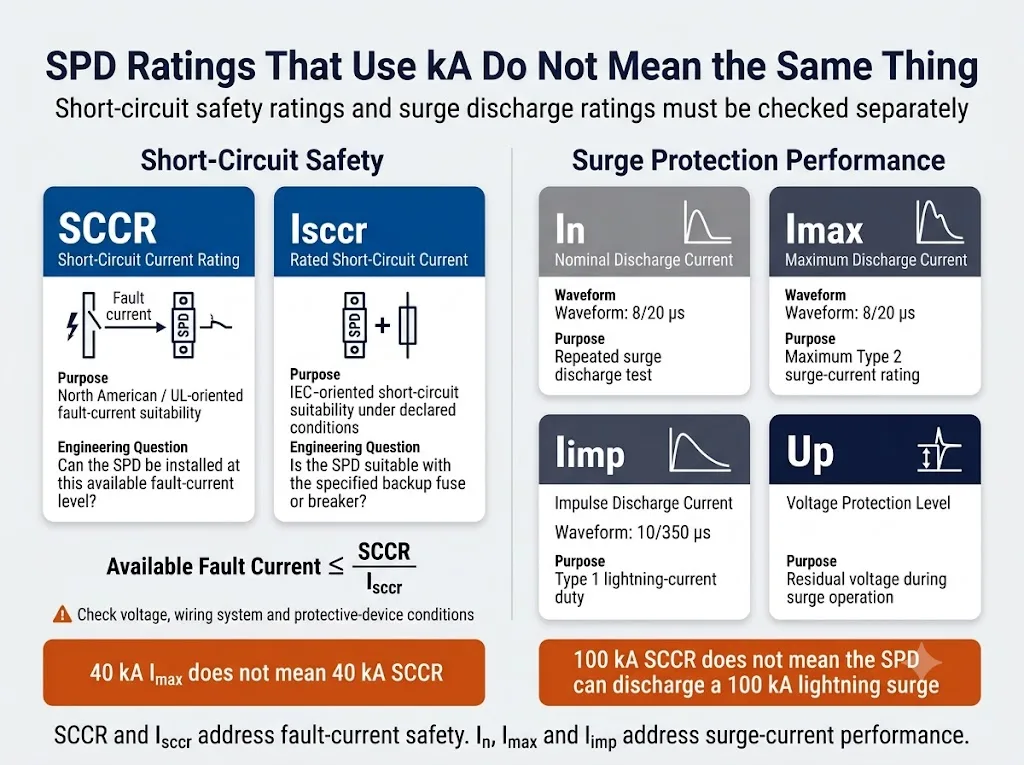
SCCR, Isccr, Imax, In e Iimp non sono intercambiabili
Diversi parametri SPD utilizzano i kA. Essi descrivono eventi elettrici differenti e rispondono a domande diverse di progetto.
| Parametro | Cosa rappresenta | Domanda di progetto | Da non confondere con |
|---|---|---|---|
| SCCR | Idoneità al cortocircuito a una tensione CA dichiarata e in condizioni valutate. | L'SPD può essere installato dove esiste questo livello di corrente di guasto disponibile? | Imax, In o potere di interruzione dell'interruttore. |
| Isccr | Massima corrente di cortocircuito presunta per la quale l'SPD è classificato con il dispositivo di protezione da sovracorrente (OCPD) a monte indicato. | L'SPD è idoneo con il fusibile o l'interruttore documentato? | Un valore autonomo incondizionato. |
| In | Corrente nominale di scarica, normalmente testata con una forma d'onda 8/20 μs. | Quale ciclo di test per la corrente di sovratensione nominale ha superato l'SPD? | Corrente di guasto a frequenza industriale. |
| Imax | Massima corrente di scarica, normalmente dichiarata con una forma d'onda 8/20 μs. | Quale corrente di sovratensione di Tipo 2 massima è dichiarata? | SCCR o Isccr. |
| Iimp | Corrente di scarica impulsiva, normalmente dichiarata con una forma d'onda 10/350 μs. | Quale ciclo per la corrente di fulmine di Tipo 1 è dichiarato? | Corrente di guasto di rete disponibile. |
| Su | Livello di protezione della tensione stabilito secondo le condizioni di prova IEC specificate. | Quale livello di tensione può apparire ai terminali dell'SPD durante l'evento di prova? | Un valore nominale di corrente. |
| VPR | Valore nominale di protezione della tensione orientato UL. | Quale categoria di tensione limitata appare nel registro UL applicabile? | Up IEC come valore automaticamente identico. |
Apri il diagramma a grandezza naturale
Due errori comuni di approvvigionamento
Un SPD con Imax di 40 kA non ha automaticamente un SCCR di 40 kA. Un SCCR di 100 kA non significa che l'SPD possa scaricare una corrente di fulmine di 100 kA.
SCCR vs AIC o AIR
L'SCCR e la capacità di interruzione dell'interruttore risolvono questioni di sicurezza diverse. La NEMA distingue specificamente il valore nominale della corrente di cortocircuito dell'SPD dalla capacità di interruzione in ampere di un dispositivo di protezione da sovracorrente. [3]
SCCR dell'SPD
Indica il livello di corrente di guasto al quale l'SPD è idoneo all'uso nelle condizioni valutate.
AIC / AIR di fusibile o interruttore
Indica la massima corrente di guasto che il dispositivo di protezione può interrompere in sicurezza alla sua tensione nominale.
Entrambi i valori nominali devono essere adeguati
Un interruttore ad alto AIC non aumenta automaticamente l'SCCR di un SPD. Un SPD ad alto SCCR non aumenta la capacità di interruzione dell'interruttore.
Utilizzare la corrente di guasto disponibile nella posizione effettiva dell'SPD
La corrente di guasto disponibile può variare tra trasformatore, quadro elettrico principale, linea di alimentazione e quadro di controllo a valle.
L'impedenza del trasformatore, la potenza della sorgente, la lunghezza del cavo, la sezione del conduttore, l'impedenza delle sbarre collettrici e i dispositivi di limitazione di corrente a monte possono influenzare il valore.
Stima rapida sul secondario del trasformatore
Per un trasformatore trifase, stimare prima la corrente a pieno carico del secondario:
Quindi stimare la corrente di guasto simmetrica ai morsetti del secondario del trasformatore:
Esempio illustrativo
Un trasformatore trifase da 500 kVA, 400 V con impedenza al 6% ha una corrente a pieno carico di circa 722 A.
Dividendo 722 A per 0,06 si ottiene una corrente di guasto stimata ai morsetti del trasformatore di circa 12,0 kA. [4]
Questa è solo una stima preliminare. Non sostituisce uno studio formale sul cortocircuito e potrebbe non rappresentare il valore presso un SPD a valle.
Non utilizzare la corrente nominale dell'interruttore come corrente di guasto del progetto
Un interruttore contrassegnato con 50 kA potrebbe essere in grado di interrompere quel livello. Ciò non prova che l'impianto abbia effettivamente 50 kA di corrente di guasto disponibile.
Perché il fusibile di backup o l'interruttore automatico sono importanti
Un valore Isccr può dipendere da uno specifico fusibile o interruttore a monte. Il numero non dovrebbe essere separato dalle condizioni di prova e di installazione in cui è stato stabilito. [2]
Se un SPD sviluppa un percorso di guasto a bassa impedenza, può scorrere attraverso di esso una corrente a frequenza industriale. Il sistema di protezione coordinato, interno ed esterno, deve scollegare l'SPD guasto in sicurezza.
Poni la domanda completa
“In quali condizioni di fusibile, interruttore, tensione e cablaggio sono stati stabiliti questo SCCR o Isccr?”
Verificare questi dettagli dell'OCPD
- Tipo di fusibile o interruttore
- Corrente nominale massima consentita
- Classe del fusibile o caratteristiche dell'interruttore
- Capacità di interruzione
- Configurazione di derivazione o passante
Correnti nominali uguali non provano una protezione uguale
Un fusibile da 125 A e un interruttore automatico scatolato da 125 A possono avere tempi di intervento, energia passante e prestazioni di limitazione della corrente diversi.
Un SPD con SCCR elevato non conferisce all'intero quadro lo stesso SCCR
Il valore nominale dell'SPD si applica all'SPD nelle sue condizioni valutate. Il valore nominale del quadro si applica all'intero quadro di controllo industriale o all'assieme elettrico.
UL identifica il Supplemento SB di UL 508A come metodo accettato per determinare l'SCCR dei quadri di controllo industriali. [5]
La valutazione può includere sezionatori, fusibili, interruttori automatici, contattori, relè di sovraccarico, avviatori motore, blocchi di distribuzione, terminali, sbarre, azionamenti e SPD.
Non copiare il valore dell'SPD sulla targhetta del quadro
Un SPD con SCCR da 100 kA o 200 kA non rende automaticamente l'intero quadro idoneo per una corrente di guasto disponibile di 100 kA o 200 kA.
Esempio illustrativo di selezione del progetto
L'esempio seguente mostra perché Imax non può essere utilizzato come sostituto di Isccr.
Opzione illustrativa A
- Uc275 V AC
- In20 kA
- Imax40 kA
- Isccr25 kA
- Fusibile di protezione125 A gG massimo
L'Isccr di 25 kA è inferiore alla corrente di guasto disponibile di 36 kA. Il valore Imax di 40 kA non corregge questo problema.
Opzione illustrativa B
- Uc275 V AC
- In20 kA
- Imax40 kA
- Isccr50 kA
- Fusibile di protezione125 A gG massimo
L'Isccr di 50 kA supera il valore di progetto di 36 kA. L'approvazione finale dipende comunque dall'esatto fusibile, dalla tensione, dal circuito, dall'ambito del certificato e dalla revisione del quadro.
Come verificare la scheda tecnica, il certificato e le condizioni di installazione
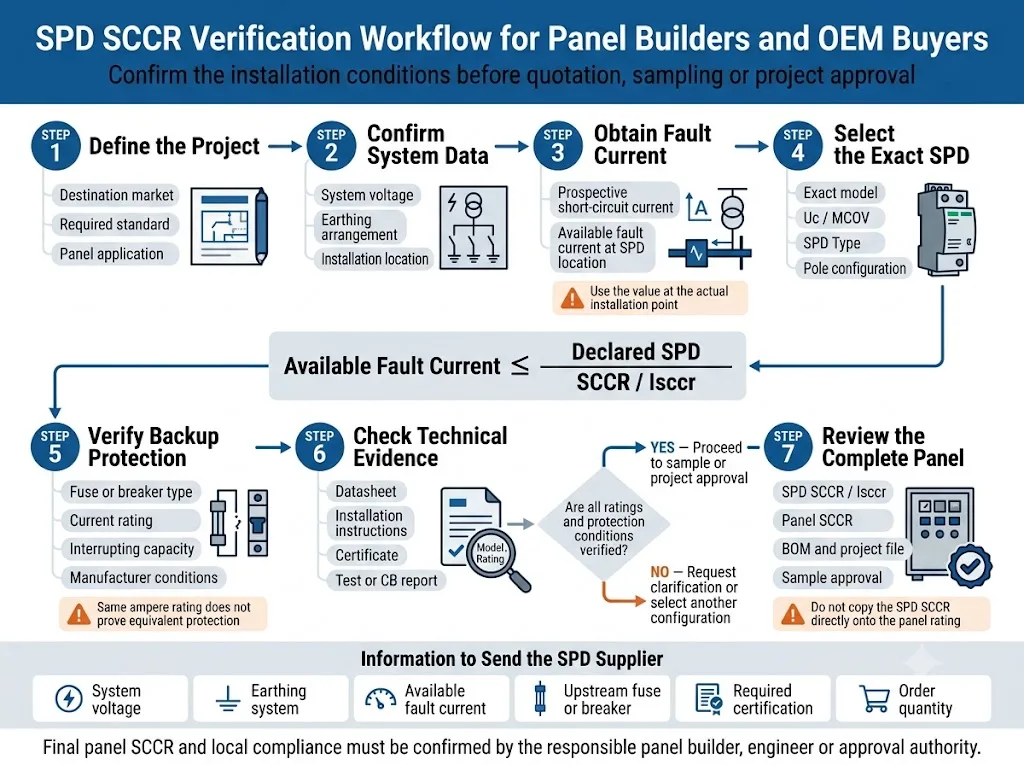
Utilizzare il modello e la configurazione esatti. Non approvare un SPD basandosi su un singolo numero isolato o su un certificato per un modello dall'aspetto simile.
Apri il diagramma a grandezza naturale
Definire il mercato di progetto
Confermare il paese di destinazione, lo standard applicabile, il certificato richiesto e il percorso di approvazione.
Confermare l'impianto elettrico
Registrare la tensione, la frequenza, il sistema di messa a terra e il punto effettivo di installazione dell'SPD.
Ottenere il valore della corrente di guasto
Utilizzare lo studio di cortocircuito del progetto o un calcolo completato da un responsabile qualificato.
Identificare il modello esatto di SPD
Confermare il codice completo, il suffisso della tensione, la disposizione dei poli, la base e il modulo sostituibile.
Individuare SCCR o Isccr
Determinare se il valore si applica a un modulo, a una modalità di protezione o all'intero assemblaggio.
Verificare l'OCPD a monte
Controllare il tipo di fusibile o interruttore, il valore nominale, il potere di interruzione e le restrizioni di sostituzione.
Corrispondenza con le evidenze tecniche
Confrontare l'etichetta, la scheda tecnica, le istruzioni di installazione, il certificato e la documentazione di prova.
Esaminare il quadro completo
Registrare la decisione nella distinta base (BOM), nel fascicolo tecnico, nella presentazione del progetto o nel verbale di approvazione del campione.
Come LEEYEE documenta SCCR e Isccr
I documenti di prodotto e di certificazione LEEYEE mostrano che SCCR o Isccr devono corrispondere all'esatta serie, tensione e configurazione del modello.
Esempi di prima parte pubblicati
- L'indice dei certificati LEEYEE elenca LY1-C40M Modelli di Tipo 2 con un Isccr di 25 kA per le configurazioni coperte.
- L'indice dei certificati elenca anche LY1-C40 and LY1-D20 modelli di serie con un Isccr di 25 kA entro il loro ambito di certificazione dichiarato.
- Il LY1-12.5/3(S) la tabella delle specifiche di prodotto pubblica valori SCCR dipendenti dal modello. Il valore esatto varia in base alla tensione e alla variante di prodotto.
- Il catalogo SPD LEEYEE elenca i dati dei fusibili di protezione separatamente dalle correnti nominali di cortocircuito. Gli acquirenti dovrebbero pertanto richiedere e verificare entrambi i valori.
Le evidenze non si trasferiscono automaticamente tra i modelli
Un certificato per una serie o un SCCR indicato per una variante di tensione non può essere utilizzato come prova generale per ogni SPD LEEYEE.
Lista di controllo RFQ per SCCR e Isccr dell'SPD
Dati di progetto completi aiutano il fornitore a identificare conflitti tecnici prima del preventivo, del campionamento o dell'approvazione OEM.
- Paese di destinazione
- Standard richiesto
- Certificato richiesto
- Applicazione del quadro
- Tensione nominale del sistema
- Tensione tra le fasi
- Tensione fase-neutro
- Frequenza CA
- Sistema di messa a terra
- Punto di installazione SPD
- Corrente di guasto disponibile
- SCCR del quadro richiesto
- Tipo di fusibile a monte
- Valore nominale fusibile
- Tipo di interruttore magnetotermico
- Valore nominale interruttore
- Capacità di interruzione
- Tipo di SPD richiesto
- Configurazione dei poli
- In o Imax richiesto
- Iimp richiesto
- Up o VPR richiesto
- SCCR o Isccr richiesto
- Requisito del contatto remoto
- Quantità d'ordine
- Etichetta e imballaggio OEM
Hai bisogno di verificare un SPD per un quadro o un progetto OEM?
Inviare la tensione di sistema, il tipo di collegamento a terra, la corrente di guasto disponibile, il fusibile o l'interruttore a monte, il tipo di SPD richiesto e i requisiti di certificazione.
LEEYEE può aiutare a confrontare i parametri richiesti con la documentazione di prodotto disponibile. I calcoli finali della corrente di guasto, la determinazione dell'SCCR del quadro e l'approvazione del progetto restano di competenza del progettista responsabile, del costruttore del quadro o dell'autorità di approvazione.
Domande frequenti
È un SPD Imax da 40 kA adatto dove la corrente di guasto disponibile è di 40 kA?
Non necessariamente. Imax descrive le prestazioni di corrente di picco. L'SCCR o Isccr dichiarato separatamente deve essere verificato rispetto alla corrente di guasto disponibile.
SCCR o Isccr devono essere superiori alla corrente di guasto disponibile?
Deve essere uguale o superiore alla corrente di guasto disponibile al punto di installazione del SPD, soggetto a tutte le condizioni di tensione, OCPD e installazione indicate.
L'SCCR è equivalente all'AIC o all'AIR dell'interruttore?
Il numero SCCR descrive l'idoneità di un componente o di un assemblaggio in condizioni di cortocircuito. AIC o AIR descrivono la corrente di guasto che un dispositivo di protezione da sovracorrente può interrompere in sicurezza.
Un interruttore a monte può aumentare l'SCCR dell'SPD?
Solo quando la combinazione e la classificazione risultanti sono supportate dalla documentazione di test, certificazione, elenco o del produttore applicabile.
Un sezionatore termico interno elimina la necessità del fusibile di protezione?
Non automaticamente. Seguire le istruzioni di installazione esatte e le condizioni del dispositivo di protezione per il modello di SPD selezionato.
Un SPD con SCCR da 200 kA rende il pannello da 200 kA SCCR?
No. L'SCCR completo del quadro deve essere determinato separatamente secondo la procedura applicabile per il quadro o il macchinario.
Cosa dovrebbe fare l'acquirente se manca la condizione di protezione di backup?
Non approvare l'SPD basandosi solo su una dichiarazione isolata di SCCR o Isccr. Richiedere la scheda tecnica esatta, le istruzioni di installazione e la certificazione o le prove documentali applicabili.