Os sistemas de iluminação de solo de aeródromo (AGL), incluindo luzes de pista, luzes de taxiamento e circuitos de iluminação de aproximação, operam em áreas externas expostas, com longos trajetos de cabos e equipamentos de campo distribuídos. Essas características criam desafios de proteção contra surtos que são diferentes dos sistemas de iluminação internos convencionais.
Este guia explica a proteção contra surtos da iluminação aeroportuária sob a perspectiva de engenharia e aquisição: por onde os riscos de surtos podem entrar no sistema, quais pontos de proteção devem ser avaliados e quais informações do projeto devem ser confirmadas antes da aprovação de uma configuração de SPD.
A proteção contra surtos da iluminação aeroportuária deve ser avaliada como um sistema coordenado, e não como um único SPD instalado em um único local. Dependendo da arquitetura, a proteção pode precisar ser considerada na distribuição de energia de entrada, nos equipamentos de controle de iluminação, nos circuitos de campo e nas interfaces de monitorização ou comunicação. A configuração final deve ser verificada em relação ao projeto elétrico real, ao sistema de aterramento e equipotencialização, aos requisitos do fabricante dos equipamentos e às especificações do projeto.[1][2]
| Área de proteção | Principal preocupação com surtos | O que deve ser confirmado |
|---|---|---|
| Quadro de distribuição principal | Sobretensão transitória entrando pela alimentação elétrica | Tensão do sistema, esquema de aterramento e coordenação requerida do SPD |
| Sistema de Controlo de Iluminação / Área CCR | Exposição de eletrónica de potência, controlos e equipamento de monitorização | Arquitetura do equipamento e requisitos do fabricante |
| Circuito de Iluminação do Aeródromo | Transitórios associados a longos trajetos de cabos exteriores e ao equipamento de campo | Topologia do circuito, encaminhamento dos cabos e requisitos do equipamento de campo |
| Interface de Monitorização / Comunicação | Perturbação transitória que entra através de linhas de sinal ou comunicação | Tipo de interface, características do sinal e proteção de sinal compatível |
A tabela identifica áreas de proteção a rever; não constitui uma especificação universal de SPD para aeroportos.
Índice
O que torna a proteção contra surtos da iluminação de aeródromos diferente?
A iluminação do aeródromo é um sistema de infraestrutura distribuído. A alimentação, o controlo e o equipamento de campo podem estar separados por longos trajetos de cabos, enquanto o equipamento de iluminação de pista, taxiway e aproximação opera num ambiente exterior exposto.
- Longos trajetos de cabos: os condutores que se estendem pelo aeródromo podem estar expostos a efeitos eletromagnéticos transitórios.
- Equipamento de campo distribuído: a proteção não pode ser avaliada apenas na fronteira do edifício ou da sala de controlo.
- Equipamento eletrónico: os drivers de LED, a eletrónica de monitorização e o equipamento de controlo podem ter diferentes características de suportabilidade a impulsos.
- Múltiplas interfaces elétricas: os circuitos de alimentação e as linhas de comunicação ou monitorização podem exigir diferentes abordagens de proteção.
- Aprovação específica do projeto: os projetos aeroportuários podem impor requisitos de equipamentos, documentação e instalação além de uma ficha técnica geral de SPD.[3][4]
Por esse motivo, a questão de engenharia útil não é simplesmente “Qual protetor contra surtos deve ser usado em um aeroporto?” É “Onde pode entrar uma sobretensão transitória neste sistema AGL específico e que equipamentos precisam de proteção em cada fronteira?”
Arquitetura de proteção contra surtos para iluminação aeroportuária
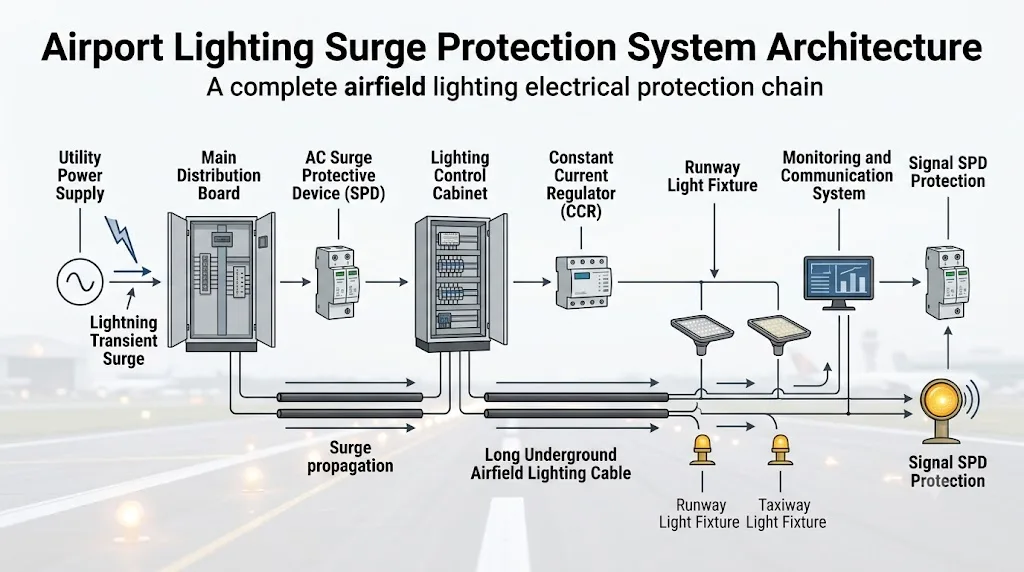
Um projeto coordenado começa pela identificação dos possíveis caminhos dos surtos no sistema. A alimentação de entrada é um caminho, mas pode não ser o único. Circuitos de campo longos e interfaces externas de comunicação podem criar pontos adicionais de exposição.
A IEC 62305 aborda a proteção contra descargas atmosféricas e a redução de danos a sistemas elétricos e eletrônicos decorrentes de efeitos relacionados a raios, enquanto a série IEC 61643 cobre dispositivos de proteção contra surtos para aplicações relevantes de baixa tensão em alimentação e sinalização.[1][2]
Onde a proteção SPD deve ser avaliada?
1. Distribuição Principal de Energia
O ponto de distribuição de entrada é uma fronteira importante de proteção, porque sobretensões transitórias podem entrar pela alimentação elétrica. A configuração do SPD não pode ser escolhida apenas com base nas palavras “iluminação de aeroporto”.
Os engenheiros devem primeiro confirmar a tensão real do sistema, a configuração da rede, o esquema de aterramento, o ambiente de surtos previsto e a coordenação necessária com a proteção a montante e a jusante.
2. Armários de Controle de Iluminação
As áreas de controle de iluminação aeroportuária podem conter controladores, equipamentos de comutação, módulos de monitoramento e outros dispositivos eletrônicos. A proteção desses itens deve ser avaliada de acordo com a arquitetura real do gabinete e as interfaces dos equipamentos.
Caso linhas de energia e de comunicação entrem ou saiam do gabinete, o projetista deve analisar ambos os caminhos, em vez de presumir que um DPS de corrente alternada também proteja uma interface de sinal.
3. Regulador de Corrente Constante (CCR) e Circuitos de Iluminação em Série
Os reguladores de corrente constante são utilizados em muitos sistemas de iluminação de pátios de aeronaves para alimentar circuitos de iluminação em série. Esta é uma distinção importante em relação à iluminação predial comum conectada em paralelo.
Não se deve presumir automaticamente que um DPS de baixa tensão padrão seja adequado para todos os pontos associados a um CCR ou ao seu circuito em série. A topologia do circuito, o projeto do regulador, a tensão de operação, o esquema de isolamento e as instruções do fabricante devem ser analisados antes da especificação de um dispositivo de proteção.
As arquiteturas de iluminação aeroportuária diferem entre sistemas e fabricantes. A proteção nos equipamentos CCR e circuitos em série, ou em seu entorno, deve ser confirmada por meio da documentação do equipamento e do projeto. Este artigo não prescreve uma conexão universal de DPS para a saída do CCR.
4. Circuitos de Campo de Iluminação de Pista, Pista de Táxi e Aproximação
Os circuitos de campo podem estender-se por grandes áreas externas. Luzes de borda de pista, luzes de pista de táxi, luzes de aproximação e equipamentos de campo relacionados podem, portanto, estar situados longe do equipamento principal de distribuição e controle.
A necessidade de proteção adicional próxima ao equipamento de campo depende do projeto do circuito, do roteamento dos cabos, da capacidade de suportar impulsos do equipamento, do arranjo de aterramento e dos requisitos do fabricante. Um ponto de proteção adequado para uma arquitetura AGL não deve ser copiado automaticamente para outra.
5. Linhas de Monitoramento e Comunicação
Os sistemas de monitoramento e controle podem utilizar interfaces eletricamente diferentes da fonte de alimentação. Se uma linha de comunicação cruzar áreas expostas ou zonas de equipamento, sua exposição a transientes deve ser avaliada separadamente.
Os DPS de sinal devem ser compatíveis com a interface real. Parâmetros importantes podem incluir tensão de operação, tipo de sinal, características de transmissão, método de conexão e o nível de proteção aceitável do equipamento.[2]
Pontos de instalação do SPD da iluminação aeroportuária
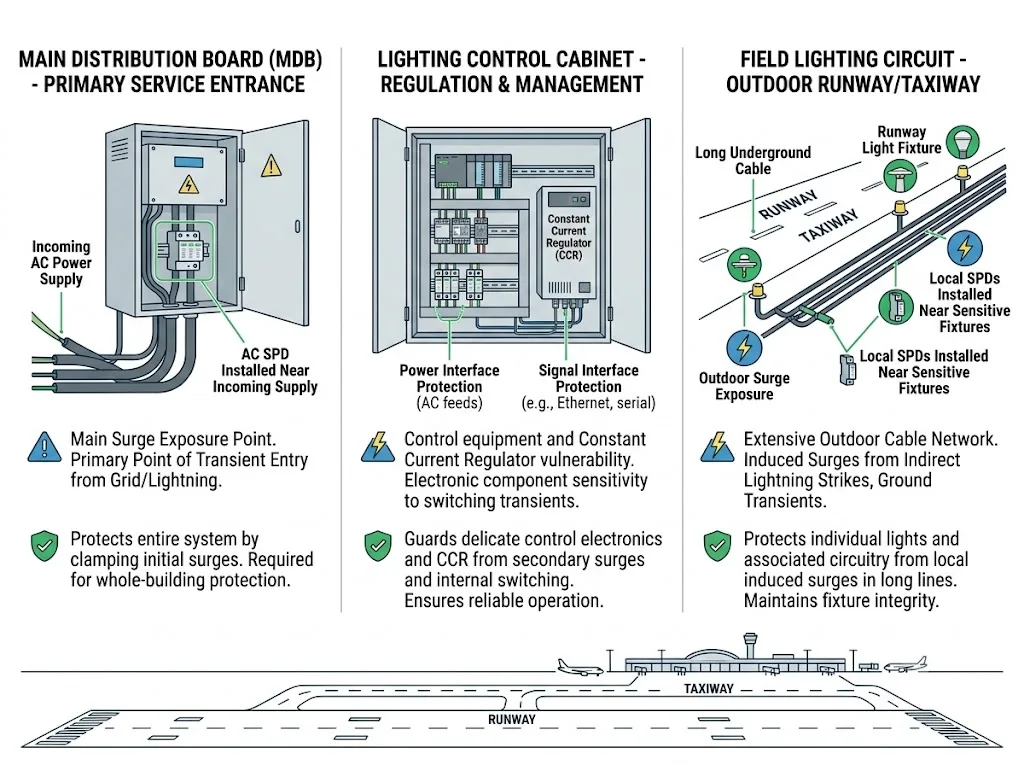
| Área do sistema | Objetivo de proteção | Confirmação do projeto |
|---|---|---|
| Entrada de Energia | Limitar o estresse transitório de entrada antes que ele se propague ainda mais pela instalação | Características de fornecimento, aterramento e projeto de proteção a montante |
| Área de Controle / CCR | Proteja equipamentos sensíveis de controle e potência na interface relevante | Documentação do fabricante do CCR e do sistema de controle |
| Equipamento de Campo | Trate a exposição associada a circuitos externos longos e equipamentos locais | Topologia de circuito, requisitos de conexão, invólucro e equipamentos |
| Interface de sinal | Limitar o estresse transitório em conexões de monitoramento ou comunicação | Tensão de sinal, tipo de interface e requisitos de transmissão |
Um dispositivo em um limite de proteção não elimina automaticamente a necessidade de avaliar outros caminhos de surto.
Aterramento, equipotencialização e comprimento de conexão são importantes
O desempenho do DPS depende da instalação ao redor do dispositivo, bem como da própria classificação do DPS. Portanto, os princípios de proteção contra raios incluem aterramento, equipotencialização e proteção coordenada contra surtos, em vez de tratar um DPS como um componente isolado.[1]
Durante a revisão do projeto, confirme:
- O arranjo de aterramento e equipotencialização utilizado pelo sistema de iluminação do aeroporto.
- O modo de proteção SPD pretendido e o método de conexão.
- A rota do condutor entre o SPD e o equipamento a ser protegido.
- A relação entre a equipotencialização do edifício, do gabinete e do equipamento de campo.
- Quaisquer regras de instalação especificadas pelo SPD, pelo equipamento AGL ou pelo projetista.
As classificações de DPS em laboratório não devem ser interpretadas como uma garantia de proteção idêntica em campo quando as condições de instalação forem diferentes.
Ambiente externo e requisitos de invólucro
Os equipamentos de aeródromo podem estar expostos à umidade, poeira, variações de temperatura e outras condições ambientais externas. Quando um DPS é instalado fora de um gabinete interno protegido, todo o conjunto e o invólucro devem ser adequados para esse ambiente de instalação.
Não presuma que a classificação IP de uma luminária de aeroporto se aplica automaticamente a uma instalação de DPS separada. A proteção do invólucro, a faixa de temperatura, a disposição dos terminais e o acesso para manutenção devem ser verificados para a instalação real.
Monitorização de estado e manutenção do SPD
Os dispositivos de proteção contra surtos não dispensam manutenção durante toda a vida útil de uma instalação. As equipes de projeto devem definir como a condição do DPS será verificada e como os dispositivos com falha ou em fim de vida útil serão identificados.
Dependendo do sistema, recursos úteis podem incluir indicação de status local, módulos substituíveis ou contatos de sinalização remota. A necessidade dessas funções é uma decisão de projeto e deve ser confirmada antes da aquisição.
Fluxo de seleção do SPD para iluminação aeroportuária
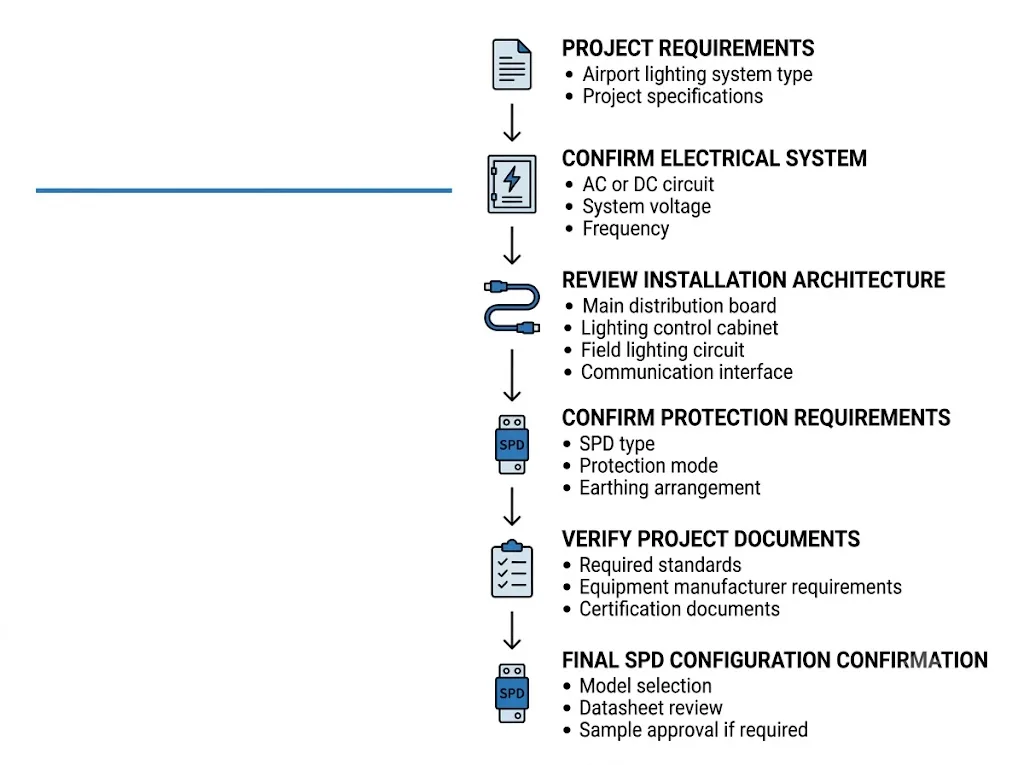
Para projetos aeroportuários, começar por um catálogo de DPS geralmente é a ordem incorreta. Inicie pela arquitetura elétrica e pelos documentos do projeto, identifique os limites de proteção e, em seguida, selecione e verifique os dispositivos necessários nesses limites.
Os padrões do projeto e a aprovação devem ser confirmados separadamente
Os projetos de iluminação aeroportuária podem ser regidos por diversas camadas de requisitos. As normas IEC fornecem princípios relevantes sobre descargas atmosféricas e DPS, enquanto as autoridades de aviação e as especificações do projeto regem os equipamentos de iluminação de aeródromos e os requisitos de aceitação do projeto.[1][2][3][4]
O Anexo 14 da ICAO aborda os requisitos para aeródromos, e a FAA dos EUA publica materiais consultivos e sobre equipamentos de iluminação aeroportuária, incluindo documentos da série AC 150/5345.[3][4] Estes documentos de aviação não devem ser interpretados como uma especificação de modelo de DPS universal.
Não afirme que um DPS de uso geral torna automaticamente uma instalação de iluminação aeroportuária em conformidade. Antes da aprovação, verifique os requisitos da autoridade aeroportuária aplicável, a especificação do projeto, a documentação do fabricante de AGL, as normas de DPS e o escopo do certificado para o modelo específico que está sendo proposto.
Antes de encomendar: lista de verificação do SPD para iluminação aeroportuária
- País e especificação aplicável do aeroporto ou projeto.
- Tensão do sistema, frequência e informações de CA/CC.
- Diagrama unifilar ou arquitetura elétrica relevante.
- Disposição de aterramento e equipotencialização.
- Local de proteção: distribuição de entrada, painel de controle, circuito de campo ou interface de sinal.
- Fabricante do CCR, modelo e informações de interface relevantes, quando aplicável.
- Aplicação em circuito de pista de pouso e decolagem, pista de táxi, aproximação ou outro circuito AGL.
- Detalhes do sinal ou da interface de comunicação caso seja necessária proteção.
- Requisitos ambientais e de invólucro.
- Norma, certificado, ficha técnica ou documentação de teste do DPS exigidos.
- Requisito de indicação de status ou sinalização remota.
- Quantidade e requisitos de OEM/marca própria, quando aplicável.
Como a LEEYEE apoia a avaliação do SPD da iluminação aeroportuária
A LEEYEE é uma fornecedora especializada em proteção contra surtos e proteção de baixa tensão. A CNSPD é a plataforma da LEEYEE focada em proteção contra surtos para compradores técnicos globais.
Para aplicações de iluminação aeroportuária, a LEEYEE pode oferecer suporte à revisão de parâmetros de DPS, documentação de modelos e discussões sobre configuração OEM dentro do escopo da linha de produtos disponível. A adequação específica para aeroportos ainda precisa ser confirmada em relação à arquitetura elétrica real, à documentação do equipamento e aos requisitos de aprovação do projeto.
Compartilhe a tensão do sistema, o diagrama do circuito relevante, a posição de instalação e os requisitos do projeto. Isso fornece à equipe técnica informações suficientes para avaliar se uma configuração de DPS disponível é adequada para uma análise posterior do projeto.
Solicitar recomendação de modeloPerguntas frequentes sobre proteção contra surtos na iluminação aeroportuária
Um único DPS pode proteger todo o sistema de iluminação do aeroporto?
Não necessariamente. Os sistemas de iluminação aeroportuária podem conter vários caminhos de entrada de surtos e limites de proteção. A energia de entrada, os circuitos de campo e as interfaces de comunicação devem ser avaliados de acordo com a arquitetura real, em vez de assumir que um único DPS protege o sistema completo.
Onde a proteção contra surtos deve ser considerada para a iluminação da pista?
A revisão pode incluir distribuição de entrada, equipamento de controle de iluminação, circuitos de campo relevantes e interfaces de comunicação. As localizações corretas dependem da arquitetura de iluminação da pista, do roteamento de cabos, das características do equipamento e dos requisitos do projeto.
Um DPS de CA normal pode ser instalado diretamente na saída de um CCR?
Isso não deve ser presumido. Um circuito em série de iluminação de aeródromo alimentado por CCR não é simplesmente um circuito de iluminação paralelo de baixa tensão comum. O projeto do CCR, as características do circuito e as instruções do fabricante devem ser verificados antes de especificar a proteção nessa interface.
Uma classificação de corrente de surto mais alta significa sempre uma melhor proteção para a iluminação do aeroporto?
Não. A capacidade de corrente de surto é apenas um parâmetro. A compatibilidade de tensão, o nível de proteção, o tipo de DPS, a posição de instalação, o aterramento e a equipotencialização, a coordenação e os requisitos do equipamento protegido influenciam a seleção final.
As linhas de sinal precisam de um DPS diferente das linhas de energia?
Frequentemente, sim. As interfaces de energia e de sinal possuem características elétricas distintas. Qualquer DPS para sinal deve ser selecionado de acordo com a tensão real da interface, as características do sinal, o método de conexão e os requisitos do equipamento.
Um DPS em conformidade com a norma IEC é automaticamente aprovado para um projeto aeroportuário?
Não. A conformidade com uma norma de DPS aplicável é apenas uma parte da avaliação do projeto. Requisitos da autoridade aeroportuária, especificações do projeto, requisitos do fabricante do equipamento, escopo do certificado e projeto de instalação também podem precisar ser revisados.
Referências
- Comissão Eletrotécnica Internacional (IEC), série IEC 62305, Proteção contra descargas atmosféricas.
- Comissão Eletrotécnica Internacional (IEC), série IEC 61643, normas de dispositivos de proteção contra surtos que abrangem aplicações relevantes de energia e sinalização de baixa tensão.
- Organização da Aviação Civil Internacional (OACI), Anexo 14 à Convenção sobre Aviação Civil Internacional, Aeródromos.
- Federal Aviation Administration (FAA), Programa de Certificação de Equipamentos de Iluminação Aeroportuária e circulares consultivas aplicáveis da série AC 150/5345 sobre equipamentos de iluminação aeroportuária.