Los sistemas de iluminación de ayudas visuales en tierra (AGL), incluidas las luces de pista, las luces de calle de rodaje y los circuitos de iluminación de aproximación, funcionan en áreas exteriores expuestas con tendidos de cable largos y equipos de campo distribuidos. Estas características crean retos de protección contra sobretensiones que son diferentes de los sistemas de iluminación interiores ordinarios.
Esta guía explica la protección contra sobretensiones en la iluminación aeroportuaria desde una perspectiva de ingeniería y adquisición: por dónde pueden entrar los riesgos de sobretensión en el sistema, qué puntos de protección deben evaluarse y qué información del proyecto debe confirmarse antes de aprobar una configuración de SPD.
La protección contra sobretensiones de la iluminación aeroportuaria debe evaluarse como un sistema coordinado y no como un único SPD instalado en un solo lugar. Según la arquitectura, puede ser necesario considerar la protección en la distribución de alimentación de entrada, en los equipos de control de iluminación, en los circuitos de campo y en las interfaces de supervisión o comunicación. La disposición final debe verificarse frente al diseño eléctrico real, el sistema de puesta a tierra y equipotencialidad, los requisitos del fabricante del equipo y las especificaciones del proyecto.[1][2]
| Área de protección | Principal riesgo de sobretensión | Qué debe confirmarse |
|---|---|---|
| Cuadro de distribución principal | Sobretensión transitoria que entra a través de la alimentación eléctrica | Voltaje del sistema, esquema de puesta a tierra y coordinación SPD requerida |
| Control de iluminación / Área CCR | Exposición de la electrónica de potencia, los controles y los equipos de supervisión | Arquitectura del equipo y requisitos del fabricante |
| Circuito de iluminación de aeródromo | Transitorios asociados a tramos largos de cableado exterior y equipos de campo | Topología del circuito, enrutamiento de cables y requisitos de los equipos de campo |
| Interfaz de supervisión / comunicación | Perturbación transitoria que entra a través de líneas de señal o comunicación | Tipo de interfaz, características de la señal y protección de señal compatible |
La tabla identifica las áreas de protección que deben revisarse; no constituye una especificación universal de SPD para aeropuertos.
Índice
¿Qué hace diferente la protección contra sobretensiones en la iluminación de aeródromos?
La iluminación de aeródromo es un sistema de infraestructura distribuida. La energía, el control y los equipos de campo pueden estar separados por largos tramos de cableado, mientras que los equipos de iluminación de pista, calle de rodaje y aproximación operan en un entorno exterior expuesto.
- Tramos largos de cableado: los conductores que se extienden por el aeródromo pueden estar expuestos a efectos electromagnéticos transitorios.
- Equipos de campo distribuidos: la protección no puede evaluarse solo en el límite del edificio o de la sala de control.
- Equipos electrónicos: los controladores LED, la electrónica de supervisión y los equipos de control pueden tener diferentes características de soportabilidad a impulsos.
- Múltiples interfaces eléctricas: los circuitos de alimentación y las líneas de comunicación o supervisión pueden requerir distintos enfoques de protección.
- Aprobación específica del proyecto: los proyectos aeroportuarios pueden imponer requisitos de equipos, documentación e instalación más allá de una ficha técnica general de SPD.[3][4]
Por esta razón, la pregunta técnica útil no es simplemente “¿Qué protector contra sobretensiones debe utilizarse para un aeropuerto?”. Es “¿Por dónde puede entrar un transitorio en este sistema AGL específico y qué equipos necesitan protección en cada límite?”
Arquitectura de protección contra sobretensiones para iluminación aeroportuaria
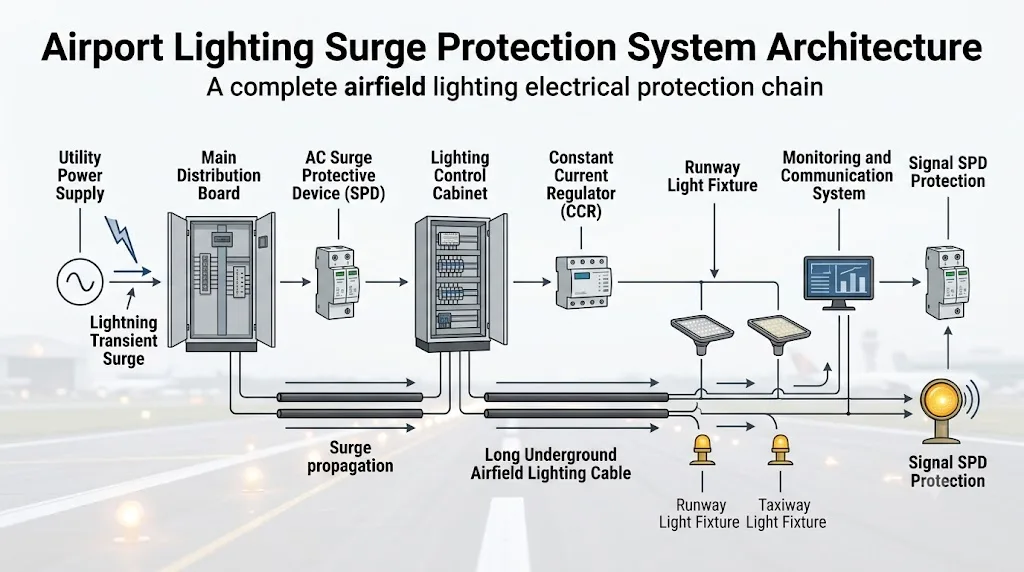
Un diseño coordinado comienza trazando las posibles trayectorias de sobretensión a través del sistema. La alimentación entrante es una trayectoria, pero puede no ser la única. Los circuitos de campo largos y las interfaces de comunicación externas pueden crear puntos de exposición adicionales.
La norma IEC 62305 aborda la protección contra el rayo y la reducción de daños en sistemas eléctricos y electrónicos por efectos relacionados con el rayo, mientras que la serie IEC 61643 cubre los dispositivos de protección contra sobretensiones para aplicaciones pertinentes de alimentación de baja tensión y señalización.[1][2]
¿Dónde debe evaluarse la protección SPD?
1. Distribución Principal de Energía
El punto de distribución entrante es un límite de protección importante porque las sobretensiones transitorias pueden entrar a través del suministro eléctrico. La configuración del SPD no puede seleccionarse solo a partir de las palabras “iluminación aeroportuaria”.
Los ingenieros deben confirmar primero la tensión real del sistema, la configuración de la red, el esquema de puesta a tierra, el entorno probable de sobretensiones y la coordinación requerida con la protección aguas arriba y aguas abajo.
2. Gabinetes de control de iluminación
Las áreas de control de iluminación de aeropuertos pueden contener controladores, equipos de conmutación, módulos de supervisión y otros dispositivos electrónicos. Su protección debe evaluarse según la arquitectura real del gabinete y las interfaces del equipo.
Si tanto las líneas de alimentación como las de comunicación salen o entran en el gabinete, el diseñador debe revisar ambas rutas en lugar de asumir que un SPD de alimentación CA también protege una interfaz de señal.
3. Regulador de corriente constante (CCR) y circuitos de iluminación en serie
Los reguladores de corriente constante se utilizan en muchos sistemas de iluminación de plataforma de aeródromos para alimentar circuitos de iluminación en serie. Esta es una distinción importante frente a la iluminación ordinaria de edificios conectada en paralelo.
No debe suponerse automáticamente que un SPD de CA de baja tensión estándar sea adecuado para cada punto asociado con un CCR o su circuito en serie. Antes de especificar un dispositivo de protección, deben revisarse la topología del circuito, el diseño del regulador, la tensión de funcionamiento, la disposición del aislamiento y las instrucciones del fabricante.
Las arquitecturas de iluminación aeroportuaria difieren entre sistemas y fabricantes. La protección en o alrededor del equipo CCR y de los circuitos en serie debe confirmarse mediante la documentación del equipo y el diseño del proyecto. Este artículo no prescribe una conexión universal de SPD para la salida del CCR.
4. Circuitos de campo de iluminación de pista, calle de rodaje y aproximación
Los circuitos de campo pueden extenderse por amplias zonas exteriores. Por lo tanto, las luces de borde de pista, las luces de calle de rodaje, las luces de aproximación y los equipos de campo relacionados pueden estar alejados del equipo principal de distribución y control.
La necesidad de protección adicional cerca del equipo de campo depende del diseño del circuito, el trazado de los cables, la capacidad de soportar impulsos del equipo, la disposición de puesta en equipotencial y los requisitos del fabricante. Un punto de protección adecuado para una arquitectura AGL no debe copiarse automáticamente en otra.
5. Líneas de supervisión y comunicación
Los sistemas de supervisión y control pueden utilizar interfaces eléctricamente diferentes de la alimentación. Si una línea de comunicación cruza entre zonas expuestas o zonas de equipos, su exposición a transitorios debe evaluarse por separado.
Los SPD de señal deben ser compatibles con la interfaz real. Los parámetros importantes pueden incluir la tensión de funcionamiento, el tipo de señal, las características de transmisión, el método de conexión y el nivel de protección aceptable del equipo.[2]
Puntos de instalación de SPD en iluminación aeroportuaria
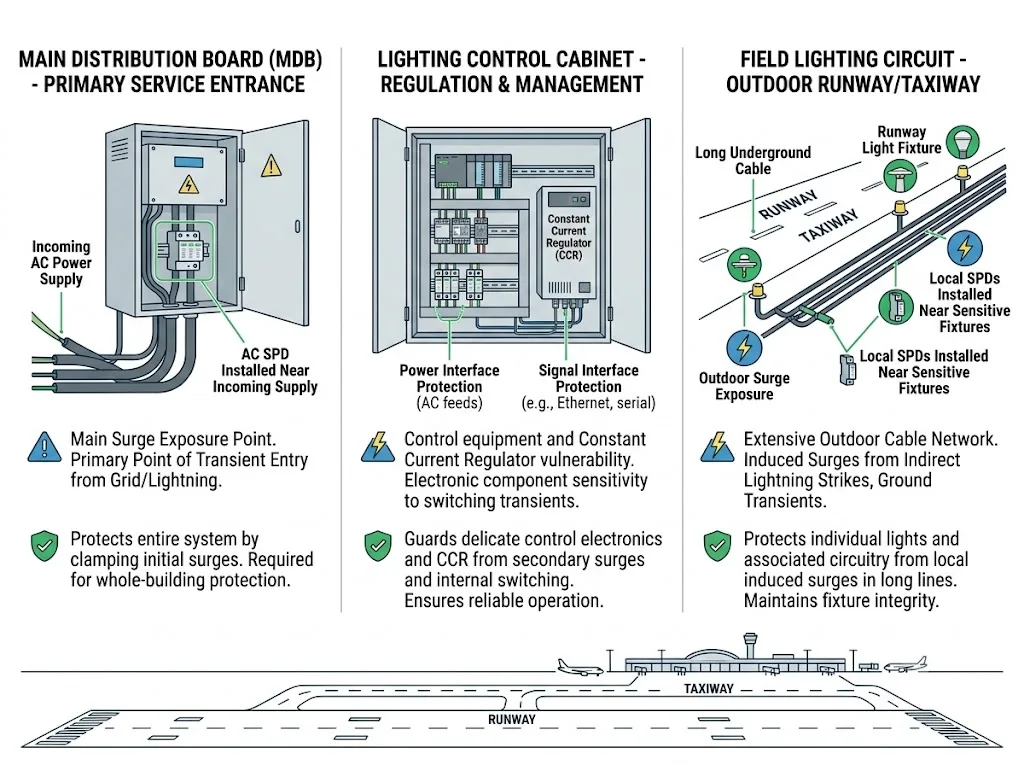
| Área del sistema | Objetivo de protección | Confirmación del proyecto |
|---|---|---|
| Entrada de alimentación | Limitar la tensión transitoria entrante antes de que se propague más en la instalación | Características de la alimentación, puesta a tierra y diseño de la protección aguas arriba |
| Área de control / CCR | Proteger los equipos sensibles de control y de potencia en la interfaz correspondiente | Documentación del fabricante del CCR y del sistema de control |
| Equipo de campo | Abordar la exposición asociada con circuitos exteriores de gran longitud y equipos locales | Topología del circuito, unión equipotencial, envolvente y requisitos del equipo |
| Interfaz de señal | Limitar el estrés transitorio en las conexiones de monitoreo o comunicación | Tensión de la señal, tipo de interfaz y requisitos de transmisión |
Un dispositivo en un límite de protección no elimina automáticamente la necesidad de evaluar otras rutas de sobretensión.
La puesta a tierra, el equipotencial y la longitud de conexión importan
El rendimiento del SPD depende tanto de la instalación alrededor del dispositivo como de la propia clasificación del SPD. Por lo tanto, los principios de protección contra rayos incluyen la puesta a tierra, la unión equipotencial y la protección coordinada contra sobretensiones, en lugar de tratar un SPD como un componente aislado.[1]
Durante la revisión del proyecto, confirme:
- El esquema de puesta a tierra y unión equipotencial utilizado por el sistema de iluminación aeroportuaria.
- El modo de protección del SPD previsto y el método de conexión.
- La ruta del conductor entre el SPD y el equipo que se protege.
- La relación entre la unión equipotencial del edificio, del gabinete y del equipo de campo.
- Cualquier regla de instalación especificada por el SPD, el equipo AGL o el diseñador del proyecto.
Las clasificaciones de SPD obtenidas en laboratorio no deben interpretarse como una garantía de una protección en campo idéntica cuando las condiciones de instalación son diferentes.
Requisitos del entorno exterior y de la envolvente
El equipo del área de movimiento puede estar expuesto a humedad, polvo, variaciones de temperatura y otras condiciones ambientales exteriores. Cuando se instala un SPD fuera de un gabinete interior protegido, el conjunto completo y la envolvente deben ser adecuados para ese entorno de instalación.
No asuma que la clasificación IP de una luminaria de aeropuerto se aplica automáticamente a una instalación independiente de SPD. Deben verificarse la protección de la envolvente, el rango de temperatura, la disposición de los terminales y el acceso para mantenimiento para la instalación real.
Supervisión del estado del SPD y mantenimiento
Los dispositivos de protección contra sobretensiones no están libres de mantenimiento durante toda la vida útil de una instalación. Los equipos del proyecto deben definir cómo se comprobará el estado del SPD y cómo se identificarán los dispositivos averiados o al final de su vida útil.
Según el sistema, las funciones útiles pueden incluir indicación local de estado, módulos reemplazables o contactos de señalización remota. Si estas funciones son necesarias es una decisión del proyecto y debe confirmarse antes de la compra.
Flujo de trabajo para la selección de SPD para iluminación aeroportuaria
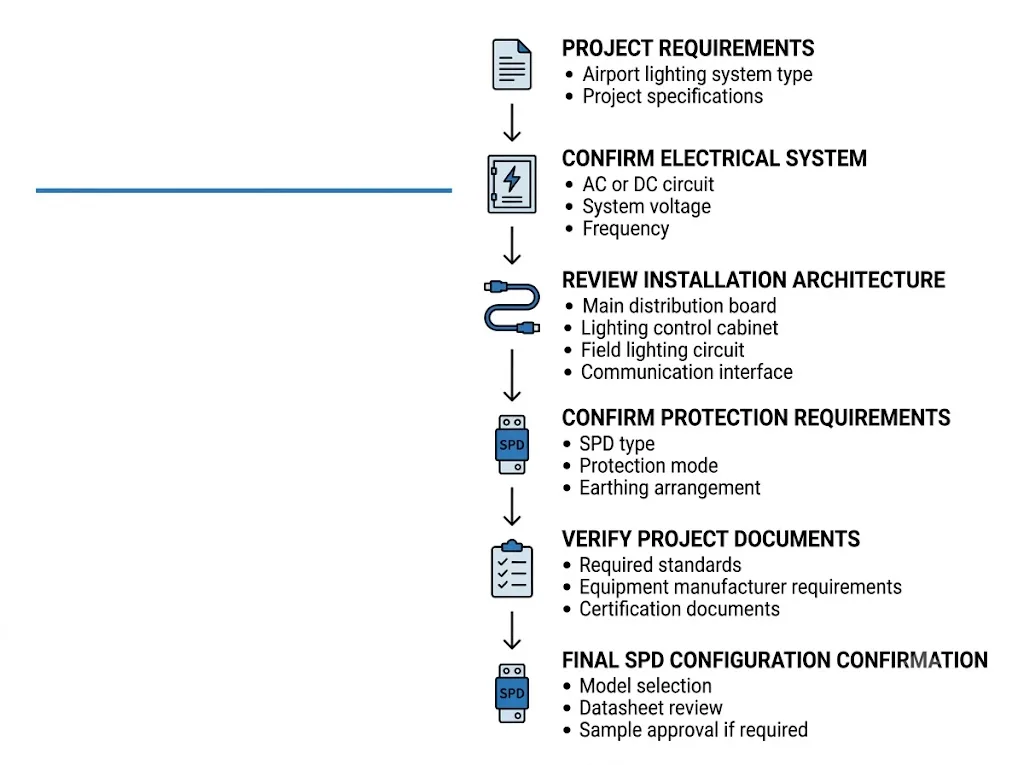
En los proyectos aeroportuarios, comenzar con un catálogo de SPD suele ser el orden incorrecto. Empiece por la arquitectura eléctrica y los documentos del proyecto, identifique los límites de protección y luego seleccione y verifique los dispositivos requeridos en esos límites.
Las normas del proyecto y la aprobación deben confirmarse por separado
Los proyectos de iluminación aeroportuaria pueden estar regidos por varias capas de requisitos. Las normas IEC proporcionan principios relevantes sobre rayos y SPD, mientras que las autoridades aeronáuticas y las especificaciones del proyecto rigen el equipo de iluminación de pista y los requisitos de aceptación del proyecto.[1][2][3][4]
El Anexo 14 de la OACI aborda los requisitos de aeródromos, y la FAA de EE. UU. publica material sobre equipos de iluminación aeroportuaria y material consultivo, incluidos documentos de la serie AC 150/5345.[3][4] Estos documentos aeronáuticos no deben interpretarse como una especificación universal del modelo de SPD.
No afirme que un SPD de uso general hace que una instalación de iluminación aeroportuaria cumpla automáticamente con la normativa. Antes de su aprobación, verifique los requisitos de la autoridad aeroportuaria correspondiente, las especificaciones del proyecto, la documentación del fabricante de AGL, las normas de los SPD y el alcance del certificado para el modelo específico propuesto.
Antes de hacer un pedido: lista de verificación de SPD para iluminación aeroportuaria
- País y especificación aplicable del aeropuerto o proyecto.
- Voltaje del sistema, frecuencia e información de CA/CC.
- Diagrama unifilar o arquitectura eléctrica relevante.
- Disposición de puesta a tierra y conexión equipotencial.
- Ubicación de la protección: distribución de entrada, armario de control, circuito de campo o interfaz de señal.
- Fabricante del CCR, modelo e información de interfaz relevante cuando corresponda.
- Aplicación de circuito de pista, calle de rodaje, aproximación u otro sistema AGL.
- Detalles de la interfaz de señal o comunicación si se requiere protección.
- Requisitos ambientales y de envolvente.
- Estándar, certificado, ficha técnica o documentación de prueba del SPD requerido.
- Requisito de indicación de estado o señalización remota.
- Cantidad y requisitos de OEM/marca privada cuando corresponda.
Cómo LEEYEE apoya la evaluación de SPD para iluminación aeroportuaria
LEEYEE es un proveedor especializado en protección contra sobretensiones y protección de baja tensión. CNSPD es la plataforma de LEEYEE centrada en la protección contra sobretensiones para compradores técnicos globales.
Para aplicaciones de iluminación aeroportuaria, LEEYEE puede brindar asistencia en la revisión de parámetros de SPD, documentación de modelos y discusiones sobre configuración OEM dentro del alcance de la gama de productos disponible. La idoneidad específica para el aeropuerto aún debe confirmarse frente a la arquitectura eléctrica real, la documentación del equipo y los requisitos de aprobación del proyecto.
Comparta el voltaje del sistema, el diagrama de circuito pertinente, la posición de instalación y los requisitos del proyecto. Esto proporciona al equipo técnico información suficiente para evaluar si una configuración de SPD disponible es adecuada para una evaluación posterior del proyecto.
Solicitar recomendación de modeloPreguntas frecuentes sobre la protección contra sobretensiones en iluminación aeroportuaria
¿Puede un solo SPD proteger todo el sistema de iluminación del aeropuerto?
No necesariamente. Los sistemas de iluminación aeroportuaria pueden contener varias rutas de entrada de sobretensiones y límites de protección. La alimentación eléctrica entrante, los circuitos de campo y las interfaces de comunicación deben evaluarse de acuerdo con la arquitectura real en lugar de asumir que un solo SPD protege el sistema completo.
¿Dónde se debe considerar la protección contra sobretensiones para la iluminación de la pista?
La revisión puede incluir la distribución entrante, el equipo de control de iluminación, los circuitos de campo pertinentes y las interfaces de comunicación. Las ubicaciones correctas dependen de la arquitectura de iluminación de la pista, el tendido de cables, las características del equipo y los requisitos del proyecto.
¿Se puede instalar un SPD de CA normal directamente en una salida de CCR?
No se debe asumir esto. Un circuito en serie de iluminación de aeródromo alimentado por CCR no es simplemente un circuito de iluminación en paralelo de bajo voltaje común. El diseño del CCR, las características del circuito y las instrucciones del fabricante deben verificarse antes de especificar la protección en esa interfaz.
¿Una mayor capacidad de corriente de sobretensión significa siempre una mejor protección para la iluminación del aeropuerto?
No. La capacidad de corriente de sobretensión es solo un parámetro. La compatibilidad de voltaje, el nivel de protección, el tipo de SPD, la posición de instalación, la conexión a tierra y la equipotencialidad, la coordinación y los requisitos del equipo protegido influyen en la selección final.
¿Las líneas de señal necesitan un SPD diferente al de las líneas de alimentación?
A menudo, sí. Las interfaces de alimentación y de señal tienen características eléctricas diferentes. Cualquier SPD de señal debe seleccionarse según el voltaje real de la interfaz, las características de la señal, el método de conexión y los requisitos del equipo.
¿Un SPD que cumple con la norma IEC está automáticamente aprobado para un proyecto aeroportuario?
No. El cumplimiento de una norma de SPD aplicable es solo una parte de la evaluación del proyecto. También puede ser necesario revisar los requisitos de la autoridad aeroportuaria, las especificaciones del proyecto, los requisitos del fabricante del equipo, el alcance del certificado y el diseño de la instalación.
Referencias
- Comisión Electrotécnica Internacional (IEC), serie IEC 62305, Protección contra rayos.
- Comisión Electrotécnica Internacional (IEC), serie IEC 61643, normas sobre dispositivos de protección contra sobretensiones que cubren las aplicaciones pertinentes de alimentación y señalización de baja tensión.
- Organización de Aviación Civil Internacional (OACI), Anexo 14 al Convenio sobre Aviación Civil Internacional, Aeródromos.
- Administración Federal de Aviación (FAA), Programa de certificación de equipos de iluminación aeroportuaria y circulares de asesoramiento aplicables de la serie AC 150/5345 sobre equipos de iluminación aeroportuaria.