
A compact automatic transfer switch is designed to transfer a load between two power sources. But if that ATS itself needs inspection, repair or replacement, it may become part of the maintenance problem. For hospitals, data centers and other critical-power projects, the key question is therefore: is a standard ATS enough, or does the complete system also need a maintenance-bypass path?
For many compact backup-power and control-panel applications, a standard ATS is sufficient when a planned ATS outage is acceptable or another independent load path already exists.
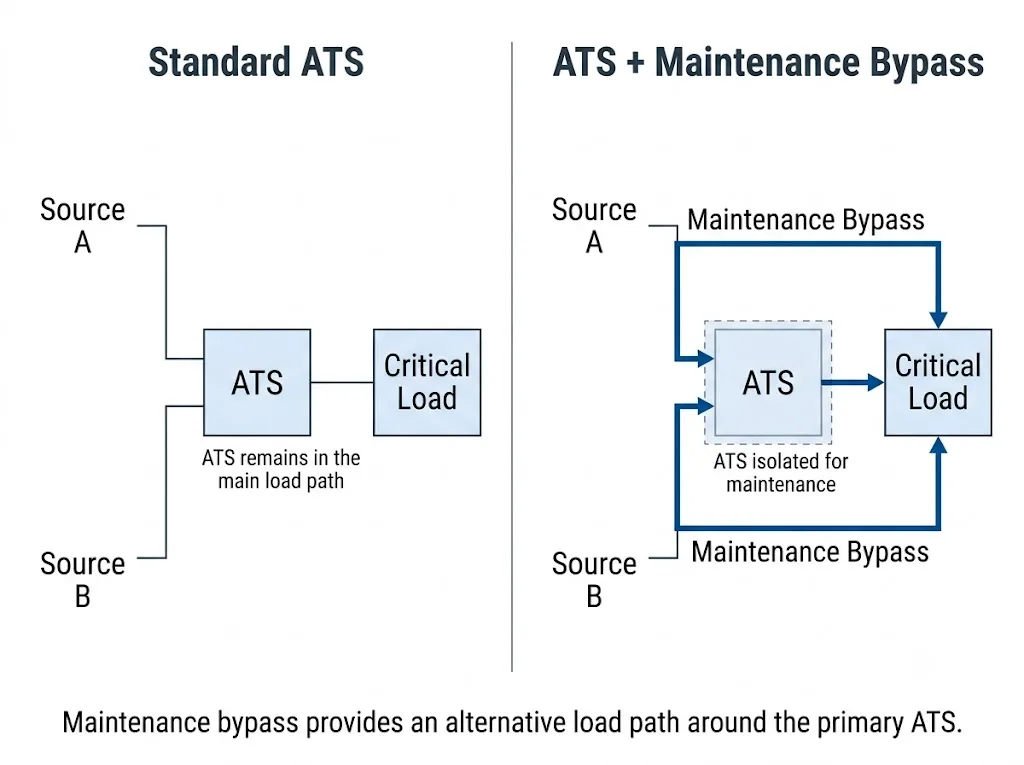
A maintenance bypass becomes relevant when the project requires the primary ATS to be taken out of service while an acceptable path to the load remains available. That bypass is normally a panel- or system-level design requirement; it should not be assumed to be built into a conventional compact ATS.
IEC 60947-6-1:2026 now explicitly includes bypass/isolation transfer switch equipment, or BTSE, with specific requirements in Annex C.[1]
Limite de segurança: this article explains engineering selection and procurement logic. It is not a field switching procedure. Actual bypass, isolation, testing and return-to-service work must follow the approved equipment documentation, facility procedure and qualified-person requirements.
Índice
First Question: Is a Standard ATS Already Enough?
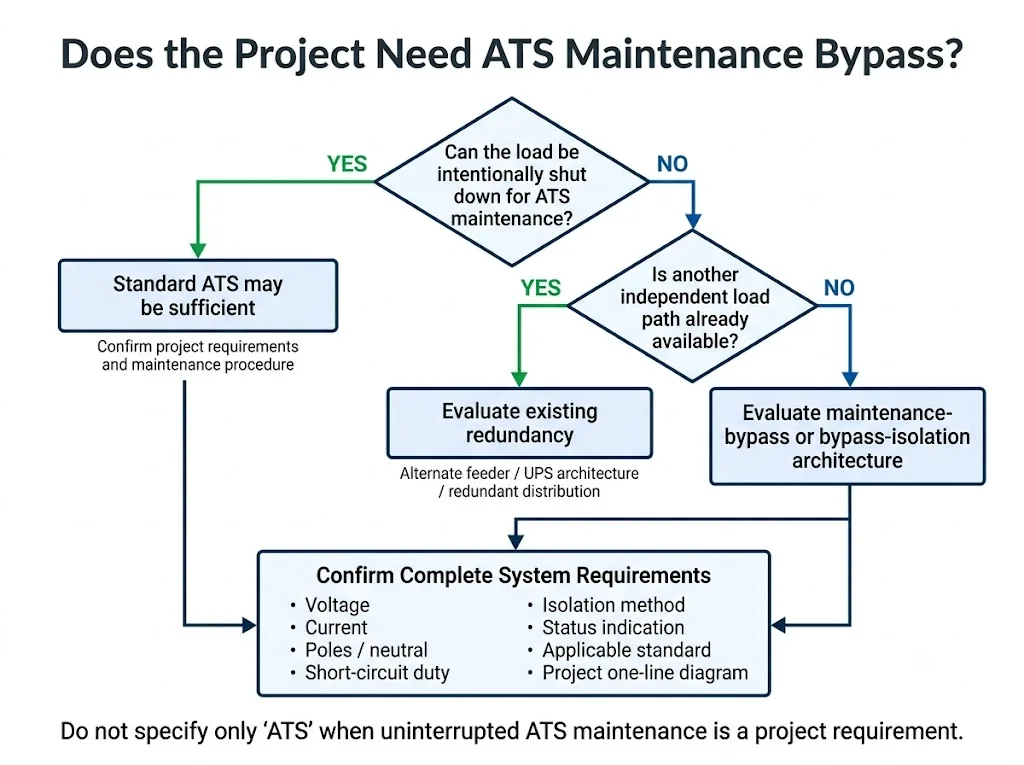
Before specifying a maintenance bypass, start with the actual maintenance consequence. A bypass should solve a real continuity problem, not simply add complexity to every ATS installation.
| Condição do Projeto | Initial Direction | Significado do Comprador |
|---|---|---|
| Planned ATS shutdown is acceptable | A standard ATS may be sufficient. | Confirm the outage window and maintenance procedure before adding bypass equipment. |
| Another independent load path already exists | Evaluate existing redundancy first. | The facility may already have another feeder, UPS path or redundant distribution route. |
| The ATS must be isolated while the load remains supplied | Evaluate a maintenance-bypass architecture. | The bypass path, isolation method and interlocking must be defined at system level. |
| The load cannot tolerate source-transfer interruption | ATS maintenance bypass alone is not enough. | UPS, closed-transition transfer or another ride-through strategy may need separate evaluation. |
Procurement conclusion: begin with the maintenance requirement, not with a more complex ATS type.
Why ATS Maintenance Can Affect the Load
In a normal two-source arrangement, Source A and Source B feed one ATS, and the ATS feeds the downstream load. That means the ATS itself is physically inside the required power path.
If the switch has to be de-energized or isolated for inspection, terminal work, mechanism service or replacement, the connected load can lose that path unless the system already provides another route.
Two separate functions must not be confused:
Source transfer: moving the load between two available sources.
Maintenance continuity: keeping an acceptable load path available while the primary ATS itself is out of service.
A conventional ATS primarily solves the first problem. A maintenance-bypass arrangement is considered only when the second problem also matters.
What Does a Maintenance Bypass Add to a Standard ATS?
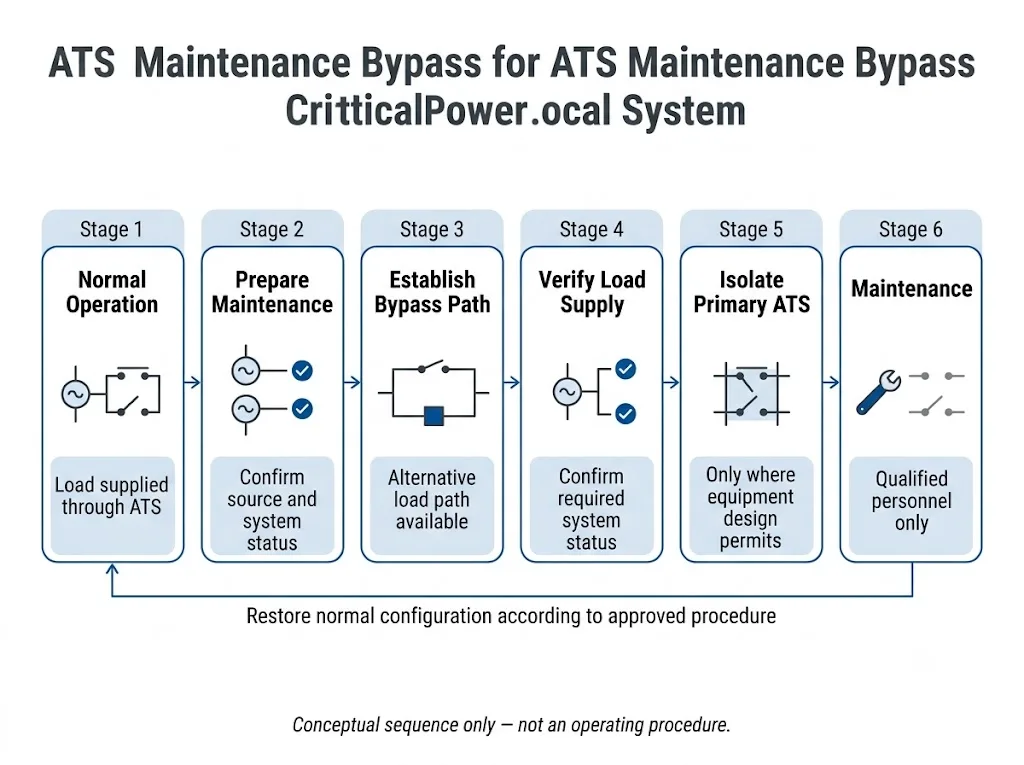
An ATS maintenance bypass creates another correctly rated power path around the primary transfer switch. Under the approved system design, the bypass path can carry the load while the primary ATS is isolated for supported maintenance.
Dedicated bypass/isolation equipment from manufacturers such as Eaton and Socomec integrates these maintenance functions into a coordinated assembly.[2][3] A panel builder can also engineer an external maintenance-bypass arrangement around a standard ATS, but the complete panel then has to be verified for ratings, fault conditions, isolation, interlocking and operating logic.
Significado de engenharia: do not assume that adding a generic parallel switch creates a verified maintenance-bypass system. The bypass path is part of the electrical architecture and must be designed accordingly.
Maintenance Bypass Does Not Mean Zero-Interruption Power
This distinction matters for hospitals and data centers. Maintenance bypass, source-transfer transition type and UPS ride-through are different engineering functions.
A bypass can preserve a load path around an ATS that is being serviced, but it does not itself store energy. It also does not automatically turn an open-transition ATS system into a zero-interruption system.
If the connected load cannot tolerate a source-transfer interruption, the project must separately evaluate UPS support, closed-transition transfer or another continuity architecture.
Do not specify maintenance bypass as a substitute for UPS ride-through. The required transfer interruption, maintenance continuity and source redundancy should be written as separate project requirements.
Why Hospitals and Data Centers Consider ATS Maintenance Bypass
Hospital Projects
Some healthcare loads have a high operational consequence if power must be intentionally interrupted for switch maintenance. In those cases, the design team may require a bypass or another redundant path so the ATS can be serviced without removing the required load path.
Eaton identifies bypass-isolation transfer equipment for healthcare and other mission-critical applications where maintenance and testing continuity are important.[4]
Data Center Projects
A data center normally evaluates ATS maintenance together with UPS topology, generator architecture, A/B distribution and redundant feeders. The correct question is whether taking one ATS out of service removes every acceptable path to the critical load.
Uptime Institute has documented a live data-center upgrade where maintenance-bypass switches were installed specifically to allow work on ATS equipment while the site remained operational.[5]
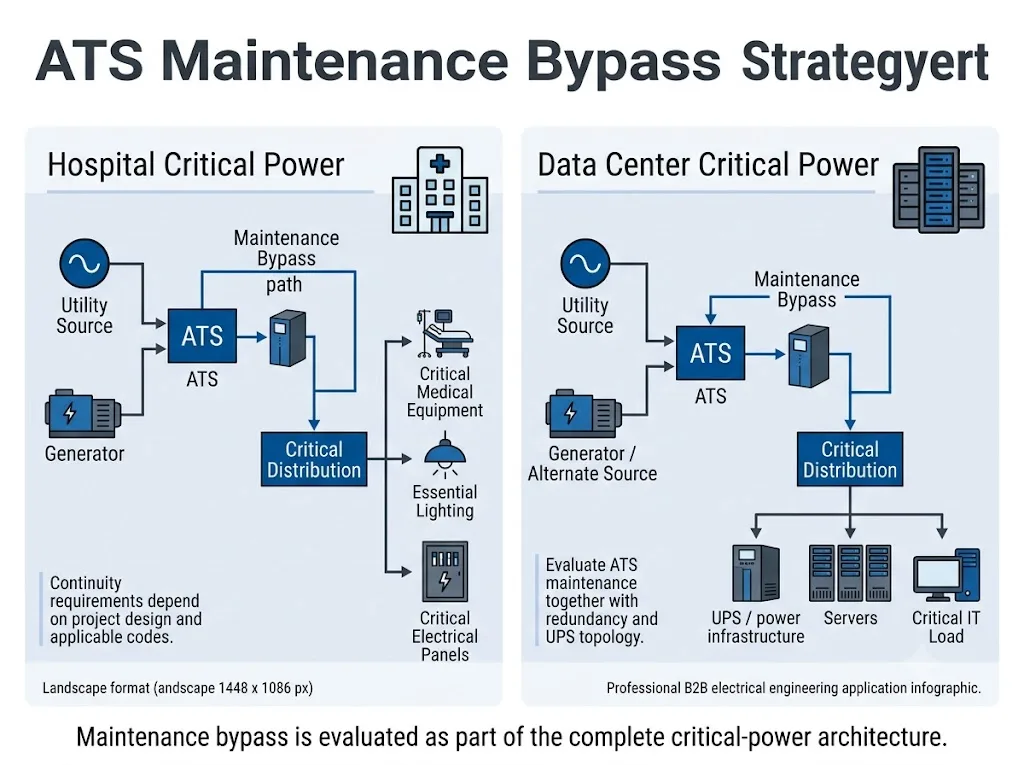
Significado do comprador: “hospital” or “data center” does not automatically mean “buy a bypass-isolation ATS.” First determine what actually happens to the required load when the existing standard ATS is taken out of service.
Where the LEEYEE Compact ATS Fits
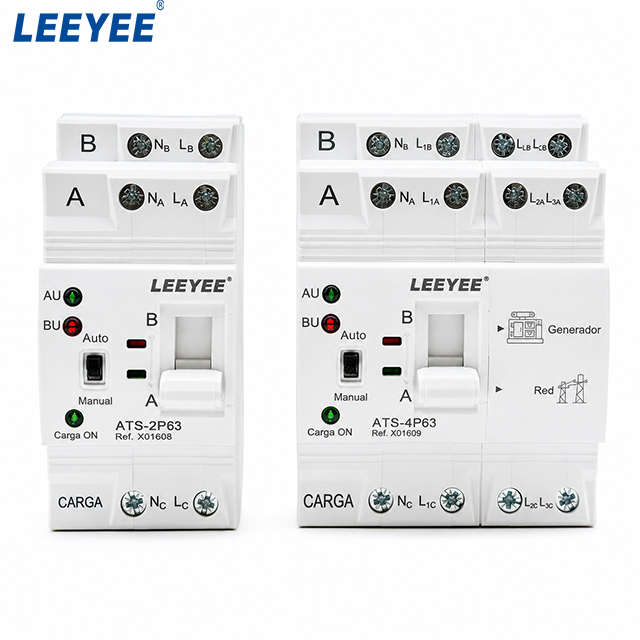
LEEYEE supplies a compact standard ATS, not an integrated bypass-isolation system
The LEEYEE ATS shown above is a compact automatic transfer switch for switching between two power sources. The current published ATS-63 range includes 2P and 4P configurations and current ratings up to 63A.[6]
Its published product specification does não declare an integrated maintenance-bypass switch, withdrawable transfer mechanism or bypass/isolation assembly.[6]
Therefore, when a project requires the ATS to be serviced while the load remains energized, that requirement must be evaluated at panel or system level. The solution may involve an external bypass path, existing system redundancy or another purpose-designed architecture.
When this LEEYEE ATS is a logical fit:
Compact backup panels, generator/mains source transfer, control panels and other applications where normal two-source transfer is required and ATS maintenance can be managed through a planned outage or existing redundancy.
When the project needs more than this ATS alone:
The primary ATS must be isolated without removing the required load path, or the project explicitly specifies maintenance bypass, bypass isolation, draw-out maintenance capability or source-transfer redundancy during ATS service.
External Maintenance Bypass vs Purpose-Designed Bypass Equipment
When a standard compact ATS is not enough for the maintenance requirement, the project generally needs to evaluate the next system layer rather than simply select a larger version of the same switch.
| Approach | Where It Is Defined | What Must Be Verified |
|---|---|---|
| Standard ATS + external bypass | Panel or system design | Bypass rating, isolation, short-circuit duty, interlocking, source arrangement and operating procedure |
| Purpose-designed bypass/isolation equipment | Manufacturer's declared equipment architecture | Equipment ratings, permitted operating modes, standards, project fit and model-specific documentation |
Neither approach should be selected from the word “bypass” alone. The complete maintenance objective has to be specified first.
Why Interlocking Matters When an External Bypass Is Added
An external maintenance path creates more possible switch combinations than a standard ATS installation. The system must prevent unintended states that could create unsafe backfeed, incorrect isolation or unintended source paralleling.
Depending on the architecture, coordination can involve mechanical interlocking, electrical interlocking or a manufacturer-integrated mechanism. The correct approach must be confirmed from the panel design and equipment documentation.
Instead of asking only: “Can you add bypass?”
Ask: “What devices carry the load during maintenance, how is the primary ATS isolated, what operating combinations are prevented, and what happens if the active source becomes unavailable during the maintenance condition?”
What Should the Panel Indicate?
A standard compact ATS can indicate its normal operating status, but once an external maintenance-bypass architecture is added, the complete panel may need additional indication so operators can identify the system state correctly.
- Normal-source available indication
- Alternate-source available indication
- Load supplied from normal or alternate source
- Auto / Manual state
- Fault alarm
- Bypass active indication
- ATS isolation status
- Remote dry contacts or communication signals
The exact functions are project-specific. Do not assume the compact ATS itself provides every bypass or panel-level indication listed above.
When You Probably Do Not Need a Maintenance Bypass
Maintenance bypass is valuable where the operational consequence justifies it, but it should not be treated as a default accessory for every compact ATS application.
- The load can be shut down during planned ATS maintenance
- The facility already has another verified independent load path
- The project has an acceptable maintenance window
- The ATS is installed in a non-mission-critical auxiliary panel
- The project specification does not require uninterrupted ATS maintenance
- The additional bypass architecture would add complexity without solving a real continuity requirement
This matters for compact 2P and 4P ATS applications because adding unnecessary bypass switching, enclosure space, interlocking and documentation can make a simple panel more complex without creating meaningful project value.
When a Standard ATS Is Not Enough
The project should move beyond a standard ATS-only design when the maintenance requirement clearly says that the ATS must be isolated while the downstream load remains supplied.
- Define the load consequence. Confirm whether an ATS outage is actually unacceptable.
- Check existing redundancy. Determine whether another feeder, UPS path or redundant distribution route already solves the maintenance problem.
- Define the required maintenance state. Confirm whether the load only needs to remain on one source or whether source-transfer capability must also remain available.
- Specify the external architecture. Define bypass switching, isolation, interlocking and status requirements at panel level.
- Verify electrical ratings. Confirm current, voltage, poles, neutral arrangement, available fault current and upstream protection.
- Approve the operating documentation. The final system should have a clear one-line diagram and model-specific maintenance procedure.
What Evidence Should a Supplier or Panel Builder Provide?
For a normal compact ATS order, the ATS datasheet may be enough to confirm the transfer device itself. Once maintenance bypass becomes part of the project, the buyer needs information for the complete architecture.
- Model-specific ATS datasheet
- Rated voltage, current, frequency and pole configuration
- Utilization category or declared switching duty
- Short-circuit information applicable to the proposed equipment
- Panel one-line diagram
- Clear drawing of the maintenance-bypass path
- Interlocking description
- Permitted operating-state description
- Isolation boundary or maintenance concept
- Local and remote status indication requirements
- Operating and maintenance instructions
- Applicable project-standard or certification documents where required
A certificate or test report for a standard ATS should not automatically be interpreted as approval of a complete external maintenance-bypass panel. Document scope must be checked for the actual project.
What to Send LEEYEE Before Selecting the ATS
- Normal-source voltage
- Alternate-source voltage
- Sistema monofásico ou trifásico
- Required 2P or 4P configuration
- Corrente de carga
- Tipo de carga
- Generator or utility source arrangement
- Whether neutral switching is required
- Whether a planned ATS outage is acceptable
- Whether another independent load path already exists
- Whether the project explicitly requires maintenance bypass
- Panel one-line diagram when available
Need to confirm whether the LEEYEE compact ATS is enough?
Send your voltage, current, 2P/4P requirement, two power sources, load type and maintenance requirement. LEEYEE can help confirm whether a standard compact ATS matches the project or whether your panel designer should evaluate an additional maintenance-bypass architecture.
Perguntas mais frequentes
Does a standard ATS include a maintenance bypass?
Not automatically. A standard ATS transfers the load between two sources. A separate maintenance-bypass path is only present when the equipment or complete panel is specifically designed to provide that function.
Does the LEEYEE compact ATS shown on this page include an integrated maintenance bypass?
No integrated maintenance-bypass or bypass/isolation function is declared in the current published specification for this compact LEEYEE ATS. If the ATS must be isolated while the load remains supplied, the additional maintenance architecture must be evaluated separately.[6]
Can I add an external maintenance bypass around a standard ATS?
It can be part of a panel-level engineering solution, but it should not be treated as a simple accessory connection. The designer must confirm switching ratings, fault duty, isolation, interlocking, source arrangement and the approved operating sequence.
Do hospitals always need a bypass-isolation ATS?
No universal rule should be assumed. The decision depends on the actual critical load, adopted healthcare and electrical requirements, redundancy, maintenance strategy and project specification.[4]
Do data centers always need ATS maintenance bypass?
No. A data center may already have UPS systems, A/B feeds or another redundant path. The maintenance requirement must be assessed at system level before adding bypass equipment.[5]
Does maintenance bypass mean there will be no power interruption?
No. Maintenance bypass keeps an alternative path available around equipment that is being serviced. The interruption associated with source transfer depends on the transfer architecture, and a bypass does not provide stored energy like a UPS.
When is a standard compact ATS the better choice?
A standard compact ATS is often appropriate when the project mainly needs automatic transfer between two sources and a planned ATS maintenance outage is acceptable or already covered by another independent load path.
What should I tell the ATS supplier before ordering?
Provide system voltage, current, phase arrangement, pole configuration, source types, load type, neutral-switching requirement and whether the project requires uninterrupted ATS maintenance. A one-line diagram is especially useful for project confirmation.
Referências
- Comissão Eletrotécnica Internacional. IEC 60947-6-1:2026 — Aparelhagem de baixa tensão — Parte 6-1: Equipamentos multifuncionais — Equipamentos de comutação de transferência. The fourth edition includes bypass/isolation transfer switch equipment and specific BTSE requirements in Annex C. Página de publicação oficial da IEC.
- Eaton. Bypass Isolation Contactor Type Automatic Transfer Switches. Manufacturer technical information describing primary transfer, bypass switching and maintenance-isolation functions for mission-critical applications. Eaton technical page.
- Socomec. ATyS Bypass — No-break ATS Maintenance Bypass. Manufacturer information describing a dedicated maintenance-bypass architecture and declared product operating functions. Socomec technical page.
- Eaton. Healthcare Design Guide — Bypass Isolation Automatic Transfer Switches. Technical guidance on transfer-switch maintenance continuity in healthcare and other mission-critical electrical systems. Eaton healthcare design guide.
- Uptime Institute. U.S. Bank Upgrades Its Data Center Electrical Distribution. Project documentation describing maintenance-bypass switches used to enable ATS work during a live data-center electrical upgrade. Uptime Institute project article.
- LEEYEE. ATS-63 Automatic Transfer Switch. Current published product information for the compact LEEYEE ATS range, including 2P/4P configuration and rated-current options up to 63A. LEEYEE ATS-63 technical specifications.
Technical requirements vary by project. Final ATS selection, external maintenance-bypass design, switching sequence, isolation method, interlocking, short-circuit coordination and applicable standards must be confirmed against the approved one-line diagram, project specification and model-specific documentation before installation or operation.