
A hospital automatic transfer switch should be selected according to the circuit it supplies, not simply because the installation is a hospital. For a generator-backed system, the main engineering question is whether the connected load can tolerate the interruption of an open-transition transfer. Medical locations have specific electrical-installation requirements, so the final transfer arrangement must follow the approved project design and applicable local rules.[1]
A compact open-transition ATS may be suitable for hospital general backup distribution, auxiliary equipment or other circuits where a break-before-make transfer is acceptable.
It should not be assumed suitable for every critical medical or life-safety circuit. If a load cannot tolerate the interruption between normal and generator power, the project may require UPS support or another continuity solution. Open transition is a break-before-make transfer method.[4]
Before selecting an ATS, confirm the load function, allowable interruption, source voltage, rated current, 2P or 4P configuration, neutral treatment, generator interface, fault conditions and applicable project requirements.
Índice
Where Does an ATS Fit in a Hospital Backup Power System?
A hospital backup-power system can include a normal utility supply, generator sets, transfer equipment, distribution boards, UPS systems and other continuity measures. The ATS has one defined role within that architecture: it transfers its connected load between available power sources.
IEC 60947-6-1:2026 applies to transfer switching equipment used to transfer a load between power supply sources. The current edition covers automatic transfer switching equipment and separately addresses bypass/isolation transfer switching equipment and ATSE with closed-transition capability.[2]
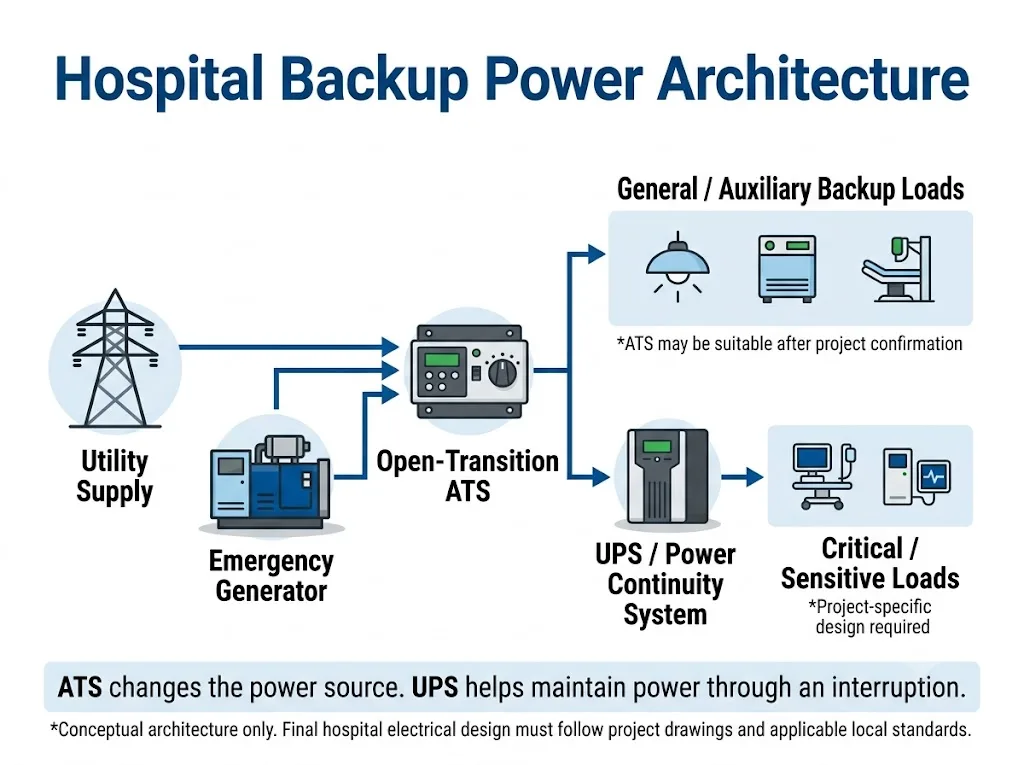
In a generator-backed arrangement, the normal source supplies the designated circuit during normal operation. When the normal source becomes unavailable or unacceptable, an ATS control sequence can initiate or respond to the alternate source and transfer the connected load when the required source conditions are satisfied. A typical ATS sequence includes transfer to a stable alternate source and later retransfer after the normal source returns.[4]
Significado do comprador: the ATS changes which source feeds the circuit. It does not automatically make the downstream load uninterrupted.
Which Hospital Circuits Can Use a Compact Open-Transition ATS?
The phrase hospital ATS does not identify one universal switch configuration. The useful selection question is: what does this circuit supply, and what happens if power is interrupted during transfer?
IEC 60364-7-710:2021 applies specifically to electrical installations in medical locations, including hospitals and clinics, with the objective of providing safety for patients and medical staff.[1] The formal classification and supply requirements therefore have to come from the actual hospital project rather than from a generic product article.
| Circuit Situation | Questão de seleção | Open-Transition ATS | Required Action |
|---|---|---|---|
| General backup distribution | Can the circuit accept an interruption during source transfer? | Potentially suitable | Confirm electrical ratings and approved drawings |
| Auxiliary equipment | Can the equipment stop briefly and restart correctly? | May be suitable | Confirm equipment behaviour and sequence of operation |
| Sensitive electronic loads | Would the transfer interruption stop the required function? | ATS alone may not be enough | Evaluate UPS or other continuity measures |
| Critical or life-safety-related circuits | What continuity and regulatory requirements apply? | Do not assume suitability | Follow the approved hospital electrical design |
This table is a procurement decision aid, not a medical-load classification standard. The actual circuit category and supply requirements must be confirmed from the applicable project documents.
Do not select the transfer method from a room name alone. Terms such as ICU, operating room, laboratory or hospital lighting do not by themselves define the correct ATS architecture. Medical use, circuit function, continuity requirement and local rules must all be considered.
ATS vs UPS: Why a Hospital May Need Both
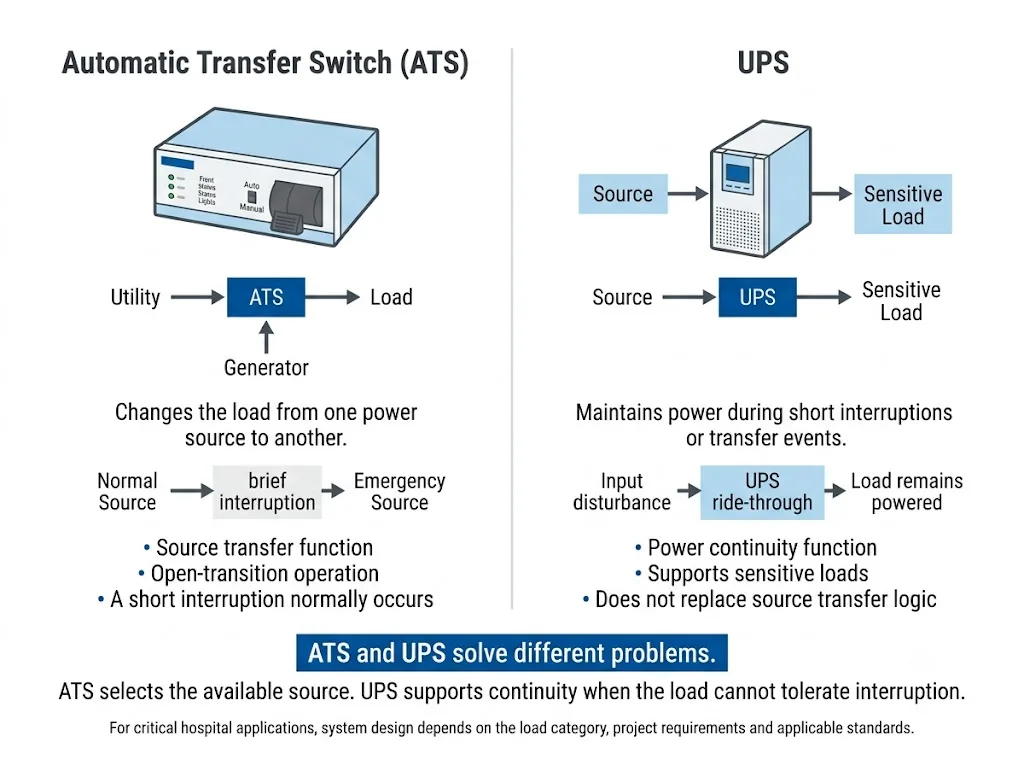
An ATS and a UPS solve different problems. An ATS selects between power sources. A UPS supports the downstream load when power continuity is required through an upstream interruption.
Open-transition ATS operation is break-before-make: the first source is disconnected before the second source is connected.[4] Therefore, a standard open-transition ATS should not be described as providing zero-interruption power.
| Decision Point | ATS | UPS |
|---|---|---|
| Função principal | Transfer a load between sources | Support continuity of the connected load |
| Generator relationship | Participates in source-transfer logic | Can support the load while upstream power changes |
| Open-transition interruption | A break exists between sources | May bridge an interruption when correctly designed |
| Main selection inputs | Source system, current, poles, load duty and fault conditions | Load power, runtime, topology and redundancy requirements |
Where Is the Limit of a Standard Open-Transition ATS?
IEC 60947-6-1:2026 treats several transfer-switching functions separately. Its scope includes ATSE, bypass/isolation transfer switching equipment and ATSE having closed-transition capability.[2]
This distinction matters for hospital procurement. A specification that requests closed transition, bypass isolation or another specialist transfer arrangement should not be matched automatically to a standard compact open-transition ATS.
Significado de engenharia: if the specification says “closed transition,” “bypass isolation,” “static transfer,” “no-break transfer” or gives another special continuity requirement, the requirement should be reviewed separately instead of being treated as a normal compact ATS application.
Start ATS Selection with the Load, Not the Ampere Rating
Current rating matters, but it should not be the first hospital ATS decision. A better procurement sequence starts with the downstream circuit and its acceptable interruption.
Define exactly what distribution board, auxiliary equipment or other load will be supplied by the ATS.
Determine whether break-before-make transfer is acceptable or whether the circuit needs additional continuity support.
Check the normal and backup source voltage, frequency, phase arrangement and generator control interface.
Match the product configuration to the actual single-phase or three-phase circuit and the project's neutral-switching requirement.
Confirm rated current, upstream protection and prospective short-circuit conditions against the applicable ATS documentation.
Check the proposed ATS against the single-line diagram, consultant specification, required standards and project approval documents.
2P or 4P: Which LEEYEE ATS Configuration Fits?
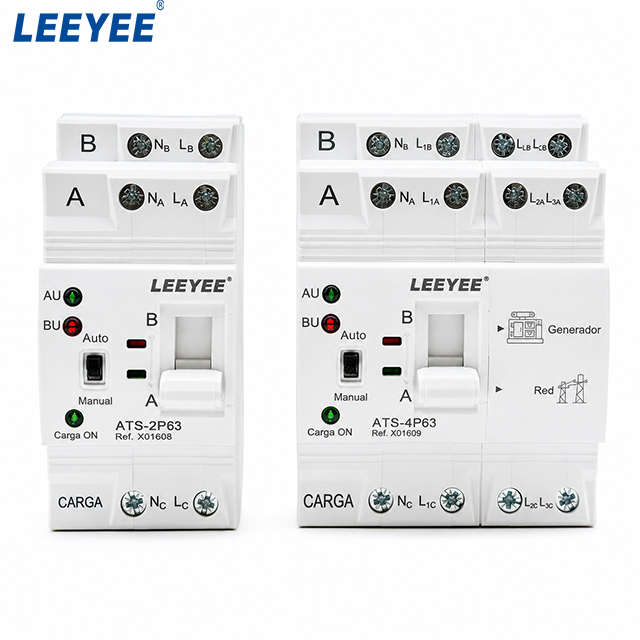
The LEEYEE compact ATS product form relevant to this guide is offered in 2P and 4P configurations. The choice should follow the actual electrical system rather than the hospital application name.
| Configuração | Typical Context | O que deve ser confirmado |
|---|---|---|
| 2P | Relevant single-phase transfer applications | System voltage, current, conductor arrangement, load type and project requirements |
| 4P | Relevant three-phase applications where the project requires four-pole transfer | Phase arrangement, neutral treatment, generator connection, earthing/protection design and approved single-line diagram |
Buyer conclusion: do not specify 4P merely because the building is a hospital. The neutral and source arrangement must be confirmed from the electrical design.
Neutral switching requires project confirmation. The correct arrangement depends on the source and earthing design, generator connection, protection strategy and applicable project requirements. A general article should not override the approved single-line diagram.
How Generator Start and Transfer Sequence Affect Selection
A generator-backed ATS is part of a sequence rather than an isolated switch. A typical ATS sequence detects loss of the normal source, transfers after the alternate source is stable within the required electrical conditions, and later retransfers when the normal source is restored.[4]
NFPA 110:2025 addresses emergency and standby power systems, including power sources, transfer equipment, controls and supervisory equipment.[3]
The exact generator-start delay, transfer delay, retransfer delay and cooldown logic should therefore come from the approved sequence of operation, generator characteristics, connected load and applicable project requirements. A universal hospital delay value should not be copied from a generic article.
Procurement tip: if the generator integrator or consultant has already issued a sequence of operation, start-signal requirement or timing requirement, send that document together with the ATS enquiry.
The Actual LEEYEE ATS Product Covered by This Guide
The image below shows the actual LEEYEE compact ATS product form discussed in this article. It includes 2P and 4P versions and an integrated front interface with Auto/Manual operation and source-status indication.
Relevant application boundary:
This compact ATS can be evaluated for general backup distribution, auxiliary equipment, equipment panels and other low-voltage circuits where an open-transition source transfer is acceptable. It is not presented here as a universal solution for all critical medical or life-safety circuits.
The product should also not be described as a closed-transition ATS, bypass-isolation ATS, static transfer switch or zero-interruption power system. IEC 60947-6-1:2026 distinguishes those transfer functions from standard ATSE arrangements.[2]
What Must Be Verified Before Ordering?
A hospital ATS enquiry should contain enough information to determine whether the actual circuit matches the product. This reduces the risk of choosing a switch that has the correct current rating but the wrong system configuration or transfer behaviour.
| Item | Por que Isso Importa | What to Provide |
|---|---|---|
| Load function | Determines the required continuity and whether open transition is acceptable | Equipment or distribution circuit served by the ATS |
| Allowed interruption | Separates ordinary source-transfer applications from continuity-sensitive loads | Project or equipment requirement |
| Source voltage and frequency | Must match both normal and backup sources | Utility and generator source data |
| Corrente nominal | Defines the required continuous current capability | Design load current and panel rating |
| 2P ou 4P | Must match the intended conductor-transfer arrangement | Single-phase/three-phase system and neutral requirement |
| Generator interface | Affects the automatic source-transfer sequence | Generator start/contact and control requirements |
| Fault conditions | The ATS and protective devices must be coordinated for the actual system | Prospective fault current and upstream protection data |
| Standards and documents | Hospital requirements differ between jurisdictions and projects | Applicable standards, certificate requirements and consultant specifications |
Procurement conclusion: current rating is only one part of ATS selection. The transfer method, poles, system arrangement, fault conditions and project requirements must also match.
Which Standards Should a Hospital ATS Buyer Check?
Product requirements and medical-installation requirements should be checked separately. One standard does not automatically prove compliance with every requirement of the complete hospital power system.
| Referência | Main Scope | Significado do Comprador |
|---|---|---|
| IEC 60947-6-1:2026 | Transfer switching equipment | Verify the transfer-switch product and declared technical scope |
| IEC 60364-7-710:2021 | Electrical installations in medical locations | Verify medical-location installation requirements |
| NFPA 110:2025 | Emergency and standby power systems | Relevant where the project uses the NFPA emergency-power framework |
IEC 60947-6-1:2026 applies to transfer switching equipment with rated voltage not exceeding 1,000 V AC or 1,500 V DC and covers several transfer-switching categories, including ATSE, bypass/isolation equipment and ATSE with closed-transition capability.[2]
IEC 60364-7-710:2021 addresses electrical installations in medical locations, including hospitals and clinics.[1] NFPA 110:2025 provides requirements for emergency and standby power systems where that framework applies.[3]
Project confirmation is mandatory. The applicable standards, editions, healthcare rules and approval process depend on the project country and electrical design. Request the actual consultant specification and required document list before confirming the ATS.
Hospital ATS Enquiry Checklist
Before requesting a model recommendation, prepare the information below. This turns the enquiry from “I need a hospital ATS” into an engineering selection request that can actually be reviewed.
- Project country and applicable standards
- What load or distribution circuit the ATS will supply
- Maximum acceptable transfer interruption
- Normal-source voltage and frequency
- Generator or backup-source voltage and frequency
- Sistema monofásico ou trifásico
- Required rated current
- Required 2P or 4P configuration
- Neutral-switching requirement
- Generator start/contact requirement
- Transfer and retransfer sequence requirements
- Corrente de curto-circuito prospectiva
- Upstream protective-device information
- Required certificates or technical documents
- Single-line diagram and consultant specification where available
Need to confirm whether a compact LEEYEE ATS fits your hospital project?
Send the source details, load function, current, 2P or 4P requirement, generator arrangement and relevant project documents. LEEYEE can review the application against the actual compact open-transition ATS scope and identify items that still require project confirmation.
Hospital Automatic Transfer Switch FAQ
Can a compact automatic transfer switch be used in a hospital?
It may be used for circuits where open-transition transfer is acceptable and the electrical ratings and project requirements are satisfied. It should not be assumed suitable for every critical medical or life-safety circuit.
Is the LEEYEE ATS a hospital-grade ATS?
This guide does not make that claim. The product shown is a compact low-voltage automatic transfer switch. Suitability for a hospital project must be verified from the actual circuit, product documentation, required standards and approval requirements.
Does an open-transition ATS provide uninterrupted power?
No. Open transition is break-before-make: one source is disconnected before the other source is connected.[4] Loads that cannot tolerate that interruption may need UPS support or another continuity solution.
Is an ATS the same as a UPS?
No. An ATS transfers a circuit between sources. A UPS supports power continuity for its connected load. A hospital backup-power design may use both.
Should I choose a 2P or 4P ATS for a hospital project?
Choose according to the real electrical system. Confirm whether the circuit is single-phase or three-phase and whether the project requires the neutral to be switched. The approved single-line diagram should control the final selection.
Can the ATS work between utility power and a generator?
That is a common ATS architecture. A typical ATS transfers a connected load to an available alternate source and retransfers after the normal source is restored.[4] The actual generator interface and timing must still match the project.
What information matters most before ordering?
Start with the load function and allowable interruption. Then confirm source voltage, current, 2P or 4P configuration, neutral treatment, generator interface, fault conditions and applicable project standards.
Which standards are relevant to hospital ATS selection?
IEC-based projects may reference IEC 60947-6-1 for transfer switching equipment and IEC 60364-7-710 for electrical installations in medical locations. NFPA 110 can also be relevant to projects using the NFPA emergency and standby power framework. The final list must be confirmed for the project location and specification.[1][2][3]
Confirm the application before fixing the ATS model
For a useful technical review, provide the single-line diagram, source details, load function, current, 2P or 4P requirement and applicable project standards.
Referências
- Comissão Eletrotécnica Internacional. IEC 60364-7-710:2021 — Low-voltage electrical installations — Part 7-710: Requirements for special installations or locations — Medical locations. Página de publicações oficiais da IEC.
- Comissão Eletrotécnica Internacional. IEC 60947-6-1:2026 — Aparelhagem de baixa tensão — Parte 6-1: Equipamentos multifuncionais — Equipamentos de comutação de transferência. Página de publicações oficiais da IEC.
- National Fire Protection Association. NFPA 110 — Standard for Emergency and Standby Power Systems, 2025 Edition. NFPA official publication page.
- Eaton. Fundamentals of Automatic Transfer Switches (ATS). Technical explanation of normal and alternate source transfer, typical transfer sequence and open-transition break-before-make operation. Eaton technical resource.