
Um gabinete PLC pode já ter um dispositivo de proteção contra surto AC na entrada de energia, mas isso não protege automaticamente os terminais de sinal PLC.
Muitas falhas de PLC ocorrem através das linhas “pequenas”: entrada digital, saída digital, entrada analógica, saída analógica, RS485, laço 4-20mA, cabo de sensor, cabo de E/S remoto e fiação de dispositivos de campo.
Este guia explica quando as linhas de I/O e sinal PLC precisam de proteção contra surto, como escolher um SPD de sinal adequado e quais informações fabricantes de painéis ou compradores de OEM devem confirmar antes de fazer um pedido.
Índice
Resposta Rápida
Use proteção contra surto de sinal para linhas I/O PLC e de comunicação quando o cabo sair do gabinete de controle, correr ao ar livre, conectar a instrumentos de campo, cruzar entre máquinas ou edifícios, ou ser instalado perto de motores, VFDs, bombas, solenóides ou cabos de energia longos.
Um SPD Tipo 2 AC protege a entrada de energia do gabinete. Um SPD de sinal protege o caminho de baixa tensão que entra no terminal PLC. Esses são pontos de proteção diferentes e não devem ser trocados entre si.
Para circuitos de sinal, dados e comunicação, a seleção de SPD é normalmente considerada sob o escopo de proteção contra surtos na linha de sinal, comumente referida pela IEC 61643-21, em vez das regras de seleção de SPD de potência CA.
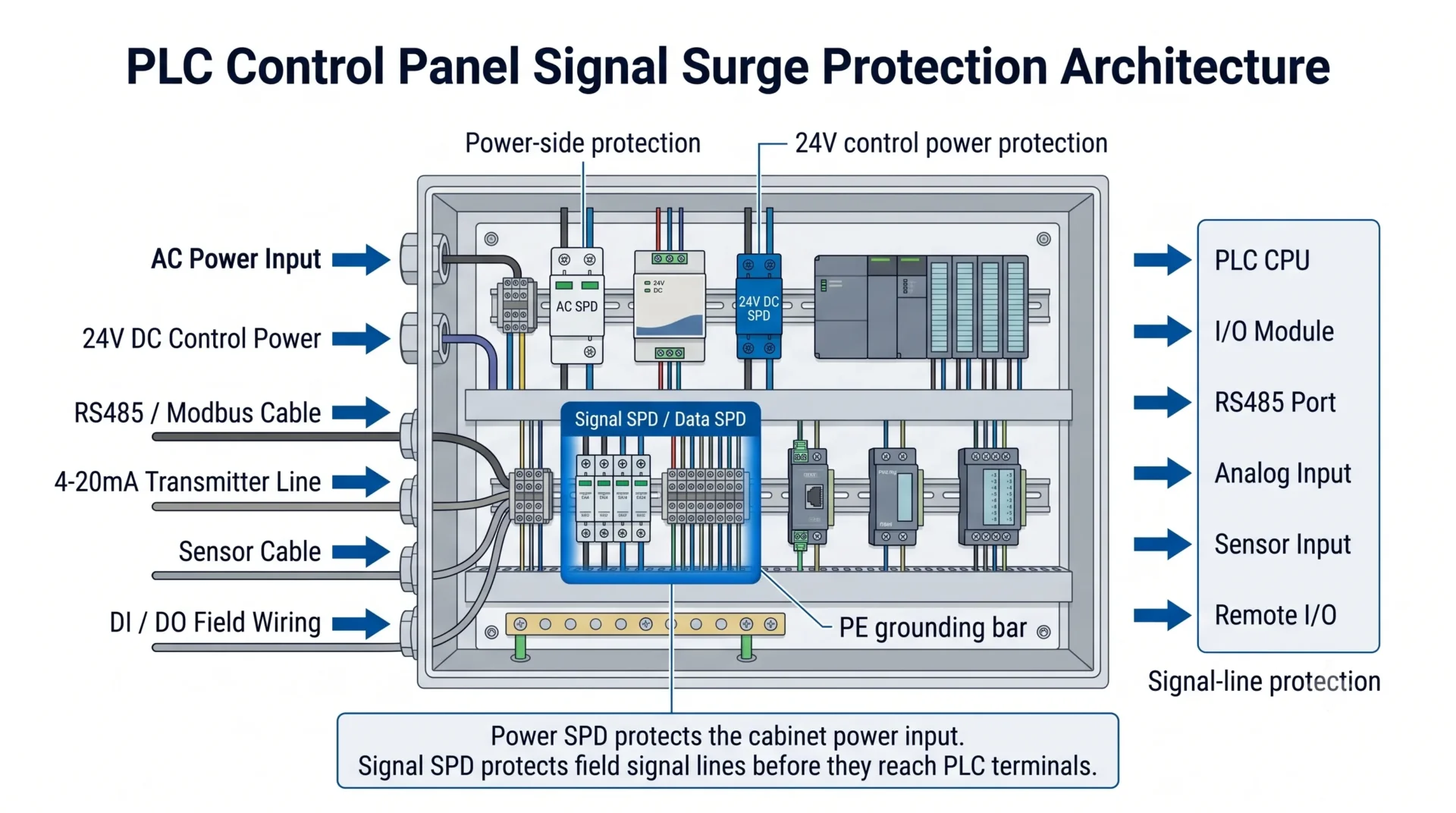
| Linha PLC | Exemplo Típico | Quando o SPD de Sinal é Recomendado | Significado do Comprador |
|---|---|---|---|
| Entrada digital / Saída digital | Entrada digital de 24V, saída de relé, sinal de status da máquina | Fiação longa de campo, equipamentos ao ar livre, cargas indutivas, seções de máquina separadas | Protege os terminais de E/S do PLC contra tensões transitórias que entram através dos fios de campo. |
| IA / OA | Loop de transmissor 0-10V, 4-20mA | Sensor ou transmissor está fora do gabinete ou o cabo está exposto a acoplamento de surto | Ajuda a reduzir danos e leituras instáveis em módulos analógicos. |
| RS485 \/ Modbus RTU | PLC para medidor, inversor, E/S remota, dispositivo SCADA | Cabo de barramento longo, RS485 ao ar livre, múltiplos gabinetes, zonas de aterramento diferentes | Protege as portas de comunicação sem usar um SPD de potência CA em uma linha de dados. |
| Linha de Sensor | Sensor de proximidade, sensor de pressão, sensor de nível, medidor de vazão | O cabo do sensor corre ao longo de bandejas de campo, próximo a motores ou fora da área protegida do gabinete. | Protege o caminho de sinal fraco antes de chegar aos terminais de entrada do PLC. |
| Cabo de Dispositivo de Campo | Atuador de válvula, sinal da bomba, status de equipamento remoto | Cabo conecta equipamentos em outra zona, outro gabinete ou área externa | Reduz o risco de sobretensão devido à diferença de potencial de terra e transientes induzidos. |
Por que as Linhas de Sinal PLC Precisam de Proteção contra Surto
Um painel de controle PLC não é protegido apenas através de seu cabo de alimentação de entrada. A energia de sobretensão pode entrar por qualquer caminho condutor conectado ao sistema PLC.
Para painéis de controle industriais, os caminhos mais comuns são:
- Energia AC de entrada para o gabinete de controle.
- Barramento de potência de controle de 24VDC dentro do gabinete.
- Fiação de I/O do PLC conectada a dispositivos de campo.
- RS485, Modbus RTU, linhas de telemetria e de monitoramento remoto.
- Cabos de sensores e instrumentos que seguem para fora do gabinete.
É por isso que um gabinete de controle pode precisar tanto de SPDs de potência quanto de SPDs de sinal. O SPD de potência lida com a energia de surto no lado da alimentação elétrica. O SPD de sinal lida com sobretensão transitória no lado de controle ou comunicação de baixa tensão.
Importante: Um SPD em CA Não Protege Todos os Terminais do PLC
Se um cabo de sensor de 50 metros entrar no gabinete e se conectar diretamente a um módulo de entrada do PLC, um surto induzido nesse cabo pode alcançar o PLC antes que o SPD em CA tenha qualquer chance de ajudar.
Por esse motivo, os SPDs de sinal devem ser considerados no ponto de entrada do cabo de campo, especialmente quando os cabos são longos, externos, expostos ou conectados a equipamentos remotos.
Proteção contra Surto de I/O PLC: Quais Linhas Precisam de SPD de Sinal?
Nem todo fio de sinal pequeno precisa de um SPD separado. A decisão correta depende do trajeto do cabo, da exposição, do ambiente de instalação, da importância do sistema e da especificação do projeto.
Geralmente vale a pena proteger
- Sensores e transmissores externos.
- Linhas de barramento RS485 entre gabinetes.
- Cabos de E/S remota.
- Loops de 4-20mA provenientes de instrumentos de campo.
- Cabos de sinal próximos a VFDs, motores, bombas ou cabos de potência longos.
- Linhas de controle que entram de outro edifício ou de outra área de aterramento.
Pode não precisar sempre de SPD separado
- Cabeamento interno muito curto dentro do mesmo gabinete.
- PLC e módulo de E/S instalados em um único invólucro protegido.
- Sem cabo externo e sem longo trecho de cabo de campo.
- Sinal de controle não crítico de baixo valor.
- A especificação do projeto não exige proteção contra surtos na linha de sinal.
Para painéis de controle OEM, a abordagem mais segura é confirmar isso durante o projeto em vez de esperar até a comissionamento em campo. Depois que o painel já foi cabeado, a adição de DPS de sinal pode exigir alterações no layout dos terminais, espaço em trilho DIN, revisão do aterramento e novos desenhos de fiação.
Você Precisa de Proteção contra Surto em Cada Ponto de I/O PLC?
Normalmente, não. Instalar um DPS em cada ponto de E/S pode aumentar o custo, o espaço no gabinete, o tempo de fiação e a complexidade de manutenção.
Um método de seleção B2B melhor é agrupar os pontos de E/S por exposição:
| Grupo de E/S | Nível de risco | Recomendação prática |
|---|---|---|
| Sinais internos do gabinete | Baixa | Normalmente, confie em bom aterramento do gabinete, separação da fiação e proteção no lado da alimentação. |
| Sensores curtos montados na máquina | Médio | Revise a rota do cabo, o ambiente da máquina e a especificação do cliente. |
| Sensores externos ou cabos longos de campo | Elevado | Use DPS de sinal próximo à entrada do cabo no gabinete ou antes do terminal do PLC. |
| RS485 entre gabinetes ou edifícios | Elevado | Use um DPS adequado para RS485 / sinal de dados e confirme tensão, protocolo, baud rate e aterramento. |
| Medição crítica de processo | Elevado | Protege o loop analógico ou o sinal do transmissor quando a parada ou uma leitura falsa tem alto custo. |
Regra simples para montadores de painéis
Se o fio permanecer dentro do gabinete, o risco de surto geralmente é menor. Se o fio sair do gabinete e seguir para o campo, trate-o como uma possível via de entrada de surtos.
SPD de Sinal vs Contato de Alarme Remoto SPD
Esses dois termos costumam ser confundidos, especialmente em painéis de PLC.
A SPD de sinal protege uma linha de comunicação ou controle de baixa tensão, como RS485, cabeamento de sensor ou um circuito de sinal industrial.
Um contato de alarme remoto do SPD é apenas um contato de status em um SPD de potência. Ele informa ao PLC se o módulo SPD está normal ou com falha. Ele não protege a própria linha de sinal do PLC.
| Item | SPD de Sinal | Contato de Alarme Remoto do SPD |
|---|---|---|
| Função principal | Limita a tensão de surto em uma linha de sinal ou comunicação. | Envia o status do DPS para PLC, BMS, SCADA, lâmpada ou circuito de alarme. |
| Terminais típicos | Terminais de entrada / saída de sinal, terminal PE ou de aterramento. | Terminais de contato seco NA / NF / COM. |
| Utilizado para | RS485, linha de sensor, 4-20mA, telemetria, sinal de controle remoto. | Monitora se um cartucho de DPS CA ou CC falhou. |
| Ele pode proteger as entradas / saídas do PLC? | Sim, quando corretamente selecionado e instalado na linha de sinal. | Não. Ele apenas informa o status do DPS. |
Para obter detalhes sobre a fiação do alarme remoto, consulte nosso guia: Fiação do contato de alarme remoto do DPS para o PLC.
Seleção de SPD de Sinal para Linhas PLC DI/DO, AI/AO, RS485 e 4-20mA
O DPS de sinal correto é selecionado pelo circuito de sinal real, não pelo tamanho do gabinete ou pela tensão do sistema CA.
Confirme o tipo de sinal
Verifique se a linha é DI / DO, AI / AO, RS485, 4-20mA, sinal de sensor, telemetria, controle remoto ou outra linha de comunicação de baixa tensão.
Compatibilize a tensão de operação
A tensão do DPS selecionado deve ser adequada à tensão normal do sinal. Uma linha de sinal de 5V, 12V, 24V ou 48V não deve ser tratada como um circuito de alimentação CA.
Verificar a corrente de carga
O SPD de sinal deve suportar a corrente normal do circuito de loop ou de sinal. Isso é especialmente importante para loops analógicos e dispositivos de campo alimentados.
Verificar os requisitos de transmissão
Para linhas RS485, de dados, telemetria ou comunicação, confirme a taxa de transmissão, a distância de transmissão, o tipo de cabo e se o SPD pode afetar a qualidade do sinal.
Confirmar a quantidade de fios e a disposição dos terminais
Verifique se a linha protegida é um cabo de 2 fios, 3 fios, 4 fios, par blindado ou multicondutor. A disposição dos terminais do SPD deve corresponder ao método de fiação.
Planejar o aterramento e a posição de instalação
Instale o SPD de sinal próximo ao ponto onde o cabo de campo entra no painel. Mantenha a conexão de aterramento curta e direta. Evite encaminhar cabos de campo desprotegidos profundamente para a área de fiação limpa do PLC.
Seleção Recomendada por Tipo de Sinal PLC
| Aplicação | O que Confirmar | Diretrizes para seleção do SPD |
|---|---|---|
| Entrada digital de 24V | Tipo de entrada, comprimento do cabo, tensão de campo, referência comum, disposição dos terminais | Use um SPD de sinal dimensionado para o sinal de controle de 24V e adequado à fiação de campo. |
| Saída digital / sinal de relé | Tipo de carga, frequência de comutação, carga indutiva, corrente, rota da fiação | Confirme se é necessária supressão de surtos próxima à carga, na entrada do painel ou em ambos os locais. |
| Loop analógico de 4-20mA | Tensão do loop, corrente, localização do transmissor, fonte de alimentação do loop, método de aterramento | Selecione um SPD de sinal que não altere a medição analógica e suporte a tensão do loop. |
| Sinal analógico de 0-10V | Tensão do sinal, impedância de entrada, rota do cabo, exposição a ruído | Use proteção de sinal de baixa tensão adequada para entradas analógicas sensíveis. |
| RS485 \/ Modbus RTU | Versão de tensão, taxa de transmissão, comprimento do cabo, aterramento da blindagem, número de nós | Use um SPD para RS485 / sinal de dados com desempenho de transmissão adequado e baixa perda de inserção. |
| Sensor / Instrumento de campo | Tensão do sensor, número de fios, tipo de saída, exposição externa, trajeto da bandeja de cabos | Escolha de acordo com a tensão do sensor e o método de cabeamento. Instale antes do PLC ou do módulo de sinal. |
Matriz de Parâmetros de SPD de Sinal PLC
Esta matriz ajuda os compradores a traduzir o tipo de sinal do PLC em detalhes práticos para a seleção do SPD. Ela não substitui uma ficha técnica, mas ajuda a evitar o erro mais comum: escolher um SPD de sinal apenas pela aparência ou pela classificação em kA.
| Linha de sinal | Tensão comum | Foco da seleção do SPD | Direção LEEYEE LY10 |
|---|---|---|---|
| RS485 \/ Modbus RTU | Dependente do sistema, geralmente circuito de comunicação de baixa tensão | Taxa de transmissão, perda de inserção, disposição dos terminais, aterramento e tratamento da blindagem | Confirme a versão de 12V / 24V / 48V de acordo com o circuito de comunicação real. |
| DI / DO de 24V | Sinal de controle de 24V CC | Uc / MCOV acima da tensão de controle normal, corrente de carga, trajeto da fiação, aterramento | A versão de 24V com MCOV de 30V CC pode ser considerada quando o circuito corresponde aos parâmetros do produto. |
| Loop analógico de 4-20mA | Geralmente alimentado por uma fonte de 24V do circuito | Tensão do circuito, corrente do circuito, precisão de medição, baixa interferência no sinal | Confirme primeiro a tensão e a corrente do circuito. Não selecione apenas pelo nome do módulo de entrada do PLC. |
| Linha de Sensor | 12V / 24V / 48V, dependendo do tipo de sensor | Tensão do sensor, quantidade de fios, tipo de saída, trajeto do cabo, exposição externa | Combine a versão de 12V / 24V / 48V com o circuito real do sensor. |
| Telemetria / Controle remoto | 12V / 24V / 48V ou específico do projeto | Protocolo, comprimento do cabo, exposição a surtos, zona de aterramento, disposição dos terminais | Combine os requisitos de tensão e protocolo antes de confirmar o modelo. |
Limites profissionais
O LY10 é principalmente adequado para RS485, telemetria, controle remoto, sensores e linhas de sinal industrial de baixa tensão quando os parâmetros do circuito correspondem às especificações do produto.
Para Ethernet, PoE, Profibus, interfaces especiais de comunicação de alta velocidade ou sistemas de barramento específicos de projetos, confirme o tipo de interface e use um DPS de linha de dados compatível, em vez de presumir que um único modelo seja adequado para todas as linhas de sinal.
SPD de Sinal LEEYEE Recomendada para Linhas PLC e RS485
Para linhas RS485, de telemetria, controle remoto, PLC, sensores e comunicação industrial, o LEEYEE LY10 é um protetor contra surtos de sinais de dados para instalação em trilho DIN, projetado para painéis de controle e circuitos de sinais industriais.
As versões normalmente disponíveis incluem sistemas de sinal de 12V, 24V e 48V. O produto foi projetado para instalação em trilho DIN e conexão em série antes dos equipamentos sensíveis.
| Parâmetro | Dados de seleção do LY10 |
|---|---|
| Tipo de produto | Protetor contra surtos de sinais de dados / RS485 |
| Tensão nominal de funcionamento | 12V / 24V / 48V CC |
| Tensão máxima de funcionamento contínuo | 15V / 30V / 60V CC |
| Corrente de carga nominal | 500mA |
| Taxa de transmissão | Até 10Mbps |
| Perda de inserção | ≤ 0.2dB |
| Instalação | Trilho DIN de 35mm / conexão por terminal |
Onde o SPD de Sinal Deve Ser Instalado?
Para painéis de controle de PLC, a melhor localização prática geralmente é próxima ao ponto de entrada do cabo de campo, antes de o cabo chegar ao terminal do PLC ou ao módulo de comunicação.
Isso ajuda a impedir que o surto percorra a área de cabeamento de controle protegido dentro do painel.
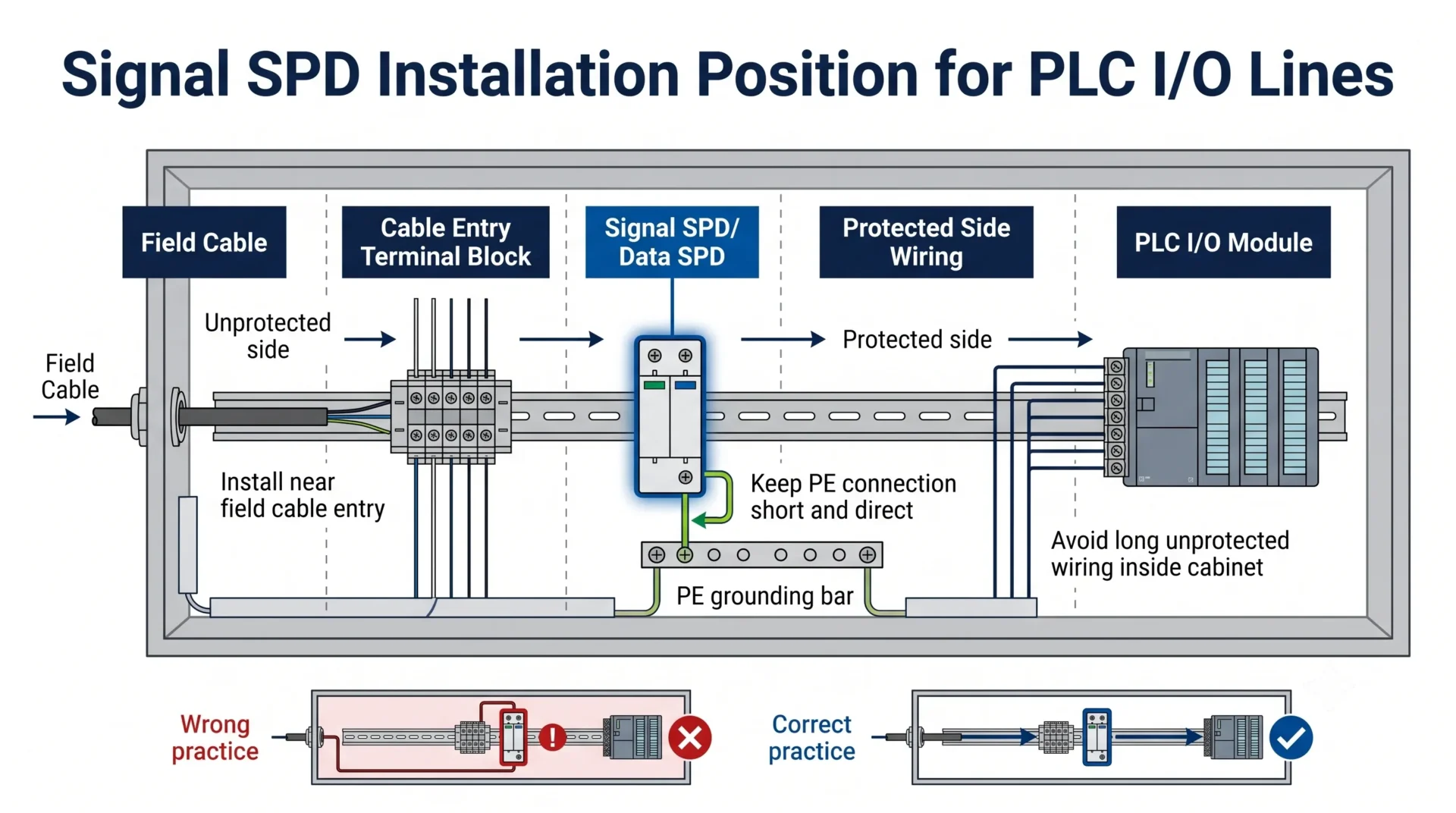
| Posição de Instalação | Recomendado? | Razão |
|---|---|---|
| Na fileira de terminais de entrada do cabo de campo | Boa prática | Intercepta o surto antes que ele entre na área de cabeamento do PLC. |
| Diretamente ao lado do módulo do PLC | Às vezes aceitável | Melhor do que nenhuma proteção, mas o cabo desprotegido ainda pode passar dentro do gabinete. |
| Somente no painel principal de CA | Insuficiente para linhas de sinal | O DPS de CA não limita a tensão do cabo de sinal de baixa tensão que entra nos terminais do CLP. |
| Somente no dispositivo de campo remoto | Depende do layout | Pode proteger o dispositivo de campo, mas o lado do CLP ainda pode precisar de proteção se o cabo for longo ou estiver exposto. |
Erro Comum
Não instale o DPS de sinal longe demais do equipamento protegido e depois passe uma fiação de sinal longa e desprotegida dentro do gabinete de controle. O cabo entre o ponto de entrada e o CLP ainda pode conduzir energia de surtos e ruído para a área sensível.
O que Acontece se as Linhas de Sinal PLC Não Estiverem Protegidas?
A falha nem sempre se manifesta como um componente queimado. Em muitos locais industriais, problemas de sinal relacionados a surtos aparecem inicialmente como comunicação instável, alarmes aleatórios de entrada, deriva na medição analógica ou falhas repetidas no mesmo canal de E/S.
Os resultados possíveis incluem:
- Danos na porta de comunicação do PLC.
- Perda de comunicação RS485 ou Modbus RTU.
- Instabilidade na leitura da entrada analógica.
- Alarmes falsos provenientes de sensores de campo.
- Substituição repetida de módulos de E/S.
- Paragem inesperada da máquina ou tempo de inatividade da produção.
- Falhas intermitentes difíceis de diagnosticar após tempestades ou eventos de comutação.
Para as equipas de manutenção fabril, estas falhas são dispendiosas, uma vez que o módulo PLC danificado é apenas uma parte do custo. O custo mais elevado reside no tempo de resolução de problemas, paragem da linha, substituição de emergência e visitas repetidas ao local.
Antes de Pedir SPD de Sinal para Painéis PLC
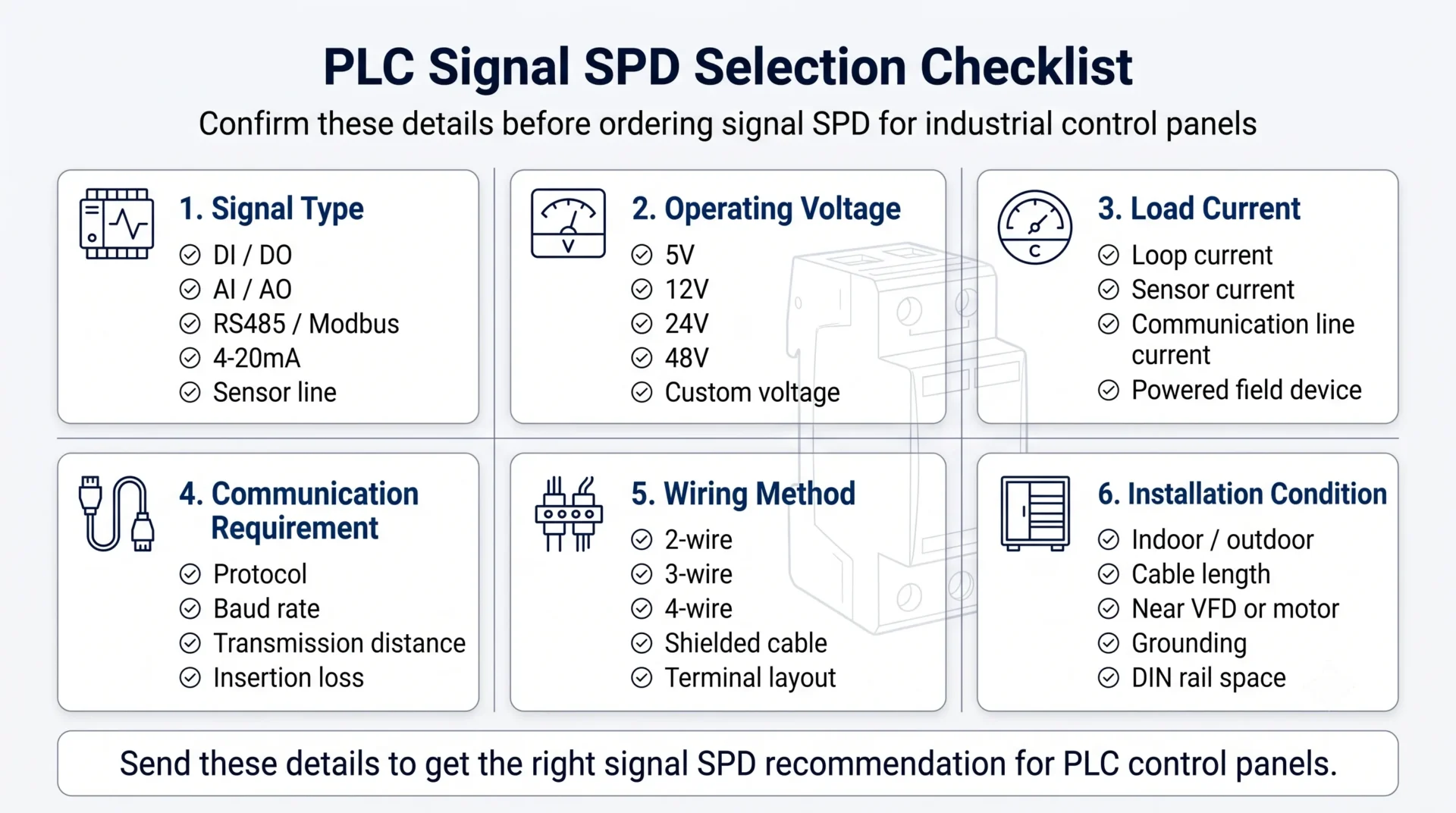
Envie estes detalhes para uma seleção de modelo mais rápida
- Tipo de sinal: DI, DO, AI, AO, RS485, 4-20mA, sensor, telemetria ou outro.
- Tensão de funcionamento normal: 5V, 12V, 24V, 48V ou outro.
- Tensão contínua máxima exigida pelo projeto.
- Corrente de carga ou corrente de loop.
- Protocolo e taxa de transmissão (baud rate) para linhas de comunicação.
- Número de fios e disposição dos terminais.
- Trajeto do cabo: interior, exterior, entre quadros, entre edifícios ou perto de cabos de energia.
- Método de ligação à terra e requisito de ligação à terra da blindagem.
- Espaço de instalação: largura da calha DIN, disposição dos terminais, profundidade do quadro.
- Requisitos de etiqueta OEM, marca privada, ficha técnica, embalagem ou diagrama de cablagem.
Erros Comuns na Seleção
| Erro | Por que isso é um problema | Melhor prática |
|---|---|---|
| Utilizar um SPD de CA numa linha RS485 ou de sinal | O nível de tensão e a norma de teste do SPD de CA não são adequados para linhas de dados de baixa tensão. | Utilize um SPD de sinal/dados compatível com o circuito de comunicação ou controlo. |
| Escolher apenas pela classificação em kA | A selecção de SPD de sinal também depende da tensão, corrente, taxa de transmissão e método de cablagem. | Confirme o circuito de sinal real antes de selecionar o SPD. |
| Ignorar a perda de inserção ou a taxa de dados | Um SPD incorreto pode afetar a qualidade da comunicação em linhas RS485 ou linhas de dados. | Verifique a taxa de transmissão, perda de inserção, taxa de baud e comprimento do cabo. |
| Instalar o SPD sem uma boa ligação à terra | Uma ligação à terra deficiente limita o caminho de descarga de sobretensões e reduz o efeito de proteção. | Mantenha a ligação à terra curta, direta e consistente com o design de ligação à terra do armário. |
| Confundir o contacto de alarme remoto com o SPD de sinal | O contacto remoto apenas reporta o estado do SPD. Não protege a cablagem de sinal. | Utilize o alarme remoto para monitorização e o SPD de sinal para a proteção de linhas de sinal. |
| Proteger apenas um lado de uma linha exterior longa | Percursos de cabos longos podem expor ambas as extremidades do equipamento ao risco de sobretensão. | Analise se tanto o lado do PLC como o lado do dispositivo de campo necessitam de proteção coordenada. |
Leitura Relacionada
Se está a conceber um painel de controlo industrial completo, estas páginas podem ajudá-lo a separar os requisitos de proteção do lado da alimentação, proteção do lado do sinal e monitorização.
FAQ: Proteção contra Surto de Sinal I/O PLC
As linhas de sinal do PLC precisam de proteção contra sobretensões?
As linhas de sinal do PLC necessitam de proteção contra sobretensões quando se ligam a sensores exteriores, cabos de campo longos, I/O remotos, redes RS485, instrumentos de campo ou dispositivos instalados noutro armário ou zona de ligação à terra. A cablagem interna curta do armário pode nem sempre necessitar de um SPD de sinal separado.
Qual é a diferença entre a proteção contra sobretensões de I/O do PLC e a proteção contra sobretensões do painel de CA?
A proteção contra sobretensões do painel de CA protege o lado da entrada de alimentação do armário de controlo. A proteção contra sobretensões de I/O do PLC protege caminhos de sinal de baixa tensão, tais como entrada digital, entrada analógica, RS485, 4-20mA, sensores e cablagem de dispositivos de campo. Estes dois pontos de proteção servem circuitos diferentes.
Pode um SPD de Tipo 2 de CA proteger terminais de I/O de PLC?
Um SPD de Tipo 2 de CA protege a entrada de alimentação do armário de controlo. Não protege diretamente a cablagem de sinal de baixa tensão ligada aos terminais de I/O ou de comunicação do PLC. As linhas de sinal necessitam de SPDs de sinal adequados quando estão expostas ao risco de sobretensão.
Cada entrada e saída de PLC deve ter um protetor contra sobretensões?
Nem sempre. Um design prático protege primeiro as linhas de alto risco: sensores exteriores, cabos de campo longos, linhas de bus RS485, I/O remoto, loops analógicos e cabos que passam perto de motores ou VFDs. A cablagem curta interna dentro do mesmo armário pode não necessitar de um SPD por ponto.
Posso usar um SPD de sinal para várias linhas de I/O de PLC?
Apenas quando o design do SPD, disposição dos terminais, classe de tensão, capacidade de corrente e método de cablagem são adequados para essas linhas. Não combine tipos de sinal não relacionados cegamente. As linhas RS485, loop analógico, entrada digital e sensores podem necessitar de disposições de proteção diferentes.
Que sinal de tensão de SPD devo escolher para uma entrada de PLC de 24V?
Escolha um SPD de sinal cuja tensão nominal e tensão máxima de operação contínua sejam adequadas para o sinal de controlo normal de 24V DC. Por exemplo, pode considerar-se um SPD de sinal de 24V com um MCOV adequado acima da tensão de trabalho normal, mas a escolha final deve também verificar a corrente, o método de cablagem, a ligação à terra e os requisitos do projeto.
Que SPD deve ser utilizado para RS485 ligado a um PLC?
Utilize um SPD de dados ou sinal concebido para RS485 e circuitos de comunicação industrial semelhantes. Confirme a versão da tensão, a taxa de transmissão (baud rate), a distância de transmissão, a perda de inserção, o número de fios, a ligação à terra da blindagem e a posição de instalação antes de encomendar.
Pode um SPD de sinal ser utilizado para circuitos analógicos de 4-20mA?
Sim, se o SPD for adequado para a tensão do circuito, corrente do circuito, método de cablagem e requisito de precisão de medição. O SPD deve proteger o sinal analógico sem interferir no funcionamento normal de 4-20mA.
Onde deve ser instalado um SPD de sinal num armário de PLC?
Instale-o próximo do ponto de entrada do cabo de campo ou da régua de terminais antes de o fio de sinal chegar ao módulo do PLC. Mantenha a ligação de terra curta e direta, e evite cablagens de sinal longas e desprotegidas dentro da área de controlo limpa.
Um contacto de alarme remoto de SPD é o mesmo que a proteção contra sobretensões de sinal?
Não. Um contacto de alarme remoto é um contacto seco utilizado para comunicar o estado do SPD a um PLC, BMS, SCADA, lâmpada ou circuito de alarme. Um SPD de sinal é instalado na linha de sinal para limitar a tensão de sobretensão antes que esta chegue a equipamento sensível.
Que informações devo enviar para escolher um SPD de sinal para PLC?
Envie o tipo de sinal, tensão de operação, corrente da linha, protocolo, taxa de transmissão (baud rate), número de fios, percurso do cabo, método de ligação à terra, espaço de instalação no armário e qualquer requisito de etiqueta OEM ou esquema de cablagem. Isto ajuda o fornecedor a recomendar um modelo de SPD de sinal adequado mais rapidamente.
Precisa de Ajuda para Escolher SPD de Sinal para um Painel de Controle PLC?
Envie-nos o seu tipo de sinal de PLC, tensão, percurso do cabo e layout do armário. A LEEYEE pode ajudar a recomendar um SPD de sinal adequado para RS485, sensores, telemetria, controlo remoto e linhas de comunicação industrial.