
Índice
Um sensor precisa de proteção contra surtos?
Uma linha de sensor precisa de uma verificação de risco de surto quando está ao ar livre, entre edifícios ou ao longo de uma longa distância.
Esses rotas de cabos podem transportar tensão de surto induzida para um PLC, RTU ou armário de controle. Isso pode acontecer mesmo quando a fonte de energia principal já possui um SPD. [1][2][3]
Opção LEEYEE para RS485 e linhas de dados industriais
O LY10 é a opção LEEYEE atualmente publicada para aplicações de RS485 e sinais de dados ou controle industriais.
Protetor contra surto de sinal de dados LY10 para trilho DIN
É destinado a comunicações RS485, telemetria, PLC, controle remoto e linhas de dados industriais relacionadas. [4]
Confirme a versão da tensão, a atribuição dos condutores, a taxa de dados e o método de aterramento antes de fazer o pedido.
Uma linha de 24V, loop de 4–20mA e linha RS485 precisam de verificações diferentes
A tensão é apenas o primeiro parâmetro. O SPD também deve permitir que o sinal normal passe sem causar um erro.
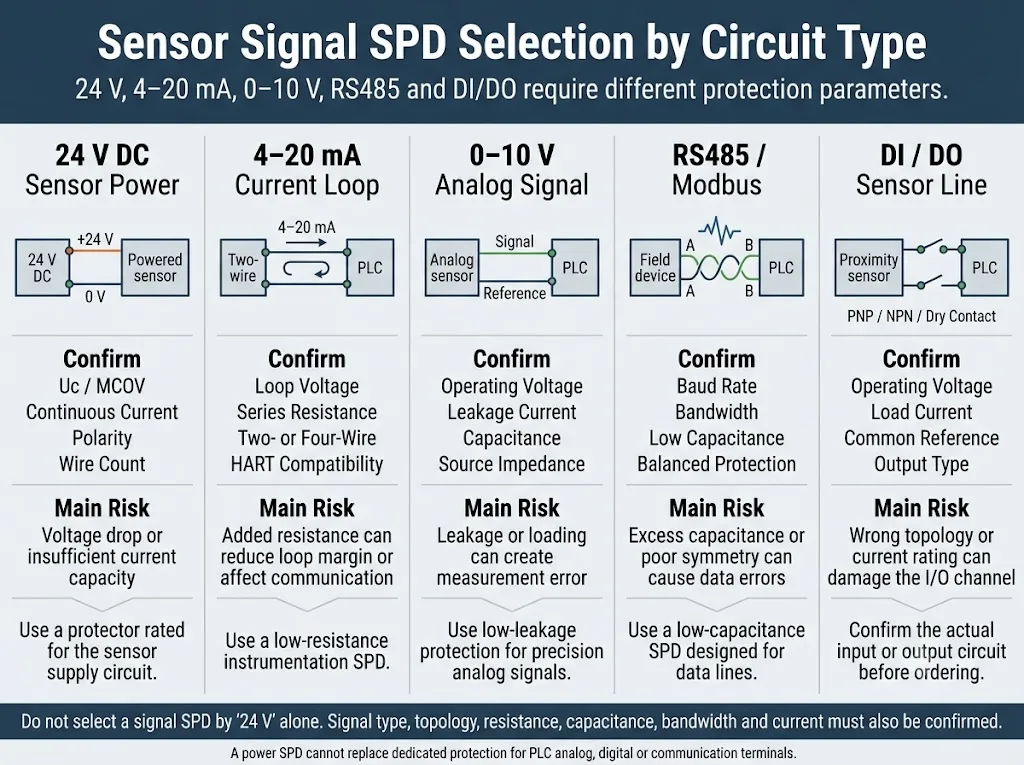
| Sinal | Uso típico | Confirmar primeiro | Principal risco | Próxima ação |
|---|---|---|---|---|
| Alimentação do sensor 24V DC | Fonte de alimentação para sensores de proximidade, transmissores ou instrumentos remotos | Uc / MCOV Atual Polaridade | O SPD pode causar uma queda de tensão excessiva ou pode não transportar a corrente necessária. | Confirmar se o cabo transporta apenas energia ou combina condutores de energia e sinal. [1][5] |
| 4–20mA ou HART | Transmissores de pressão, fluxo, nível e processo | Tensão do loop Resistência HART | Resistência extra pode usar parte da tensão necessária pelo transmissor. | Enviar a fonte do loop, a folha de dados do transmissor e os dados de entrada analógica. [5][6] |
| 0–10V AI ou AO | Sensores analógicos, atuadores e I/O analógico de PLC | Fuga Capacitância Referência | A fuga ou carga elétrica pode deslocar o valor medido. | Forneça a faixa de sinal, impedância de origem e erro de medição aceitável. [5][6] |
| RS485 ou Modbus | Redes PLC, BMS, telemetria e I/O remoto | Taxa de transmissão Capacitância Contagem de fios | Capacitância excessiva pode distorcer o sinal de dados e causar erros de comunicação. | Use o guia RS485 para fiação detalhada A/B, verificação de blindagem e terminação. [1][4][6] |
| DI ou DO | Interruptores de proximidade, contatos secos, alarmes e saídas de transistor | PNP / NPN Corrente de carga Fio comum | O circuito errado pode conectar referências compartilhadas ou sobrecarregar o protetor. | Confirme o tipo de entrada/saída, voltagem, corrente e condutor comum compartilhado. [5] |
Instale o SPD onde o cabo exposto entra na zona protegida
Proteja primeiro a extremidade do gabinete. Adicione proteção do lado de campo quando o dispositivo remoto ou o trajeto do cabo também estiver exposto. [2][3][7]
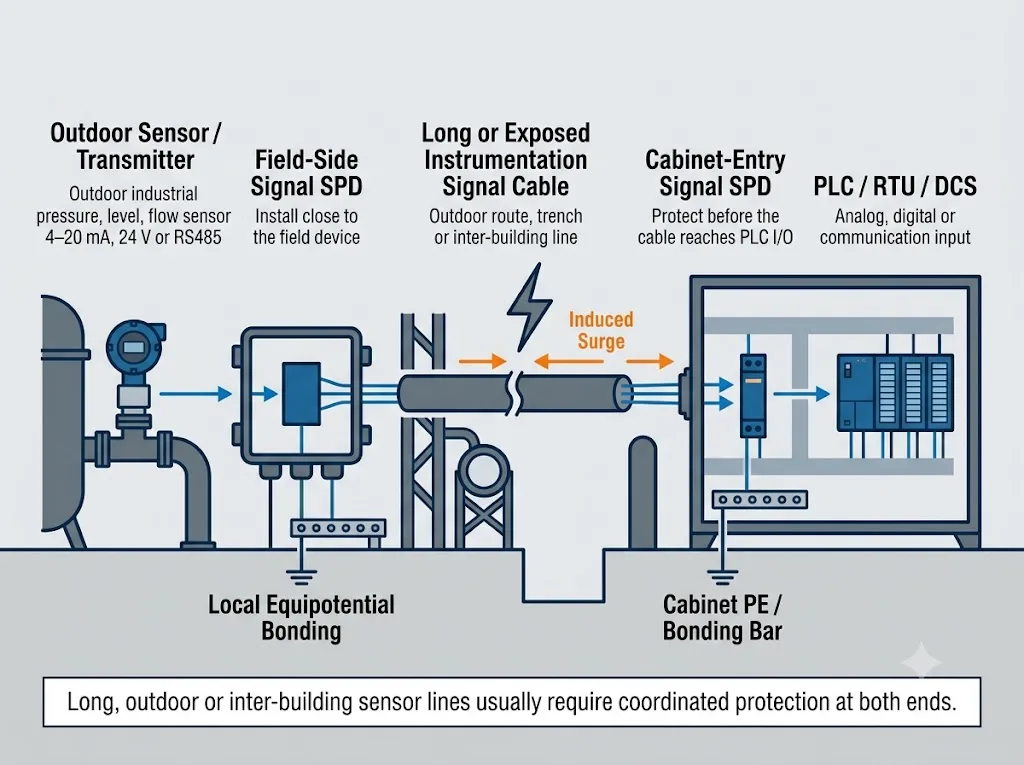
Proteção de entrada do gabinete
Instale o SPD próximo à entrada de cabos ou área de distribuição. Não transporte um cabo de campo longo e desprotegido ao lado do PLC. [2][7]
Proteção do lado de campo
Adicione proteção próxima a um transmissor externo, mastro, tanque, bomba ou caixa de junção remota quando o dispositivo de campo estiver exposto. [2][3]
Proteção em ambas as extremidades
Avalie ambas as extremidades quando o cabo cruzar edifícios, áreas externas, zonas de proteção contra raios ou zonas de aterramento separadas. [2][3][7]
Mantenha a conexão de aterramento do SPD curta. Um condutor longo adiciona tensão indutiva durante um surto. Isso pode aumentar a tensão registrada pelo equipamento protegido. [6][7]
Quatro parâmetros de SPD que podem afetar o funcionamento normal
Estes parâmetros explicam porque um protetor não pode ser selecionado apenas pela tensão.
1. Resistência em série
Esta é a resistência extra adicionada pelo SPD ao circuito.
2. Corrente de fuga
Esta é uma pequena corrente que pode fluir através do SPD durante a operação normal.
3. Capacitância e largura de banda
Estes parâmetros mostram como um sinal de dados em mudança pode passar facilmente pelo protetor.
4. Arranjo de aterramento e blindagem
O SPD precisa de um caminho de descarga curto para o sistema equipotencial local.
Informações necessárias antes da confirmação de modelo, amostra ou orçamento
Um pedido que diz apenas “SPD de sinal de 24V” não é suficiente para uma seleção confiável.
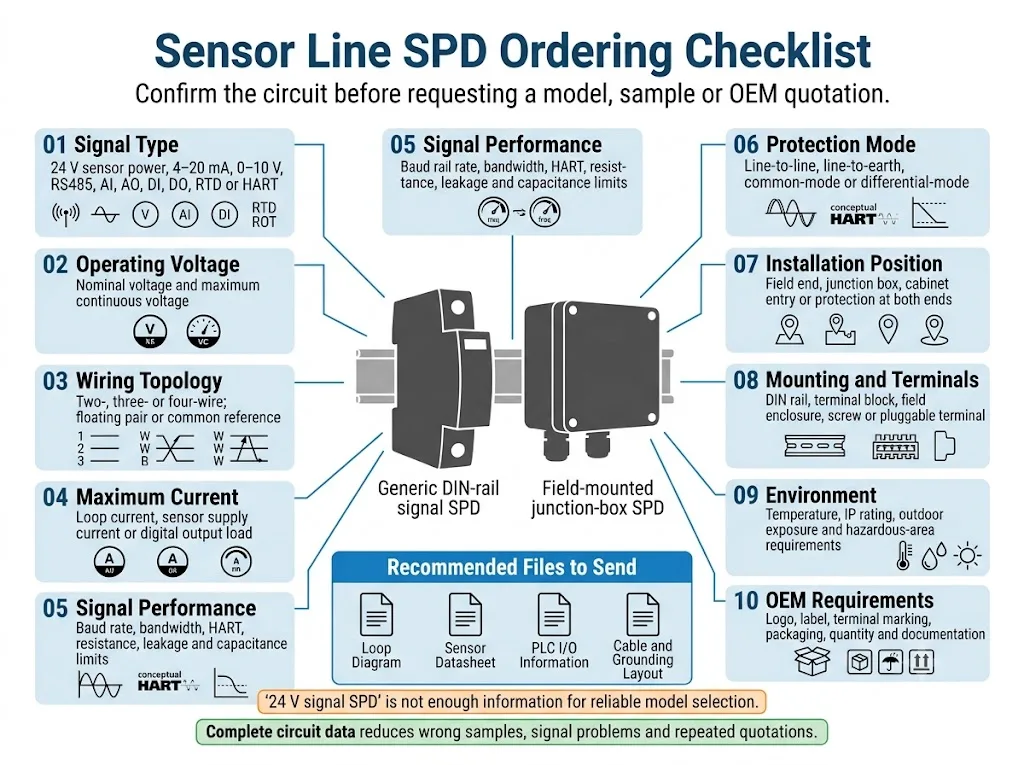
24V, 4–20mA, HART, 0–10V, RS485, DI, DO ou outro sinal.
Tensão nominal e a maior tensão contínua.
Circuito de dois, três ou quatro fios e atribuição de condutores.
Corrente de carga do loop, do sensor ou de saída digital.
Taxa de Baud, HART, limites de resistência, vazamento ou capacitância.
Comprimento, trajeto, exposição ao ar livre e seções entre edifícios.
Entrada do gabinete, dispositivo de campo, caixa de junção ou ambas as extremidades.
Ponto de ligação local, terminação da blindagem e método de referência.
Temperatura, classificação IP, necessidades externas e áreas perigosas.
Logotipo, etiqueta, marcas de terminais, quantidade, embalagem e documentos.
Quem normalmente especifica ou compra SPDs para linhas de sensor?
Fabricantes de painéis de controle
Para PLC, RTU, I/O analógico, I/O remoto e proteção contra entrada de cabos de campo.
Integradores de sistemas industriais
Para tratamento de água, automação de fábricas, BMS, telemetria e projetos de controle de processos.
Compradores OEM e de marcas próprias
Para correspondência de modelos, marcação de terminais, rótulos de marcas, embalagens e fornecimento em grande quantidade.
Projetos de água e bombas
Para sinais de nível externo, pressão, fluxo, interruptores de flutuação e estações remotas.
Equipes de manutenção de fábricas
Para falhas repetidas de sensores, canais PLC instáveis e linhas de instrumentos expostas.
Distribuidores industriais
Para faixas de sinal-SPD em estoque que devem cobrir tensões e tipos de sinal claramente definidos.
Envie o diagrama do loop—não apenas “SPD de sinal de 24V”
A LEEYEE pode revisar o tipo de sinal, tensão, contagem de fios, corrente, caminho do cabo, método de montagem e requisitos OEM antes da confirmação do modelo.
Perguntas sobre proteção contra surtos para linhas de sensor
Todo sensor externo precisa de um protetor contra surtos?
Não automaticamente. Verifique o comprimento do cabo, a exposição ao ar livre, as zonas de proteção contra raios, o valor do equipamento e a proteção existente. A exposição ao ar livre é uma forte razão para realizar uma avaliação de risco de surtos. [2][3]
Os SPDs da linha de sensor devem ser instalados em ambas as extremidades?
Avalie ambas as extremidades quando o cabo cruzar edifícios, áreas externas ou zonas de aterramento locais separadas. Um cabo interno curto dentro de uma estrutura bem aterrada pode não precisar da mesma disposição. [2][3][7]
Um SPD pode proteger tanto a alimentação de 24V quanto um sinal de 4–20mA?
Somente quando for projetado para esse circuito combinado exato. Um par de potência e um par de sinal analógico podem ter requisitos diferentes de corrente, resistência, vazamento e modo de proteção. [5][6]
Um SPD de sinal pode afetar a medição ou a comunicação?
Sim, se selecionado incorretamente. A resistência em série pode afetar um loop de corrente. O vazamento pode afetar uma tensão analógica. Uma capacitância excessiva pode afetar um sinal de dados. [5][6]
Que informações são necessárias para a confirmação do modelo?
Forneça o tipo de sinal, tensão, contagem de fios, corrente, taxa de dados ou requisito HART, caminho do cabo, posição de instalação, arranjo de aterramento e ambiente. [1][2]
Fontes autoritativas utilizadas neste guia
- [1] IEC 61643-21:2025 — Dispositivos de proteção contra surtos de baixa tensão conectados a redes de telecomunicações e sinalização: requisitos de desempenho e métodos de teste.
- [2] IEC 61643-22:2015 — Princípios de seleção, operação, localização e coordenação para SPDs de redes de telecomunicações e sinalização.
- [3] IEC 62305-4:2024 — Proteção de sistemas elétricos e eletrônicos dentro de estruturas contra efeitos eletromagnéticos de raios.
- [4] Dispositivo de Proteção Contra Surtos de Sinal de Dados LEEYEE LY10 — Dados de tensão publicada, corrente, taxa de transmissão, perda de inserção e instalação em trilho DIN.
- [5] Phoenix Contact — Fundamentos para Proteção Contra Surtos — Circuitos de instrumentação e controle, loops flutuantes de 4–20mA, sinais binários e medições de resistência.
- [6] Eaton MTL — Proteção contra Raios e Surtos: Princípios Básicos — Operação de signal-SPD, impedância em série, vazamento, capacitância e efeitos em circuitos de sinal normais.
- [7] Eaton MTL — Guia de Aterramento para Proteção contra Sobretensões — Ligação equipotencial, telas de cabos, conexões à terra locais e instalações de campo para sala de controle.
A seleção final deve ser verificada em relação ao sensor, transmissor, PLC ou folha de dados do controlador, à avaliação de risco de iluminação do projeto e aos dados técnicos do SPD selecionado.