
Compare Dispositivos de Proteção Tipo 1, Tipo 2 e Tipo 3 por posição de instalação, forma de onda de teste, capacidade de corrente e função de proteção.
Índice
Encontre as Informações de Que Você Precisa
Comparação Rápida entre Tipo 1, Tipo 2 e Tipo 3 de Dispositivos de Proteção contra Sobretensões
A maneira mais fácil de entender os três tipos de SPD é conectar cada tipo com sua posição normal na instalação elétrica.
| Tipo de SPD | Posição típica | Função principal de proteção | Dever de teste principal | Classificação chave comum |
|---|---|---|---|---|
| Tipo 1 | Origem ou quadro principal de entrada | Descargas de corrente parcial de alta energia do relâmpago | 10/350 μs corrente de impulso | Iimp |
| Tipo 2 | Quadro de distribuição principal ou secundário | Limita relâmpagos induzidos e picos de comutação | 8/20 μs corrente de descarga | In e Imax |
| Tipo 3 | Perto de equipamentos terminais sensíveis | Limita a sobretensão residual restante | Teste de onda combinada | Uoc e Up |
O que é um Dispositivo de Proteção contra Sobretensões Tipo 1?
Um SPD Tipo 1 é projetado para instalação onde a corrente de raios parcial pode entrar no sistema elétrico de baixa tensão.
É comumente considerado na origem de uma instalação, particularmente onde o edifício possui um sistema de proteção contra raios externo ou onde o arranjo do fornecimento de entrada cria uma exposição significativa à corrente de raios.
O que um SPD Tipo 1 faz?
Um SPD Tipo 1 desvia a corrente de impulso de alta energia em direção ao sistema de aterramento e de ligação equipotencial. Seu principal papel é prevenir que a corrente de raios passe descontroladamente pela instalação elétrica interna.
Forma de onda de teste Tipo 1
Os SPDs Tipo 1 são testados usando um impulso de corrente de 10/350 μs..A classificação principal associada a este teste é Iimp, ou corrente de descarga de impulso.
Iimp não deve ser comparado diretamente com o valor de Imax de um SPD Tipo 2, pois as duas classificações utilizam formas de onda diferentes e representam diferentes deveres de teste.
Onde um SPD Tipo 1 é instalado?
- Entrada de serviço;
- Quadro de distribuição de baixa tensão principal;
- Origem da instalação elétrica;
- Transição da zona de proteção contra raios onde se espera corrente de raios parcial.
Quando o Tipo 1 deve ser considerado?
- O edifício possui um sistema de proteção contra raios externo;
- O fornecimento de entrada está exposto à entrada de corrente de raios;
- Uma avaliação de risco do projeto identifica corrente de raios parcial;
- As regras de instalação nacionais especificam proteção Tipo 1;
- A instalação é uma infraestrutura crítica com um conceito de proteção contra descargas atmosféricas definido.
O que é um Dispositivo de Proteção contra Sobretensões Tipo 2?
Um SPD Tipo 2 é o dispositivo de proteção contra surtos de nível de distribuição mais comum em instalações elétricas de baixa tensão.
Ele limita sobretensões transitórias causadas por efeitos de descargas atmosféricas indiretas, operações de comutação e energia residual de surtos de uma etapa de proteção a montante.
Quais fontes de surtos o Tipo 2 aborda?
- Efeitos de descargas atmosféricas indiretas;
- Operações de comutação;
- Motores e transformadores;
- Perturbações na rede elétrica;
- Energia residual de surto após um SPD a montante.
Forma de onda de teste do Tipo 2
Os SPDs Tipo 2 são testados usando o Forma de onda de corrente 8/20 μs..Classificações importantes incluem Em, Imax, Para cima e Uc.
Onde um SPD Tipo 2 é instalado?
- Painéis de distribuição principais;
- Painéis de subdistribuição;
- Gabinetes de controle de máquinas;
- Painéis industriais;
- Painéis elétricos comerciais;
- Painéis de distribuição de inversores solares AC.
Quando o Tipo 2 pode ser suficiente?
Um SPD do Tipo 2 pode ser suficiente na origem de algumas instalações onde o sistema não é esperado para suportar corrente parcial de raios.
Isso pode incluir certas instalações com:
- Fornecimento subterrâneo incoming;
- Sem sistema de proteção contra raios externo;
- Menor exposição avaliada à corrente de raios;
- Nenhum requisito de obrigação de Tipo 1 a montante.
O que é um Dispositivo de Proteção contra Sobretensões Tipo 3?
Um SPD Tipo 3 fornece proteção no ponto de uso para equipamentos terminais sensíveis. Ele limita a tensão residual de surto que permanece após a proteção à montante ou se desenvolve ao longo dos condutores à jusante.
Onde é instalado o Tipo 3?
O Tipo 3 é instalado próximo aos equipamentos protegidos, incluindo:
- CLPs;
- Servidores;
- Sistemas de controle;
- Equipamentos de comunicação;
- Equipamentos médicos;
- Fontes de alimentação sensíveis;
- Equipamentos eletrônicos domésticos.
A proteção Tipo 3 pode estar embutida em tomadas, extensões, módulos de proteção de equipamentos, dispositivos de painel de controle ou unidades de proteção terminal.
Método de teste Tipo 3
Os dispositivos Tipo 3 são comumente avaliados com um gerador de onda de combinação produzindo uma forma de onda de tensão em circuito aberto 1.2/50 μs e uma forma de onda de corrente de curto-circuito 8/20 μs. As classificações relevantes podem incluir Uoc e Para cima.
O Tipo 3 pode ser usado isoladamente?
O Tipo 3 normalmente não deve ser esperado para descarregar a alta energia de surto presente na entrada de serviço ou no nível de distribuição principal.
Comparação Técnica: Tipo 1 vs Tipo 2 vs Tipo 3
| Item de comparação | DUP tipo 1 | DUP tipo 2 | DUP tipo 3 |
|---|---|---|---|
| Papel principal | Descarga de corrente de raio | Limitação de surto no nível de distribuição | Proteção final do equipamento |
| Posição típica | Origem ou quadro principal de entrada | Quadro de distribuição principal ou secundário | Próximo ao equipamento terminal |
| Classe de teste | Classe I | Classe II | Classe III |
| Onda principal | 10\/350 μs | 8/20 μs | Onda de combinação |
| Classificação importante | Iimp | In e Imax | Uoc |
| Também avaliar | Uc, Up e comportamento em falha | Uc, Up e classificação de curto-circuito | Up e compatibilidade de carga |
| Ambiente típico de surto | Corrente parcial de raio | Transientes de raio induzidos e de chaveamento | Tensão residual de surto |
| Ele pode proteger toda a instalação sozinho? | Nem sempre | Nem sempre | Não |
| Tecnologia comum | Tecnologia de gap de centelha, MOV ou tecnologia combinada | Tecnologia baseada em MOV ou combinada | Proteção compacta baseada em MOV, GDT ou filtro |
10/350 μs vs 8/20 μs: Por que a Forma de Onda do Teste é Importante
Um valor de corrente mostrado em quiloamperes é significativo apenas quando a forma de onda e a definição de classificação associadas também são conhecidas.
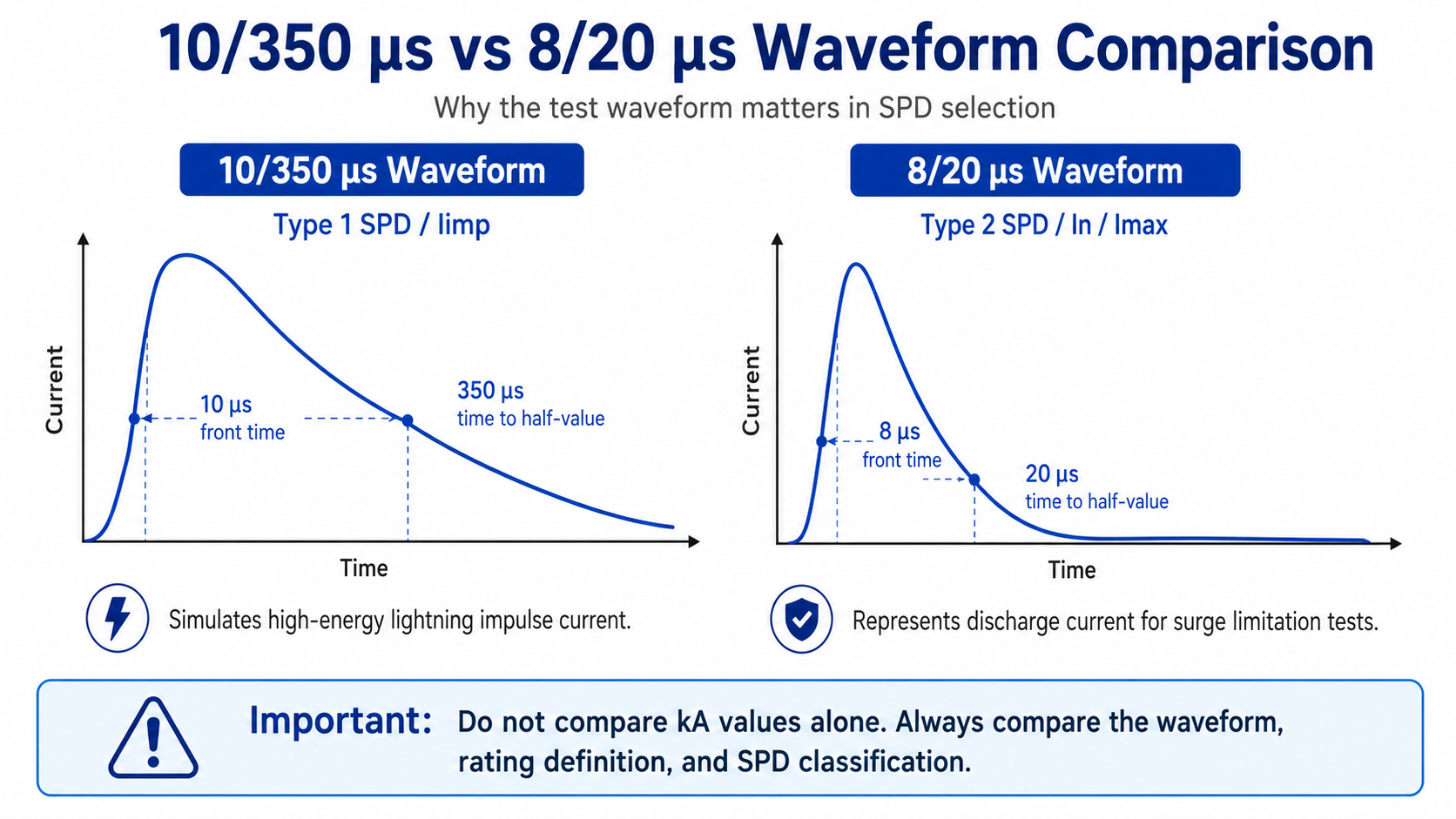
Iimp versus In versus Imax versus Uoc
Esses valores descrevem diferentes testes e não devem ser tratados como versões intercambiáveis da mesma classificação de corrente.
Outros valores importantes incluem Uc, Up, classificação de corrente de curto-circuito e requisitos de proteção de backup.
Como os Dispositivos de Proteção contra Sobretensões Tipo 1, Tipo 2 e Tipo 3 Funcionam Juntos
Uma proteção contra surtos eficaz é baseada em estágios de proteção coordenados, não simplesmente na instalação do SPD com a maior classificação de corrente.
Um conceito típico pode usar:
- Tipo 1 na origem para descarregar a corrente parcial de raios;
- Tipo 2 em um quadro de distribuição a jusante para limitar a sobretensão remanescente;
- Tipo 3 perto de equipamentos sensíveis para reduzir a tensão de surto residual final.
Isso não significa que todo edifício deve usar três SPDs separados. Alternativas possíveis incluem SPDs combinados Tipo 1+2, SPDs combinados Tipo 2+3, ou proteção Tipo 2 na origem onde a responsabilidade Tipo 1 não é necessária.
Nenhuma regra única de distância de cabo deve ser aplicada a toda combinação de SPDs. A coordenação necessária depende da tecnologia SPD, coordenação testada pelo fabricante, disposição dos condutores, níveis de proteção e o equipamento protegido.
O que é um Dispositivo de Proteção contra Sobretensões Combinado Tipo 1+2?
Um SPD Tipo 1+2 é testado para as responsabilidades Tipo 1/Class I e Tipo 2/Class II. Ele combina a descarga de corrente de impulso de raios e a limitação de tensão de surto em nível de distribuição.
Um SPD Tipo 1+2 pode ser útil onde:
- Ambas as responsabilidades de proteção são necessárias em um ponto de instalação;
- O espaço no painel principal é limitado;
- A coordenação de SPDs separados seria difícil;
- Uma solução compacta e internamente coordenada é preferida.
Para orientações completas sobre seleção de Tipo 1+2, consulte o guia dedicado guia de SPD Tipo 1+2.
Qual Tipo de Dispositivo de Proteção você Precisa?
A tabela a seguir fornece uma direção inicial. A seleção final deve ainda seguir o projeto do sistema real e os requisitos aplicáveis.
| Situação do projeto | Direção da seleção inicial |
|---|---|
| O edifício possui um sistema de proteção contra descargas atmosféricas externo | Considere o Tipo 1 ou Tipo 1+2 |
| Corrente de raio parcial pode entrar na instalação | O dever do Tipo 1 é necessário |
| Proteção geral do painel principal sem dever Tipo 1 | Tipo 2 |
| Subdistribuição ou painel de controle de máquinas | Tipo 2 |
| Equipamento terminal sensível | Tipo 3 próximo ao equipamento |
| Deveres do Tipo 1 e Tipo 2 são necessários em um quadro principal | Tipo 1+2 |
| O equipamento está longe do SPD principal | Considere tipos adicionais 2 ou 3 |
| A proteção contra surtos é necessária em um circuito DC de energia solar PV | Use um SPD DC específico para PV |
Como Selecionar o Tipo Correto de Dispositivo de Proteção
- Identifique a posição da instalação. O SPD está instalado na origem, no quadro de distribuição, no painel da máquina ou no equipamento terminal?
- Avalie a exposição a raios. Verifique o sistema de proteção contra descargas atmosféricas externo, a alimentação de entrada e as zonas de proteção contra descargas atmosféricas.
- Confirme a aplicação AC ou DC. Não use um SPD AC normal no lado DC de um sistema fotovoltaico.
- Confirme o sistema de aterramento. Identifique TN-S, TN-C, TT, IT ou o arranjo de aterramento DC relevante.
- Verifique o conjunto de classificação total. Revise Uc, Up, Iimp, In, Imax, Uoc, classificação de curto-circuito e proteção de backup.
- Verifique a coordenação. Verifique a relação entre a proteção a montante, SPDs a jusante e o equipamento protegido.
Erros Comuns na Seleção de Dispositivos de Proteção
- Escolhendo apenas pelo maior valor de kA. Um número de corrente maior não corrige a forma de onda errada, classificação de voltagem ou configuração do circuito.
- Comparando Iimp diretamente com Imax. Esses valores representam diferentes exigências de teste e diferentes formas de onda.
- Usando o Tipo 3 como o SPD principal do edifício. O Tipo 3 é destinado à proteção de equipamentos finais, não à corrente de surto de alta energia na entrada.
- Assumindo que o Tipo 1 protege cada carga. A tensão residual e os efeitos do condutor a montante ainda podem exigir proteção adicional.
- Usando uma regra fixa de 10 metros. A coordenação deve seguir as tecnologias SPD selecionadas e a documentação do fabricante.
- Ignorando Uc e Up. A capacidade de corrente sozinha não determina a compatibilidade de tensão ou a proteção do equipamento.
- Usando um SPD CA em PV CC. Os circuitos CC fotovoltaicos requerem características de tensão e desconexão específicas para a aplicação.
- Ignorando a coordenação de curto-circuito. O SPD, o fusível de backup e a corrente de curto-circuito prospectiva devem ser compatíveis.
Os Tipos de Dispositivos de Proteção IEC e UL Não São Definições Idênticas
Os sistemas IEC e UL utilizam a terminologia Tipo 1, Tipo 2 e Tipo 3, mas as classificações não devem ser tratadas como totalmente intercambiáveis.
Sob a estrutura IEC, os tipos estão intimamente associados a classes de teste, formas de onda e deveres de proteção. Sob a UL 1449, os tipos de SPD estão fortemente relacionados ao local de conexão permitido e à instalação em relação ao equipamento de serviço e à proteção contra sobrecarga.
Para projetos na América do Norte, confirme:
- Listagem UL;
- Tipo de SPD;
- Corrente nominal de descarga;
- Classificação de proteção de tensão;
- Classificação de corrente de curto-circuito;
- Localização de conexão permitida.
Perguntas Frequentes sobre Dispositivos de Proteção Tipo 1 vs Tipo 2 vs Tipo 3
Qual é a principal diferença entre SPD Tipo 1, Tipo 2 e Tipo 3?
O Tipo 1 gerencia a responsabilidade de corrente de relâmpago na origem, o Tipo 2 fornece proteção contra surto em nível de distribuição e o Tipo 3 limita a tensão residual de surto próxima a equipamentos sensíveis.
É o Tipo 1 melhor do que o Tipo 2?
Não. Eles desempenham funções diferentes. O Tipo 1 lida com a função de corrente de raios, enquanto o Tipo 2 limita a sobretensão transitória no sistema de distribuição elétrica.
Pode o Tipo 2 ser instalado no quadro de distribuição principal?
Sim. O Tipo 2 é comumente instalado em quadros de distribuição principais e secundários, onde a função de corrente de raios do Tipo 1 não é necessária ou onde já existe uma etapa de Tipo 1 a montante.
Toda instalação precisa de um SPD Tipo 1?
Não. A necessidade do Tipo 1 depende da exposição à corrente de raio, da proteção contra raios externa, da disposição do fornecimento de energia e dos requisitos do projeto aplicáveis.
O SPD Tipo 3 pode ser usado sem o Tipo 1 ou Tipo 2?
O Tipo 3 não deve normalmente ser considerado como a única proteção onde surtos de alta energia possam entrar na instalação. Ele é destinado principalmente como proteção coordenada de terminais.
O Tipo 1+2 é o mesmo que o Tipo 1 e o Tipo 2?
Um SPD Tipo 1+2 é testado para funções de Tipo 1 e Tipo 2 dentro de um único produto. Dispositivos Tipo 1 e Tipo 2 separados podem fornecer as mesmas etapas, mas sua coordenação deve ser verificada.
Qual é a diferença entre Iimp e Imax?
Iimp está associado ao teste de corrente de impulso Tipo 1 de 10/350 μs. Imax está associado ao teste de corrente de descarga máxima Tipo 2 de 8/20 μs.
O LEEYEE pode ajudar a selecionar o tipo correto de SPD?
Sim. Forneça a tensão do sistema, aplicação em CA ou CC, arranjo de aterramento, posição de instalação, polos, classificações necessárias e quantidade do projeto.
Guias Relacionados à Proteção Contra Sobretensão
Precisa de Ajuda para Selecionar o Tipo Correto de Dispositivo de Proteção?
Envie a aplicação AC ou DC, tensão do sistema, arranjo de aterramento, posição de instalação, polos necessários, classificações de corrente e quantidade do projeto. A LEEYEE ajudará a identificar uma configuração de proteção contra surtos adequada.