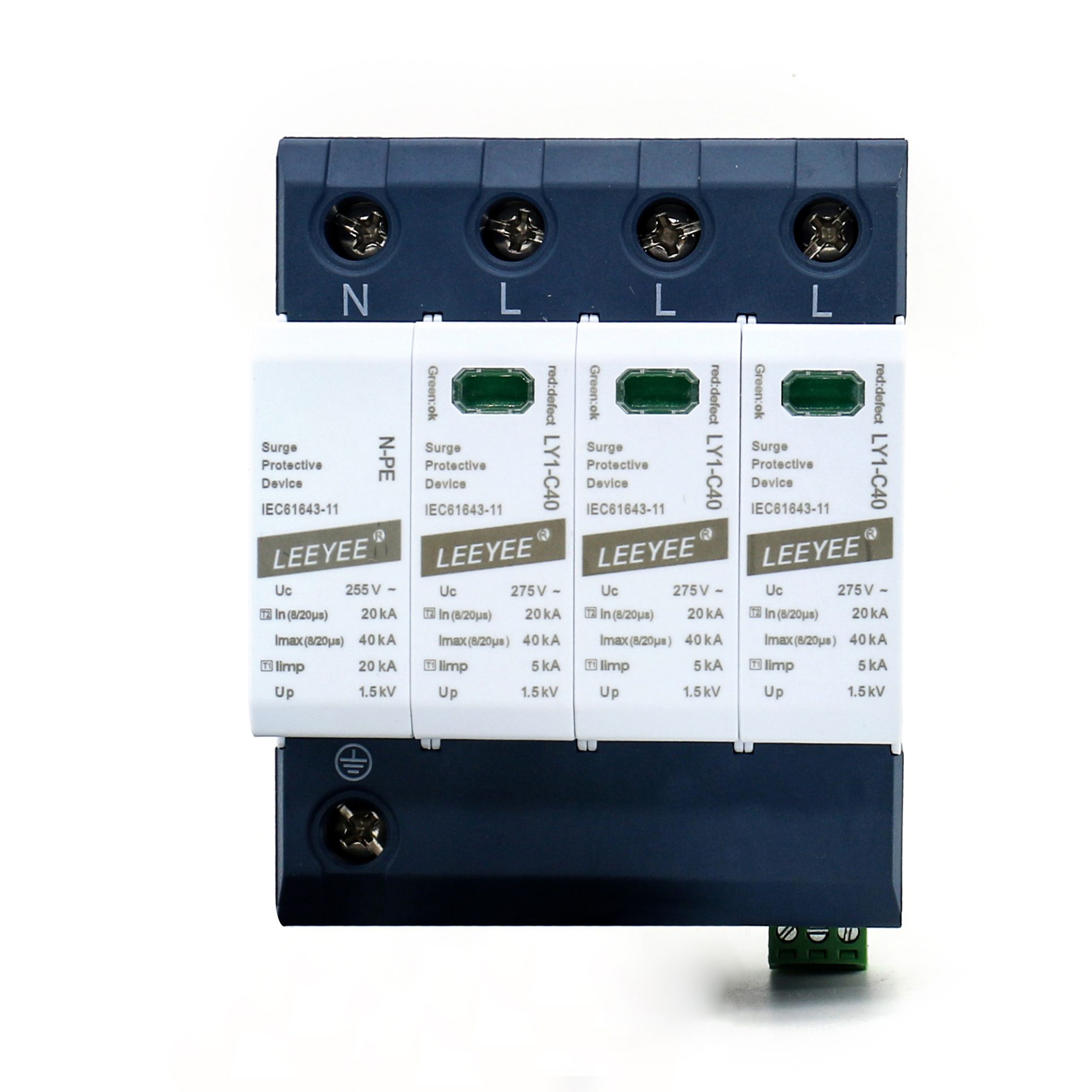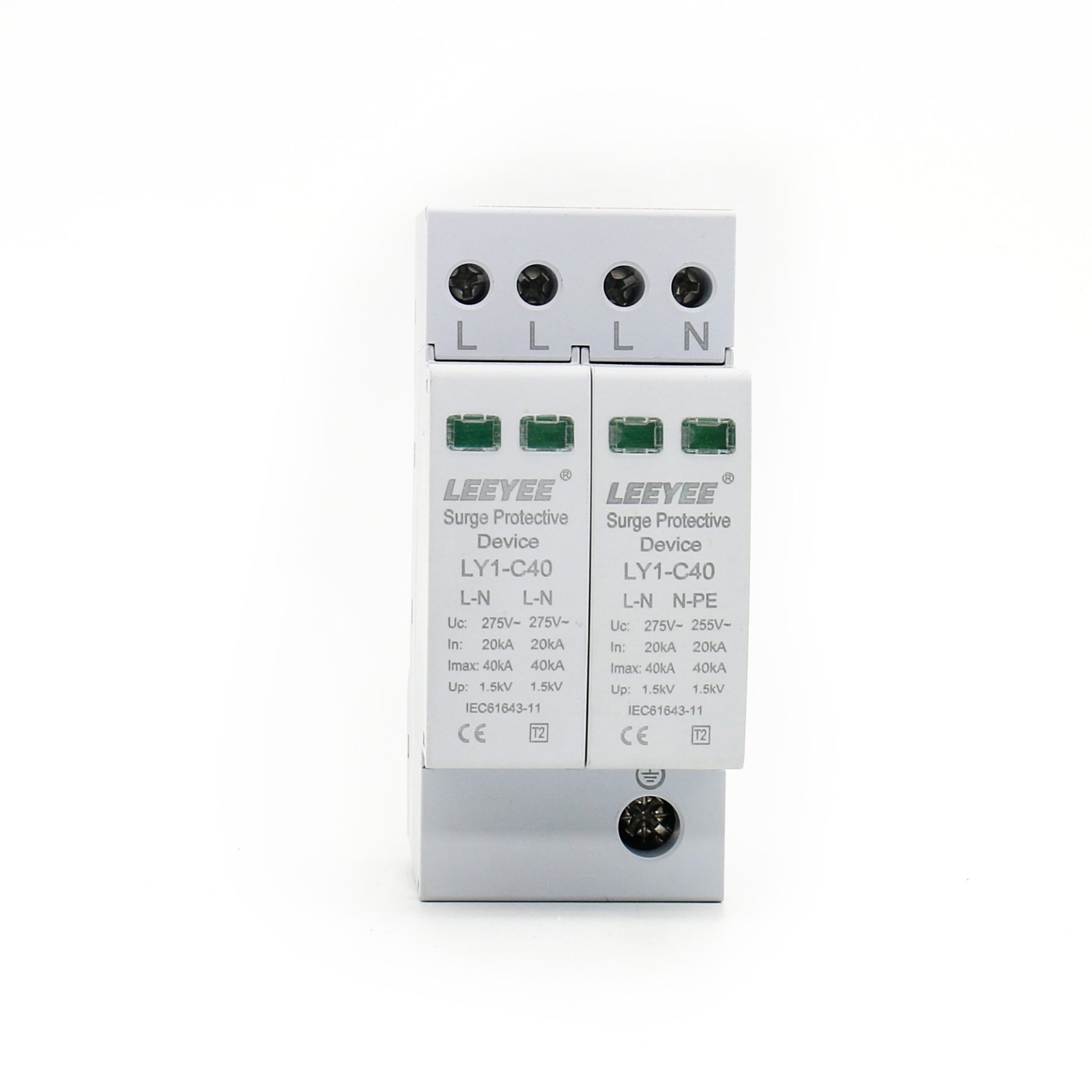
อุปกรณ์ป้องกันไฟกระชาก 3 เฟสใช้เพื่อป้องกันระบบไฟฟ้าสามเฟสในภาคอุตสาหกรรมและเชิงพาณิชย์จากแรงดันไฟฟ้าเกินชั่วขณะ.
โดยทั่วไปจะติดตั้งในตู้จ่ายไฟหลัก แผงจ่ายไฟย่อย ตู้ควบคุม แผงควบคุมเครื่องจักร ระบบ HVAC แผงไฟฟ้า AC ของอินเวอร์เตอร์ PV และตู้ไฟฟ้าสำหรับ OEM.
ประเด็นสำคัญนั้นเรียบง่าย: ไม่ควรเลือกอุปกรณ์ป้องกันไฟกระชาก 3 เฟสโดยพิจารณาเฉพาะแรงดันไฟฟ้าหรือจำนวนขั้วเท่านั้น SPD ที่เหมาะสมขึ้นอยู่กับระบบไฟฟ้าทั้งหมด.
สารบัญ
คำตอบด่วน: คุณจะเลือกอุปกรณ์ป้องกันไฟกระชาก 3 เฟสอย่างไร?
สำหรับตู้จ่ายไฟสามเฟสมาตรฐาน ขั้นแรกให้ตรวจสอบ แรงดันระบบ และ ระบบสายดิน. จากนั้นเลือกประเภท SPD และการจัดวางขั้ว.
แผงไฟฟ้าขาเข้าหลักอาจต้องใช้การป้องกันแบบ Type 1 หรือ Type 1+2 ตู้จ่ายไฟย่อยมาตรฐานโดยทั่วไปใช้การป้องกันแบบ Type 2 ระบบ TN-S, TN-C-S, TT, IT และระบบสามเฟส 3 สายอาจต้องใช้การจัดวาง SPD ที่แตกต่างกัน.
| การใช้งาน | ตัวเลือก SPD ที่ใช้บ่อย | หมายเหตุสำหรับผู้ซื้อ |
|---|---|---|
| แผงไฟฟ้าขาเข้าหลักที่มีความเสี่ยงจากฟ้าผ่าสูง | SPD แบบ Type 1 หรือ Type 1+2 | ตรวจสอบค่า Iimp และอุปกรณ์ป้องกันสำรอง. |
| ตู้จ่ายไฟย่อยมาตรฐาน | ชนิดที่ 2 SPD | ใช้โดยทั่วไปสำหรับแผงไฟฟ้าในงานอุตสาหกรรมและเชิงพาณิชย์. |
| ระบบ TN-S สามเฟส 4 สาย | SPD แบบ 4P หรือ 4 ขั้วที่เหมาะสม | ป้องกัน L1, L2, L3, N และ PE ตามการออกแบบ. |
| ระบบ TT สามเฟส 4 สาย | SPD แบบ 3P+N \/ 3+1 | ต้องพิจารณาเส้นทางการป้องกันระหว่าง N-PE. |
| ระบบสามเฟส 3 สาย | SPD แบบ 3P | ใช้เมื่อไม่มีสายนิวทรัล. |
| ตู้ไฟฟ้า OEM | ขึ้นอยู่กับแบบโครงการ | ตรวจสอบแรงดันไฟฟ้า การต่อลงดิน จำนวนขั้ว และการรับรองมาตรฐาน. |
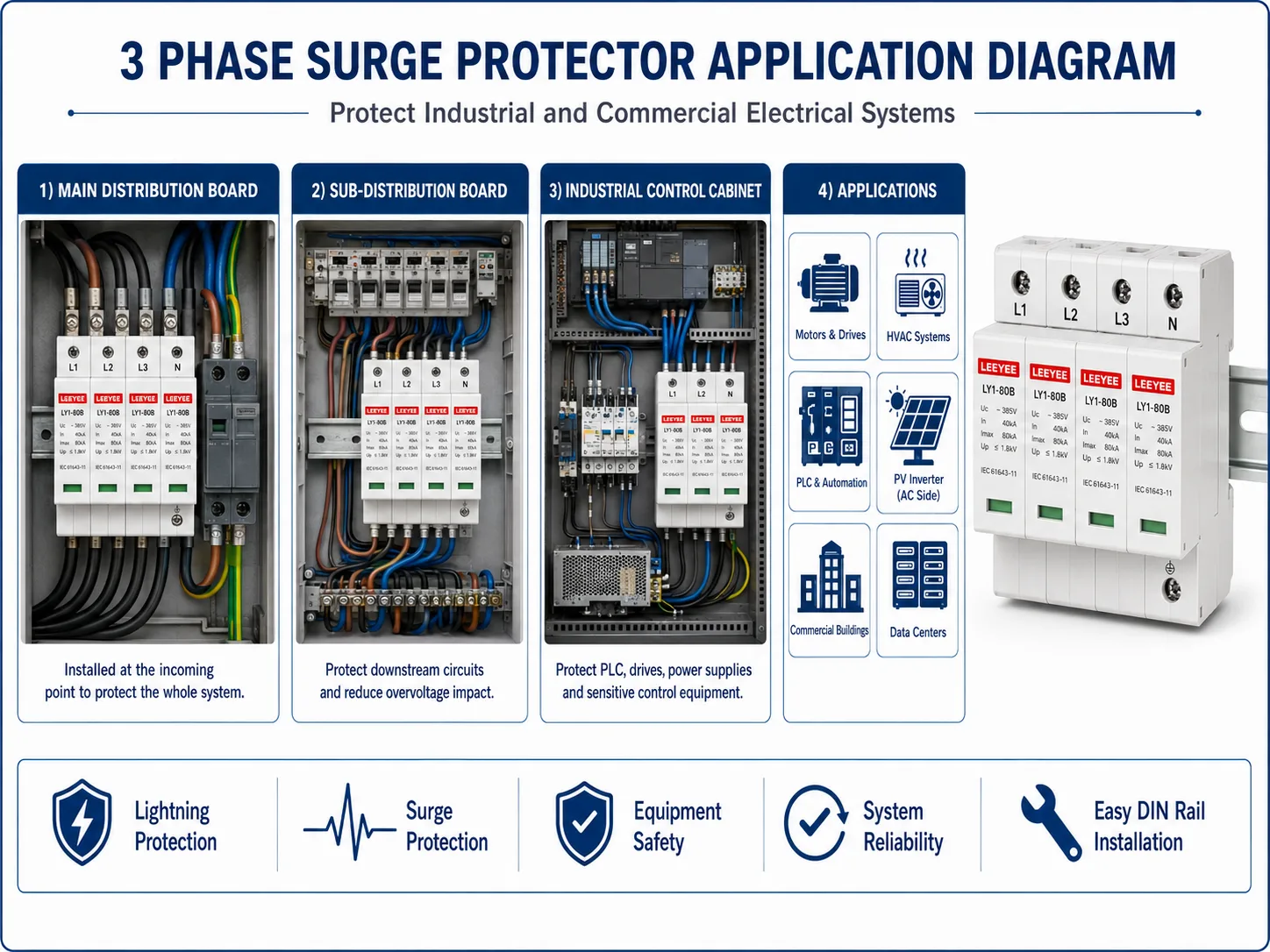
ค่าพิกัด kA ที่สูงกว่าไม่ได้หมายความว่า SPD จะเหมาะสมกว่าสำหรับทุกตู้โดยอัตโนมัติ SPD ที่ถูกต้องคืออุปกรณ์ที่ตรงกับระบบไฟฟ้าจริง ตำแหน่งติดตั้ง และข้อกำหนดด้านการป้องกัน.
อุปกรณ์ป้องกันไฟกระชาก 3 เฟสคืออะไร?
อุปกรณ์ป้องกันไฟกระชากสำหรับระบบ 3 เฟส หรือที่เรียกว่าอุปกรณ์ป้องกันแรงดันไฟฟ้ากระชากแบบสามเฟส หรือ 3 phase SPD ได้รับการออกแบบมาเพื่อจำกัดแรงดันไฟฟ้าเกินชั่วขณะในระบบไฟฟ้าสามเฟส.
ไฟกระชากอาจเกิดจากกิจกรรมฟ้าผ่า การสวิตช์ในโครงข่ายไฟฟ้า การสตาร์ตและหยุดมอเตอร์ การสวิตช์หม้อแปลง การสวิตช์ชุดคาปาซิเตอร์ การทำงานของ VFD ความขัดข้องที่อยู่ใกล้เคียง หรือการสวิตช์โหลดในภาคอุตสาหกรรม.
SPD จัดเตรียมเส้นทางระบายกระแสไฟกระชากที่มีการควบคุม เมื่อเกิดแรงดันไฟฟ้าเกินชั่วขณะ SPD จะจำกัดแรงดันไฟฟ้าให้อยู่ในระดับที่ปลอดภัยยิ่งขึ้น และช่วยระบายพลังงานไฟกระชากลงสู่ดิน.
สิ่งนี้ช่วยปกป้องอุปกรณ์ปลายทาง เช่น PLC, ไดรฟ์, แหล่งจ่ายไฟ, เซนเซอร์, แผงควบคุม, อุปกรณ์สื่อสาร และเครื่องจักรอุตสาหกรรม.
เหตุใดระบบสามเฟสจึงต้องเลือก SPD แตกต่างกัน
ระบบสามเฟสมีความซับซ้อนกว่าวงจรเฟสเดียว ไฟกระชากอาจเกิดขึ้นระหว่างตัวนำที่แตกต่างกัน.
- สายไฟถึงดิน: L-PE
- สายไฟถึงนิวทรัล: L-N
- สายกลางถึงสายดิน: N-PE
- สายถึงสาย: L-L
นี่คือเหตุผลว่าทำไมการเลือกอุปกรณ์ป้องกันไฟกระชาก (SPD) แบบสามเฟสจึงต้องพิจารณาโครงสร้างของระบบด้วย คำว่า “สามเฟส” เพียงอย่างเดียวไม่เพียงพอสำหรับการเลือก SPD
อุปกรณ์ป้องกันไฟกระชาก 3 เฟสใช้ที่ใดบ้าง?
SPD แบบ 3 เฟส มักใช้ในระบบไฟฟ้าสำหรับภาคธุรกิจ (B2B) ซึ่งรวมถึง:
- ตู้จ่ายไฟอุตสาหกรรม
- แผงไฟฟ้าสำหรับอาคารพาณิชย์
- ระบบจ่ายไฟฟ้าในโรงงาน
- ตู้ควบคุมเครื่องจักร
- แผงควบคุมระบบปรับอากาศ (HVAC)
- ศูนย์ควบคุมมอเตอร์
- ตู้ควบคุม PLC และระบบอัตโนมัติ
- แผงจ่ายไฟสำหรับศูนย์ข้อมูล
- ระบบจ่ายไฟสำหรับสถานีชาร์จรถยนต์ไฟฟ้า
- แผงเอาต์พุตไฟฟ้ากระแสสลับของอินเวอร์เตอร์โซลาร์เซลล์
- ตู้ควบคุมไฟฟ้าสำหรับ OEM
- โครงการประกอบตู้ไฟฟ้า
สำหรับผู้ซื้อแบบ OEM ผู้นำเข้า และผู้ประกอบตู้ไฟฟ้า SPD จะต้องตอบโจทย์ทั้งในด้านข้อกำหนดทางเทคนิคและการออกแบบผลิตภัณฑ์ขั้นสุดท้าย
ซึ่งรวมถึงพื้นที่เดินสาย การติดตั้งบนราง DIN ประเภทโมดูลแบบเสียบปลั๊ก หน้าสัมผัสสัญญาณระยะไกล การรับรอง การออกแบบฉลาก และความเสถียรในการจัดหาในระยะยาว
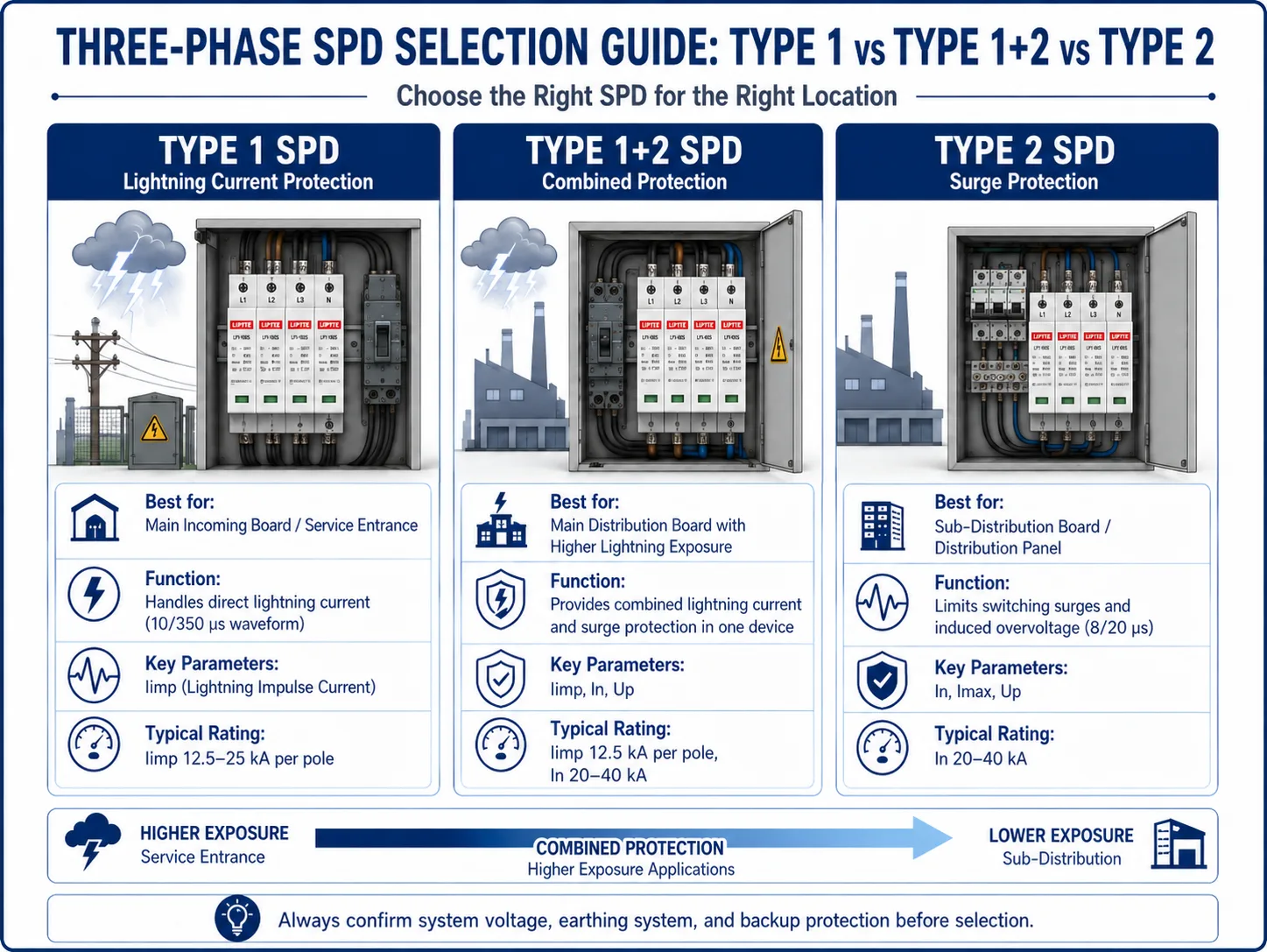
SPD สามเฟส Type 1, Type 2 และ Type 1+2
ประเภทของ SPD ควรตรงกับตำแหน่งการติดตั้งและระดับการสัมผัสกับไฟกระชาก ไม่ควรใช้ SPD ประเภท 2 โดยไม่พิจารณาในจุดที่ต้องการการป้องกันประเภท 1 แต่ก็ไม่ได้หมายความว่าจำเป็นต้องใช้ประเภท 1 ในทุกตู้ควบคุมเสมอไป
| ประเภท SPD | ตำแหน่งการติดตั้งทั่วไป | หน้าที่หลัก | หมายเหตุสำหรับผู้ซื้อ |
|---|---|---|---|
| SPD ประเภท 1 | ตู้เมนไฟฟ้าหลัก, จุดรับไฟเข้าอาคาร | รองรับกระแสฟ้าผ่าบางส่วน | ตรวจสอบค่า Iimp |
| SPD ประเภท 1+2 | ตู้จ่ายไฟหลักที่มีความเสี่ยงสูง | การป้องกันกระแสฟ้าผ่าและไฟกระชาก | มีประโยชน์ในจุดที่ต้องการการป้องกันแบบรวมที่มีขนาดกะทัดรัด |
| ชนิดที่ 2 SPD | ตู้จ่ายไฟย่อย, ตู้ควบคุม | จำกัดไฟกระชากจากการสับเปลี่ยนและไฟกระชากเหนี่ยวนำ | พบได้ทั่วไปสำหรับตู้ควบคุมในงานอุตสาหกรรม |
| ชนิดที่ 3 SPD | ใกล้กับอุปกรณ์ปลายทางที่มีความละเอียดอ่อน | การป้องกันละเอียดใกล้กับอุปกรณ์ | โดยปกติจะใช้หลังจากระบบประสานงานประเภทที่ 2 |
ทางเลือกที่ถูกต้องขึ้นอยู่กับการสัมผัสกับฟ้าผ่า การป้องกันต้นทาง การออกแบบระบบไฟฟ้าในพื้นที่ ตำแหน่งการติดตั้ง และข้อกำหนดของโครงการ
3P, 4P และ 3P+N: แตกต่างกันอย่างไร?
ผู้ซื้อจำนวนมากเลือกอุปกรณ์ป้องกันไฟกระชาก (SPD) แบบสามเฟสตามจำนวนขั้ว ซึ่งอาจนำไปสู่ความผิดพลาดได้
การกำหนดค่าขั้วควรสอดคล้องกับการเดินสายไฟของระบบและการจัดวางระบบสายดิน
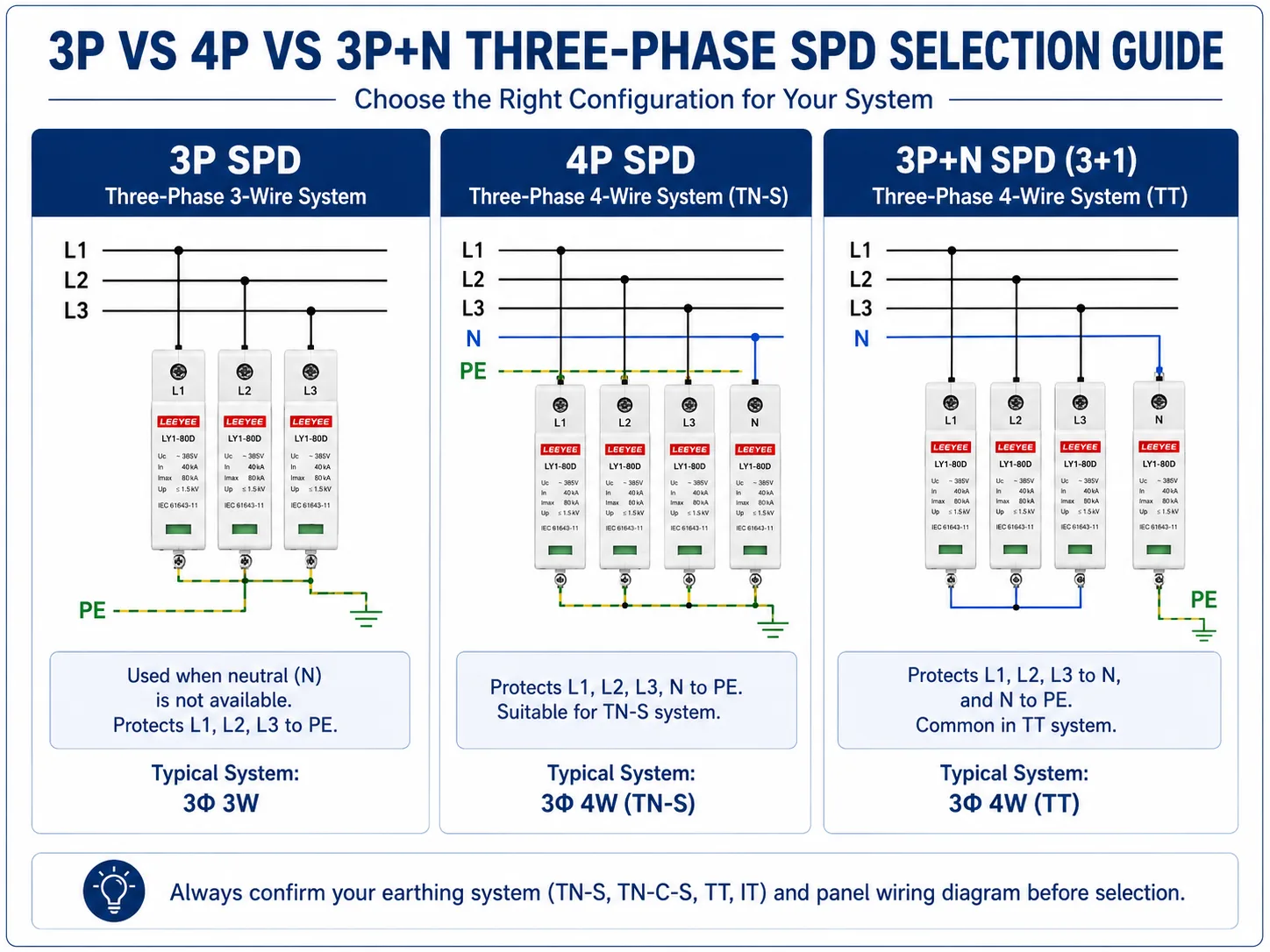
| การกำหนดค่า SPD | การใช้งานทั่วไป | ความหมายของมัน | หมายเหตุสำคัญ |
|---|---|---|---|
| SPD แบบ 3P | ระบบ 3 เฟส 3 สาย | การป้องกัน L1, L2, L3 | ใช้ในกรณีที่ไม่มีสายนิวทรัล |
| SPD แบบ 4P | ระบบ 3 เฟส 4 สาย | การป้องกัน L1, L2, L3, N | ตรรกะการเดินสายขึ้นอยู่กับการออกแบบระบบ |
| SPD 3P+N | มักใช้ในการออกแบบระบบป้องกันแบบ 3+1 | L1/L2/L3 to N, N to PE | พบได้ทั่วไปในการออกแบบระบบป้องกันที่เกี่ยวข้องกับ TT |
| การกำหนดค่าแบบ 4+0 | มักใช้ในระบบ TN-S | L1, L2, L3, N ป้องกันไปยัง PE | ตรวจสอบการออกแบบผลิตภัณฑ์และแผนผังการเดินสายไฟ |
| การกำหนดค่าแบบ 3+1 | มักใช้ในระบบ TT | L1/L2/L3 to N, N to PE | เส้นทาง N-PE มีความสำคัญอย่างยิ่ง |
SPD แบบ 4P และ 3P+N ไม่ควรถูกมองว่าเป็นสิ่งเดียวกันในทุกโครงการ SPD แบบ 3P ไม่ได้เหมาะสมกับระบบสามเฟสทั้งหมดโดยอัตโนมัติ และ SPD แบบ 3P+N ไม่ได้จำเป็นสำหรับทุกระบบที่มีสายกลางเสมอไป
ก่อนทำการสั่งซื้อ โปรดตรวจสอบแบบแปลนโครงการ ระบบสายดิน และแผนผังการเดินสาย SPD สำหรับแผนผังการเดินสายโดยละเอียด โปรดดูที่ คู่มือแผนภาพการเดินสาย SPD สามเฟส.
ระบบต่อลงดินส่งผลต่อการเลือก SPD 3 เฟสอย่างไร
ระบบสายดินเป็นหนึ่งในปัจจัยที่สำคัญที่สุดในการเลือกใช้ SPD ระบบสายดินที่แตกต่างกันอาจต้องใช้โหมดการป้องกันที่แตกต่างกัน
ระบบ TN-S
ในระบบ TN-S สายกลางและสายดินจะเป็นตัวนำแยกจากกัน แผงควบคุมสามเฟส TN-S ทั่วไปจะมี L1, L2, L3, N และ PE
ในตู้จ่ายไฟฟ้าแบบ TN-S ส่วนใหญ่ จะมีการใช้ SPD แบบ 4 ขั้ว หรืออุปกรณ์ป้องกันแบบ 4 ขั้วที่เหมาะสม การเชื่อมต่อที่แน่นอนจะขึ้นอยู่กับการออกแบบของ SPD และการเดินสายภายในตู้
ระบบ TN-C-S
ในระบบ TN-C-S ตัวนำ PEN จะถูกแยกออกเป็น N และ PE ณ จุดใดจุดหนึ่ง การเลือก SPD จะขึ้นอยู่กับตำแหน่งที่ติดตั้ง SPD นั้น
สำหรับระบบ TN-C-S อย่าเลือก SPD โดยพิจารณาจากจำนวนสายไฟเพียงอย่างเดียว โปรดตรวจสอบแบบแปลนของตู้ไฟฟ้าก่อน
ระบบ TT
ในระบบ TT การติดตั้งจะมีขั้วต่อลงดินในพื้นที่ของตนเอง ความสัมพันธ์ระหว่างสายนิวทรัลกับสายดินจะแตกต่างจากระบบ TN-S
ระบบ TT มักใช้ตรรกะการป้องกันแบบ 3P+N หรือ 3+1 เส้นทางการป้องกันระหว่าง N-PE จะต้องได้รับการพิจารณาอย่างรอบคอบ
ระบบไอที
ระบบ IT จำเป็นต้องได้รับความสนใจเป็นพิเศษ ระบบนี้อาจมีสายนิวทรัลแบบแยกส่วนหรือแบบต่อลงดินผ่านอิมพีแดนซ์
การเลือกอุปกรณ์ป้องกันไฟกระชาก (SPD) สำหรับระบบ IT ควรเป็นไปตามการออกแบบทางไฟฟ้าของโครงการ ข้อกำหนดในการตรวจสอบความเป็นฉนวน และกฎระเบียบในท้องถิ่น ห้ามใช้คำแนะนำ SPD สำหรับระบบ TN หรือ TT ทั่วไปโดยไม่ได้ตรวจสอบการออกแบบระบบก่อน
พารามิเตอร์สำคัญสำหรับอุปกรณ์ป้องกันไฟกระชาก 3 เฟส
Uc / MCOV
Uc หรือที่เรียกว่า MCOV คือแรงดันไฟฟ้าใช้งานต่อเนื่องสูงสุด ค่านี้จะต้องสูงกว่าแรงดันไฟฟ้าปกติของระบบ แต่ต้องไม่เลือกให้สูงเกินไปโดยไม่มีการพิจารณา
หากค่า Uc ต่ำเกินไป SPD อาจเสื่อมสภาพเร็วขึ้นหรือเสียหายก่อนกำหนด หากค่า Uc สูงเกินไป ระดับการป้องกันอาจมีความไวลดลง
ใน
In คือกระแสคายประจุระบุ ค่านี้แสดงถึงความสามารถของ SPD ในการรองรับกระแสไฟกระชากซ้ำๆ โดยปกติจะใช้รูปคลื่นขนาด 8/20 μs
IMAX
Imax คือกระแสคายประจุสูงสุด ซึ่งแสดงถึงความสามารถในการคายประจุจากไฟกระชากสูงสุดเพียงครั้งเดียวของอุปกรณ์ป้องกันไฟกระชาก (SPD) ภายใต้เงื่อนไขการทดสอบที่กำหนด
Iimp
Iimp คือกระแสอิมพัลส์จากฟ้าผ่า ซึ่งมีความสำคัญสำหรับอุปกรณ์ป้องกันไฟกระชากประเภทที่ 1 (Type 1) และประเภทที่ 1+2 (Type 1+2)
Up
Up คือระดับการป้องกันแรงดันไฟฟ้า โดยค่า Up ที่ต่ำกว่ามักหมายถึงประสิทธิภาพในการจำกัดแรงดันไฟฟ้าที่ดีกว่า
ฟิวส์สำรองหรือเบรกเกอร์ (MCB)
โดยปกติแล้วอุปกรณ์ป้องกันไฟกระชาก (SPD) แบบ 3 เฟส จำเป็นต้องมีการป้องกันกระแสเกินสำรองที่เหมาะสม ซึ่งอาจเป็น MCB, MCCB หรือฟิวส์ โดยพิกัดควรเป็นไปตามเอกสารข้อมูลของ SPD
ตารางการเลือกอุปกรณ์ป้องกันไฟกระชาก 3 เฟส
ใช้ตารางนี้เป็นจุดเริ่มต้นอย่างรวดเร็วก่อนส่งคำถาม
| ระบบหรือการใช้งาน | แนวทางการเลือกที่แนะนำ | สิ่งที่ต้องยืนยัน |
|---|---|---|
| ตู้จ่ายไฟฟ้า 230/400V ระบบ TN-S | อุปกรณ์ป้องกันไฟกระชาก (SPD) ชนิดที่ 2 แบบ 4 โพล หรือรุ่นที่เหมาะสม | ค่า Uc, In, Imax และระบบป้องกันสำรอง |
| ตู้ควบคุมไฟฟ้าสำหรับงานอุตสาหกรรม 400/415V | ประเภท 2 หรือประเภท 1+2 ขึ้นอยู่กับตำแหน่งการติดตั้ง | แรงดันไฟฟ้าของระบบและระดับการสัมผัส |
| แผงจ่ายไฟหลักขาเข้า | อาจจำเป็นต้องใช้ประเภท 1 หรือประเภท 1+2 | ค่า Iimp, อุปกรณ์ป้องกันต้นทาง, และรหัสการติดตั้ง |
| ตู้จ่ายไฟย่อย | ชนิดที่ 2 SPD | In, Imax, Up, ฟิวส์สำรอง |
| ระบบ TT | อาจจำเป็นต้องใช้ 3P+N / 3+1 | เส้นทาง N-PE และความเหมาะสมของผลิตภัณฑ์ |
| ระบบสามเฟส 3 สาย | SPD แบบ 3P | ไม่มีสายนิวทรัล, แรงดันไฟฟ้าของระบบ, การต่อลงดิน |
| ตู้ OEM | SPD เฉพาะสำหรับโครงการ | ฉลาก, การรับรอง, พื้นที่เดินสายไฟ, สัญญาณระยะไกล |
| แผงควบคุมการตรวจสอบระยะไกล | SPD พร้อมหน้าสัมผัสสัญญาณระยะไกล | ประเภทและการเดินสายไฟของหน้าสัมผัสสัญญาณเตือน |
ตารางนี้ไม่ได้มีไว้เพื่อใช้แทนแบบแปลนของโครงการ แต่เป็นเครื่องมือช่วยเลือกอุปกรณ์อย่างรวดเร็วสำหรับผู้ซื้อ ผู้จัดจำหน่าย และผู้ประกอบตู้ควบคุม
ตำแหน่งการติดตั้ง: ตู้เมนเทียบกับตู้จ่ายไฟย่อย
ควรติดตั้งอุปกรณ์ป้องกันไฟกระชากแบบ 3 เฟสตามโซนการป้องกันและหน้าที่ของตู้ควบคุม
- ตู้จ่ายไฟหลักขาเข้า
- ตู้จ่ายไฟย่อย
- ตู้ควบคุมเครื่องจักร
- ตู้ PLC
- แผงเอาต์พุตไฟฟ้ากระแสสลับของอินเวอร์เตอร์ PV
- แผงควบคุมระบบปรับอากาศ (HVAC)
- แผงจ่ายไฟฟ้าสำหรับศูนย์ข้อมูล
ที่จุดรับไฟฟ้าหลัก อาจจำเป็นต้องใช้ประเภท 1 หรือประเภท 1+2 ขึ้นอยู่กับการสัมผัสกับฟ้าผ่าและการออกแบบระบบป้องกันอาคาร ที่แผงจ่ายไฟย่อย มักใช้ประเภท 2 เพื่อป้องกันวงจรที่อยู่ถัดไป
การเดินสายและความยาวสายต่อมีความสำคัญ
SPD ที่ดีอาจทำงานได้ไม่เต็มประสิทธิภาพหากเดินสายไฟไม่ถูกต้อง ในระหว่างที่เกิดไฟกระชาก กระแสไฟฟ้าจะเพิ่มขึ้นอย่างรวดเร็ว สายไฟที่ยาวจะเพิ่มค่าความเหนี่ยวนำและอาจทำให้แรงดันไฟฟ้าที่อุปกรณ์ปลายทางได้รับสูงขึ้น
สำหรับแผนผังการเดินสายไฟแบบ TN-S, TN-C-S, TT, 3P, 4P และ 3P+N โดยละเอียด โปรดดูที่ คู่มือแผนภาพการเดินสาย SPD สามเฟส.
ข้อผิดพลาดทั่วไปในการเลือก SPD 3 เฟส
1. การเลือกโดยพิจารณาจากจำนวนขั้วเพียงอย่างเดียว
ผู้ซื้อบางรายสอบถามเพียงแค่ “3P” หรือ “4P” โดยไม่ได้ตรวจสอบระบบสายดิน ซึ่งอาจนำไปสู่การเลือกผลิตภัณฑ์ที่ไม่ถูกต้อง
2. การละเลยระบบสายดิน
ระบบ TN-S, TN-C-S, TT และ IT อาจต้องใช้ตรรกะการเดินสาย SPD ที่แตกต่างกัน อย่าใช้วิธีการเดียวกันกับตู้ไฟฟ้าสามเฟสทุกตู้
3. การใช้ SPD ประเภทที่ 2 ในจุดที่จำเป็นต้องใช้ประเภทที่ 1 หรือประเภทที่ 1+2
SPD ประเภทที่ 2 มักใช้สำหรับตู้จ่ายไฟ แต่หากตู้ไฟฟ้าติดตั้งอยู่ที่จุดรับไฟหลักและมีความเสี่ยงสูงต่อฟ้าผ่า อาจจำเป็นต้องใช้ SPD ประเภทที่ 1 หรือประเภทที่ 1+2
4. การเลือกค่า Uc ต่ำเกินไป
หากค่า Uc ต่ำเกินไปสำหรับแรงดันไฟฟ้าขณะใช้งานจริง อุปกรณ์ป้องกันไฟกระชาก (SPD) อาจเสื่อมสภาพเร็วขึ้นหรือเสียหายก่อนกำหนด ควรตรวจสอบแรงดันไฟฟ้าที่กำหนดและความผันผวนของแรงดันไฟฟ้าอยู่เสมอ
5. พิจารณาเฉพาะค่า Imax
ค่า Imax มีความสำคัญ แต่ไม่ใช่ปัจจัยทั้งหมดที่ต้องพิจารณา ควรตรวจสอบค่า In, Iimp, Up, Uc, ฟิวส์สำรอง และการรับรองมาตรฐาน
6. ละเลยการติดตั้งอุปกรณ์ป้องกันสำรอง
ควรป้องกันอุปกรณ์ป้องกันไฟกระชาก (SPD) ตามข้อมูลในเอกสารทางเทคนิค โดยเบรกเกอร์ (MCB) หรือฟิวส์สำรองจะช่วยให้สามารถตัดการทำงานได้อย่างปลอดภัยเมื่อสิ้นสุดอายุการใช้งานหรือในกรณีที่เกิดความผิดปกติ
7. การละเลยข้อกำหนดด้านสัญญาณระยะไกล
สำหรับทีมบำรุงรักษาในภาคอุตสาหกรรม หน้าสัมผัสสัญญาณระยะไกลสามารถช่วยตรวจสอบสถานะของ SPD ได้ หากตู้ควบคุมจำเป็นต้องมีเอาต์พุตแจ้งเตือน โปรดตรวจสอบรายละเอียดนี้ก่อนทำการสั่งซื้อ
คุณควรส่งข้อมูลใดก่อนสั่งซื้อ?
ก่อนขอใบเสนอราคา โปรดเตรียมรายละเอียดเหล่านี้ เพื่อช่วยให้ซัพพลายเออร์สามารถแนะนำอุปกรณ์ป้องกันไฟกระชากแบบ 3 เฟสที่เหมาะสมได้อย่างรวดเร็วยิ่งขึ้น
| ข้อมูล | เหตุผลที่สำคัญ |
|---|---|
| แรงดันระบบพิกัด | กำหนดการเลือก Uc / MCOV |
| ระบบต่อลงดิน | TN-S, TN-C-S, TT, IT หรือระบบ 3 เฟส 3 สาย |
| ตำแหน่งการติดตั้ง | ตู้เมนไฟฟ้า, ตู้ย่อย, ตู้ควบคุมเครื่องจักร, ตู้ OEM |
| ประเภท SPD | ประเภท 1, ประเภท 2, ประเภท 1+2 หรือประเภท 3 |
| การจัดเรียงขั้ว | 3P, 4P, or 3P+N. |
| ข้อกำหนด In / Imax / Iimp | กำหนดความสามารถในการระบายกระแส |
| ฟิวส์สำรองหรือเซอร์กิตเบรกเกอร์ (MCB) | จำเป็นสำหรับการประสานการทำงานที่ปลอดภัย |
| ข้อกำหนดสัญญาณระยะไกล | จำเป็นสำหรับการแจ้งเตือนหรือการตรวจสอบเพื่อการบำรุงรักษา |
| ข้อกำหนดการรับรอง | เอกสารรับรอง CE, TUV, CB หรือเอกสารเฉพาะสำหรับโครงการ |
| ข้อกำหนดฉลาก OEM | มีความสำคัญสำหรับผู้จัดจำหน่ายและผู้ซื้อสินค้าภายใต้แบรนด์ของตนเอง |
| แผนผังการเดินสายไฟในตู้ควบคุม | ช่วยยืนยันการกำหนดค่า SPD ที่ถูกต้อง |
ต้องการความช่วยเหลือในการเลือกอุปกรณ์ป้องกันไฟกระชาก 3 เฟสหรือไม่?
โปรดส่งข้อมูลแรงดันไฟฟ้าของระบบ, ประเภทการต่อลงดิน, ตำแหน่งการติดตั้ง, แผนผังการเดินสายไฟในตู้, ข้อกำหนดฟิวส์สำรอง และข้อกำหนดด้านการรับรองให้แก่เรา ทีมงานของเราสามารถแนะนำรุ่น SPD ที่เหมาะสมสำหรับแผงจ่ายไฟ, ตู้ควบคุม หรือตู้ไฟฟ้า OEM ของคุณได้
ผลิตภัณฑ์ SPD 3 เฟสที่แนะนำสำหรับผู้ซื้อ B2B
LEEYEE จัดหาอุปกรณ์ป้องกันไฟกระชากแบบติดตั้งบนราง DIN สำหรับระบบไฟฟ้าสามเฟสทั้งในภาคอุตสาหกรรมและเชิงพาณิชย์ สำหรับแผงจ่ายไฟสามเฟส, ตู้ควบคุม และตู้ไฟฟ้า OEM หน้าผลิตภัณฑ์ต่อไปนี้จะช่วยให้คุณเปรียบเทียบตัวเลือก SPD ที่เหมาะสมได้
คำถามที่พบบ่อย
อุปกรณ์ป้องกันไฟกระชากแบบ 3 เฟสคืออะไร?
อุปกรณ์ป้องกันไฟกระชากแบบ 3 เฟส คือ SPD ที่ใช้สำหรับป้องกันระบบไฟฟ้าสามเฟสจากแรงดันไฟฟ้าเกินชั่วขณะ มักใช้ในตู้ควบคุมไฟฟ้าในโรงงานอุตสาหกรรม แผงจ่ายไฟเชิงพาณิชย์ ตู้เครื่องจักร และระบบไฟฟ้าของอุปกรณ์ OEM
ฉันควรเลือก SPD แบบ 3 เฟสอย่างไร
โปรดตรวจสอบแรงดันไฟฟ้าของระบบ ระบบสายดิน ตำแหน่งการติดตั้ง ประเภทของ SPD การกำหนดค่าขั้ว พิกัดกระแสกระชาก อุปกรณ์ป้องกันสำรอง และข้อกำหนดด้านการรับรอง ห้ามเลือกเพียงแค่จำนวนขั้วหรือพิกัด Imax เท่านั้น
ความแตกต่างระหว่าง SPD แบบ 3P และ 4P คืออะไร?
SPD แบบ 3P มักใช้สำหรับระบบสามเฟส 3 สายที่ไม่มีสายนิวทรัล SPD แบบ 4P ใช้สำหรับระบบสามเฟส 4 สาย ซึ่งจำเป็นต้องมีการป้องกันสำหรับ L1, L2, L3 และ N ตามการออกแบบของระบบ
SPD แบบ 4P กับ 3P+N ต่างกันอย่างไร?
SPD แบบ 4P และ 3P+N ไม่เหมือนกันเสมอไป โดยทั่วไป SPD แบบ 3P+N จะหมายถึงตรรกะการป้องกันแบบ 3+1 ซึ่งมีการป้องกันสามเฟสเทียบกับสายกลาง และป้องกันสายกลางเทียบกับสายดิน (PE) การเลือกที่ถูกต้องขึ้นอยู่กับระบบสายดิน
ใช้ SPD ชนิดใดสำหรับระบบ TN-S แบบสามเฟส?
แผงจ่ายไฟสามเฟสแบบ TN-S หลายแห่งใช้การป้องกันด้วย SPD แบบ 4P หรือแบบ 4 ขั้วที่เหมาะสม การเชื่อมต่อที่แน่นอนขึ้นอยู่กับการออกแบบแผงควบคุม ประเภทของ SPD และข้อกำหนดของโครงการ
ใช้ SPD ใดสำหรับระบบ TT แบบสามเฟส?
ระบบ TT มักใช้ตรรกะการป้องกันแบบ 3P+N หรือ 3+1 ต้องพิจารณาเส้นทางการป้องกัน N-PE อย่างรอบคอบ โปรดตรวจสอบเอกสารข้อมูลผลิตภัณฑ์และแบบแปลนโครงการก่อนทำการเลือกใช้งานเสมอ
ฉันจำเป็นต้องใช้ SPD แบบ Type 1 หรือ Type 2 สำหรับแผงไฟ 3 เฟสหรือไม่?
อาจจำเป็นต้องใช้ Type 1 หรือ Type 1+2 ณ จุดรับไฟหลักที่มีความเสี่ยงต่อฟ้าผ่า Type 2 มักใช้ในตู้ย่อยและตู้ควบคุม การเลือกที่ถูกต้องขึ้นอยู่กับตำแหน่งการติดตั้งและระดับความเสี่ยง
อุปกรณ์ป้องกันไฟกระชาก 3 เฟสจำเป็นต้องมีฟิวส์สำรองหรือ MCB หรือไม่?
โดยส่วนใหญ่แล้วใช่ ฟิวส์สำรองหรือ MCB จะช่วยตัดการเชื่อมต่อ SPD อย่างปลอดภัยหากอุปกรณ์หมดอายุการใช้งานหรือเกิดความล้มเหลวภายใต้สภาวะผิดปกติ พิกัดควรเป็นไปตามเอกสารข้อมูลของ SPD
ฉันสามารถใช้ SPD เฟสเดียว 3 ตัวแทน SPD 3 เฟส 1 ตัวได้หรือไม่?
ในเชิงเทคนิคอาจเป็นไปได้ในบางการออกแบบ แต่โดยทั่วไปแนะนำให้ใช้ SPD แบบสามเฟสโดยเฉพาะ เพื่อการติดตั้งที่สอดประสานกัน การตรวจสอบที่ง่ายขึ้น และการออกแบบตู้ควบคุมที่เป็นระเบียบ โปรดปฏิบัติตามแบบแปลนโครงการและคำแนะนำจากซัพพลายเออร์
ฉันควรส่งข้อมูลใดบ้างเพื่อขอคำแนะนำเกี่ยวกับ SPD ที่ถูกต้อง
โปรดส่งข้อมูลแรงดันไฟฟ้าของระบบ ระบบต่อลงดิน ตำแหน่งติดตั้ง ข้อกำหนดจำนวนขั้ว ประเภท SPD แผนผังการเดินสายของแผง ข้อกำหนดฟิวส์สำรอง ข้อกำหนดด้านการรับรอง และระบุว่าจำเป็นต้องมีหน้าสัมผัสสัญญาณระยะไกลหรือไม่.