
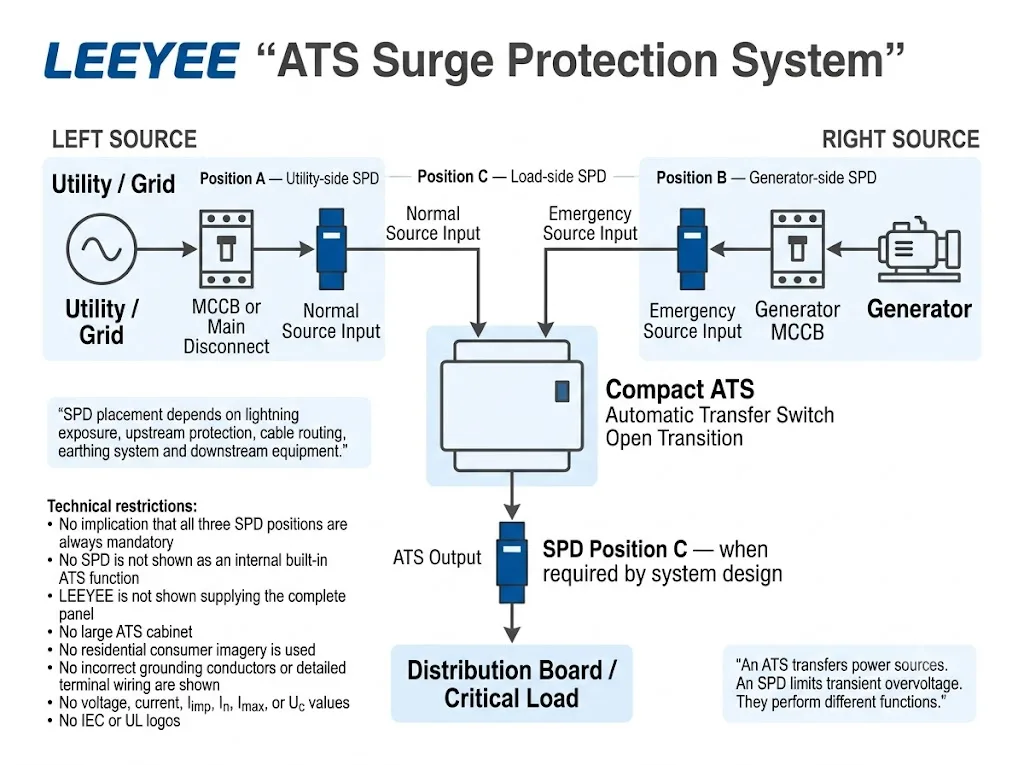
An automatic transfer switch and a surge protective device solve two different problems. The ATS transfers a load between available power sources; an SPD limits transient overvoltage and diverts surge current. For a backup-power system, surge protection should therefore be evaluated around the ATS rather than treated as an internal ATS function. [1][2]
An ATS does not replace an SPD. Surge protection may be considered on the utility input, generator input, ATS output or downstream distribution, but the correct locations depend on the complete power architecture rather than the ATS ampere rating alone. [2][3][4]
สารบัญ
ATS and SPD Perform Different Electrical Functions
IEC 60947-6-1:2026 covers transfer switching equipment used to transfer a load between power supply sources. That source-transfer function is fundamentally different from surge protection. [1]
IEC 61643-11:2025 applies to surge protective devices connected to low-voltage AC power systems. These devices are intended to limit surge voltages and divert surge currents arising from lightning effects or other transient overvoltages. [2]
Therefore, an ATS can perform its source-transfer function correctly while the surrounding installation still requires separate surge-protection measures.
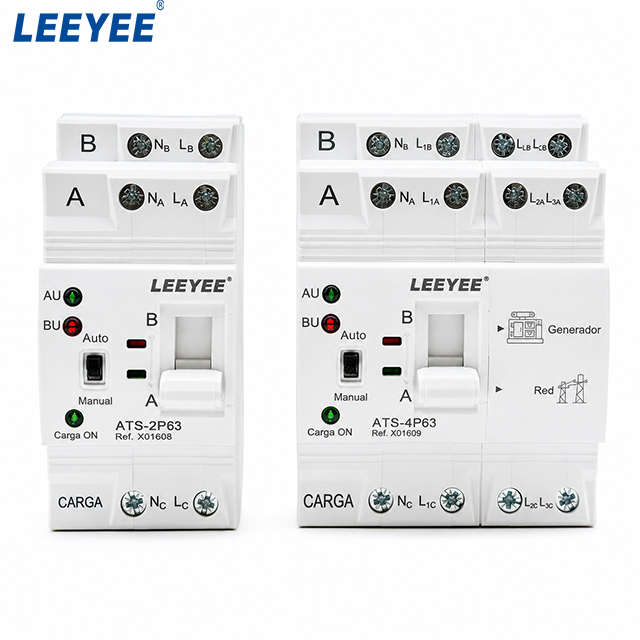
LEEYEE's standard ATS offering is a compact integrated automatic transfer switch, including configurations such as 2P and 4P for normal/emergency source transfer. It is supplied as the ATS device rather than as a complete ATS cabinet, AMF cabinet or bypass-isolation system.
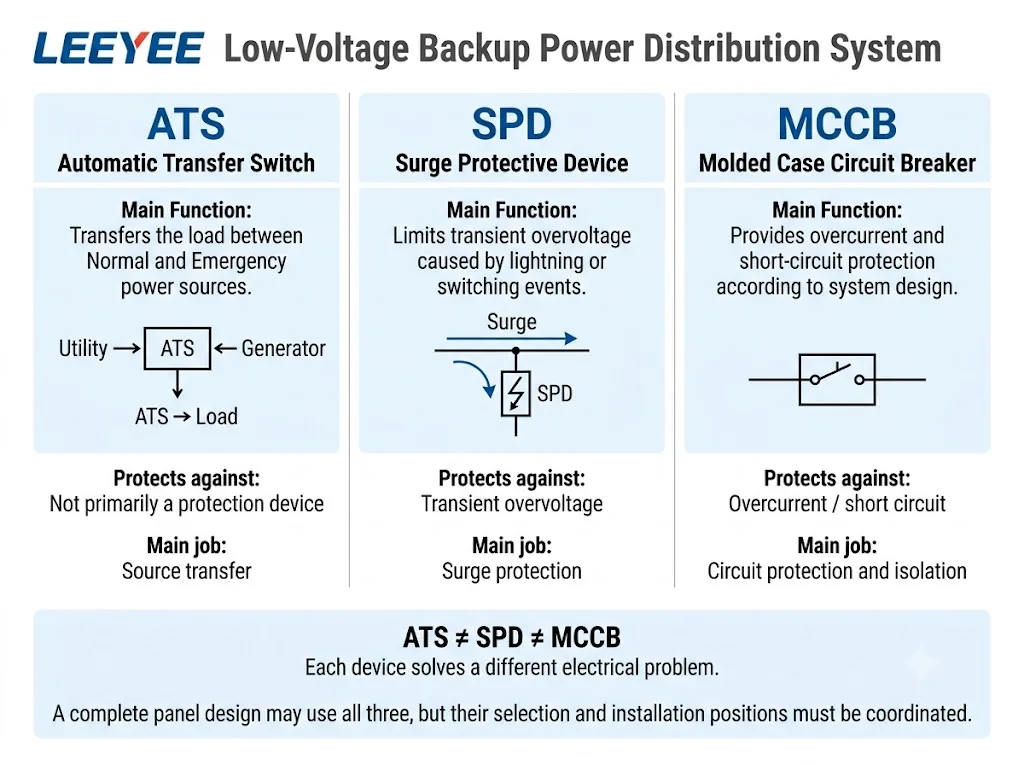
Transfers the load between normal and emergency power sources.
Limits transient overvoltage and diverts surge current.
Provides circuit interruption, overcurrent protection and isolation according to the selected device and system design.
A higher-current ATS does not replace an SPD. An SPD does not replace an MCCB. Panel builders should verify source transfer, overcurrent protection, short-circuit performance and surge protection separately, then coordinate them at system level.
Where Can an SPD Be Installed Around an Automatic Transfer Switch?
For engineering review, divide the power path into three areas: the utility or normal source, the generator or emergency source, and the load side after the transfer switch.
Schneider Electric application guidance for automatic transfer switches discusses surge protection at the service-entry side, generator side and transfer-switch load side. System arrangement and existing protection affect the final solution. [5]
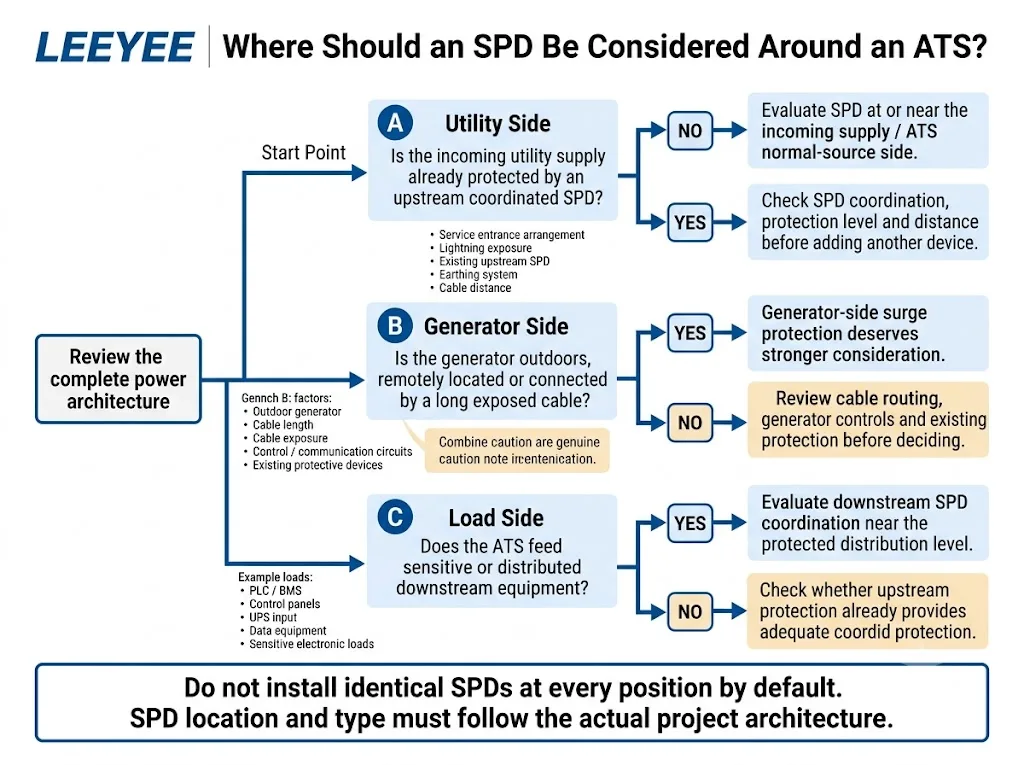
This does not mean every ATS installation requires three identical SPDs.
| ตำแหน่ง SPD | Why evaluate it? | สิ่งที่ต้องได้รับการยืนยันคืออะไร? | Procurement meaning |
|---|---|---|---|
| Utility / normal source | Incoming lightning-related or switching transients | Service entrance, upstream SPD, earthing and lightning protection concept | Check existing upstream protection first |
| Generator / emergency source | Separate surge exposure through generator conductors | Generator location, cable route, exposure and existing protection | Outdoor and remote circuits deserve separate review |
| ATS output / load side | Additional protection for downstream equipment | Load sensitivity, downstream panels and upstream SPD coordination | Use as part of a coordinated protection concept |
The ATS nameplate alone cannot determine where the SPD belongs. Review the complete single-line architecture first.
Does the Utility Input Side Need Surge Protection?
The utility side is one of the first locations engineers review because transient overvoltages can enter from the incoming power system.
IEC 62305-4:2024 addresses surge-protection measures for electrical and electronic systems within structures exposed to lightning electromagnetic effects. IEC 60364-5-53 covers selection and erection requirements relevant to protective, switching and control equipment in low-voltage installations. [3][4]
If a suitable upstream SPD already exists, another SPD immediately beside the ATS may or may not provide meaningful additional protection.
Does the Generator Input Need Its Own SPD?
The emergency source should be assessed independently because its physical installation may create a different surge path.
An outdoor or remotely installed generator may be connected through long or exposed conductors. That differs from a compact indoor installation with short protected cable runs.
ATS surge-protection application guidance also identifies generator-side power and external control or monitoring circuits as areas that may require separate consideration. [5]
Confirm generator location, cable exposure, system voltage, earthing arrangement, existing protection and the applicable project standard before fixing the SPD configuration.
Should the SPD Be Installed Before or After the ATS?
There is no universal “before” or “after” answer.
An upstream SPD can address transient overvoltages arriving from a source. A downstream SPD can form another protection stage closer to distribution equipment or sensitive loads.
Some installations use coordinated SPDs at several levels. A compact installation with suitable upstream protection may not require another device at every possible position.
Do You Need SPDs on All Three Sides?
No universal rule requires the same three-SPD arrangement for every ATS system.
Type 1 or Type 2 SPD for an ATS System?
Do not determine SPD type from the ATS current rating.
IEC 61643-11:2025 specifies requirements and test methods for SPDs connected to low-voltage AC systems, including requirements relevant to Type 1 and Type 2 devices. [2]
In an IEC-oriented project, Type 1 protection is generally associated with locations where lightning-current discharge capability forms part of the lightning protection concept. Type 2 SPDs are commonly used at distribution levels for transient overvoltage protection and coordinated downstream protection.
Final selection still depends on installation position, external lightning protection, earthing system, existing upstream protection, Uc, Up and required surge-current capability.
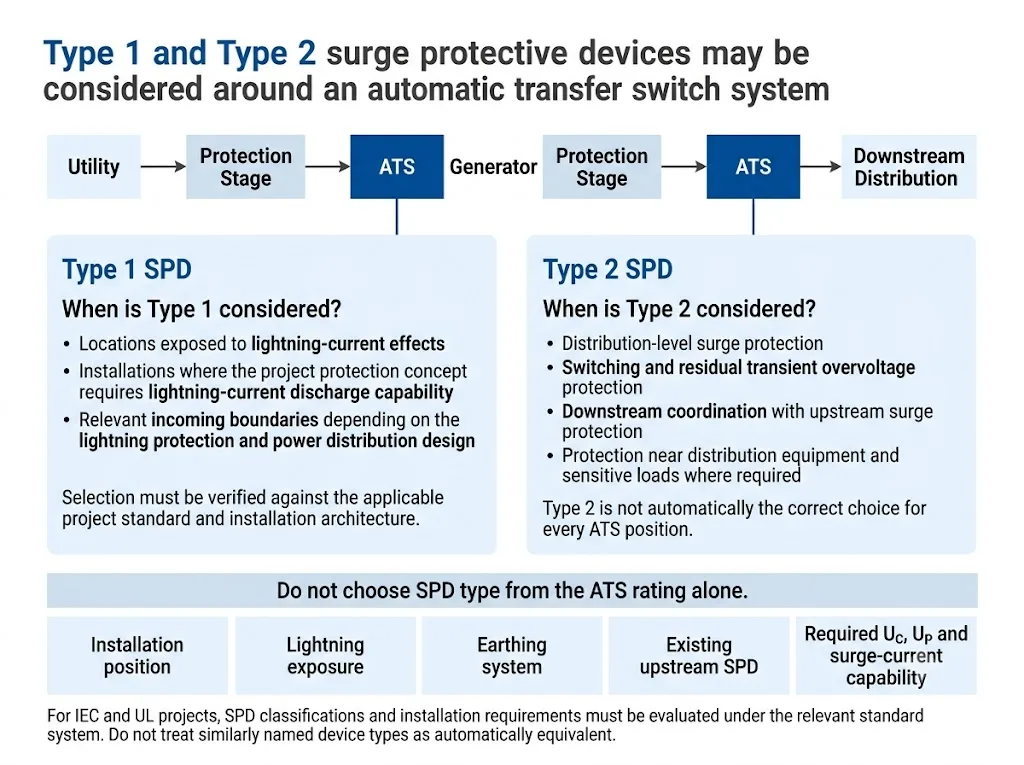
IEC and UL use different classification and installation frameworks. Buyers should confirm the required market standard and product certification before OEM approval. [6]
How MCCB, SPD and ATS Work Together
A backup-power panel may use MCCBs or other protective devices together with SPDs and a compact ATS, but each component has a different purpose.
The ATS handles source transfer. The SPD handles transient overvoltage. The MCCB handles circuit protection and switching functions appropriate to its design.
SPD backup protection also requires project confirmation. Fuse or breaker ratings, conductor size, prospective short-circuit current and permitted installation arrangement must follow the selected SPD documentation and applicable standard.
Do not determine conductor size, SPD backup fuse or breaker rating, protection mode, neutral arrangement or short-circuit coordination from a generic article. Confirm the actual SPD model and project conditions.
What Should Buyers Confirm When Ordering ATS + SPD Together?
- Rated system voltage
- ระบบไฟฟ้าเฟสเดียวหรือสามเฟส
- กระแสไฟฟ้าที่ระบุ
- 2P, 3P or 4P configuration
- Normal and emergency source type
- Open-transition requirement
- Required standard or project specification
- แรงดันระบบ
- รูปแบบการต่อลงดิน
- Proposed installation position
- Type 1, Type 2 or coordinated protection requirement
- Uc and Up requirements
- In, Imax หรือ Iimp ตามความเหมาะสม
- Required certification or market standard
LEEYEE supplies compact automatic transfer switches and surge protective devices. The surrounding MCCB arrangement, enclosure, generator controls and complete panel architecture remain project-specific unless separately confirmed.
Need to review an ATS + SPD configuration?
Send the system voltage, ATS current and poles, utility/generator arrangement, earthing system, proposed SPD positions and required standard.
Common ATS Surge-Protection Design Mistakes
1. Treating surge protection as an ATS built-in function
Do not assume a transfer switch includes surge protection unless the actual assembly documentation says so.
2. Installing the same SPD at every possible position
Utility, generator and downstream positions can have different surge exposure, earthing and coordination requirements.
3. Choosing an SPD from ATS current alone
ATS current does not by itself determine SPD Type, Uc, Up, In, Imax or Iimp.
4. Ignoring existing upstream protection
Additional SPDs should be coordinated with devices already installed.
5. Forgetting control and communication circuits
Remote start contacts, BMS links and communication circuits may require separate signal-line protection. Power-line SPDs do not automatically protect every signal interface. [5]
ATS + SPD Combination Sourcing for Panel Builders
ATS and SPD combination sourcing can simplify model confirmation when the system architecture is already known. The benefit is not that they become one device; it is that their requirements can be reviewed together before panel production.
For distribution-level SPD information, see the LEEYEE Type 2 Surge Protective Device. For ATS operating logic and selection, see the LEEYEE Automatic Transfer Switch Selection Guide.
คำถามที่พบบ่อย
Does every automatic transfer switch need surge protection?
Not as a universal rule. Review source exposure, existing protection, generator location, earthing and downstream load sensitivity.
Should an SPD be installed before or after an ATS?
Either or both locations may be appropriate. The final arrangement depends on source exposure and coordination with other SPDs.
Does a generator input need its own SPD?
It depends. Generator-side protection deserves stronger consideration when the generator is outdoors, remote or connected by long or exposed conductors.
Can the same Type 2 SPD be used on utility and generator inputs?
Do not assume so. Each source should be checked for voltage, earthing, installation position and required surge-current capability.
Is an MCCB enough to protect an ATS from surge voltage?
No. MCCBs and SPDs address different electrical events. An SPD is specifically intended to limit transient overvoltage and divert surge current.
Does LEEYEE supply the complete ATS panel?
This article does not make that claim. LEEYEE's standard offering is the compact integrated ATS device, and LEEYEE also supplies surge protective devices. Complete cabinet design and project wiring must be confirmed separately.
Confirm the system before fixing the models
Share the utility and generator voltage, ATS current and poles, earthing system, existing upstream SPD, downstream load type and required project standard.
เอกสารอ้างอิง
- คณะกรรมการเทคโนโลยีกำลังไฟฟ้าสากล (IEC), IEC 60947-6-1:2026 — อุปกรณ์สวิตช์และควบคุมแรงดันต่ำ — ส่วน 6-1: อุปกรณ์หลายฟังก์ชัน — อุปกรณ์สวิตช์โอนถ่าย. หน้าเผยแพร่เอกสารอย่างเป็นทางการของ IEC.
- คณะกรรมการเทคโนโลยีกำลังไฟฟ้าสากล (IEC), IEC 61643-11:2025 — อุปกรณ์ป้องกันไฟกระชากแรงดันต่ำ — ส่วนที่ 11: อุปกรณ์ป้องกันไฟกระชากที่เชื่อมต่อกับระบบไฟฟ้าแรงดันต่ำกระแสสลับ — ข้อกำหนดและวิธีการทดสอบ. หน้าเผยแพร่เอกสารอย่างเป็นทางการของ IEC.
- คณะกรรมการเทคโนโลยีกำลังไฟฟ้าสากล (IEC), IEC 60364-5-53:2019 + AMD1:2020 + AMD2:2024 — Low-voltage electrical installations — Part 5-53. หน้าเผยแพร่เอกสารอย่างเป็นทางการของ IEC.
- คณะกรรมการเทคโนโลยีกำลังไฟฟ้าสากล (IEC), IEC 62305-4:2024 — การป้องกันฟ้าผ่า — ส่วนที่ 4: ระบบไฟฟ้าและอิเล็กทรอนิกส์ภายในสิ่งปลูกสร้าง. หน้าเผยแพร่เอกสารอย่างเป็นทางการของ IEC.
- Schneider Electric, Locations for a surge protective device in an Automatic transfer switch application, FAQ000255143. Schneider Electric application guidance.
- ยูแอล โซลูชันส์, UL iQ for Surge Protective Devices. UL Solutions certification information.
