
¿Necesita un diagrama de cableado de SPD trifásico para un cuadro de distribución, panel de control o gabinete eléctrico OEM?
El punto clave es simple: un SPD trifásico no se selecciona solo contando los cables. Debe coincidir con el sistema de puesta a tierra, la tensión del sistema, la configuración de polos, la posición de instalación y la protección de respaldo.
Para muchos paneles trifásicos TN-S y TN-C-S, el SPD se conecta comúnmente entre L1, L2, L3, N y PE. Para sistemas TT, a menudo se utiliza una conexión 3+1 o 3P+N porque la relación neutro a tierra es diferente.
Nota de seguridad: Esta guía explica la lógica de cableado de SPD trifásico para selección, diseño de panel y comunicación técnica. La instalación final debe seguir el código eléctrico local, los planos del proyecto y la hoja de datos del SPD, y debe ser realizada por personal eléctrico calificado.
Índice
Respuesta Rápida: ¿Cómo se conecta un SPD trifásico?
En un cuadro de distribución trifásico típico, el SPD se instala cerca del suministro entrante y se conecta a los conductores de fase, conductor neutro y tierra protectora.
Un diagrama de cableado SPD trifásico común incluye L1, L2, L3, N y PE. El terminal de tierra del SPD debe conectarse a la barra de PE con un conductor corto y directo.
El modo de cableado correcto depende principalmente del sistema de conexión a tierra. Los sistemas TN-S suelen utilizar cableado 4P o 4+0. Los sistemas TT a menudo utilizan cableado 3P+N o 3+1.
| Tipo de sistema | Lógica de cableado SPD común | Configuración SPD común | Nota del Comprador |
|---|---|---|---|
| TN-S | L1, L2, L3 y N protegidos a PE | 4P / 4+0 | Común para cuadros de distribución industriales y comerciales. |
| TN-C-S | Después de que PEN se divida en N y PE, cablear de acuerdo con el diseño del panel | 4P o 3P+N | Confirme dónde se separa PEN antes de elegir el SPD. |
| TT | L1, L2 y L3 protegidos a N; N protegido a PE | 3P+N / 3+1 | No usar ciegamente 4+0 sin comprobar la condición N-PE. |
| 3-fase 3-hilo | L1, L2 y L3 protegidos a PE | 3P | Utilizado cuando el neutro no está disponible en el punto de protección. |
| TI | Se requiere diseño específico del proyecto | Generalmente específico del proyecto | Confirme con el diseño eléctrico antes de hacer el pedido. |
La imagen a continuación es un diagrama de cableado de SPD trifásico para un panel de distribución TN-S. Muestra la relación típica entre el suministro entrante, el interruptor principal, la protección de respaldo del SPD, el SPD de 4P, la barra de PE y el equipo en la parte posterior.
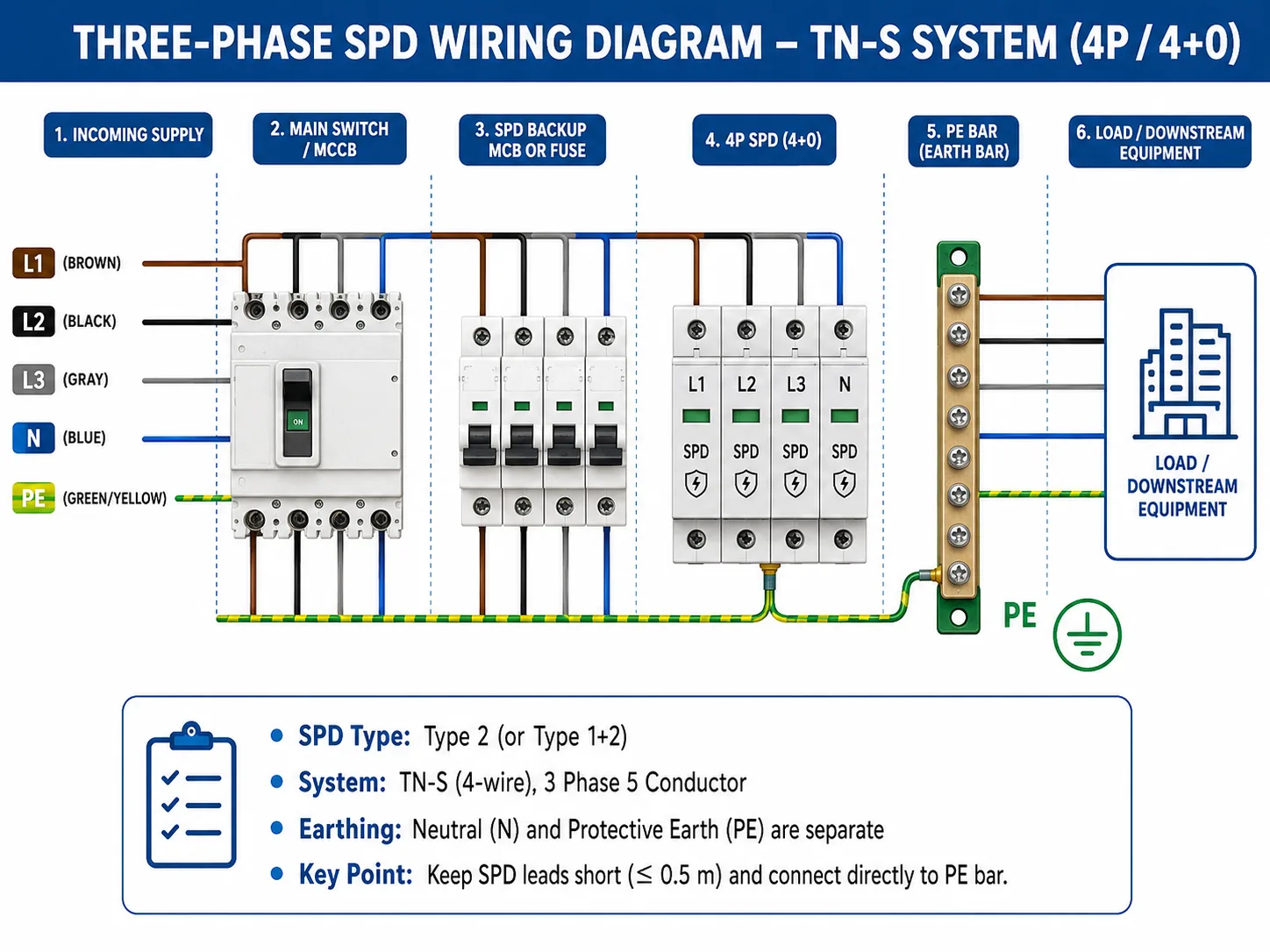
Importante: Un diagrama de cableado no solo debe mostrar el módulo SPD. También debe mostrar el suministro entrante, el interruptor principal, el MCB de respaldo o el fusible, la barra de PE, la dirección de carga y el sistema de tierra.
Pasos Básicos para el Cableado de un SPD Trifásico
El cableado exacto debe seguir el plano del proyecto y la hoja de datos del SPD. Pero para la selección y el diseño del panel, el proceso básico de cableado del protector contra sobretensiones trifásico generalmente sigue estos pasos.
¿Qué muestra un diagrama de cableado de un SPD trifásico?
Un diagrama útil de cableado de SPD trifásico debería mostrar cómo se descargan de manera segura las corrientes de sobrevoltaje a tierra. No debería ser solo una imagen decorativa del producto.
Un diagrama completo debería mostrar:
- Suministro de entrada: L1, L2, L3, N y PE
- Interruptor principal, MCCB, MCB o fusible
- Posición de instalación del SPD
- Configuración de polos del SPD
- Conexión de la barra PE
- Dirección del lado de carga
- Sistema de conexión a tierra
- Protección de respaldo
Esto es importante porque un SPD no funciona como un disyuntor normal. Un disyuntor protege contra sobrecargas y cortocircuitos. Un SPD protege contra sobrevoltajes transitorios.
El SPD debe proporcionar un camino corto para que la corriente de sobrevoltaje se descargue a tierra. Si el cableado es demasiado largo, suelto o conectado al punto de referencia incorrecto, el equipo aguas abajo puede seguir viendo un pico de voltaje alto.
Diagrama de Cableado de SPD Trifásico para Sistemas TN-S
En un sistema TN-S, el neutro y la tierra protectora son conductores separados. Un panel TN-S trifásico típico tiene L1, L2, L3, N y PE.
En muchos tableros de distribución TN-S, se utiliza una conexión de 4P SPD o 4+0. Cada conductor está protegido con un camino de descarga a PE.
| Conductor | Conexión SPD | Propósito |
|---|---|---|
| L1 | Terminal L1 del SPD | Ruta de protección contra sobretensiones de fase |
| L2 | Terminal L2 del SPD | Ruta de protección contra sobretensiones de fase |
| L3 | Terminal L3 del SPD | Ruta de protección contra sobretensiones de fase |
| N | Terminal N del SPD | Ruta de protección contra sobretensiones neutra |
| PE | Terminal de tierra del SPD a la barra PE | Ruta de descarga a tierra |
El SPD debe instalarse cerca del lado de entrada y cerca de la barra PE. Esto reduce la longitud del cable y mejora el nivel de protección real dentro del panel.
Para los fabricantes de paneles OEM, este punto es importante. Una instalación que se ve ordenada no siempre es una buena instalación. Si los cables del SPD se dirigen alrededor del gabinete solo por apariencia, la longitud total del cable puede volverse demasiado larga.
Diagrama de Cableado de SPD Trifásico para Sistemas TN-C-S
Los sistemas TN-C-S necesitan atención adicional. En un sistema TN-C-S, el lado de suministro puede usar un conductor PEN combinado. En un cierto punto, el PEN se separa en N y PE.
El SPD debe seleccionarse y cablearse de acuerdo con la posición donde ocurre esta separación.
Antes de elegir el SPD para TN-C-S, confirme:
- ¿Está el SPD instalado antes o después de la separación del PEN?
- ¿El panel tiene barras N y PE separadas?
- ¿Está presente el conductor neutro en el punto de instalación del SPD?
- ¿Qué especifica el plano del proyecto?
- ¿Qué requiere el código eléctrico local?
Si el SPD se instala después de que el PEN ya se haya dividido en N y PE, el cableado puede parecerse al de un panel TN-S. Pero no asuma esto solo por la apariencia.
Para los sistemas TN-C-S, el punto de instalación es importante. Por esta razón, los compradores deben enviar el diagrama de cableado del panel al proveedor del SPD antes de confirmar el modelo.
Diagrama de Cableado de SPD Trifásico para Sistemas TT
En un sistema TT, la instalación tiene su propio electrodo de tierra local. La relación entre neutro y tierra protectora es diferente de un sistema TN-S.
Por esta razón, los sistemas TT a menudo utilizan una configuración de SPD 3+1 o 3P+N.
La lógica de cableado común es:
- L1 a N
- L2 a N
- L3 a N
- N a PE a través de un camino de protección N-PE dedicado.
Este diseño ayuda a evitar aplicar la lógica de protección incorrecta entre neutro y tierra. Un sistema TT no debe ser tratado igual que un sistema TN-S solo porque ambos pueden tener conductores L1, L2, L3, N y PE en el panel.
El número de cables no es suficiente. El sistema de puesta a tierra decide la lógica de conexión del SPD.
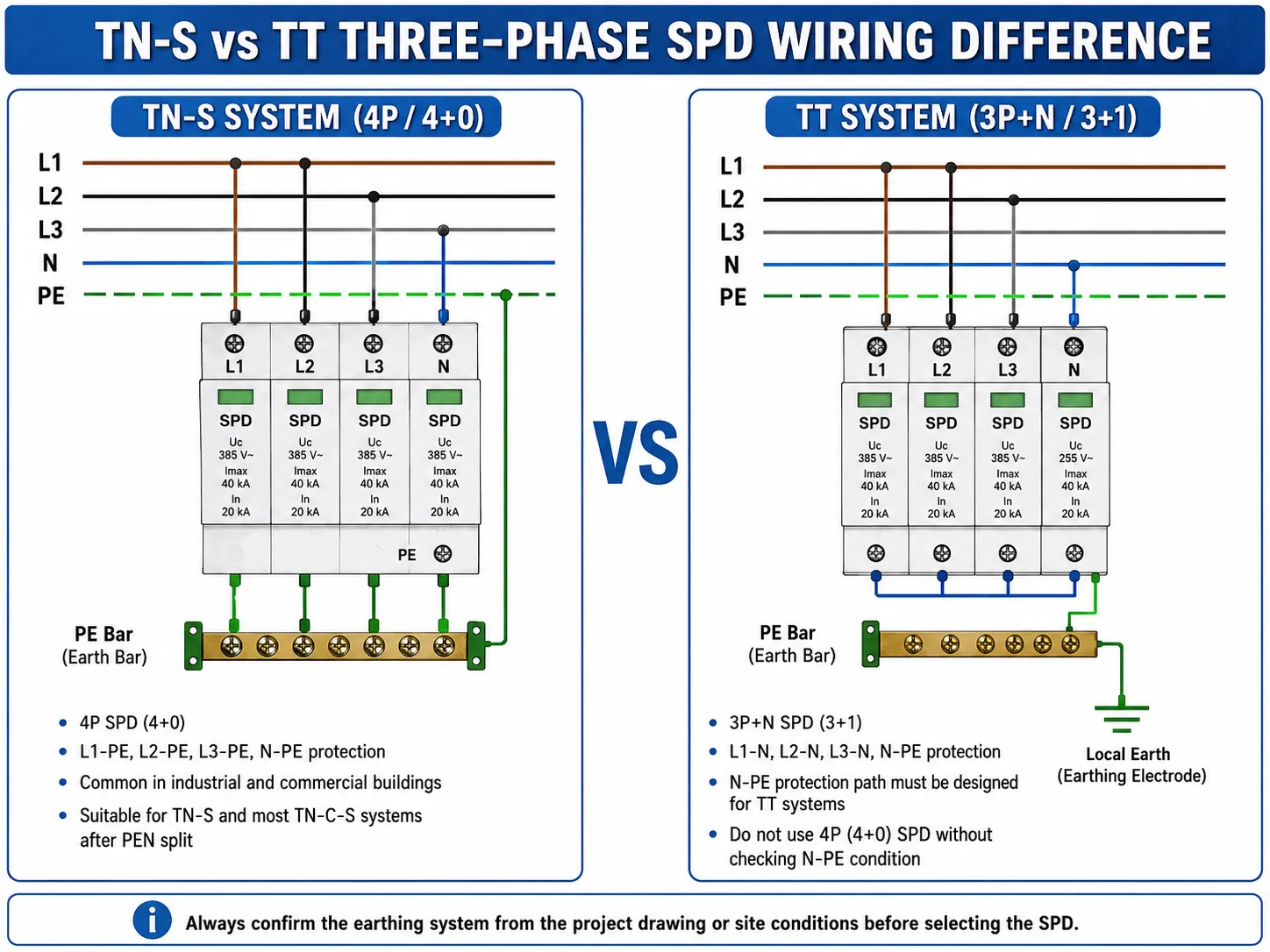
El siguiente diagrama de cableado de SPD TN-S vs TT compara el cableado 4P / 4+0 con el cableado 3P+N / 3+1. Esta comparación es especialmente útil para tableros de distribución trifásicos, sistemas TT y selección de gabinetes eléctricos OEM.
Cableado de SPD 3P vs 4P vs 3P+N
Muchos errores de cableado ocurren porque los compradores eligen los polos de SPD solo por mirar el panel. Esto es arriesgado.
Un sistema trifásico puede usar SPD 3P, 4P o 3P+N dependiendo del diseño de cableado y puesta a tierra.
| Configuración de SPD | Uso Típico | Significado del cableado | Nota importante |
|---|---|---|---|
| SPD de 3P | Sistemas trifásicos de 3 hilos | Protección L1, L2 y L3 | Usado donde no hay neutro. |
| SPD 4P | Sistemas TN-S o similares de 4 hilos trifásicos | Protección L1, L2, L3 y N a PE | Común en muchos tableros de distribución. |
| 3P+N SPD | Sistemas TT o diseño de protección 3+1 | L1/L2/L3 a N, N a PE | No reemplazar ciegamente por un 4P ordinario. |
| Tipo 1+2 SPD trifásico | Paneles de entrada principal o de alta exposición | Protección contra impulsos de rayo y sobretensiones | Verificar Iimp, In y fusible de respaldo. |
| Tipo 2 SPD trifásico | Subdistribución o paneles estándar | Protección contra sobretensiones para equipos a monte. | Común para paneles de control industrial. |
Un SPD de 3P no significa automáticamente “SPD trifásico para todos los paneles trifásicos.” Un SPD de 4P no significa automáticamente “mejor que 3P+N.”
La elección correcta depende del sistema de puesta a tierra, la disponibilidad de neutro, el tipo de SPD, la posición del panel, el voltaje del sistema, el estándar requerido, la protección de respaldo y los requisitos de diseño del OEM.
¿Dónde debe instalarse el SPD en un panel trifásico?
Para la mayoría de los paneles de CA trifásicos, el SPD se instala cerca del lado de suministro entrante.
Las posiciones de instalación comunes incluyen:
- Cuadro de distribución principal
- Cuadro de subdistribución
- Gabinete de control industrial
- Panel de control de máquina
- Caja de distribución de edificio comercial
- Panel de salida AC del inversor PV
- Gabinete eléctrico OEM
En muchos paneles, el SPD se coloca después del interruptor principal o del disyuntor principal, con un MCB o fusible de respaldo dedicado. La posición exacta depende del diseño del panel y de los requisitos eléctricos locales.
La regla clave es simple: el SPD debe tener un camino corto y de baja impedancia hacia PE.
¿Necesita un SPD trifásico un interruptor automático o un fusible?
Sí, en la mayoría de las instalaciones, el SPD debe tener protección contra sobrecorriente adecuada en sentido ascendente. Esto puede ser un MCB, MCCB o fusible.
La protección de respaldo no se utiliza para detener sobretensiones. Se utiliza para desconectar el SPD de forma segura si el SPD alcanza el final de su vida útil o falla en cortocircuito.
La clasificación del fusible o disyuntor de respaldo debe seguir la hoja de datos del SPD. No seleccione la protección de respaldo solo por costumbre.
Antes de ordenar, confirme: la clasificación máxima del fusible de respaldo, la clasificación de corriente de cortocircuito, el tipo de SPD, el voltaje del sistema, la corriente de falla esperada, la clasificación del disyuntor principal del panel y el estándar de instalación local.
Longitud del Cable: Por qué importa el cableado corto del SPD
Los cables del SPD deben ser lo más cortos y directos posible.
Durante una sobretensión, la corriente aumenta muy rápido. Los cables largos añaden inductancia. Esto aumenta el voltaje visto por el equipo incluso cuando el SPD mismo está funcionando.
Eso significa que un SPD de alta calidad puede funcionar mal si se instala con cables largos.
Errores Comunes en el Cableado de SPD Trifásico
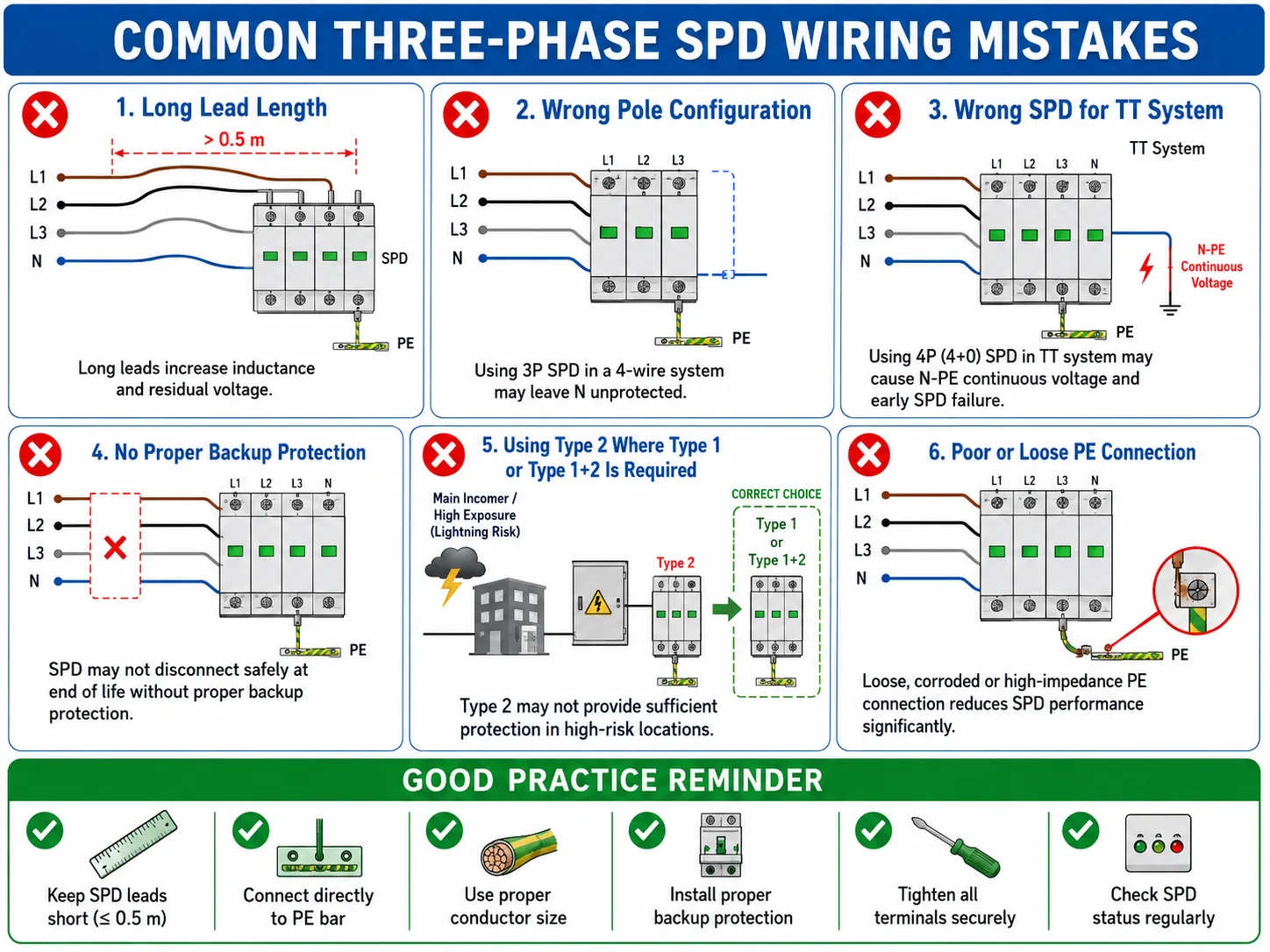
Los problemas de cableado de SPD trifásico a menudo parecen pequeños en el gabinete, pero pueden reducir el efecto de protección real. El siguiente diagrama destaca los errores comunes de cableado de protector contra sobretensiones trifásico que se observan en tableros de distribución y paneles de control.
1. Elegir SPD solo por el número de polos.
Algunos compradores eligen 3P, 4P o 3P+N solo contando los cables en el gabinete. Esto no es suficiente. El sistema de aterrizaje y el modo de conexión deben confirmarse.
2. Usar SPD 4P a ciegas en sistemas TT.
Los sistemas TT a menudo requieren lógica de protección 3+1. Si no se considera la condición N-PE, el SPD puede envejecerse más rápido o fallar prematuramente.
3. Conexión PE larga
Un cable PE largo puede reducir el rendimiento real de protección. El SPD puede parecer que está instalado correctamente, pero el equipo aguas abajo puede ver un voltaje residual más alto.
4. Sin protección de respaldo adecuada
Algunas instalaciones omiten el MCB o fusible de respaldo del SPD para ahorrar espacio. Esto no se recomienda. El SPD necesita un camino de desconexión seguro si falla al final de su vida útil.
5. Posición incorrecta de Tipo 1 y Tipo 2
El SPD de Tipo 2 es común para tableros de subdistribución. Si la instalación está en el punto de entrada principal con alta exposición, puede ser necesario Tipo 1 o Tipo 1+2.
6. Conexión PE deficiente
El camino PE es el camino de descarga. Un terminal PE suelto, un conductor dañado, una conexión corroída o una conexión de barra de tierra deficiente pueden hacer que el SPD sea mucho menos efectivo.
Antes de ordenar un SPD trifásico, confirme estos detalles
Antes de solicitar una cotización, prepare estos detalles. Esto ayuda al proveedor a recomendar el modelo de SPD correcto más rápidamente.
| Información para Confirmar | Por qué es Importante |
|---|---|
| Voltaje nominal del sistema | Determina Uc y la clasificación de voltaje del SPD. |
| Tipo de sistema | TN-S, TN-C-S, TT, IT, o 3-fase 3-hilo. |
| Configuración de polos | Determina si 3P, 4P, o 3P+N es adecuado. |
| Tipo de SPD | Tipo 1, Tipo 2, o Tipo 1+2. |
| Posición de instalación | Entrada principal, sub-tablero, panel de control, o armario OEM. |
| En / Imax / requisito Iimp | Determina la capacidad de descarga. |
| Fusible o MCB de respaldo | Requerido para una coordinación segura. |
| Disponibilidad neutral | Afecta la selección 3P, 4P y 3P+N. |
| Requisito de señal remota | Necesario para monitoreo y mantenimiento. |
| Requisito de certificación | Documentos CE, TUV, CB o específicos del proyecto. |
| Requisito de etiqueta OEM | Importante para distribuidores y fabricantes de paneles. |
¿Necesita ayuda para elegir el SPD trifásico adecuado?
Envíenos el voltaje de su sistema, tipo de puesta a tierra, foto del panel y diagrama de cableado. Nuestro equipo puede recomendar una configuración de SPD adecuada para pedidos de tableros de distribución o paneles OEM.
Lógica Recomendada para la Selección de SPD Trifásicos
- Confirme el voltaje del sistema. Por ejemplo: 230/400V, 380/400V o 400/415V.
- Confirme el sistema de puesta a tierra. Los sistemas TN-S, TN-C-S, TT e IT pueden requerir una lógica de cableado diferente.
- Confirme si hay presencia de neutro. Un sistema trifásico de 3 hilos puede usar 3P. Un sistema trifásico de 4 hilos puede usar 4P o 3P+N dependiendo del diseño de puesta a tierra.
- Confirme la posición de instalación. Los paneles de entrada principales pueden necesitar Tipo 1 o Tipo 1+2. Los cuadros de subdistribución suelen usar Tipo 2.
- Confirme el requisito de corriente de sobretensión. Verifique In, Imax o Iimp según los requisitos del proyecto.
- Confirme la protección de respaldo. Utilice la clasificación del fusible o interruptor de respaldo recomendada en la hoja de datos del SPD.
- Confirme las necesidades de mantenimiento. Si el panel necesita alarma remota, elija un SPD con contacto de señal remota.
PREGUNTAS FRECUENTES
¿Cuál es el cableado correcto para un SPD trifásico?
Un SPD trifásico generalmente se conecta a L1, L2, L3, N si está presente, y PE. El cableado exacto depende del sistema de puesta a tierra y la configuración del SPD. Los sistemas TN-S comúnmente utilizan cableado 4P o 4+0, mientras que los sistemas TT a menudo utilizan cableado 3P+N o 3+1.
¿Cómo cableo un protector contra sobretensiones de 3 fases?
Primero confirme el voltaje del sistema, el sistema de puesta a tierra, la disponibilidad de neutro y la configuración del SPD. Luego conecte L1, L2, L3, N si es necesario, y PE de acuerdo con el modo de cableado que se muestra en la hoja de datos del SPD. El terminal de tierra del SPD debe conectarse directamente a la barra de PE con un conductor corto.
¿Es suficiente 3P SPD para un sistema trifásico?
Un SPD 3P puede ser adecuado para un sistema trifásico de 3 hilos sin neutro. Si el panel tiene neutro y requiere protección de neutro, puede ser necesario un 4P o 3P+N. No elija solo por las palabras “trifásico”.”
¿Cuál es la diferencia entre SPD 4P y 3P+N?
Un SPD 4P comúnmente protege L1, L2, L3 y N a PE. Un SPD 3P+N generalmente sigue la lógica de protección 3+1, donde las tres fases están protegidas hacia el neutro y el neutro está protegido hacia PE. La elección correcta depende del sistema de puesta a tierra.
¿Qué significa el cableado 3+1 SPD?
El cableado del SPD 3+1 generalmente significa que L1, L2 y L3 están protegidos hacia el neutro, y el neutro está protegido hacia PE a través de un camino de protección dedicado N-PE. Esta conexión se utiliza a menudo en sistemas TT.
¿Puedo usar un SPD de 4P en un sistema TT?
No utilice un SPD 4P en un sistema TT sin verificar el diseño de cableado y la idoneidad del producto. Los sistemas TT a menudo utilizan configuración de SPD 3+1 o 3P+N porque la relación N-PE es diferente de los sistemas TN-S.
¿Dónde debe instalarse un SPD trifásico?
Un SPD trifásico generalmente se instala cerca del lado de entrada de un tablero de distribución o panel de control, cerca de la barra PE. El camino de conexión debe ser corto y directo.
¿Un SPD trifásico necesita un fusible de respaldo o un MCB?
En la mayoría de las instalaciones, sí. El fusible de respaldo o MCB ayuda a desconectar el SPD de manera segura si falla al final de su vida útil. La clasificación debe seguir la hoja de datos del SPD.
¿Qué sucede si el cable a tierra del SPD es demasiado largo?
Un cableado SPD prolongado aumenta la inductancia y puede incrementar el voltaje residual observado por el equipo aguas abajo. El SPD aún puede funcionar, pero el efecto de protección real se debilita.
¿Qué información debo enviar antes de ordenar un SPD trifásico?
Envíe el voltaje del sistema, el sistema de puesta a tierra, los requisitos del poste, la posición de instalación, el diagrama de cableado del panel, los requisitos del fusible de respaldo, los requisitos de certificación y si se necesita contacto de señal remota.