
Selección del SPD del sistema de aterrizaje TT
Para un sistema de aterrizaje TT, la selección del SPD no debe basarse solo en el conteo de polos. Esta guía explica cuándo especificar un SPD 3+1, cómo funciona la protección N-PE, lo que un SPD 4P puede o no significar, y qué confirmar antes de ordenar.
Está escrita para fabricantes de paneles, contratistas eléctricos, distribuidores, compradores de ingeniería y clientes OEM que necesitan confirmar la estructura correcta del SPD para tableros de distribución TT.
Respuesta Rápida
Índice
¿Qué SPD se utiliza normalmente en un sistema de aterrizaje TT?
Para un sistema TT trifásico, los compradores normalmente deberían especificar un Disposición SPD 3+1 compatible con TT en lugar de pedir solo un SPD 4P genérico. Una disposición 3+1 generalmente significa tres caminos de protección L-N más un camino de protección N-PE. Para sistemas TT monofásicos, un disposición 1+1 se utiliza comúnmente.
| Pregunta del comprador | Respuesta práctica | Qué confirmar antes de ordenar |
|---|---|---|
| ¿Necesita un sistema TT protección N-PE? | En la mayoría de los diseños de SPD TT, el camino N-PE debe ser considerado porque el neutro y el PE local están separados. | Pregunte si el SPD incluye un camino de protección N-PE dedicado. |
| ¿Es adecuado el SPD 3+1 para sistemas TT trifásicos? | Generalmente sí, cuando el dispositivo está diseñado para sistemas TT con protección L-N más N-PE. | Confirme el diagrama de circuito interno, no solo el conteo de módulos externos. |
| ¿Puedo usar un SPD de 4P en un sistema TT? | Quizás, pero solo si el circuito interno es adecuado para TT. Algunos productos parecen tener 4 polos pero utilizan una lógica de protección diferente. | Pregunte si es 3+1, 4+0, o algún otro diseño aprobado compatible con TT. |
| ¿Debería especificar un espacio de chispa N-PE? | Para muchos diseños TT o TN-S 3+1, el camino N-PE es manejado por un espacio de chispa o un módulo N-PE dedicado. | Confirme el tipo de módulo N-PE, la clasificación de descarga, la norma y el diseño del proveedor. |
| ¿Qué pasa con la coordinación RCD? | Los sistemas TT a menudo dependen de la protección RCD, por lo que la posición del SPD y el comportamiento de fuga deben ser verificados cuidadosamente. | Envíe la ubicación del RCD, sensibilidad y diagrama del panel al proveedor. |
¿Necesita confirmar un modelo de SPD del sistema TT?
Envíenos su sistema de puesta a tierra, voltaje, tipo de fase, disposición del RCD y tipo de SPD requerido. LEEYEE puede ayudar a recomendar una configuración de SPD adecuada para tableros de distribución o pedidos de panel OEM.
Por qué los sistemas de aterrizaje TT necesitan atención especial en SPD
Un sistema de puesta a tierra TT es diferente de los sistemas TN porque la tierra de protección en la instalación está conectada a un electrodo de tierra local. El conductor neutro y el conductor PE local están separados.
Esto es importante para la protección contra sobretensiones porque el SPD no solo trata con conductores vivos. La corriente de sobretensión también necesita un camino adecuado a tierra, y el camino N-PE puede volverse importante durante un evento de sobretensión transitoria.
PE local
El conductor PE está conectado al electrodo de tierra local de la instalación.
N y PE separados
El neutro y la tierra de protección no deben ser tratados como el mismo conductor dentro de la lógica de selección del SPD.
Dependencia RCD
Los sistemas TT suelen utilizar protección RCD, por lo que la selección e instalación del SPD necesitan un cuidado especial.
No copie ciegamente una solución de SPD TN-S.
Un cuadro de distribución puede parecer similar por fuera, pero el sistema de puesta a tierra cambia el requisito del circuito SPD. Para sistemas TT, siempre confirme si el producto es adecuado para TT y si se incluye la protección N-PE.
¿Qué hace la protección N-PE en un sistema TT?
La protección N-PE significa que el SPD proporciona un camino de protección contra sobretensiones controlado entre el conductor neutro y la tierra de protección. En sistemas TT, este camino es especialmente importante porque N y PE están separados en la instalación.
En muchas configuraciones de SPD TT trifásico, los conductores vivos están protegidos hasta el neutro, y un módulo N-PE dedicado maneja el camino de sobretensión de neutro a tierra. Esta es la idea básica detrás de muchos. SPD 3+1 disposiciones.
Significado para el comprador
Cuando solicite un SPD para sistema TT, no diga solo “SPD 4P”. Una mejor solicitud es: “Necesitamos un SPD trifásico compatible con TT con conexión 3+1 y protección N-PE.”
| Término | Lo que significa | Por qué es importante en los sistemas TT |
|---|---|---|
| protección N-PE | Un camino de protección entre neutro y tierra de protección. | Los sistemas TT tienen N y PE local separados, por lo que este camino debe ser considerado. |
| Espacio de chispa N-PE | Un módulo o componente de protección basado en espacio de chispa entre N y PE. | Se utiliza a menudo en diseños TT/TN-S 3+1 para manejar la descarga de sobretensiones entre N y PE. |
| SPD 3+1 | Tres caminos de protección L-N más un camino de protección N-PE. | Estructura común para sistemas TT trifásicos cuando el producto está diseñado para esta aplicación. |
| SPD 4P | Una apariencia de producto de cuatro polos o una disposición de cuatro módulos. | No siempre le indica el circuito interno. Siempre confirme el diagrama. |
¿Cuándo deben los compradores solicitar un espacio de chispa N-PE?
Los compradores deben preguntar sobre un espacio de chispa N-PE cuando el proyecto utilice un sistema de puesta a tierra TT y se espera que el SPD proporcione un camino de sobretensión dedicado de neutro a tierra. Esta pregunta es especialmente importante para configuraciones de SPD 1+1 y 3+1.
El comprador no siempre necesita decidir el componente interno por sí mismo. Pero deberían pedir al proveedor que confirme si la ruta N-PE está basada en la brecha de chispa, en MOV o en otro diseño de proveedor aprobado.
| Situación | ¿Por qué preguntar sobre la brecha de chispa N-PE? | Redacción del comprador |
|---|---|---|
| Tablero de distribución TT trifásico | El sistema normalmente necesita una ruta clara de protección contra sobretensiones N-PE en una disposición 3+1. | “Por favor, confirme el circuito 3+1 y el tipo de módulo N-PE.” |
| Panel TT monofásico | Una disposición 1+1 puede usar protección L-N más protección N-PE. | “Por favor, recomiende un SPD 1+1 adecuado para puesta a tierra TT.” |
| Instalación TT protegida por RCD | La ruta N-PE y el comportamiento de fuga del SPD pueden afectar la coordinación y el riesgo de disparo intempestivo. | “Por favor, verifique este SPD con nuestro arreglo de RCD.” |
| Pedido OEM o de marca privada | La etiqueta del producto puede decir 4P, pero el comprador aún necesita confirmar el circuito interno. | “Por favor, proporcione la hoja de datos, el diagrama de cableado y los detalles de protección N-PE.” |
No asuma que cada SPD 4P tiene el mismo diseño N-PE.
Algunos productos se describen por el número de polos, mientras que otros se describen por la disposición del circuito. Para sistemas TT, siempre confirme la ruta de protección N-PE antes de realizar un pedido por volumen.
SPD 3+1 en sistemas TT: ¿cuándo es adecuado?
Un SPD 3+1 se usa comúnmente en sistemas TT trifásicos cuando el diseño usa protección L-N para cada fase y una ruta de protección N-PE. Es común en tableros de distribución principales, paneles eléctricos comerciales, armarios de baja tensión y proyectos de tableros de distribución OEM.
El punto clave es que “3+1” describe la disposición de protección, no solo el número físico de módulos. Un producto puede parecer un SPD de cuatro módulos, pero el comprador aún necesita confirmar el circuito interno.
| Aplicación | Disposición de SPD común | Nota del Comprador |
|---|---|---|
| Tablero de distribución TT monofásico | 1+1 L-N + N-PE | Confirmar voltaje, Uc, disposición del RCD y diseño del módulo N-PE. |
| Tablero de distribución principal TT trifásico | 3+1 L1-N, L2-N, L3-N + N-PE | Opción común cuando el producto está diseñado y certificado para uso TT. |
| Panel eléctrico OEM para exportación | Compatible con TT 3+1 o circuito aprobado | Confirme el mercado de destino, el certificado, la etiqueta y el requisito de cableado. |
| Orden de replazo del proyecto | Coincidir el sistema y circuito originales | No reemplace solo por el tamaño del módulo o la cantidad de polos. Verifique el antiguo diagrama de cableado. |
¿Se puede usar un SPD 4P en un sistema TT?
A veces sí, pero esta pregunta puede ser engañosa. En el mercado, “4P SPD” puede describir la forma del producto externo, el número de módulos enchufables o la cantidad de polos en la etiqueta. No siempre explica la ruta de protección interna.
Para sistemas TT, el comprador no debe juzgar solo por “4P”. Debe verificar si el SPD está organizado internamente como 3+1, 4+0 u otro circuito que sea adecuado para la puesta a tierra TT.
La pregunta equivocada es: “¿Tienes 4P SPD?”
La mejor pregunta es: “¿Es este SPD adecuado para un sistema de puesta a tierra TT y el circuito incluye la protección adecuada N-PE?”
| Redacción del comprador | Riesgo | Mejor redacción |
|---|---|---|
| “Necesitamos 4P SPD.” | El proveedor puede no saber si su sistema es TT, TN-S o TN-C-S. | “Necesitamos SPD para un sistema TT trifásico.” |
| “Utilice el mismo SPD que en el último proyecto.” | El proyecto anterior puede tener un sistema de puesta a tierra o una disposición de RCD diferente. | “Por favor, verifique el diagrama de cableado adjunto y confirme la estructura del SPD.” |
| “Cualquier 275V 4P SPD está bien.” | Uc puede coincidir, pero la ruta de protección interna puede no ser adecuada. | “Por favor, confirme Uc, Tipo 2, circuito 3+1 y protección N-PE para TT.” |
Para una comparación de estructura más amplia, utilice una guía separada para 3P+N vs 4P SPD. Esta guía TT se centra únicamente en la aplicación del sistema TT y decisiones de pedido.
Coordinación entre SPD y RCD en sistemas TT
Las instalaciones TT suelen utilizar RCDs para la protección contra fallos. Dado que un SPD puede descargar corriente de sobretensión a tierra durante un evento transitorio, se debe verificar cuidadosamente la relación entre la posición del SPD, la corriente de fuga, el tipo de RCD y el diseño de la instalación.
No trate todos los paneles TT de la misma manera. La instalación correcta depende del diseño del sistema, las normas eléctricas locales, la disposición del RCD, el tipo de SPD y las instrucciones de instalación del fabricante.
Lo que deben enviar los compradores
Clasificación del RCD, ubicación del RCD, diagrama de cableado del panel, voltaje nominal y si el SPD está instalado en el cuadro principal o en el subcuadro.
Lo que deben confirmar los proveedores
Tipo de SPD, Uc, diseño N-PE, protección de respaldo, longitud del cableado y si el modelo propuesto es adecuado para la instalación TT.
| Información del RCD | Por qué es importante para la selección del SPD TT | Qué enviar |
|---|---|---|
| RCD antes o después de la rama del SPD | Afecta la ruta de descarga de sobretensión y el riesgo de disparos indeseados. | Diagrama de cableado del panel o diagrama unifilar. |
| Sensibilidad del RCD | Ayuda al proveedor a verificar si se debe revisar el riesgo de coordinación. | Clasificación del RCD como 30mA, 100mA, 300mA o valor específico del proyecto. |
| Instalación en el cuadro principal o en el subcuadro | La posición de instalación cambia la protección de respaldo, la longitud del conductor y el diseño del cableado. | Ubicación de la instalación del SPD dentro del sistema de distribución. |
| Código local o regla del proyecto | La posición final del SPD debe seguir el diseño eléctrico del proyecto y los requisitos locales. | Norma aplicable, requisito del consultor o dibujo del panel. |
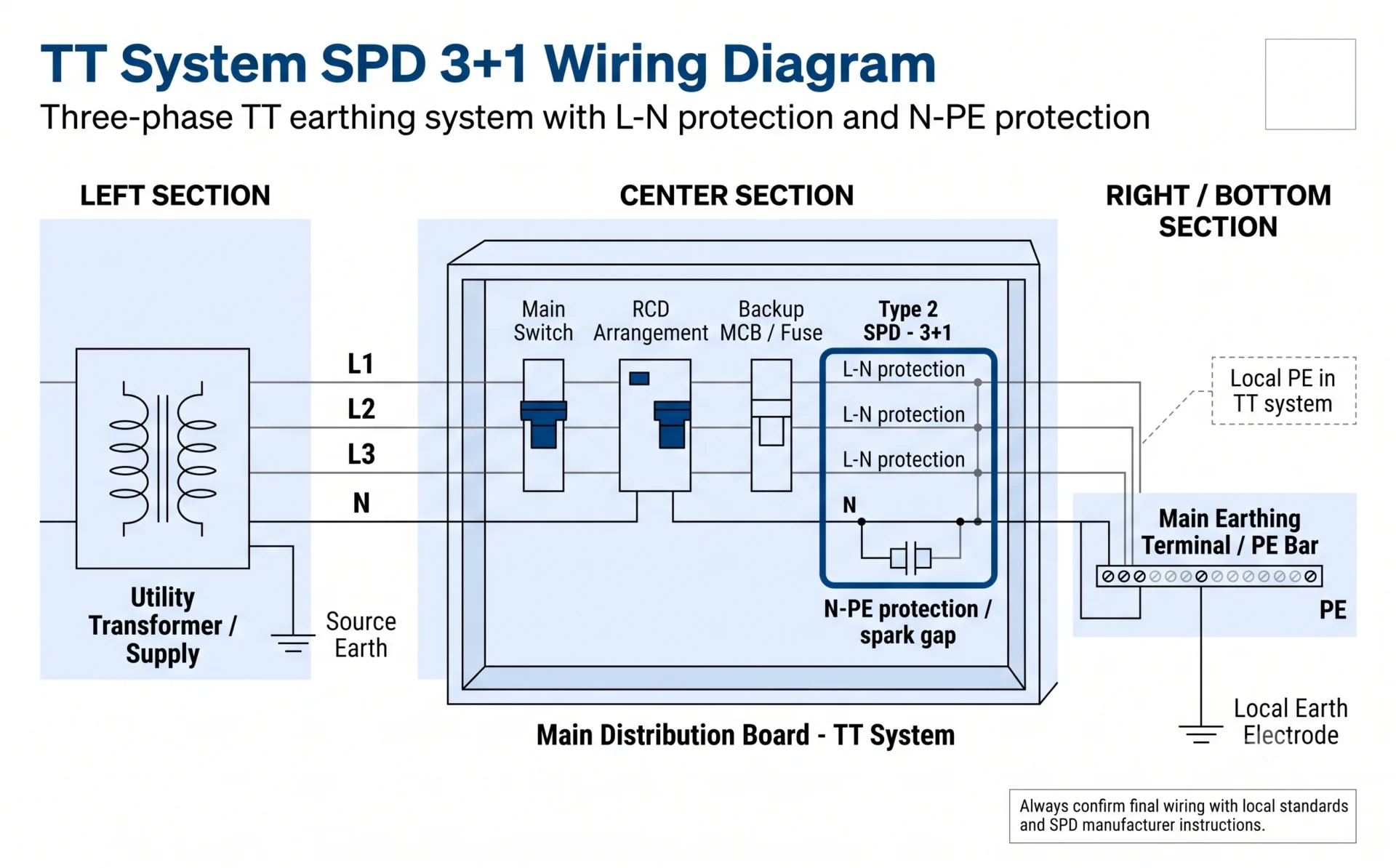
Diagrama de cableado del SPD del sistema TT
El diagrama a continuación muestra un sistema TT trifásico típico utilizando un arreglo de SPD 3+1. Ayuda a los compradores a entender las rutas de protección L-N y la ruta de protección N-PE dedicada antes de confirmar un modelo.
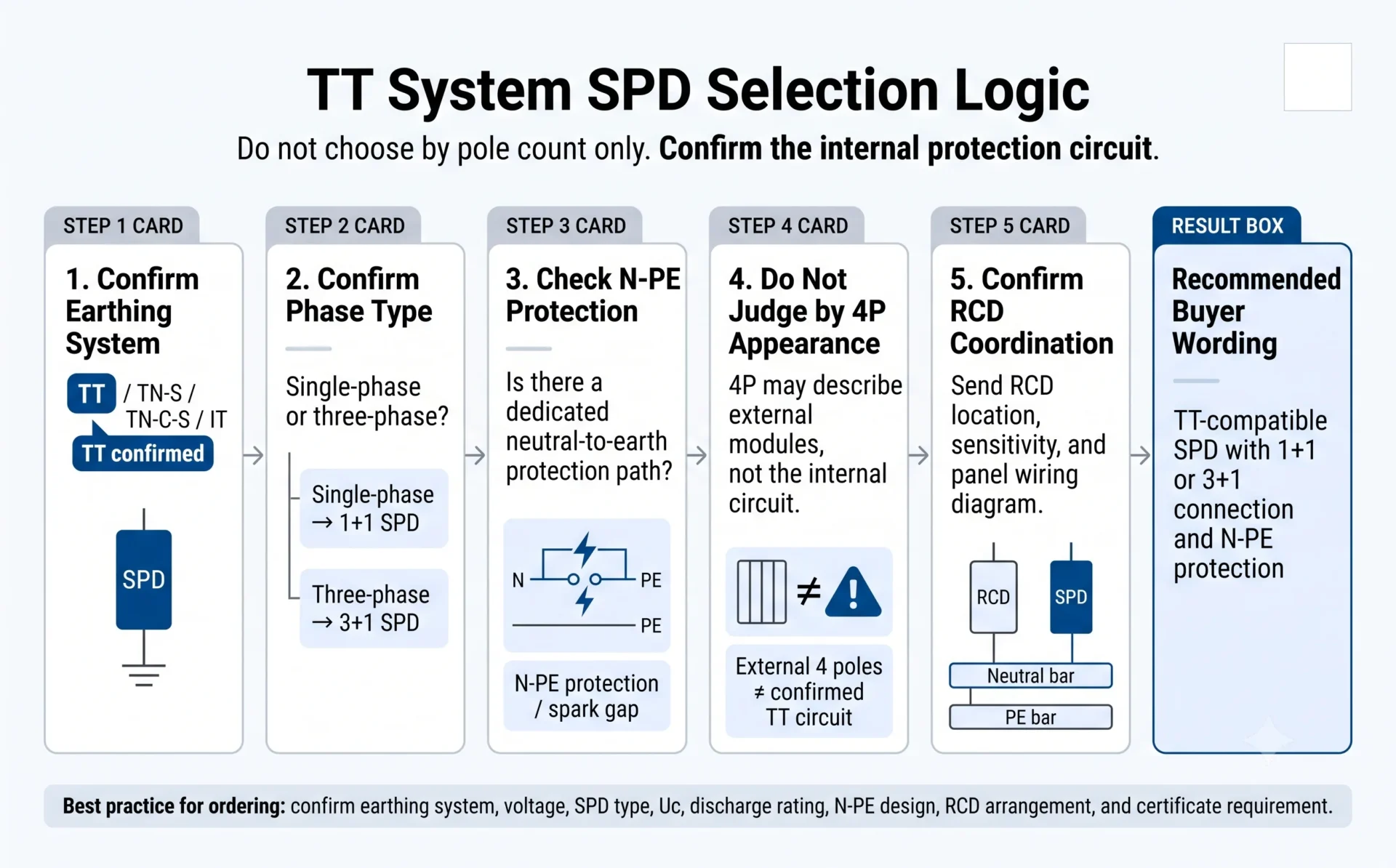
Lógica de selección del SPD del sistema TT
Cuando el cliente solo dice “Necesito un SPD 4P”, el proveedor aún no tiene suficiente información. Utilice la siguiente lógica para confirmar la estructura correcta del SPD.
Errores comunes al ordenar SPDs para el sistema TT
| Error | Por qué es Importante | Cómo evitarlo |
|---|---|---|
| Solo pedir “SPD 4P” | 4P puede describir la apariencia, no el circuito de protección interno. | Solicitar un diagrama de circuito compatible con TT. |
| No confirmar el sistema de puesta a tierra | El proveedor puede recomendar una solución estándar TN. | Indique claramente: “Este proyecto utiliza puesta a tierra TT.” |
| Ignorando la protección N-PE | La ruta de sobretensión de neutro a tierra puede no estar manejada correctamente. | Confirme el tipo y la calificación del módulo N-PE. |
| No mencionar RCD | Pueden aparecer problemas de disparo inoportuno del RCD o de coordinación. | Envíe la sensibilidad del RCD, la posición y el diagrama de circuitos. |
| Copiando el SPD de otro proyecto | El voltaje, la puesta a tierra y el diseño del panel pueden ser diferentes. | Confirme los detalles del sistema antes de reemplazar o hacer un pedido al por mayor. |
| No verificar el alcance del certificado | El certificado puede no coincidir con el voltaje, el tipo de SPD o la aplicación. | Solicite la hoja de datos y el certificado antes de la compra al por mayor. |
Antes de ordenar un SPD para el sistema TT, confirme estos detalles
Para distribuidores, fabricantes de paneles y compradores de OEM, esta lista de verificación ayuda a evitar la selección incorrecta de modelos antes de realizar un pedido al por mayor.
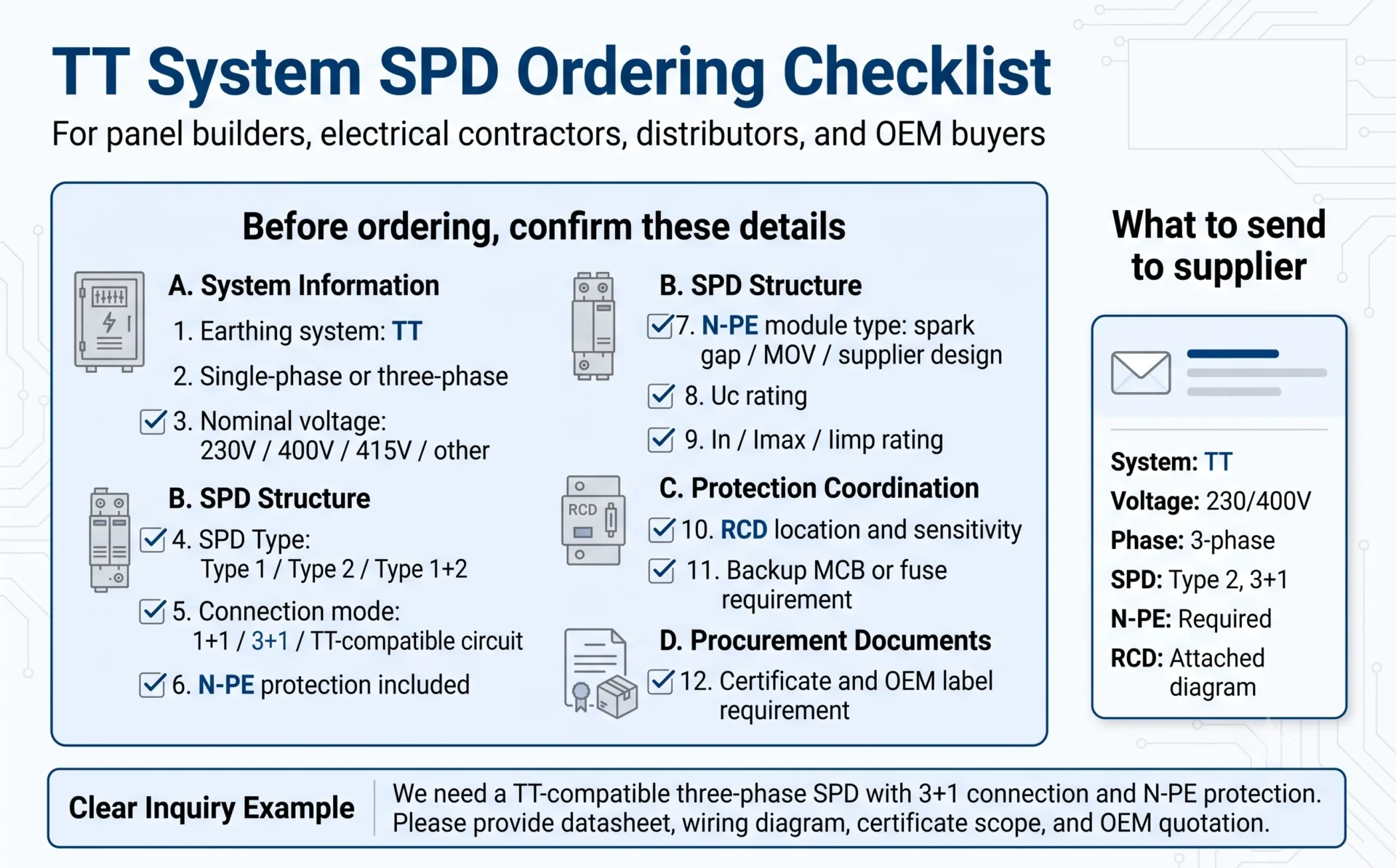
- Sistema de puesta a tierra: TT
- Sistema monofásico o trifásico
- Voltaje nominal: 230V, 400V, 415V u otro
- Tipo de SPD: Tipo 1, Tipo 2 o Tipo 1+2
- Modo de conexión: 1+1, 3+1 o circuito compatible con TT
- Protección N-PE incluida o no
- Tipo de módulo N-PE: descarga de chispa, MOV o diseño específico del proveedor
- Clasificación Uc y fluctuación del voltaje del sistema
- Requerimiento In, Imax o Iimp
- Ubicación y sensibilidad del RCD
- Requerimiento de MCB de respaldo o fusible
- Requerimiento de certificado y etiqueta del OEM
Envíe su requerimiento de panel TT antes de ordenar
Si no está seguro de si debe pedir 3+1, 4P o un módulo N-PE específico, envíenos el voltaje del sistema, tipo de conexión a tierra, disposición del RCD y posición de instalación.
Cómo escribir una consulta clara para el SPD del sistema TT
Una consulta clara ahorra tiempo y ayuda al proveedor a recomendar la estructura de producto correcta. Puedes usar la redacción a continuación al solicitar un presupuesto.
Ejemplo de consulta
Necesitamos dispositivos de protección contra sobretensiones para un sistema de puesta a tierra TT. El sistema es trifásico 230/400V, instalado en un tablero de distribución principal con protección RCD. Por favor, recomienda un SPD Tipo 2 con conexión 3+1 compatible con TT y protección N-PE. También proporciona la hoja de datos, el alcance del certificado, el diagrama de conexión y el presupuesto para la cantidad OEM.
Si el proyecto utiliza un voltaje diferente, un SPD Tipo 1+2, o un arreglo RCD especial, añade esos detalles en la consulta. No te fíes solo de la apariencia del producto.
Lectura relacionada
Estas guías ayudan a los compradores a confirmar los detalles de selección de SPD circundantes sin mezclar la intención de búsqueda de esta página del sistema TT.
Preguntas frecuentes: SPD del sistema de aterrizaje TT y protección N-PE
¿Necesita un sistema de puesta a tierra TT protección N-PE para SPD?
En muchos diseños de SPD TT, sí. Dado que el neutro y el PE local están separados, se debe considerar la ruta de sobretensión N-PE. Para realizar el pedido, pregunta si el SPD incluye una ruta de protección N-PE dedicada y si es adecuada para sistemas de puesta a tierra TT.
¿Es 3+1 SPD mejor que 4P SPD para sistemas TT?
La mejor pregunta no es solo “3+1 o 4P”, sino si el circuito interno es adecuado para TT. Un SPD 3+1 comúnmente proporciona tres rutas de protección L-N más una ruta de protección N-PE. Un producto 4P puede parecer similar por fuera, así que se debe confirmar el diagrama del circuito.
¿Puedo usar un SPD de 4P normal en un sistema de puesta a tierra TT?
No asumas que es adecuado solo porque es 4P. Confirma si el SPD está diseñado para sistemas TT, si incluye protección N-PE, y si el diagrama de conexión del proveedor coincide con tu panel.
¿Qué es un espacio de chispa N-PE en un SPD?
Un espacio de ruptura N-PE es un elemento de protección utilizado entre el neutro y la tierra protectora. Proporciona una ruta de descarga de sobretensión cuando ocurre una sobreintensidad transitoria entre N y PE. Al realizar un pedido para sistemas TT, pide al proveedor que confirme el tipo y la clasificación del módulo N-PE.
¿Cuándo deben los compradores solicitar un espacio de chispa N-PE?
Los compradores deben preguntar sobre el espacio de ruptura N-PE al seleccionar configuraciones de SPD 1+1 o 3+1 para sistemas de puesta a tierra TT. La clave es confirmar cómo se maneja la ruta de sobretensión del neutro a tierra y si el producto es adecuado para el diseño del proyecto.
¿Debería instalarse el SPD antes o después del RCD en un sistema TT?
La respuesta depende del diseño del panel, las normas eléctricas locales, el arreglo RCD y las instrucciones del fabricante de SPD. Para proyectos B2B, envía el diagrama del panel y la información RCD al proveedor o ingeniero del proyecto antes de la selección final.
¿Qué SPD es adecuado para un panel de distribución TT de 230/400V?
Una opción común es un SPD trifásico compatible con TT con arreglo de protección 3+1. Sin embargo, el modelo final depende del tipo de SPD, la calificación Uc, la calificación de corriente de descarga, el arreglo RCD, la protección de respaldo y el requisito de certificado.
¿Qué información debo enviar antes de pedir SPDs para sistema TT?
Envía el sistema de puesta a tierra, tipo de fase, voltaje nominal, tipo de SPD, Uc, In/Imax/Iimp, ubicación y sensibilidad del RCD, requisito de protección de respaldo, requisito de certificado, cantidad y necesidades de etiqueta o embalaje OEM.
¿Necesita ayuda para elegir un SPD para un sistema de aterrizaje TT?
LEEYEE suministra dispositivos de protección contra sobretensiones para tableros de distribución, paneles eléctricos, proyectos OEM y aplicaciones de protección de baja tensión. Si tu proyecto utiliza un sistema de puesta a tierra TT, envíanos los detalles de tu sistema y requisito de panel.
- Confirma la estructura de SPD 1+1, 3+1, 4P o compatible con TT
- Verifica la protección N-PE y la información de coordinación RCD
- Recomendar modelos de SPD Tipo 1, Tipo 2 o Tipo 1+2 adecuados
- Soporte para requisitos de etiqueta OEM, paquete, hoja de datos y certificado