
Índice
Respuesta Rápida
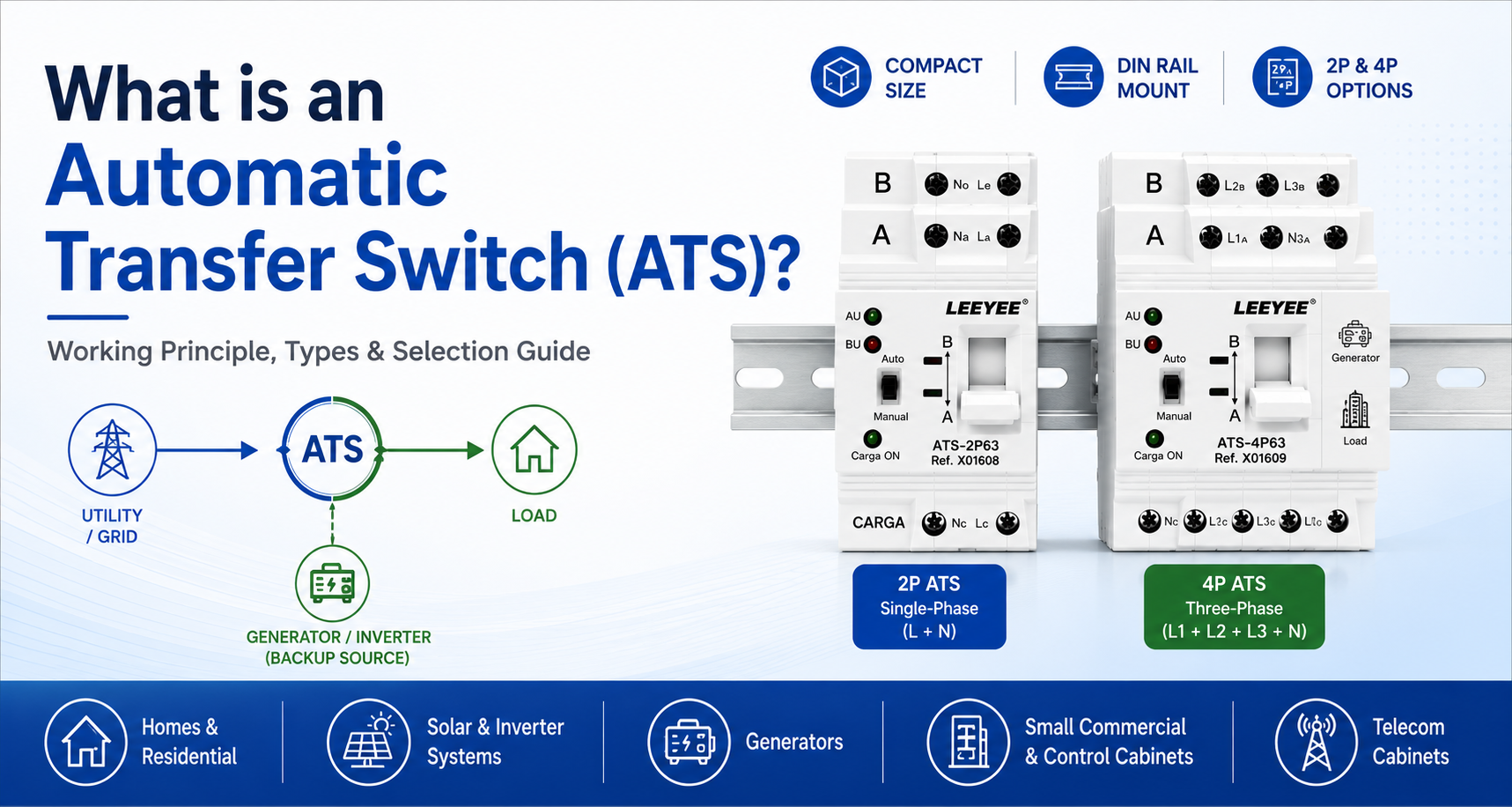
Un interruptor de transferencia automática, o ATS, cambia una carga entre dos fuentes de energía.
Cuando falla la energía principal, el ATS transfiere la carga a la energía de respaldo.
La fuente de respaldo puede ser un generador, un inversor, un sistema de respaldo solar u otra fuente de AC.
Cuando la energía principal regresa y se estabiliza, el ATS vuelve a transferir la carga.
Para el LEEYEE ATS-63, el tiempo de conmutación es de menos de 50 ms.
Este es el tiempo de conmutación del ATS solamente. Un generador puede necesitar tiempo adicional para arrancar y estabilizarse.
Principales Conclusiones
- Un ATS cambia una carga entre energía normal y energía de respaldo.
- Un ATS de 2P se utiliza comúnmente para sistemas monofásicos.
- Un ATS de 4P se utiliza comúnmente para sistemas trifásicos.
- Elija el ATS por corriente, voltaje, número de polos y fuente de respaldo.
- Un ATS no es un SAI. No almacena energía.
- Un ATS no reemplaza interruptores, fusibles, SPD o conexiones a tierra.
- El LEEYEE ATS-63 está disponible en opciones de 2P / 4P y de 6A a 63A.
¿Qué es un Interruptor de Transferencia Automática?
Un interruptor de transferencia automática es un dispositivo para sistemas de energía de respaldo.
Conecta la carga a una fuente de energía a la vez. Generalmente, una fuente es energía normal. La otra fuente es energía de respaldo.
La energía normal puede ser energía de la red eléctrica. La energía de respaldo puede ser un generador, un inversor, un sistema de respaldo solar u otra fuente de AC.
El ATS supervisa las fuentes de energía. Si falla la energía normal, el ATS transfiere la carga a la energía de respaldo cuando la fuente de respaldo está lista.
La idea clave es simple: un ATS no es solo un interruptor de encendido/apagado. Es un dispositivo de transferencia de fuente.
¿Qué Hace un Interruptor de Transferencia Automática?
Un ATS mantiene la carga conectada a la fuente de energía disponible.
En un sistema de respaldo simple, el ATS hace esto:
- Monitorea la energía normal.
- Detecta una falla de energía o un voltaje inestable.
- Verifica la fuente de respaldo.
- Transfiere la carga a la energía de respaldo.
- Transfiere la carga de vuelta cuando se restablece la energía normal.
Esto reduce el conmutador manual. También ayuda a mantener alimentadas las cargas importantes durante un corte.
¿Cómo Funciona un Interruptor de Transferencia Automática?
Un ATS monitorea dos fuentes de energía.
Una fuente es la fuente normal. La otra fuente es la fuente de respaldo.
Cuando la energía normal está disponible, la carga permanece en energía normal.
Cuando falla la energía normal, el ATS verifica la fuente de respaldo.
Si la fuente de respaldo está lista, el ATS transfiere la carga.
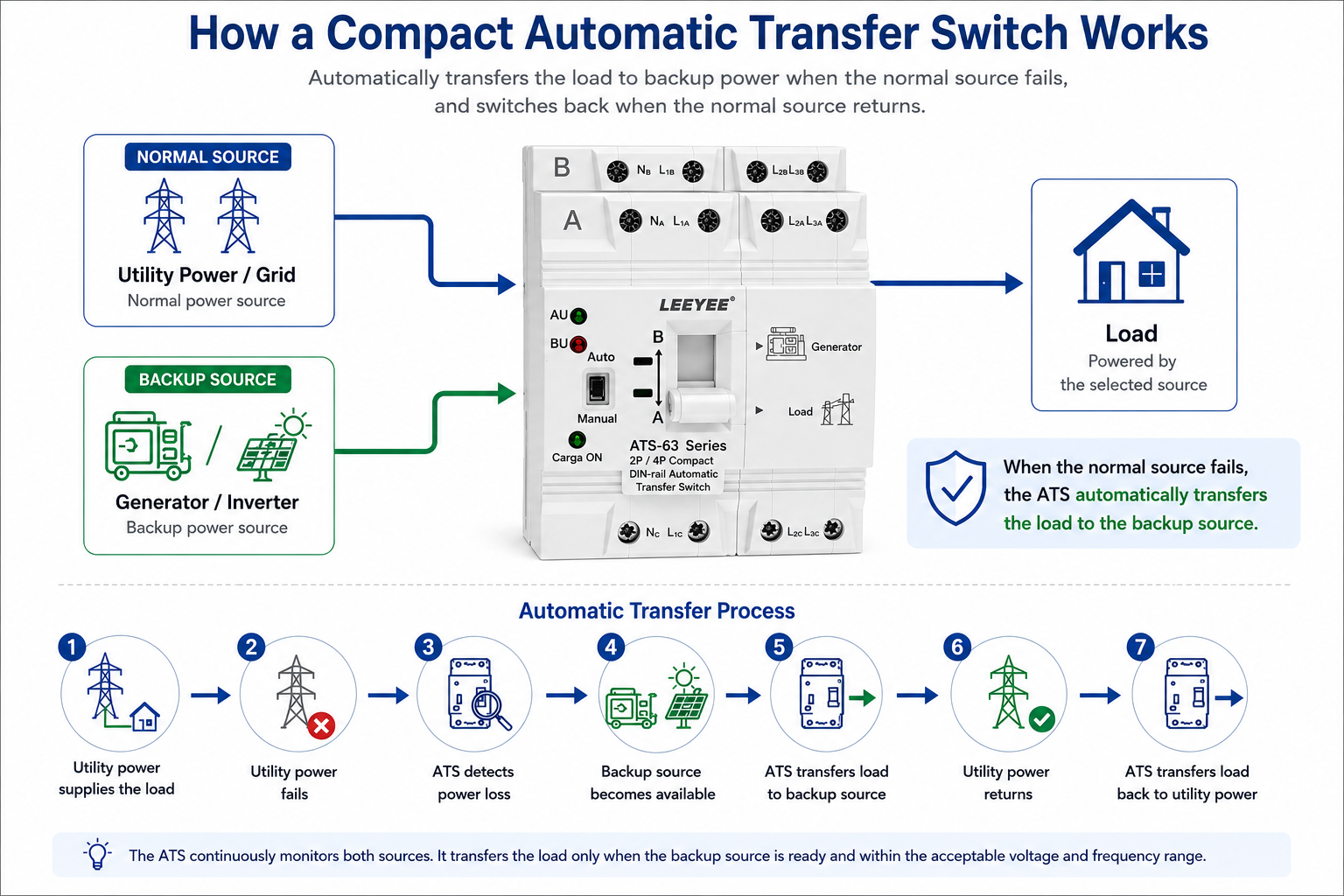
Un proceso típico de ATS se ve así:
- La energía de la red suministra la carga.
- La energía de la red falla o se vuelve inestable.
- El ATS detecta el problema.
- La fuente de respaldo se vuelve disponible.
- El ATS transfiere la carga a la energía de respaldo.
- La energía de la red regresa.
- El ATS transfiere la carga de vuelta a la energía de la red.
 Ver más grande
El LEEYEE ATS-63 tiene un tiempo de conmutación de transferencia de menos de 50 ms.
Esto no significa que todo el sistema de respaldo se recupere en 50 ms.
Si la fuente de respaldo es un generador, el generador aún necesita tiempo para arrancar y estabilizarse.
Si la carga no puede aceptar ni siquiera un breve corte de energía, utilice un UPS u otro diseño de energía.
Ejemplo de Interruptor de Transferencia Automática
Piense en un pequeño edificio con energía de la red y un generador de respaldo.
En condiciones normales, el edificio funciona con energía de la red.
Cuando la energía de la red falla, el generador de respaldo se enciende. Cuando la fuente de respaldo está lista, el ATS transfiere la carga.
Cuando la energía de la red regresa y se vuelve estable, el ATS transfiere la carga de vuelta.
La misma idea también se puede utilizar con sistemas de respaldo de inversores solares, tableros de distribución, paneles de bombas y pequeños armarios de control.
Interruptor de Transferencia Manual vs Interruptor de Transferencia Automática
Un interruptor de transferencia manual necesita una persona para operarlo.
Un interruptor de transferencia automática realiza el cambio por sí mismo.
| Tipo | Cómo Funciona | Uso Típico |
|---|---|---|
| Interruptor de transferencia manual | Conmutado a mano | Sistemas simples donde el conmutador manual es aceptable |
| Interruptor de transferencia no automático | Operado eléctricamente, pero controlado manualmente | Sistemas que necesitan operación alimentada pero no automatización completa |
| Interruptor de transferencia automática | Conmutadores que automáticamente basan en el estado de la fuente | Sistemas de respaldo que necesitan transferencia de energía automática |
Tipos Principales de Aplicación de ATS
Un ATS se puede utilizar en diferentes configuraciones de fuente. La elección correcta depende del sistema de energía.
De la red al generador
Este es uno de los usos más comunes del ATS.
La energía normal es la energía de la red. La energía de respaldo es un generador.
Cuando falla la energía de la red, el ATS transfiere la carga a la energía del generador. Cuando la energía de la red regresa, transfiere la carga de vuelta.
De la red a la red
En esta configuración, ambas fuentes son suministros de utilidad.
Si una fuente falla, el ATS transfiere la carga a la segunda fuente.
Utilidad a inversor o respaldo solar
Algunos sistemas de respaldo solar o de batería utilizan un ATS para alternar entre la energía de la red y la salida del inversor.
Verifique el voltaje del inversor, la frecuencia, el método de conexión a tierra, el cableado neutro y el código local antes de la selección.
ATS de Transición Abierta vs ATS de Transición Cerrada
Los interruptores de transferencia a menudo se describen como de transición abierta o de transición cerrada.
ATS de transición abierta
La transición abierta significa romper antes de hacer.
El ATS se desconecta de una fuente antes de conectarse a la otra fuente.
Esto es común en sistemas generales de energía de respaldo. Puede ocurrir una breve interrupción durante la transferencia.
ATS de transición cerrada
La transición cerrada significa hacer antes de romper.
Conecta brevemente dos fuentes sincronizadas antes de desconectarse de la primera fuente.
Este es un sistema más complejo. Generalmente se utiliza en sistemas de energía de ingeniería más grandes.
Nota importante para productos ATS compactos
No suponga que todos los ATS admiten la transición cerrada.
Los productos ATS compactos de riel DIN se utilizan principalmente para conmutación de fuentes de respaldo generales.
Si su proyecto necesita cero interrupciones o sincronización de fuentes, utilice una solución de energía de ingeniería diferente.
Interruptor de Transferencia Automática 2P vs 4P
El número de polos es uno de los puntos de selección de ATS más importantes.
No elija solo por la clasificación de corriente. Un ATS de 63A puede seguir siendo incorrecto si el número de polos no coincide con el cableado.
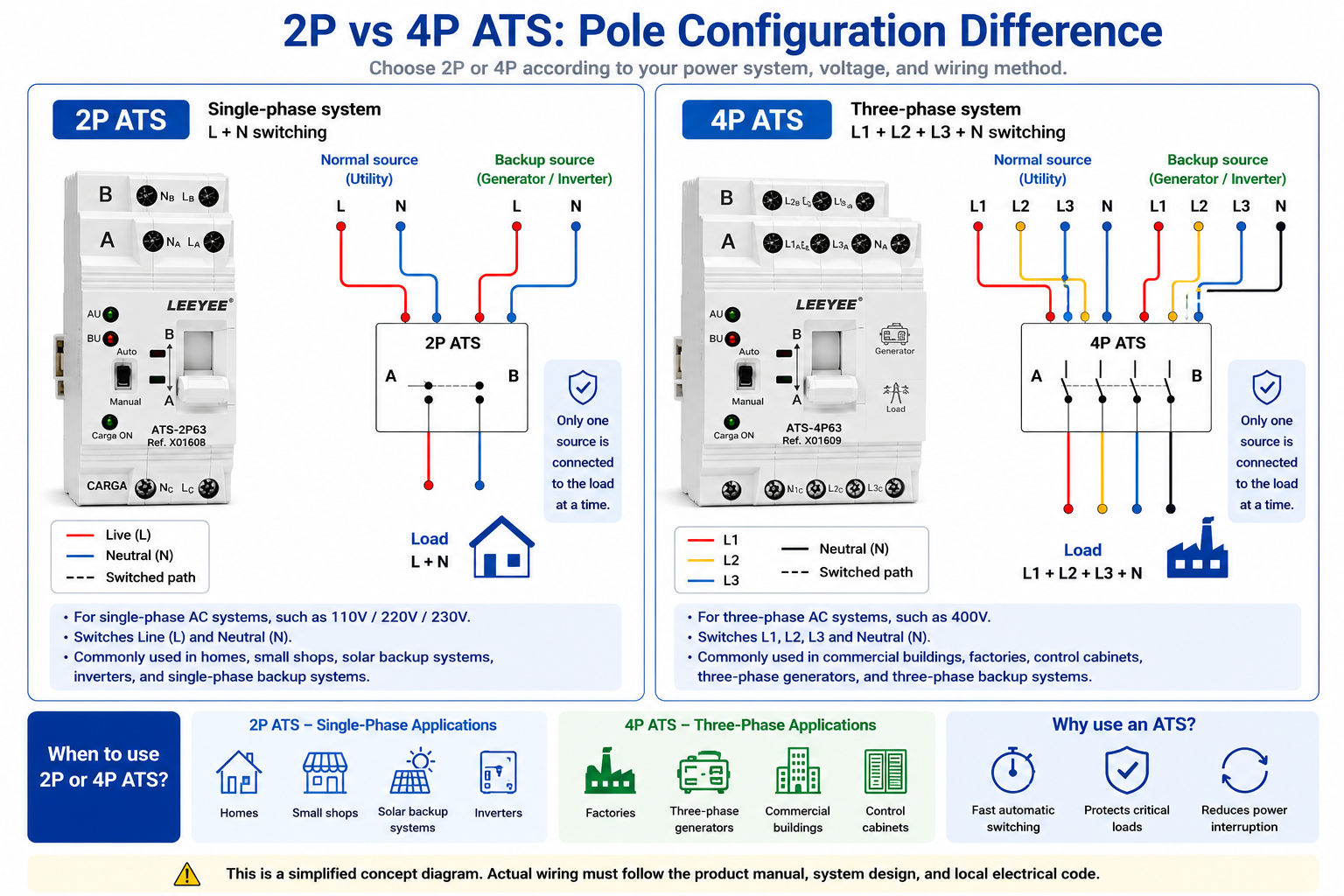
¿Qué es un ATS 2P?
Un ATS 2P tiene dos polos de conmutación.
Se utiliza comúnmente para sistemas monofásicos donde la Línea y el Neutro necesitan ser conmutados.
Las aplicaciones típicas de ATS 2P incluyen:
- Sistemas de respaldo en el hogar
- Pequeñas tiendas
- Pequeñas oficinas
- Respaldo de generador monofásico
- Respaldo de inversor monofásico
- Cuadros de distribución residenciales
¿Qué es un ATS 4P?
Un ATS de 4 polos tiene cuatro polos de conmutación.
Se utiliza comúnmente para sistemas trifásicos donde L1, L2, L3 y Neutro deben ser conmutados.
Las aplicaciones típicas de un ATS de 4P incluyen:
- Sistemas comerciales trifásicos
- Pequeñas fábricas
- Armarios de control
- Respaldo de generador trifásico
- Paneles de control de bombas
- Tableros de distribución que requieren conmutación de neutro
Tabla de selección de ATS de 2P vs 4P
| Tipo de sistema | Elección común de ATS | Notas |
|---|---|---|
| Sistema AC monofásico | ATS de 2P | Común en hogares, tiendas y pequeñas oficinas |
| Respaldo de generador monofásico | ATS de 2P | Utilizado para la conmutación L + N |
| Sistema AC trifásico | ATS de 4P | Utilizado para la conmutación L1 + L2 + L3 + N |
| Respaldo de generador trifásico | ATS de 4P | Común en armarios de control y sistemas de distribución |
| Sistema de respaldo de inversor | 2P o 4P | Depende de la salida del inversor y el diseño del cableado |
 Ver más grande
Regla simple: use 2P para muchos sistemas monofásicos. Use 4P para muchos sistemas trifásicos.
La selección final siempre debe seguir el diseño de cableado real.
Cómo Elegir el Interruptor de Transferencia Automática Correcto
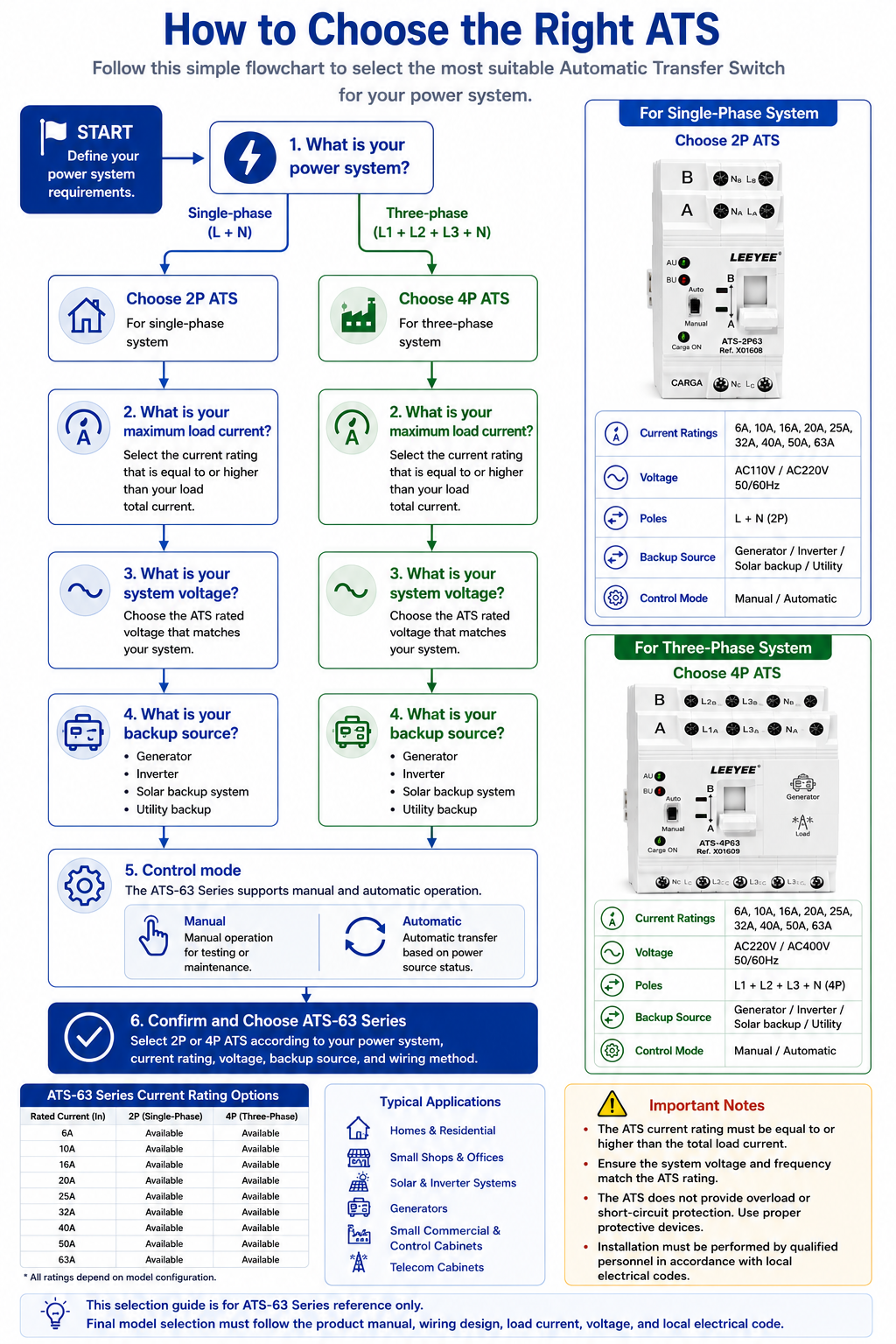
Comience con el sistema de energía. Luego elija el ATS.
1. Confirme el tipo de fase
¿Es el sistema monofásico o trifásico?
Muchos sistemas monofásicos utilizan 2P. Muchos sistemas trifásicos utilizan 4P.
2. Confirme la corriente de carga
La calificación actual del ATS debe coincidir o superar la corriente de carga.
El LEEYEE ATS-63 está disponible en 6A, 10A, 16A, 20A, 25A, 32A, 40A, 50A y 63A.
Para motores, bombas y compresores, también verifique la corriente de arranque.
3. Confirme el Voltaje del Sistema
La clasificación de voltaje del ATS debe coincidir con el voltaje del sistema.
El LEEYEE ATS-63 soporta configuraciones de AC110V, AC220V, AC400V y 50/60Hz.
4. Confirme la Fuente de Respaldo
La fuente de respaldo puede ser un generador, inversor, sistema de respaldo solar, respaldo de utilidad u otra fuente de AC.
Para sistemas de inversores y solares, verifique el cableado del neutro, la puesta a tierra y el código local.
5. Confirme el Tiempo de Conmutación de Transferencia
El tiempo de conmutación de transferencia le indica cuán rápido el ATS cambia de una fuente a otra.
El tiempo de conmutación de transferencia del LEEYEE ATS-63 es inferior a 50 ms.
Esto no es lo mismo que el tiempo total de recuperación de respaldo. Un generador puede necesitar más tiempo para arrancar.
6. Confirme el Funcionamiento Manual y Automático
Los productos ATS compactos a menudo soportan tanto funcionamiento manual como automático.
El funcionamiento manual es útil para pruebas y mantenimiento. El funcionamiento automático se utiliza para el conmutador de respaldo normal.
7. Confirme las Condiciones de Instalación
Verifique el espacio en riel DIN, el espacio de cableado, el acceso a los terminales, la disipación de calor, el diseño del gabinete y el entorno de instalación.
 Ver más grande
Especificaciones Clave a Verificar Antes de Comprar un ATS
| Especificación | Qué Confirmar |
|---|---|
| Tensión nominal | Debe coincidir con el voltaje del sistema. |
| Corriente nominal | Debe coincidir o exceder la corriente de carga |
| Configuración de polos | Elija 2P o 4P según el tipo de fase y el método de cableado |
| Frecuencia | Verifique 50Hz o 60Hz |
| Tiempo de conmutación de transferencia | El tiempo de conmutación de transferencia del LEEYEE ATS-63 es <50 ms |
| Fuente de respaldo | Generador, inversor, respaldo solar, respaldo de red o otra fuente de CA |
| Diseño de protección | Utilice interruptores automáticos, fusibles, SPD, conexión a tierra y dimensionamiento de cables adecuados |
| Diagrama de cableado | Debe coincidir con el diseño real del sistema |
Un proveedor confiable debe proporcionar datos técnicos, dimensiones, diagramas de cableado y soporte de selección.
Normas y Cumplimiento
Los compradores a menudo piden documentación CE y RoHS para productos ATS compactos.
CE se refiere a los requisitos de conformidad europeos aplicables para la categoría de producto declarada.
RoHS se refiere a sustancias peligrosas restringidas en equipos eléctricos y electrónicos.
Los interruptores de transferencia automáticos LEEYEE se pueden suministrar con documentación CE y RoHS.
Los requisitos del proyecto pueden variar según el país. Para instalaciones reguladas, confirme los estándares locales antes de ordenar.
ATS frente a MTS frente a UPS
Los dispositivos ATS, MTS y UPS realizan diferentes funciones.
| Dispositivo | Nombre Completo | Función Principal |
|---|---|---|
| ATS | Interruptor de Transferencia Automático | Cambia automáticamente la carga entre dos fuentes de energía |
| MTS | Interruptor de Transferencia Manual | Cambia la carga mediante operación manual |
| UPS | Fuente de Alimentación Ininterrumpida | Proporciona energía de batería temporal durante una interrupción |
Un ATS no almacena energía. Solo transfiere la carga.
Un UPS almacena energía en baterías. Algunos sistemas utilizan un ATS y un UPS juntos.
¿Proporciona un ATS Protección contra Sobrecarga o Cortocircuito?
N.º.
Un ATS transfiere la carga entre fuentes de energía. No reemplaza los dispositivos de protección de circuitos.
Un sistema completo debe incluir los interruptores adecuados, fusibles, protección contra sobretensiones, puesta a tierra y dimensionamiento de cables.
Aplicaciones Comunes de Interruptores de Transferencia Automática
Respaldo de Energía para el Hogar
Un ATS puede cambiar circuitos seleccionados del hogar de la energía de la red a la energía de respaldo del generador o inversor.
Las cargas típicas incluyen iluminación, refrigeradores, enrutadores, bombas de agua y sistemas de seguridad.
Pequeñas Tiendas y Oficinas
Los pequeños usuarios comerciales pueden necesitar energía de respaldo para iluminación, cajas registradoras, dispositivos de comunicación, refrigeración o sistemas de seguridad.
Sistemas de Respaldo de Generador
El ATS transfiere la carga a la energía del generador cuando falla la energía de la red.
Transfiere la carga de nuevo cuando la energía de la red regresa.
Sistemas de Respaldo Solar e Inversor
Algunos sistemas de respaldo solar o de batería utilizan un ATS para alternar entre la energía de la red y la salida del inversor.
Siempre verifique la salida del inversor, el cableado neutro, la puesta a tierra, el tipo de carga y el código local.
Sistemas de Control de Bombas
Las bombas pueden necesitar energía de respaldo en sistemas de riego, drenaje y gabinetes de control.
Para cargas de bomba, verifique la corriente de funcionamiento y la corriente de arranque.
Gabinetes de Telecomunicaciones
Los productos ATS compactos pueden usarse en gabinetes de telecomunicaciones y salas de equipos remotos.
Gabinetes de Control y Tableros de Distribución
Un ATS puede soportar circuitos auxiliares, sistemas de monitoreo, ventiladores, motores pequeños y circuitos de respaldo.
Interruptor de Transferencia Automática LEEYEE ATS-63
LEEYEE proporciona la serie ATS-63 para sistemas de energía de respaldo compactos.
Es adecuada para respaldo de generador, respaldo de inversor solar, pequeños sistemas de distribución y gabinetes de control.
ATS-63 es un interruptor de transferencia automático DIN-rail compacto. Cambia entre la energía A y la energía B en sistemas de CA.
Está disponible en versiones de 2P y 4P para aplicaciones monofásicas y tres fases.
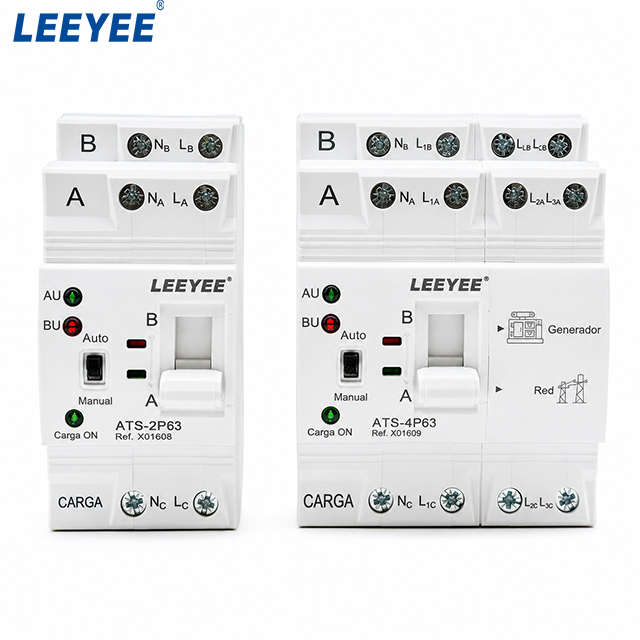
Para datos técnicos completos, detalles de cableado y dimensiones, consulte la página del producto ATS-63 o contacte a LEEYEE para soporte en la selección.
Cuándo el ATS-63 Es una Buena Opción
ATS-63 es adecuado para sistemas de respaldo AC compactos.
Los usos típicos incluyen respaldo para el hogar, respaldo de generador y respaldo de inversor solar.
También se puede utilizar en pequeñas tiendas, distribución comercial ligera, paneles de control y armarios de telecomunicaciones.
Utilícelo solo cuando la corriente, el voltaje, el número de polos, el método de cableado y los requisitos de transferencia coincidan con el sistema.
Cuándo el ATS-63 Puede No Ser la Opción Correcta
ATS-63 no es un sistema de transferencia de gran potencia.
ATS-63 no es adecuado para todos los sistemas.
No está destinado para sistemas superiores a 63A, centros de datos, hospitales, cargas de cero interrupción o sistemas de transición cerrada.
Tampoco proporciona protección contra sobrecargas por sí solo.
Para esos proyectos, utilice una solución de transferencia más grande diseñada.
Errores Comunes al Elegir un ATS
Elegir solo por calificación de corriente
“Necesito un ATS de 63A” no es suficiente.
También necesita el voltaje, tipo de fase, número de polos, fuente de respaldo, método de cableado y tiempo de transferencia.
Uso de ATS de 2P en un sistema trifásico
Un ATS de 2P no es adecuado para un sistema trifásico estándar que necesita conmutación de cuatro polos.
Ignorando la conmutación neutral
La conmutación neutral depende del sistema de puesta a tierra, diseño del generador, cableado del inversor y normativa local.
Subdimensionando el ATS
El ATS no debe operar por encima de su corriente nominal.
Para motores y bombas, también verifique la corriente de arranque.
Tratando el ATS como un UPS
Un ATS no proporciona respaldo de batería.
Si la carga no puede aceptar un breve corte de energía, utilice un UPS.
Dispositivos de Protección de Olvido
Un ATS no reemplaza interruptores, fusibles o protección contra sobretensiones.
¿Cuándo Debes Usar un Interruptor de Transferencia Automática?
Utilice un ATS cuando una carga necesita cambiar automáticamente a la energía de respaldo después de que falle el suministro principal.
Un ATS es adecuado cuando hay dos fuentes de energía CA disponibles y el cambio manual es demasiado lento o incómodo.
Puede que no sea suficiente para cargas de cero interrupción, fuentes de respaldo inestables, sistemas de cableado poco claros o cargas sobredimensionadas.
Para electrónica sensible, use un ATS junto con un UPS si es necesario.
Preguntas Frecuentes sobre Interruptores de Transferencia Automática
¿Cuál es el propósito de un interruptor de transferencia automática?
Transfiere la carga de la energía normal a la energía de respaldo cuando falla la energía normal.
¿Para qué se utiliza un interruptor de transferencia automática?
Se utiliza para el cambio de energía de respaldo en hogares, pequeños edificios, sistemas de generadores y sistemas de respaldo de inversores solares.
También se puede utilizar en paneles de control, tableros de distribución y gabinetes de telecomunicaciones.
¿Cómo funciona un interruptor de transferencia automática?
Monitorea la fuente normal y la fuente de respaldo.
Cuando falla la energía normal y la energía de respaldo está lista, el ATS transfiere la carga.
¿Qué ocurre cuando la energía de la red vuelve?
El ATS transfiere la carga de vuelta a la energía de la red después de que la fuente se estabiliza.
¿Puede un ATS funcionar sin un generador?
Sí. Puede alternar entre energía de la red y energía de inversor, respaldo solar, dos fuentes de servicios públicos u otras fuentes de CA.
¿Se requiere un ATS para un generador?
No siempre.
Pero un ATS es útil cuando se necesita una transferencia automática de respaldo del generador.
¿Puede un ATS alternar entre la red eléctrica y el inversor solar?
Sí, en algunos sistemas.
Primero verifique la salida del inversor, el voltaje, la frecuencia, el cableado neutro, la puesta a tierra y el código local.
¿Qué tan rápido cambia un ATS?
El tiempo de conmutación depende del diseño del ATS y de la condición de la fuente.
El tiempo de conmutación de transferencia del LEEYEE ATS-63 es inferior a 50 ms.
¿Cuál es el tiempo de conmutación de transferencia del ATS-63 de LEEYEE?
Es menos de 50 ms según el manual del producto.
Este es solo el tiempo de conmutación del ATS. El tiempo de arranque del generador es aparte.
¿Cuál es la diferencia entre un ATS y un UPS?
Un ATS transfiere la carga entre dos fuentes de energía.
Un UPS proporciona energía de batería durante una interrupción.
¿Cuál es la diferencia entre un ATS de 2P y uno de 4P?
Un ATS de 2P se utiliza comúnmente para sistemas monofásicos.
Un ATS de 4P se utiliza comúnmente para sistemas trifásicos que cambian L1, L2, L3 y Neutro.
¿Se puede usar un ATS de 2P en un sistema trifásico?
N.º.
Un sistema trifásico estándar necesita conmutación trifásica o de cuatro polos.
¿Qué tamaño de interruptor de transferencia automática necesito?
Elija según la corriente de carga, voltaje, número de polos, tipo de fuente, método de cableado y requisitos de transferencia.
¿Se puede usar el ATS-63 para energía de respaldo en casa?
Sí, cuando el voltaje, la corriente, el número de polos y el método de cableado coinciden con el sistema de respaldo en casa.
¿Se puede utilizar el ATS-63 para respaldo de generador?
Sí, si los parámetros del sistema y el diseño del cableado coinciden con la clasificación del ATS.
¿Se puede utilizar el ATS-63 para sistemas de respaldo solar?
Sí, en algunos sistemas de respaldo solar o de inversores.
Verifique la salida del inversor, el voltaje, la frecuencia, el conmutador neutral y el método de cableado antes de la selección.
¿Qué certificaciones están disponibles para el ATS de LEEYEE?
Los interruptores de transferencia automáticos LEEYEE se pueden suministrar con documentación CE y RoHS.
¿Proporciona un ATS protección contra sobretensiones?
No. La protección contra sobretensiones requiere un dispositivo de protección contra sobretensiones separado.
¿Proporciona un ATS protección contra sobrecargas o cortocircuitos?
No. Use interruptores automáticos, fusibles y otros dispositivos de protección adecuados.
¿Qué debo confirmar antes de comprar un ATS?
Confirme el voltaje, la corriente, el número de polos y la frecuencia.
También verifique el tipo de fuente, el método de cableado, el tiempo de transferencia, el espacio de instalación y las necesidades de certificación.
¿Necesita ayuda para elegir un ATS?
Díganos su voltaje, corriente, tipo de fase, fuente de respaldo, requisitos de transferencia y detalles del cableado.
LEEYEE puede ayudarle a seleccionar una opción ATS-63 adecuada.
Los usos comunes incluyen respaldo de generadores, respaldo de inversores solares, tableros de distribución y armarios de control compactos.
Conclusión
Un interruptor de transferencia automática mueve una carga entre energía normal y energía de respaldo.
Se utiliza ampliamente en respaldo de generadores, respaldo de inversores solares y respaldo para el hogar.
También se puede utilizar en pequeños sistemas comerciales, armarios de telecomunicaciones, paneles de control y tableros de distribución.
Antes de elegir un ATS, confirme el voltaje, la corriente, el tipo de fase y el número de polos.
Luego verifique la fuente de respaldo, el método de cableado, el tiempo de transferencia y las condiciones de instalación.
Para sistemas de respaldo compactos, LEEYEE ATS-63 ofrece opciones de riel DIN de 2P y 4P de 6A a 63A.
Su tiempo de conmutación de transferencia es inferior a 50 ms.
Un ATS bien seleccionado facilita la conmutación de energía de respaldo, haciéndola más fácil, segura y confiable.