
IEC 60947-6-1 ATS Buyer Verification Guide
IEC 60947-6-1 is the principal IEC product standard for transfer switching equipment used to transfer a load between power sources. For an ATS buyer, however, seeing “IEC 60947-6-1” on a catalogue is only the starting point. A useful technical approval must connect the standard claim to the exact TSE type, PC/CB/CC class, rated voltage and current, utilization category, short-circuit performance, protective-device coordination and documented model scope.[1]
This guide explains IEC 60947-6-1:2026 from the perspective of importers, distributors, panel builders, electrical contractors, project procurement teams and OEM buyers. It does not reproduce the standard. Instead, it turns the important requirements into a practical verification process for automatic transfer switch purchasing.
Table of Contents
Quick Answer: What Should an ATS Buyer Check?
IEC 60947-6-1:2026, Edition 4.0 is the current IEC standard for transfer switching equipment (TSE). It covers manually operated TSE, remotely operated TSE, automatic transfer switching equipment (ATSE), stand-alone ATS controllers, bypass/isolation TSE, closed-transition ATSE and fire-pump TSE within the stated scope.[1]
Before approving an ATS, verify the equipment type, short-circuit class, Ue, Ie, utilization category, short-circuit ratings, upstream protection requirements, test evidence and exact certificate/model scope. Do not approve a product only because “IEC 60947-6-1” appears on its datasheet.
The last two rows are where many purchasing errors occur: real documentation can still be irrelevant if it does not cover the exact configuration being ordered.
| Buyer check | What to confirm | Why it matters |
|---|---|---|
| Standard edition | IEC 60947-6-1 edition used | Shows the technical basis of the declaration, test or certification document. |
| Equipment type | ATSE, RTSE, MTSE, BTSE or another covered arrangement | “ATS” is a broad commercial term; IEC terminology is more precise. |
| Class | PC, CB or CC | The class changes the short-circuit function and protection architecture. |
| Operational rating | Ue, Ie, poles, frequency and utilization category | The ampere marking alone does not describe the complete switching duty. |
| Short-circuit data | Applicable Icw, Iq, Icm or breaking characteristics and their conditions | Identical-looking kA values can represent different technical capabilities. |
| Test evidence | Test report, certificate, datasheet and nameplate traceability | A marketing declaration alone does not prove the exact product was evaluated. |
| Model / OEM scope | Exact model, rating, pole arrangement, brand and permitted variants | One real certificate should not be assumed to cover every product in a catalogue. |
Procurement conclusion: approve the complete combination of product, ratings, classification and supporting evidence—not a standard number printed by itself.
What Does IEC 60947-6-1:2026 Actually Cover?
The current publication is IEC 60947-6-1:2026, Edition 4.0, published on 2 April 2026. Its full title is Low-voltage switchgear and controlgear – Part 6-1: Multiple function equipment – Transfer switching equipment.[1]
IEC states that the standard applies to transfer switching equipment used to maintain continuity of supply and support energy management by transferring a load between power-supply sources. Its scope covers rated voltages not exceeding 1,000 V AC or 1,500 V DC.[1]
It covers manually operated transfer switching equipment (MTSE), remotely operated transfer switching equipment (RTSE), automatic transfer switching equipment (ATSE), stand-alone ATS controllers, bypass/isolation transfer switching equipment, closed-transition ATSE and fire-pump TSE.[1]
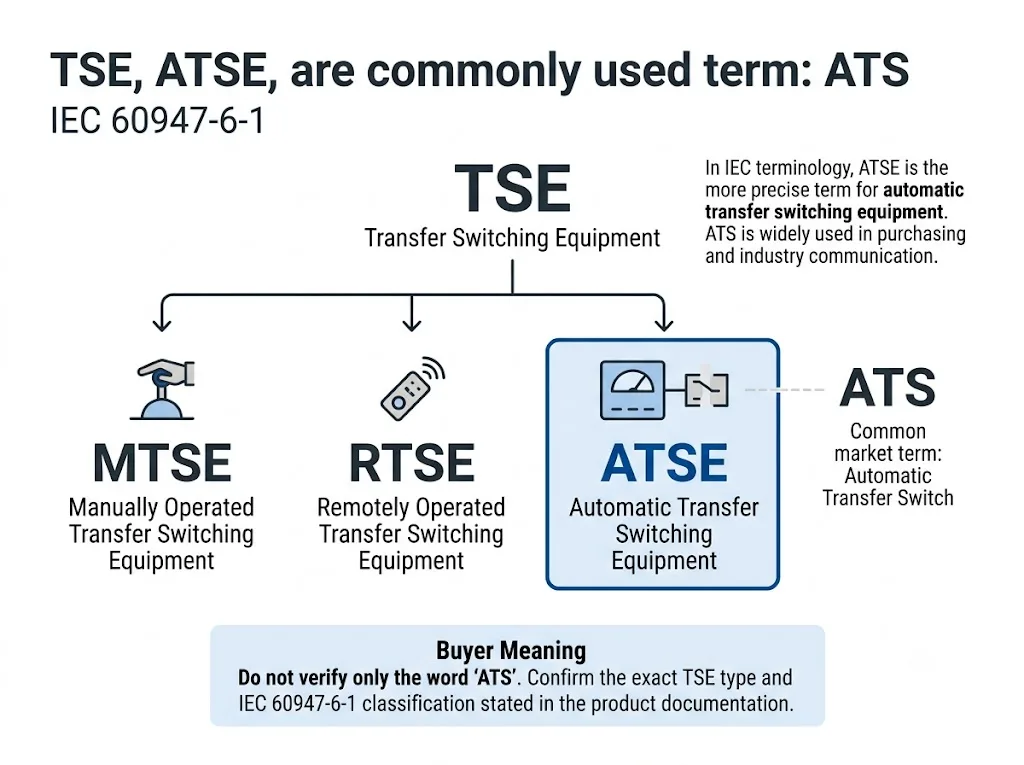
TSE, ATSE and ATS: What Is the Relationship?
TSE means Transfer Switching Equipment. It is the broad product category used by IEC 60947-6-1.
ATSE means Automatic Transfer Switching Equipment. It is one type of TSE and includes the automatic function needed to carry out the transfer operation.[1]
ATS, or Automatic Transfer Switch, is the common term used in quotations, product listings and project conversations. For IEC-based technical approval, however, the equipment classification shown in the technical documentation is more useful than the marketing term alone.
Class PC vs Class CB vs Class CC
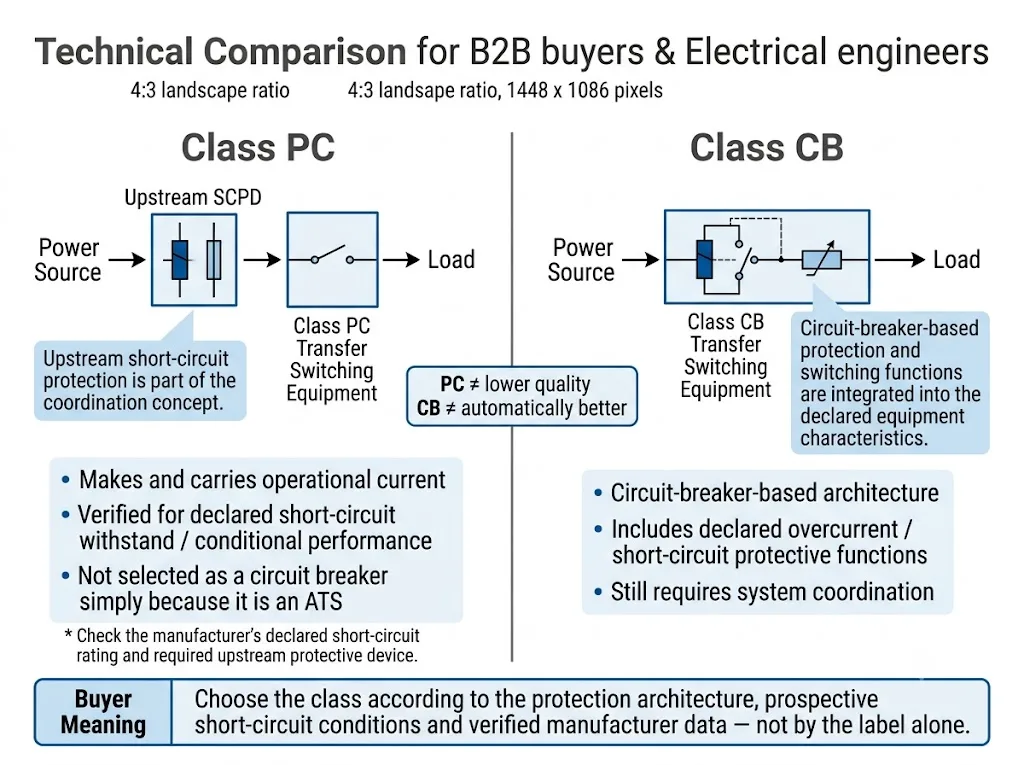
A complete IEC 60947-6-1 buyer guide should not reduce the classification to PC versus CB only. Transfer switching equipment can also be classified as Class CC. ABB’s technical guidance summarises PC, CB and CC as three different short-circuit-function and equipment-architecture routes.[3]
Class PC
Class PC TSE is capable of making and withstanding specified short-circuit current but is not intended to perform short-circuit breaking. Switch and switch-disconnector technology is commonly associated with this class.[3]
Class CB
Class CB TSE is capable of making, withstanding and breaking short-circuit current according to its declared characteristics and is provided with overcurrent releases. Circuit-breaker-based arrangements are commonly associated with this class.[3]
Class CC
Class CC TSE is based on devices fulfilling the applicable IEC 60947-4-1 contactor requirements. It can make and withstand short-circuit current under its declared conditions but is not intended to provide the short-circuit breaking function.[3]
PC and CB receive most of the attention in many industrial ATS purchasing discussions, but Class CC should not be omitted when checking the classification of contactor-based transfer solutions.
What Changed in IEC 60947-6-1:2026?
The fourth edition is not simply a date update. IEC identifies several significant technical changes compared with the 2021 third edition, including clarified scope and terminology plus dedicated requirements for bypass/isolation TSE, closed-transition ATSE, stand-alone ATS controllers and fire-pump TSE.[1]
| 2026 change | IEC location | Buyer meaning |
|---|---|---|
| Bypass / isolation TSE | Annex C | If bypass/isolation is required, do not assume evidence for a standard ATSE automatically covers the bypass arrangement. |
| Closed-transition ATSE | Annex D | If the project requires source overlap during transfer, confirm closed-transition capability and documentation explicitly. |
| Stand-alone ATS controller | Annex E | Controller compliance alone should not be assumed to prove that a complete assembled ATS has been evaluated as a complete TSE. |
| Fire-pump TSE | Annex F | Fire-pump applications need application-specific project and regulatory review. |
Do Not Approve an ATS by Ampere Rating Alone
“400 A ATS” is not a complete engineering description. Rated operational current must be read together with the voltage, utilization category and conditions under which the current is declared.
| Parameter | Plain-English meaning | Buyer check |
|---|---|---|
| Ue | Rated operational voltage | Does the declared rating cover the actual system voltage? |
| Ie | Rated operational current | Does the configuration support the required current under the declared utilization category? |
| Poles | Number of switched poles | Does the switching arrangement match the neutral and system design? |
| Frequency | Declared AC operating frequency | Does it match the source and project specification? |
| Utilization category | The electrical switching duty for which the TSE is rated | Do not assume the same Ie applies to every load type. |
AC-31, AC-32 and AC-33 Utilization Categories
Utilization category is important because electrical switching stress changes with the load. Practical manufacturer guidance commonly associates AC-31 with non-inductive or slightly inductive loads, AC-32 with mixed resistive and inductive loads, and AC-33 with motor-containing loads.[4]
| Category family | Typical load description | Buyer implication |
|---|---|---|
| AC-31 | Non-inductive or slightly inductive loads | Do not automatically extend an AC-31 rating to a motor-heavy application. |
| AC-32 | Mixed resistive and inductive loads | Check the actual Ie declaration for the selected model and voltage. |
| AC-33 | Motor loads or mixed loads containing motors | Motor duty can increase switching stress; verify category and operational current. |
Short-Circuit Capability: Do Not Compare Only the kA Number
Short-circuit performance is one of the most important areas where apparently similar ATS products can differ. The first question should be: what does the stated kA value actually represent?
| Term | Buyer meaning | Condition to verify |
|---|---|---|
| Icw | Declared short-time withstand current | Time duration, voltage and exact TSE configuration. |
| Iq | Conditional short-circuit current with a specified SCPD | The protective device and verified combination are part of the declaration. |
| Icm | Short-circuit making characteristic where declared | Applicable voltage, test condition and product classification. |
| Breaker breaking capacity | Relevant to circuit-breaker-based Class CB architecture | Do not treat it as the same quantity as Icw or Iq. |
How Should a Class PC ATS Coordinate With Upstream Protection?
For Class PC equipment, the short-circuit protection concept must be reviewed together with the upstream short-circuit protective device where the declared conditional rating depends on that protective device.
For project approval, ask for:
- the applicable upstream fuse or circuit-breaker type;
- the protective-device rating used for the declared conditional performance;
- the relevant prospective short-circuit-current condition;
- Icw together with the stated duration where applicable;
- confirmation that the data applies to the selected current rating, poles and construction.
Does “IEC 60947-6-1 Compliant” Mean the ATS Is Certified?
Not by itself. IEC publishes standards and operates conformity-assessment systems, but an IEC standard number printed on a product page does not identify who performed the conformity assessment or which exact models are covered.
Depending on the project, supporting evidence may include manufacturer technical files, independent laboratory test reports, certification-body certificates, CB Scheme documentation or another conformity route required by the destination market.
What Changed for Test Documentation in 2026?
The IECEE published IECEE TRF 60947-6-1E:2026 on 4 September 2026. IEC identifies it as the Test Report Form for IEC 60947-6-1:2026 used in conjunction with IEC 60947-1:2020.[2]
How to Read an ATS Test Report as a Buyer
A test report is useful only when the tested equipment can be connected to the product that will actually be supplied.
| Report item | Buyer question | Risk if ignored |
|---|---|---|
| Manufacturer | Does the identity correspond to the supplied equipment? | The document may relate to another manufacturer. |
| Model / series | Is the ordered model explicitly covered or traceably included? | A genuine report can still be irrelevant to the purchased model. |
| TSE type | Is it ATSE, RTSE, MTSE or another documented configuration? | The tested control arrangement may differ from the offered unit. |
| Class | Is PC, CB or CC clearly identified? | The assumed short-circuit function may be wrong. |
| Ue / Ie | Does the scope cover the required voltage and current? | A different rating may be incorrectly treated as equivalent. |
| Utilization category | Does the switching duty match the intended load? | The current rating may be interpreted outside its tested duty. |
| Short-circuit data | Are Icw, Iq, Icm or applicable breaking conditions clear? | A kA figure may be compared under the wrong technical meaning. |
| Poles / variants | Does the scope include the ordered construction? | An unverified variant may be assumed to be covered. |
Certificate Scope: Does It Cover the ATS You Are Buying?
A frequent purchasing mistake is accepting a genuine certificate without checking whether it covers the actual ATS model.
One certificate should not automatically be treated as evidence for every current rating, pole configuration, controller, model suffix or construction in a supplier’s catalogue.
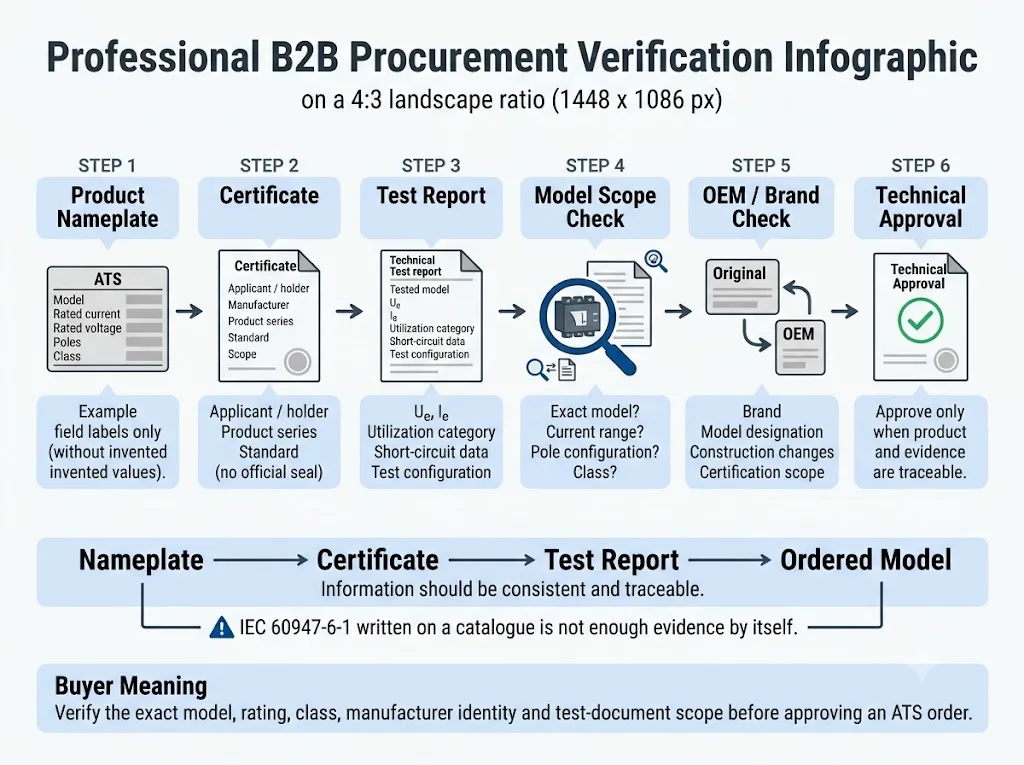
Product nameplate → Datasheet → Certificate → Test report → Purchase-order model.
If one link cannot be connected to the next, request clarification before technical approval.
OEM and Private-Label ATS: Does the Original Certificate Still Apply?
Do not assume that changing the commercial brand or model designation automatically leaves certification coverage unchanged.
OEM projects can change the trademark, model number, nameplate, controller, enclosure, pole arrangement, rated current, terminal design or internal construction. Some changes may be commercial only; others can affect product identity or the tested construction.
- Which tested or certified original model does the OEM model map to?
- Are any electrical or mechanical parts changing?
- Can the new trademark and model designation remain within the current certification arrangement?
- Does the certification body need to review the OEM identity?
- Will the final product remain traceable to the evaluated construction?
IEC 60947-6-1 and UL 1008 Are Different Procurement Routes
IEC 60947-6-1 is the IEC standard for transfer switching equipment within its defined scope. In the North American conformity framework, UL 1008 is used for transfer switch equipment.[8]
An IEC 60947-6-1 declaration does not by itself establish UL 1008 compliance, and UL 1008 certification does not by itself establish conformity with IEC 60947-6-1.
How This Verification Applies to a Real LEEYEE ATS Datasheet
Use published product data as the start of verification—not the end
Public LEEYEE ATS product information can provide fields such as rated operational current, rated working voltage, class, utilization category, short-circuit data and protective-device recommendations.
These are the kinds of fields a B2B buyer should trace through the product datasheet, nameplate and applicable test or conformity documents before project approval.
Important: a product specification page is not, by itself, proof that a particular third-party certificate covers that exact model. Projects requiring IEC 60947-6-1 certification or a specific conformity route should verify the supporting documents separately.
A Practical IEC 60947-6-1 ATS Approval Workflow
- Confirm the destination-market requirement. Identify the country, project specification, IEC/EN/UL route and local approval requirement.
- Confirm the TSE type. Determine whether the project requires ATSE, RTSE, MTSE, bypass/isolation TSE, closed-transition ATSE or another defined arrangement.
- Confirm PC, CB or CC class. Match the class to the project protection architecture.
- Confirm Ue, Ie and utilization category. Evaluate the rating under the actual voltage and load duty instead of using ampere value alone.
- Confirm short-circuit performance. Identify the meaning of each Icw, Iq, Icm or breaker-related value and all attached conditions.
- Confirm protective-device coordination. Where performance depends on an upstream SCPD, verify the exact fuse or circuit-breaker combination.
- Confirm the evidence. Compare test report, certificate, datasheet and manufacturer documentation.
- Confirm the supplied product. Make sure the final purchase-order model, label, poles, ratings and OEM identity remain traceable to the approved documents.
Common ATS Procurement Mistakes
| Mistake | Why it is risky | Better buyer action |
|---|---|---|
| “It says IEC 60947-6-1, so it is approved.” | The statement does not identify the evidence or model scope. | Request model-specific technical and conformity documents. |
| Comparing only 250 A vs 250 A. | Voltage, utilization category and class may differ. | Compare the complete declared operating duty. |
| Comparing only “50 kA vs 50 kA.” | The values may describe different short-circuit characteristics. | Identify the rating type, duration and associated SCPD. |
| Ignoring Class CC. | Contactor-based TSE can follow a different classification route. | Verify whether the proposed equipment is PC, CB or CC. |
| Assuming Class CB is always better. | PC, CB and CC represent different functions and architectures. | Select according to the actual protection design. |
| Using one certificate for an entire catalogue. | Certificate scope may be narrower than the commercial range. | Trace the ordered model to the certificate and report. |
IEC 60947-6-1:2021 vs 2026: What Should Buyers Do?
IEC 60947-6-1:2026 is the current fourth edition and replaces the third edition published in 2021.[1]
For new sourcing and project review, identify which edition supports the supplier’s current documentation. Do not independently declare an earlier-edition certificate invalid only because a newer edition exists; transition arrangements and project acceptance must be confirmed with the relevant certification body and project authority.
Before Ordering: IEC ATS Verification Checklist
- Destination market: country, project specification and required conformity route.
- System: rated voltage, frequency, phase arrangement and neutral design.
- Load: continuous current and major motor, transformer or high-inrush characteristics.
- Transfer function: automatic, remote, manual, open transition, closed transition or bypass requirement.
- Poles: required switching arrangement based on the actual system.
- TSE class: PC, CB or CC.
- Utilization category: category and corresponding Ie for the exact model.
- Short-circuit conditions: available fault current and applicable Icw, Iq, Icm or breaker data.
- Upstream protection: required SCPD and manufacturer coordination data.
- Documentation: standard edition, certificate, test report, datasheet and installation instructions.
- Model scope: exact current rating, poles, controller and construction covered.
- OEM requirement: trademark, model name, label, packaging and any technical change.
Need to review an ATS for an IEC-based project or OEM order? Prepare the system voltage, load current, poles, utilization category, available fault current and required conformity documents before requesting final model confirmation.
Frequently Asked Questions
Is IEC 60947-6-1 the IEC standard for automatic transfer switches?
IEC 60947-6-1 is the IEC product standard for transfer switching equipment within its scope and includes automatic transfer switching equipment (ATSE). ATS is the common commercial term.
What is the latest edition of IEC 60947-6-1?
The current edition is IEC 60947-6-1:2026, Edition 4.0, published on 2 April 2026.[1]
What is Class PC in an ATS?
Class PC TSE can make and withstand specified short-circuit current but is not intended to perform the short-circuit breaking function. Its short-circuit ratings must be reviewed together with the applicable protection arrangement.
What is Class CB in an ATS?
Class CB is associated with TSE capable of making, withstanding and breaking short-circuit current according to its declared characteristics and incorporating overcurrent releases.
What is Class CC?
Class CC applies to contactor-based TSE using equipment that fulfils the relevant IEC 60947-4-1 requirements. It should be verified separately rather than assumed to be PC or CB.
Is Class CB better than Class PC?
No general ranking should be made. The classes represent different protection functions and architectures. Selection depends on the actual short-circuit and protection design.
Does one IEC 60947-6-1 certificate cover every ATS current rating?
Do not assume that it does. Check the certificate scope, product family, ratings, construction variants and associated test documentation.
Can an OEM ATS use the original manufacturer's certificate after changing the brand?
Possibly under some certification arrangements, but this must be confirmed. The certificate holder, certification body, model identity and approved construction determine whether the private-label variant remains within scope.
Is IEC 60947-6-1 equivalent to UL 1008?
No. They are different standards and conformity frameworks. The project specification and destination market should determine which route is required.
Final Procurement Rule
The weak question is:
The stronger question is:
References
- International Electrotechnical Commission, IEC 60947-6-1:2026 — Low-voltage switchgear and controlgear – Part 6-1: Multiple function equipment – Transfer switching equipment, Edition 4.0. IEC official publication page.
- IECEE, IECEE TRF 60947-6-1E:2026 — Test Report Form for IEC 60947-6-1:2026. IEC / IECEE official TRF page.
- ABB, How to Select an Automatic Transfer Switch, technical white paper covering PC, CB and CC classifications and short-circuit selection. ABB official technical paper.
- ABB, technical guidance on transfer switching and utilization categories. ABB official technical presentation.
- ABB, TruONE ATS Automatic Transfer Switches — Catalogue, operational-current, utilization-category and short-circuit data. ABB official catalogue.
- International Electrotechnical Commission, IEC CAB-P01 — IEC Conformity Assessment Board Policy. IEC official policy.
- International Electrotechnical Commission, Test Report Forms. IEC official TRF information.
- UL Solutions, Switch Certification and Evaluation Services. UL Solutions official page.
Standards, certification schemes and national acceptance requirements can change. For a specific project, confirm the applicable standard edition, conformity route, certificate scope, local adoption and protection design with the manufacturer, certification body and project authority before final approval.