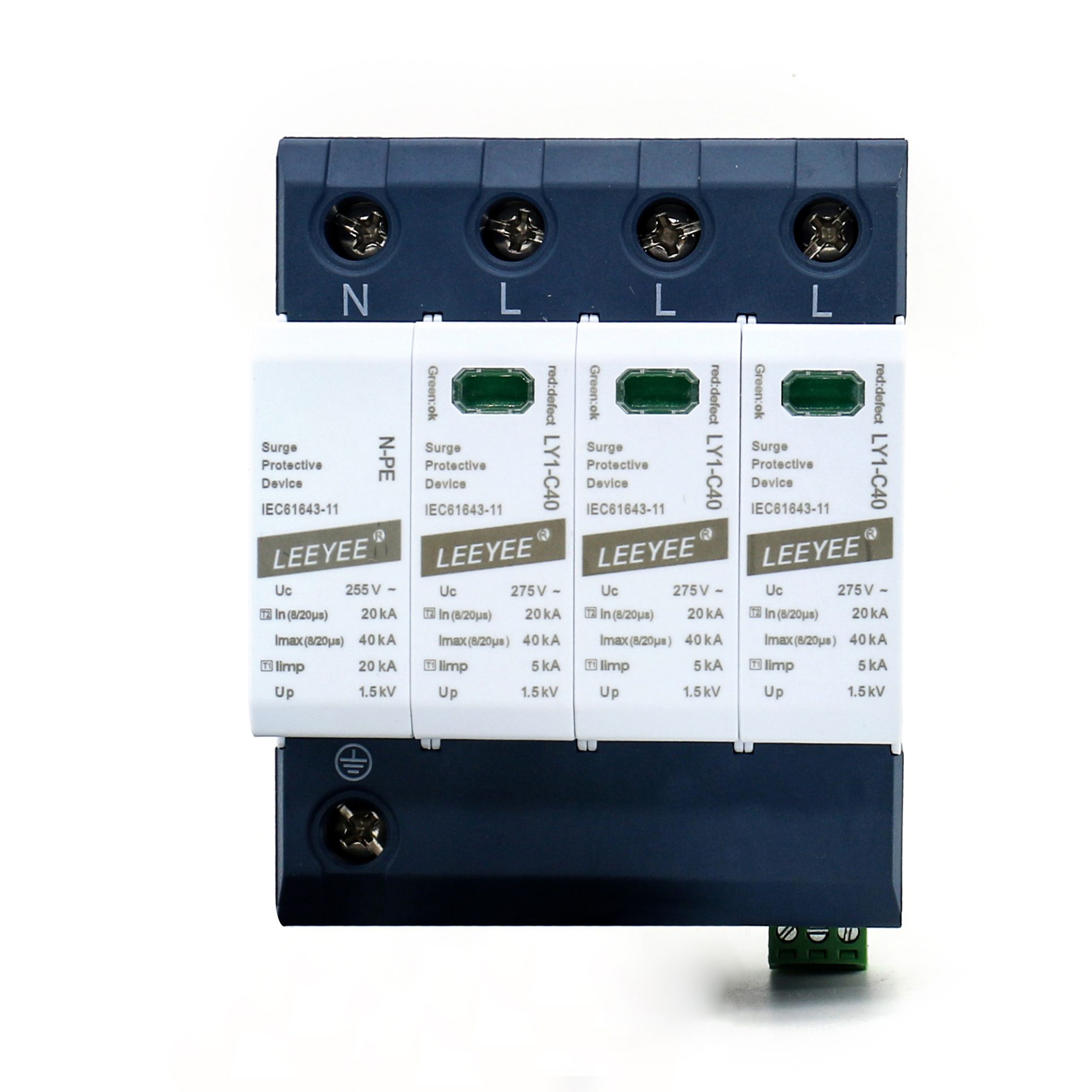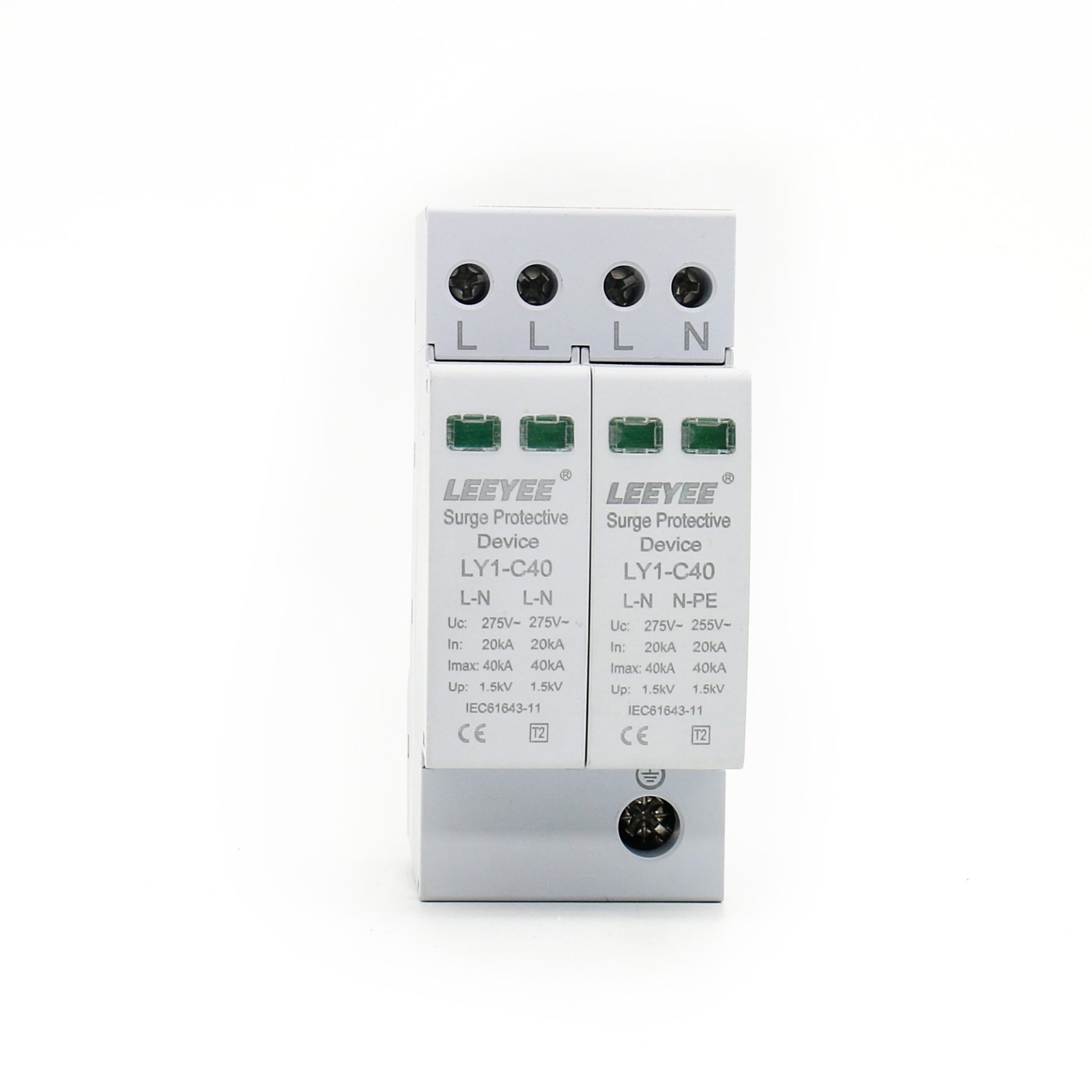
Un limitatore di sovratensione trifase viene utilizzato per proteggere i sistemi di alimentazione trifase industriali e commerciali dalle sovratensioni transitorie.
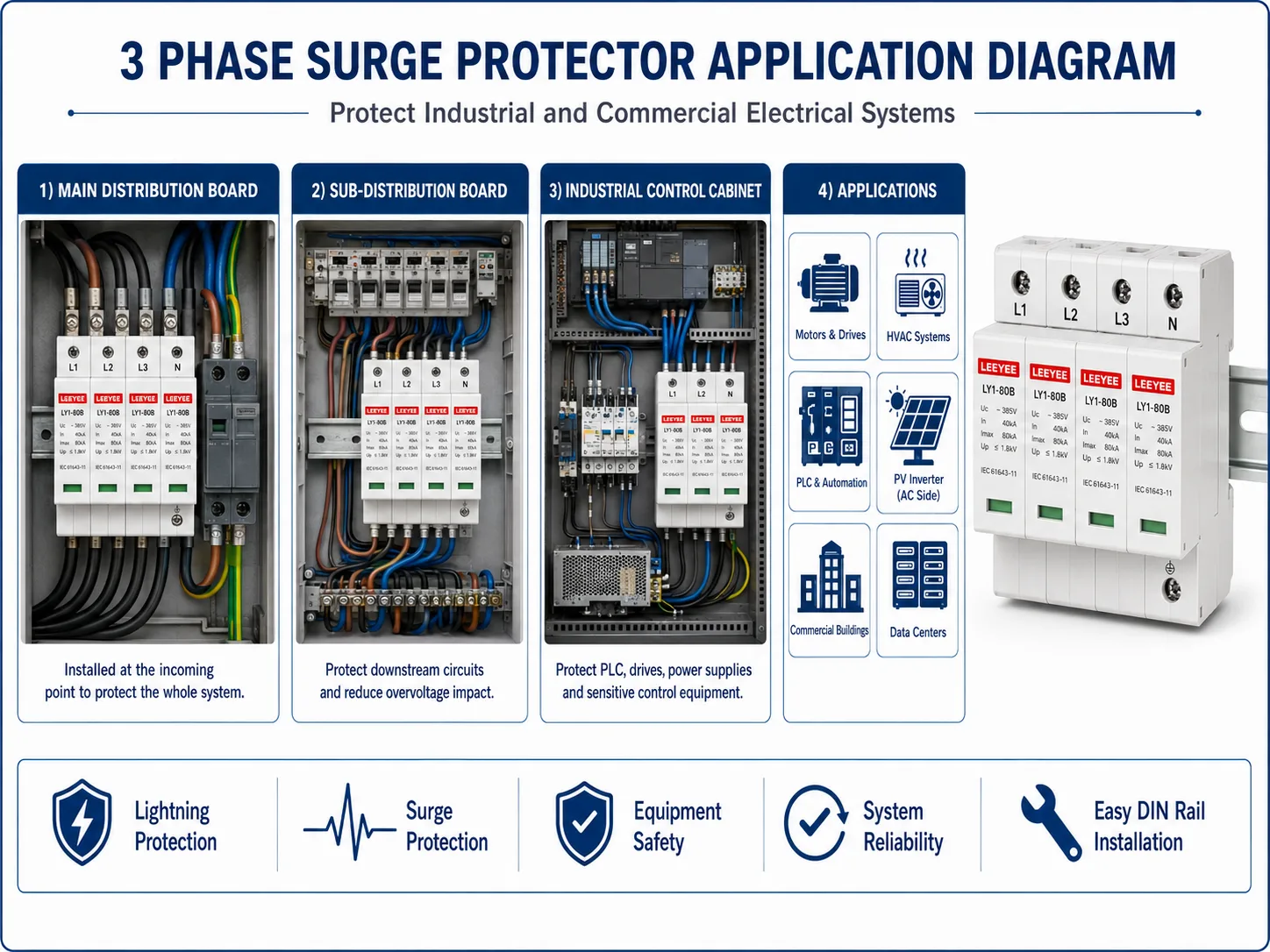
Viene comunemente installato in quadri di distribuzione principali, quadri di distribuzione secondari, quadri di comando, quadri macchina, sistemi HVAC, quadri CA per inverter FV e quadri elettrici OEM.
Il punto importante è semplice: un limitatore di sovratensione trifase non dovrebbe essere scelto solo in base alla tensione o al numero di poli. L'SPD corretto dipende dall'intero impianto elettrico.
Indice dei contenuti
Risposta rapida: come scegliere un limitatore di sovratensione trifase?
Per un quadro di distribuzione trifase standard, confermare prima la tensione di sistema e il sistema di messa a terra. Successivamente, scegliere il tipo di SPD e la configurazione dei poli.
I quadri di ingresso principali potrebbero necessitare di protezione di Tipo 1 o Tipo 1+2. I quadri di distribuzione secondari standard utilizzano solitamente la protezione di Tipo 2. I sistemi TN-S, TN-C-S, TT, IT e i sistemi trifase a 3 fili possono richiedere configurazioni SPD differenti.
| Applicazione | Scelta comune dello SPD | Nota dell'acquirente |
|---|---|---|
| Quadro di ingresso principale con alta esposizione ai fulmini | SPD di Tipo 1 o Tipo 1+2 | Verificare Iimp e la protezione di backup. |
| Quadro di distribuzione secondaria standard | DOCUP di tipo 2 | Comune per quadri industriali e commerciali. |
| Sistema trifase a 4 fili TN-S | 4P o SPD a 4 poli idoneo | Protegge L1, L2, L3, N e PE in base alla progettazione. |
| Sistema trifase a 4 fili TT | 3P+N / 3+1 SPD | È necessario considerare il percorso di protezione N-PE. |
| Sistema trifase a 3 fili | SPD 3P | Utilizzato quando il neutro non è disponibile. |
| Armadio elettrico OEM | Dipende dal disegno del progetto | Confermare tensione, messa a terra, numero di poli e certificazione. |
Un valore nominale di kA più elevato non significa automaticamente che l'SPD sia migliore per ogni quadro. Un SPD corretto è quello che corrisponde al sistema elettrico reale, alla posizione di installazione e al requisito di protezione.
Che cos'è un limitatore di sovratensione trifase?
Un limitatore di sovratensione trifase, chiamato anche dispositivo di protezione contro le sovratensioni trifase o SPD trifase, è progettato per limitare le sovratensioni transitorie nei sistemi di alimentazione trifase.
Una sovratensione può derivare da attività fulminea, commutazione della rete elettrica, avviamento e arresto di motori, commutazione di trasformatori, commutazione di banchi di condensatori, funzionamento di VFD, guasti vicini o commutazione di carichi industriali.
L'SPD fornisce un percorso di scarica controllato per la corrente di sovratensione. Quando compare una sovratensione transitoria, l'SPD limita la tensione a un livello più sicuro e aiuta a scaricare l'energia di sovratensione a terra.
Ciò contribuisce a proteggere le apparecchiature a valle come PLC, azionamenti, alimentatori, sensori, schede di controllo, apparecchiature di comunicazione e macchinari industriali.
Perché i sistemi trifase richiedono una selezione diversa dell'SPD
Un sistema trifase è più complesso di un circuito monofase. Le sovratensioni possono apparire tra diversi conduttori.
- Linea verso terra: L-PE
- Linea verso neutro: L-N
- Neutro verso terra: N-PE
- Linea verso linea: L-L
Ecco perché la selezione di un SPD trifase deve considerare la struttura del sistema. La parola "trifase" non è sufficiente per selezionare l'SPD.
Dove vengono utilizzati i limitatori di sovratensione trifase?
Gli SPD trifase sono comunemente utilizzati nei sistemi elettrici B2B, tra cui:
- Quadri di distribuzione industriali
- Pannelli per edifici commerciali
- Sistemi di distribuzione di potenza per stabilimenti
- Quadri di controllo macchina
- Pannelli di controllo HVAC
- Centri di controllo motore
- Armadi PLC e di automazione
- Quadri di potenza per data center
- Sistemi di distribuzione per la ricarica di veicoli elettrici
- Quadri di uscita AC per inverter FV
- Armadi elettrici OEM
- Progetti di quadristica elettrica
Per acquirenti OEM, importatori e quadristi, l'SPD deve soddisfare sia i requisiti tecnici che il design del prodotto finale.
Ciò include lo spazio per il cablaggio, il montaggio su guida DIN, il tipo di modulo innestabile, il contatto di segnalazione remota, la certificazione, il design dell'etichetta e la stabilità della fornitura a lungo termine.
SPD trifase di Tipo 1, Tipo 2 e Tipo 1+2
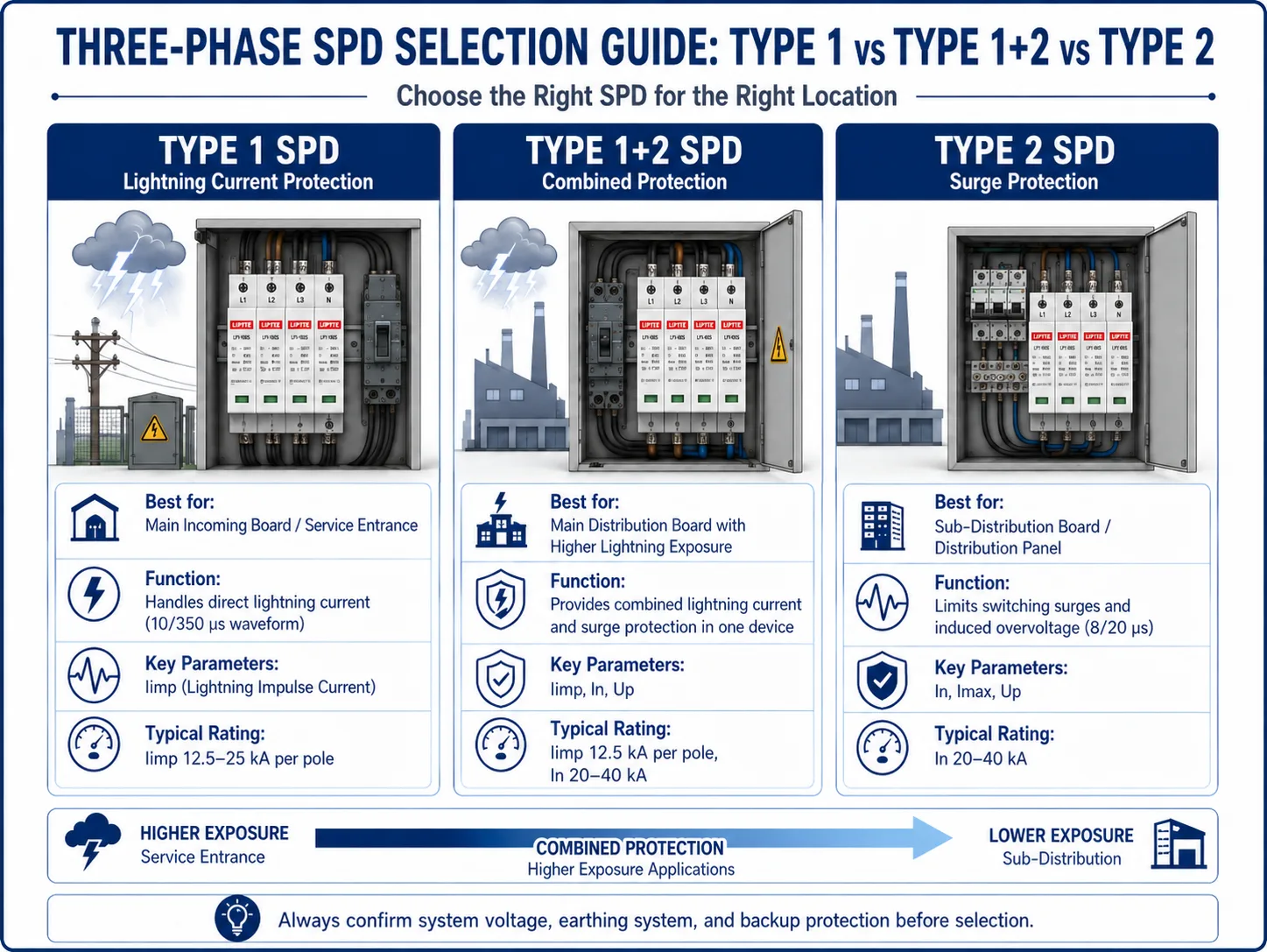
Il tipo di SPD dovrebbe corrispondere alla posizione di installazione e al livello di esposizione alle sovratensioni. Un SPD di Tipo 2 non dovrebbe essere utilizzato alla cieca dove è richiesta una protezione di Tipo 1. Tuttavia, il Tipo 1 non è richiesto automaticamente in ogni quadro.
| Tipo SPD | Posizione di installazione comune | Funzione principale | Nota dell'acquirente |
|---|---|---|---|
| DOCUP di tipo 1 | Quadro principale di ingresso, punto di consegna | Gestisce la corrente parziale da fulmine | Verificare il valore Iimp. |
| SPD Tipo 1+2 | Quadro di distribuzione principale con maggiore esposizione | Protezione da fulmini e sovratensioni | Utile dove è necessaria una protezione combinata compatta. |
| DOCUP di tipo 2 | Quadro di sotto-distribuzione, quadro di controllo | Limita le sovratensioni di manovra e le sovratensioni indotte | Comune per i quadri industriali. |
| DOCUP di tipo 3 | Vicino ad apparecchiature terminali sensibili | Protezione fine vicino alle apparecchiature | Solitamente utilizzato dopo il coordinamento di Tipo 2. |
La scelta corretta dipende dall'esposizione ai fulmini, dalla protezione a monte, dal progetto elettrico locale, dalla posizione di installazione e dai requisiti del progetto.
3P, 4P e 3P+N: qual è la differenza?
Molti acquirenti scelgono un SPD trifase in base al numero di poli. Questo può portare a errori.
La configurazione dei poli dovrebbe corrispondere al cablaggio del sistema e alla disposizione della messa a terra.
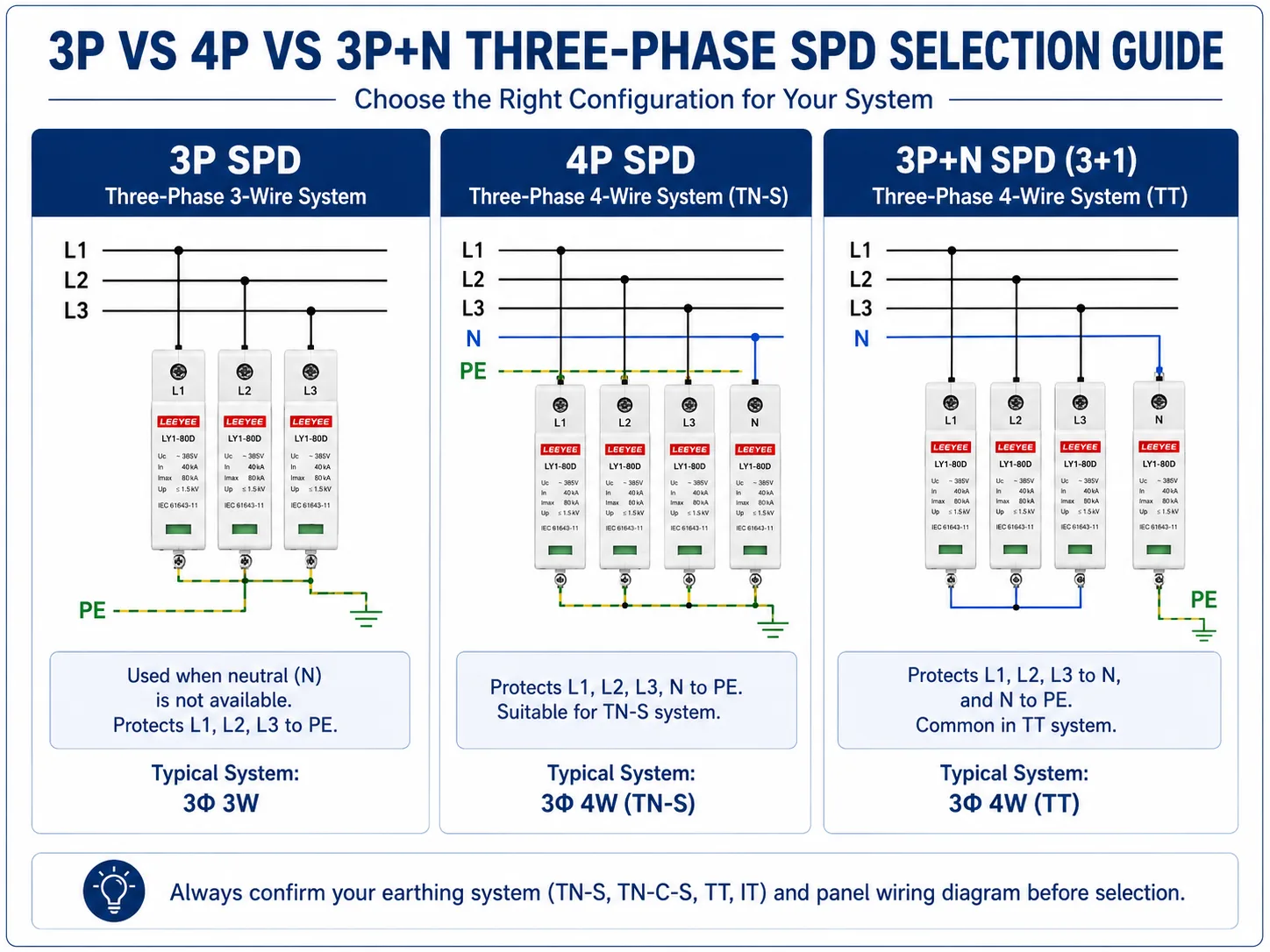
| Configurazione SPD | Uso comune | Cosa significa | Nota importante |
|---|---|---|---|
| SPD 3P | Sistemi trifase a 3 fili | Protezione L1, L2, L3 | Utilizzato quando il neutro non è presente. |
| SPD 4P | Sistemi trifase a 4 fili | Protezione L1, L2, L3, N | La logica di cablaggio dipende dal design del sistema. |
| SPD 3P+N | Spesso utilizzato nel design della protezione 3+1 | L1/L2/L3 a N, N a PE | Comune nel design della protezione relativo a sistemi TT. |
| Configurazione 4+0 | Spesso utilizzato nei sistemi TN-S | L1, L2, L3, N protetti verso PE | Verificare il design del prodotto e lo schema elettrico. |
| Configurazione 3+1 | Spesso utilizzato nei sistemi TT | L1/L2/L3 a N, N a PE | Il percorso N-PE è critico. |
Un SPD 4P e un SPD 3P+N non dovrebbero essere considerati la stessa cosa in ogni progetto. Un SPD 3P non è automaticamente adatto a tutti i sistemi trifase. Un SPD 3P+N non è automaticamente richiesto per ogni sistema con neutro.
Prima di ordinare, confermare il disegno del progetto, il sistema di messa a terra e lo schema di cablaggio dell'SPD. Per schemi di cablaggio dettagliati, consultare il nostro Guida al diagramma di cablaggio SPD trifase.
In che modo i sistemi di messa a terra influiscono sulla scelta dell'SPD trifase
Il sistema di messa a terra è uno dei fattori più importanti nella selezione dell'SPD. Diversi sistemi di messa a terra possono richiedere diverse modalità di protezione.
Sistemi TN-S
In un sistema TN-S, il neutro e la terra di protezione sono conduttori separati. Un tipico quadro trifase TN-S ha L1, L2, L3, N e PE.
In molti quadri di distribuzione TN-S, viene utilizzato un SPD 4P o una protezione quadripolare adatta. La connessione esatta dipende dal design dell'SPD e dal cablaggio del quadro.
Sistemi TN-C-S
In un sistema TN-C-S, il conduttore PEN viene separato in N e PE in un determinato punto. La selezione dell'SPD dipende da dove viene installato l'SPD.
Per i sistemi TN-C-S, non selezionare l'SPD guardando solo al numero di fili. Confermare prima il disegno del quadro.
Sistemi TT
In un sistema TT, l'impianto dispone del proprio elettrodo di terra locale. Il rapporto tra neutro e terra è diverso rispetto ai sistemi TN-S.
I sistemi TT utilizzano spesso una logica di protezione 3P+N o 3+1. Il percorso di protezione N-PE deve essere considerato attentamente.
Sistemi IT
I sistemi IT richiedono un'attenzione particolare. Possono avere un neutro isolato o collegato a terra tramite impedenza.
La selezione dell'SPD per i sistemi IT deve seguire il progetto elettrico, i requisiti di monitoraggio dell'isolamento e le normative locali. Non utilizzare una raccomandazione standard per SPD TN o TT senza aver verificato il design del sistema.
Parametri chiave per un limitatore di sovratensione trifase
Uc / MCOV
Uc, detta anche MCOV, è la massima tensione continuativa di funzionamento. Deve essere superiore alla tensione normale del sistema, ma senza essere selezionata eccessivamente alta a priori.
Se Uc è troppo bassa, l'SPD potrebbe invecchiare più rapidamente o guastarsi precocemente. Se Uc è troppo alta, il livello di protezione potrebbe diventare meno sensibile.
In
In è la corrente nominale di scarica. Indica la capacità dell'SPD di gestire correnti di sovratensione ripetute, solitamente con una forma d'onda 8/20 μs.
Imax
Imax è la corrente massima di scarica. Indica la capacità massima di scarica dell'SPD per una singola sovratensione in condizioni di prova specificate.
Iimp
Iimp è la corrente impulsiva di fulmine. È importante per gli SPD di Tipo 1 e di Tipo 1+2.
Su
Up è il livello di protezione della tensione. Un valore di Up più basso generalmente indica migliori prestazioni di limitazione della tensione.
Fusibile di backup o interruttore automatico (MCB)
Un SPD trifase richiede solitamente un'adeguata protezione di backup contro le sovracorrenti. Puo trattarsi di un MCB, un MCCB o un fusibile. La taratura deve essere conforme alla scheda tecnica dell'SPD.
Tabella di selezione del limitatore di sovratensione trifase
Utilizza questa tabella come punto di partenza rapido prima di inviare una richiesta.
| Sistema o applicazione | Direzione di selezione consigliata | Cosa confermare |
|---|---|---|
| Quadro di distribuzione 230/400V TN-S | Tipo 2, 4P o SPD quadripolare idoneo | Uc, In, Imax, protezione di backup. |
| Quadro industriale 400/415V | Tipo 2 o Tipo 1+2 a seconda della posizione | Tensione di sistema e livello di esposizione. |
| Quadro generale di ingresso | Potrebbero essere richiesti Tipo 1 o Tipo 1+2 | Iimp, protezione a monte, normativa di installazione. |
| Quadro di sub-distribuzione | DOCUP di tipo 2 | In, Imax, Up, fusibile di backup. |
| Sistema TT | Potrebbe essere richiesto 3P+N / 3+1 | Percorso N-PE e idoneità del prodotto. |
| Sistema trifase a 3 fili | SPD 3P | Senza neutro, tensione di sistema, messa a terra. |
| Armadio OEM | SPD specifico per il progetto | Etichetta, certificazione, spazio per il cablaggio, segnale remoto. |
| Quadro di monitoraggio remoto | SPD con contatto di segnalazione remoto | Tipo di contatto di allarme e cablaggio. |
Questa tabella non sostituisce il disegno del progetto. È uno strumento di selezione rapida per acquirenti, distributori e costruttori di quadri.
Posizione di installazione: quadro principale vs. quadro di distribuzione secondario
Un limitatore di sovratensioni trifase deve essere installato in base alla zona di protezione e alla funzione del quadro.
- Quadro elettrico principale di distribuzione in ingresso
- Quadro di sub-distribuzione
- Quadro di comando macchina
- Quadro PLC
- Pannello di uscita AC dell'inverter PV
- Quadro di controllo HVAC
- Quadro di alimentazione data center
Nel punto di ingresso principale, potrebbero essere richiesti Tipo 1 o Tipo 1+2 a seconda dell'esposizione ai fulmini e del design di protezione dell'edificio. Nei quadri di sottodistribuzione, il Tipo 2 è comunemente utilizzato per proteggere i circuiti a valle.
Il cablaggio e la lunghezza dei conduttori sono importanti
Un buon SPD può funzionare male se cablato in modo errato. Durante una sovratensione, la corrente aumenta molto rapidamente. I cavi lunghi aggiungono induttanza e possono aumentare la tensione vista dalle apparecchiature a valle.
Per schemi elettrici dettagliati TN-S, TN-C-S, TT, 3P, 4P e 3P+N, vedere il Guida al diagramma di cablaggio SPD trifase.
Errori comuni nella scelta di un SPD trifase
1. Scelta basata solo sul numero di poli
Alcuni acquirenti richiedono solo "3P" o "4P" senza confermare il sistema di messa a terra. Ciò può portare alla scelta del prodotto sbagliato.
2. Ignorare il sistema di messa a terra
I sistemi TN-S, TN-C-S, TT e IT possono richiedere una logica di cablaggio diversa per gli SPD. Non trattare tutti i quadri trifase allo stesso modo.
3. Utilizzo di Tipo 2 dove è richiesto Tipo 1 o Tipo 1+2
L'SPD di Tipo 2 è comune per i quadri di distribuzione. Tuttavia, se il quadro si trova nel punto di ingresso principale con elevata esposizione ai fulmini, potrebbe essere necessario un Tipo 1 o Tipo 1+2.
4. Selezione di un Uc troppo basso
Se Uc è troppo basso per la tensione operativa reale, l'SPD potrebbe invecchiare più rapidamente o guastarsi precocemente. Controllare sempre la tensione nominale e le fluttuazioni di tensione.
5. Considerare solo Imax
Imax è importante, ma non è tutto. Controllare In, Iimp, Up, Uc, fusibile di backup e certificazione.
6. Omettere la protezione di backup
L'SPD dovrebbe essere protetto secondo la sua scheda tecnica. L'interruttore automatico o il fusibile di backup aiutano a garantire una disconnessione sicura a fine vita o in condizioni di guasto.
7. Ignorare il requisito del segnale remoto
Per i team di manutenzione industriale, un contatto di segnalazione remoto può aiutare a monitorare lo stato dell'SPD. Se il quadro necessita di un'uscita di allarme, confermarlo prima di ordinare.
Quali informazioni dovresti inviare prima di ordinare?
Prima di richiedere un preventivo, preparare questi dettagli. Aiuta il fornitore a consigliare più rapidamente il limitatore di sovratensione trifase corretto.
| Informazioni | Perché è importante |
|---|---|
| Tensione nominale del sistema | Determina la selezione di Uc / MCOV. |
| Sistema di messa a terra | TN-S, TN-C-S, TT, IT o 3-fase 3-fili. |
| Posizione di installazione | Ingresso principale, sottotquadro, quadro macchina, armadio OEM. |
| Tipo di SPD | Tipo 1, Tipo 2, Tipo 1+2 o Tipo 3. |
| Configurazione dei poli | 3P, 4P, or 3P+N. |
| Requisito di / Imax / Iimp | Determina la capacità di scarica. |
| Fusibile di backup o MCB | Necessario per una coordinazione sicura. |
| Requisito di segnale remoto | Necessario per l'allarme o il monitoraggio della manutenzione. |
| Requisito di certificazione | CE, TUV, CB o documenti specifici del progetto. |
| Requisito di etichetta OEM | Importante per distributori e acquirenti di private label. |
| Schema elettrico del quadro | Aiuta a confermare la configurazione corretta dell'SPD. |
Hai bisogno di aiuto per scegliere un limitatore di sovratensione trifase?
Inviateci la tensione di sistema, il tipo di messa a terra, la posizione di installazione, lo schema elettrico del quadro, il requisito del fusibile di backup e il requisito di certificazione. Il nostro team può consigliare un modello di SPD adatto al vostro quadro di distribuzione, quadro di controllo o armadio elettrico OEM.
Prodotti SPD trifase consigliati per acquirenti B2B
LEEYEE fornisce dispositivi di protezione contro le sovratensioni montati su guida DIN per sistemi elettrici trifase industriali e commerciali. Per quadri di distribuzione trifase, quadri di controllo e armadi elettrici OEM, le seguenti pagine di prodotto possono aiutarvi a confrontare le opzioni di SPD adatte.
FAQ
Che cos'è un limitatore di sovratensione trifase?
Un limitatore di sovratensione trifase è un SPD utilizzato per proteggere i sistemi elettrici trifase da sovratensioni transitorie. È comunemente utilizzato in quadri industriali, quadri di distribuzione commerciali, armadi macchina e sistemi elettrici OEM.
Come scelgo un SPD trifase?
Confermare la tensione di sistema, il sistema di messa a terra, la posizione di installazione, il tipo di SPD, la configurazione dei poli, la corrente di scarica, la protezione di backup e il requisito di certificazione. Non selezionare solo in base al numero di poli o al valore Imax.
Qual è la differenza tra SPD 3P e 4P?
Un SPD 3P è comunemente utilizzato per sistemi trifase a 3 fili senza neutro. Un SPD 4P è utilizzato per sistemi trifase a 4 fili in cui L1, L2, L3 e N necessitano di protezione secondo il progetto del sistema.
Qual è la differenza tra SPD 4P e 3P+N?
Un SPD 4P e un SPD 3P+N non sono sempre la stessa cosa. Un SPD 3P+N si riferisce spesso alla logica di protezione 3+1, in cui le tre fasi sono protette verso il neutro e il neutro è protetto verso il PE. La scelta corretta dipende dal sistema di messa a terra.
Quale SPD viene utilizzato per un sistema trifase TN-S?
Molti quadri di distribuzione trifase TN-S utilizzano una protezione SPD 4P o 4 poli idonea. Il collegamento esatto dipende dal design del quadro, dal tipo di SPD e dai requisiti del progetto.
Quale SPD viene utilizzato per un sistema TT trifase?
I sistemi TT utilizzano spesso la logica di protezione 3P+N o 3+1. Il percorso di protezione N-PE deve essere considerato attentamente. Consultare sempre la scheda tecnica del prodotto e il disegno di progetto prima della selezione.
È necessario un SPD di Tipo 1 o di Tipo 2 per un quadro trifase?
Un Tipo 1 o Tipo 1+2 potrebbe essere richiesto nel punto di ingresso principale con esposizione ai fulmini. Il Tipo 2 è comunemente utilizzato nei quadri di sottodistribuzione e nei quadri di controllo. La scelta corretta dipende dalla posizione di installazione e dal livello di esposizione.
Un limitatore di sovratensione trifase necessita di un fusibile di backup o di un interruttore magnetotermico (MCB)?
Nella maggior parte delle installazioni, sì. Il fusibile di backup o l'interruttore automatico aiutano a scollegare l'SPD in modo sicuro se raggiunge la fine della sua vita utile o si guasta in condizioni di errore. Il valore nominale deve seguire la scheda tecnica dell'SPD.
È possibile utilizzare tre SPD monofase al posto di un unico SPD trifase?
Può essere tecnicamente possibile in alcuni progetti, ma solitamente si preferisce un SPD trifase dedicato per un'installazione coordinata, un monitoraggio più semplice e un design del quadro più pulito. Seguire il disegno di progetto e la raccomandazione del fornitore.
Quali informazioni dovrei inviare per ottenere una corretta raccomandazione sull'SPD?
Inviare la tensione di sistema, il sistema di messa a terra, la posizione di installazione, il requisito dei poli, il tipo di SPD, lo schema di cablaggio del quadro, i requisiti per il fusibile di backup, i requisiti di certificazione ed eventuale necessità di contatto di segnalazione remota.