
La protezione contro le sovratensioni delle torri di comunicazione deve coprire l'intero sito radio, non solo un SPD all'interno di un armadio esterno. Lo stesso principio a livello di sito si applica alla protezione da sovratensioni dei siti cellulari, alla protezione dai fulmini delle torri telecom e a molte installazioni di stazioni radio base.
La struttura della torre, l'alimentazione AC, i feeders a −48 V DC, le interfacce delle antenne, le linee dati in rame, i cabinet per l'equipaggiamento e la rete di messa a terra del sito devono funzionare come un unico sistema di protezione coordinato.
Indice dei contenuti
Risposta rapida
Un sito di torre di comunicazione normalmente necessita di quattro funzioni coordinate: un sistema di protezione dai fulmini esterno, un sistema di messa a terra del sito, il collegamento equipotenziale e SPD selezionati correttamente su linee di alimentazione e segnale conduttive.[1][2]
L'alimentazione AC, il DC a −48 V, i feeders RF o coassiali, Ethernet, PoE e le linee di controllo richiedono dispositivi di protezione diversi. Ogni SPD deve corrispondere al circuito reale, al confine dell'installazione e all'esposizione prevista a sovratensioni.
Significato dell'acquirente: inviare al fornitore l'architettura del sito, le tensioni operative, il piano di messa a terra, le interfacce dei cavi e le posizioni proposte per gli SPD. Una richiesta di “un solo SPD per una torre di comunicazione” non è sufficiente per una selezione affidabile.
Come funziona la protezione dai fulmini e le sovratensioni delle torri di comunicazione insieme
Un colpo diretto può inviare corrente attraverso la struttura della torre, la rete di terra, le schermature dei cavi e i servizi connessi. Pertanto, le apparecchiature elettroniche possono essere danneggiate anche quando il fulmine non colpisce direttamente una porta dell'apparecchiatura.
L'ITU-T K.112 fornisce procedure pratiche per la protezione dai fulmini, la messa a terra e il collegamento a stazioni radio base autonome e sul tetto.[2] L'ITU-T K.119 valuta quattro parti collegate del sistema di protezione.[3]
Terminazione aerea e percorso della corrente
Il sistema esterno intercetta i fulmini diretti e fornisce un percorso progettato verso terra.
Sistema di messa a terra del sito
La torre, il rifugio e le strutture associate si collegano a una rete di terminazione di terra coordinata.
Collegamento equipotenziale
Strutture metalliche, schermature dei cavi, telai delle apparecchiature e conduttori protettivi sono coordinati per limitare le differenze di potenziale.
Dispositivi di protezione da sovratensioni
Le SPD limitano le sovratensioni condotte su circuiti AC, DC, RF, dati e controllo ai confini rilevanti.
Cosa include un'architettura di protezione completa per siti di torri?
Inizia con il sito fisico piuttosto che con un catalogo di prodotti. Traccia i percorsi di corrente di fulmine previsti, identifica ciascun cavo conduttivo che attraversa un confine di protezione e assegna la funzione di protezione corretta a quella posizione.
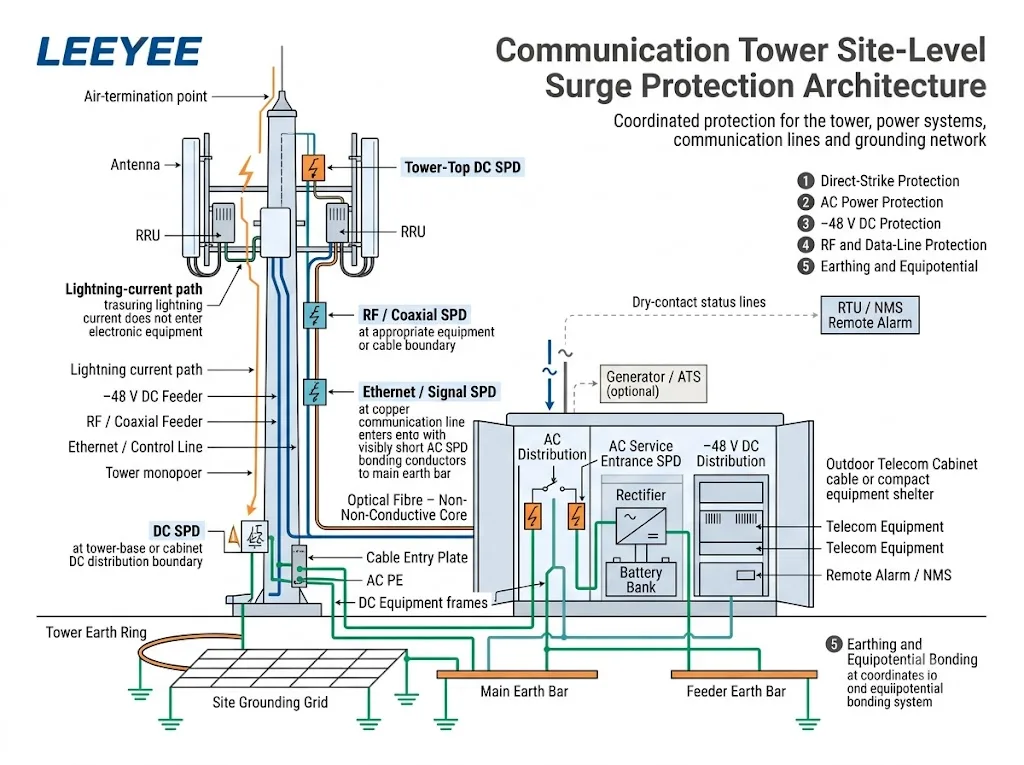
- Valuta la torre e la sua esposizione ai fulmini. Conferma se l'installazione è una torre autonoma, un sito sul tetto, un monopolo, un palo di trasmissione o una stazione wireless remota. La IEC 62305-2 fornisce una procedura di gestione del rischio per selezionare misure di protezione appropriate.[5]
- Definire il sistema di protezione contro le scariche atmosferiche esterne. Confermare l'arrangiamento del terminale aereo, il percorso della corrente, la terminazione a terra, i requisiti di separazione e la protezione contro le tensioni di contatto e di passo.[6]
- Stabilire il concetto di messa a terra del sito. Identificare la carpenteria in acciaio della torre, il cabinet, il rifugio, la piastra di ingresso cavi, le barre di terra dell'alimentatore, il PE AC, i telai delle apparecchiature DC e i rack delle apparecchiature radio.
- Mappare ogni servizio conduttivo. Includere l'AC di utilità, i generatori, -48 V DC, alimentatori coassiali, Ethernet, PoE, RS485, AISG, linee di allarme, sensori e circuiti di illuminazione della torre.
- Contrassegnare ciascun confine di protezione. Identificare dove i cavi entrano o escono da un'area di potenziale equipotenziale e dove sono collegate apparecchiature sensibili.
- Selezionare e coordinare gli SPD. Utilizzare il relativo standard SPD per AC, DC o telecomunicazioni e verificare i parametri richiesti in ciascuna posizione.[8][9][11][12]
- Pianificare la messa in servizio e la manutenzione. Mantenere gli indicatori, i contatti remoti, i punti di collegamento equipotenziale e i moduli sostituibili accessibili per l'ispezione.
Dove possono entrare le sovratensioni in un sito di torre di comunicazione?
La torre è il punto di esposizione più visibile, ma non è l'unico percorso. Ogni collegamento conduttivo tra apparecchiature esterne, torre, fonte di alimentazione, armadio ed elettronica sensibile richiede una valutazione.
| Percorso di ingresso | Esposizione tipica | Funzione di protezione | L'acquirente deve confermare |
|---|---|---|---|
| Torre o traliccio | Colpo diretto e flusso di corrente di fulmine attraverso la struttura | LPS esterno, percorso della corrente, messa a terra e collegamento equipotenziale | Tipo di torre, altezza, disposizione, valutazione del rischio e progettazione LPS |
| Alimentazione CA | Linea di utilità, sezione aerea, generatore, ATS o distribuzione di sito | SPD CA coordinato con l'alimentazione e l'esposizione ai fulmini | Tensione, fasi, sistema di messa a terra, Uc, Iimp o In, Up e protezione di riserva |
| Alimentatore −48 V CC | Lunga linea di alimentazione in rame tra raddrizzatore, distribuzione CC e radio montata su torre | SPD CC a bassa tensione ai confini di protezione richiesti | Tensione massima del bus, polarità, collegamento equipotenziale, modalità di protezione e posizioni degli SPD |
| Linea RF o coassiale | Alimentatore d'antenna metallico, connettore e schermatura del cavo | SPD RF e collegamento equipotenziale della schermatura al confine progettato | Connettore, impedenza, frequenza, potenza RF, perdita di inserzione e VSWR |
| Ethernet o PoE | Cavo di rete in rame per esterni tra diverse aree di apparecchiature | SPD per linee dati abbinato alle prestazioni Ethernet e PoE | Velocità dati, tipo PoE, potenza, coppie protette e schermatura |
| Linea di controllo o allarme | RS485, AISG, sensore, contatto pulito o circuito luci di navigazione | SPD di segnale selezionato per il circuito operativo reale | Tensione, protocollo, numero di coppie, corrente e disposizione dei terminali |
Una fibra ottica interamente dielettrica non conduce correnti di sovratensione attraverso la fibra di vetro. Armature metalliche, elementi di rinforzo, conduttori di alimentazione ibridi, involucri delle apparecchiature e relativi circuiti in rame richiedono comunque una valutazione.
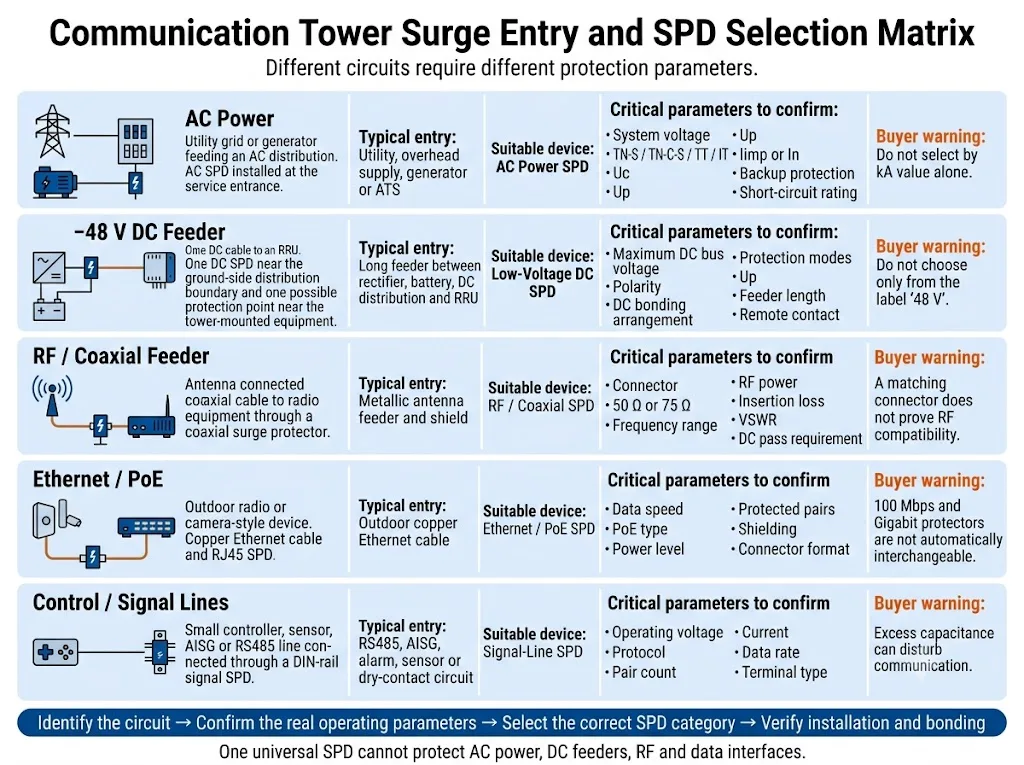
Conclusione dell'acquisto: identificare il circuito prima di confrontare le correnti di scarica nominali. Un valore kA elevato o un connettore corrispondente non dimostrano la compatibilità con la tensione operativa, la modalità di protezione, la frequenza o le prestazioni dei dati.
Come dovrebbe essere protetto l'ingresso AC?
La configurazione della protezione CA dipende dall'esposizione della torre, dall'alimentazione in ingresso, dal sistema di protezione esterno contro i fulmini e dalla distribuzione a monte.
Una torre indipendente con un servizio in ingresso esposto può richiedere una soluzione diversa rispetto alle apparecchiature sul tetto alimentate attraverso un sistema di distribuzione dell'edificio protetto.
La norma IEC 61643-11:2025 specifica i requisiti e i metodi di prova per gli SPD collegati ai sistemi di alimentazione CA a bassa tensione.[9] La norma IEC 61643-12:2020 riguarda la selezione, il funzionamento, la posizione e il coordinamento degli SPD in CA.[10]
Confermare questi parametri CA
- Tensione di sistema e Uc: utilizzare la tensione operativa continua massima reale, non solo l'etichetta di rete nominale.
- Sistema di messa a terra: Le configurazioni TN-S, TN-C-S, TT e IT possono richiedere diverse modalità di protezione.
- Esposizione alle correnti di fulmine: confermare se sia richiesto un dispositivo di Tipo 1, Tipo 1+2 o un'altra configurazione coordinata.
- Livello di protezione della tensione: coordinare Up con il livello di tenuta dell'apparecchiatura e con la protezione a valle.
- Parametri di scarica: confermare Iimp, In o Imax in base alla classificazione dell'SPD e ai requisiti del progetto.
- Condizioni di cortocircuito: verificare la corrente di cortocircuito presunta, la capacità di cortocircuito dell'SPD e la protezione di riserva.
- Percorsi di alimentazione alternativi: includere generatori, circuiti ATS ed eventuali altre fonti collegate.
- Percorso di connessione: Mantenere il collegamento dell'SPD completo breve e diretto, poiché l'induttanza del conduttore aumenta la tensione durante una sovratensione rapida.
Come dovrebbe essere protetto il feeder a −48 V DC?
I siti radio utilizzano comunemente raddrizzatori e batterie per alimentare le apparecchiature radio montate sulla torre tramite lunghi cavi di alimentazione CC in rame. Un transitorio può entrare dal lato della torre o apparire a causa di una differenza di potenziale tra le apparecchiature sulla torre e quelle a livello del suolo.
La norma IEC 61643-41:2025 si applica agli SPD collegati a circuiti di alimentazione CC e ad apparecchiature con tensione nominale fino a 1.500 V CC.[11] Il dispositivo selezionato deve comunque essere progettato e dimensionato per l'effettivo circuito di telecomunicazione a bassa tensione.
Non basarsi esclusivamente sull'etichetta "48 V"
Il bus CC può superare il suo valore nominale durante il funzionamento del raddrizzatore, la carica della batteria o la regolazione del sistema. Confermare la tensione operativa continua massima prima di definire il valore nominale di tensione dell'SPD.
| Domanda sulla CC | Perché è importante | Informazioni da fornire |
|---|---|---|
| Tensione massima del bus | Una tensione continua non idonea può causare un invecchiamento prematuro o un livello di protezione inadeguato. | Gamma del raddrizzatore, tensione di mantenimento della batteria, tensione di carica e limiti operativi anomali. |
| Configurazione del collegamento equipotenziale CC | Le modalità di protezione dipendono dalla relazione tra CC+, ritorno, CC- e PE. | Schema unifilare e configurazione di collegamento o messa a terra del progetto. |
| Esposizione del cavo di alimentazione | Un lungo cavo di alimentazione che attraversa diverse aree dell'impianto può richiedere una protezione coordinata in più di un punto di confine. | Lunghezza del cavo, percorso, altezza della torre, posizioni delle radio e posizioni proposte per gli SPD. |
| Monitoraggio dello stato | Un guasto in un sito non presidiato può passare inosservato senza un segnale remoto. | Contatto NO, NC o di scambio richiesto e logica di allarme RTU o NMS. |
Come dovrebbero essere protette le linee RF, Ethernet e di controllo?
Ogni protettore deve preservare le normali prestazioni del proprio circuito limitando al contempo la tensione transitoria. Un dispositivo può adattarsi meccanicamente ed essere comunque elettricamente non idoneo.
Cavi RF e coassiali
Confermare il tipo di connettore, l'impedenza caratteristica, la frequenza operativa, la potenza RF, la perdita di inserzione, la perdita di ritorno o VSWR, il requisito di passaggio CC e il grado di protezione ambientale.
La schermatura del cavo e il protettore RF devono essere collegati nel punto richiesto dal progetto del sito. La protezione o il collegamento equipotenziale su entrambe le estremità possono essere appropriati in alcune architetture, ma non è una regola universale.
Ethernet e PoE
La norma IEC 61643-21:2025 copre gli SPD per le reti di telecomunicazione e segnalazione, incluse le reti che forniscono alimentazione sulla stessa linea, come il PoE.[12]
Confermare la velocità Ethernet, il tipo PoE, la potenza massima, le coppie protette, la schermatura e le prestazioni di inserzione accettabili. Un dispositivo progettato per 100 Mbps o PoE a bassa potenza non dovrebbe essere considerato idoneo per Gigabit Ethernet o PoE ad alta potenza.
Circuiti RS485, AISG, allarme e sensori
Abbinare l'SPD alla tensione operativa, al livello di segnale massimo, al numero di conduttori, alla corrente, alla velocità di trasmissione dati, al conduttore di riferimento e alla disposizione dei terminali.
Una capacità eccessiva o un livello di protezione non idoneo possono disturbare la comunicazione anche quando l'SPD stesso rimane operativo.
Perché la messa a terra e il collegamento equipotenziale determinano il risultato?
Un SPD devia la corrente di sovratensione nella rete di collegamento equipotenziale e di messa a terra. Se tale percorso è lungo, indiretto, corroso o mal coordinato, la tensione presso l'apparecchiatura protetta può essere significativamente superiore al valore Up riportato sulla scheda tecnica dell'SPD.
Il collegamento equipotenziale del sito non è semplicemente un insieme di picchetti di terra. Il suo scopo è ridurre le pericolose differenze di potenziale tra la torre, l'armadio, il shelter, le schermature dei cavi, il PE CA, le apparecchiature CC e altri sistemi conduttivi durante un evento di fulmine.[2][7]
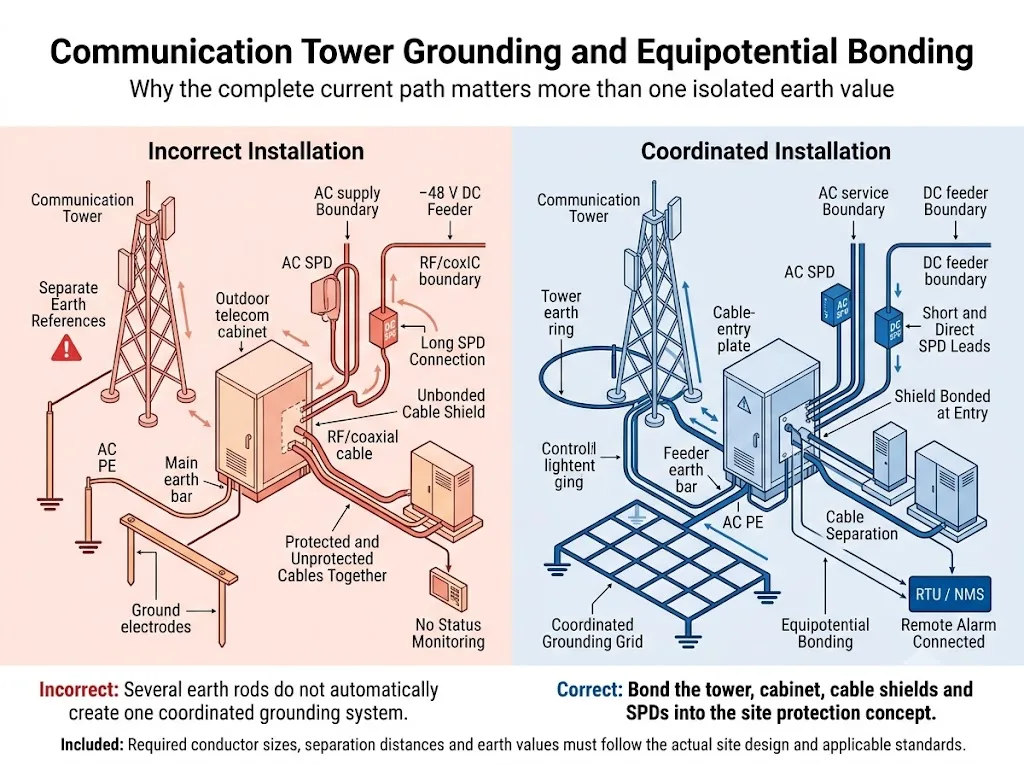
Un valore di resistenza di terra non è la risposta completa
La resistenza di terra è importante, ma il risultato dipende anche dai percorsi dei conduttori, dall'induttanza, dalla geometria della rete, dalle condizioni del suolo, dalla ripartizione della corrente, dalla qualità della connessione, dalla corrosione e dalla posizione del collegamento.
Non promettere che ogni torre sia protetta quando la resistenza misurata è inferiore a un valore fisso. I criteri di accettazione devono seguire le specifiche del sito, le normative locali, il metodo di misurazione e una progettazione qualificata della protezione contro i fulmini.
Punti di equipotenzialità che richiedono solitamente una revisione
- Struttura in acciaio della torre, base del monopolo o del traliccio.
- Conduttori di discesa esterni, se installati separatamente.
- Barra di terra alla base della torre e barra di equipotenzialità principale del locale apparati.
- Telaio dell'armadio esterno, porta, piastra di ingresso cavi e barra PE interna.
- Schermature dei cavi coassiali e barre di terra dei feeder.
- PE AC, messa a terra del generatore e collegamento equipotenziale correlato all'ATS.
- Raddrizzatore, scaffale batterie, distribuzione in corrente continua e rack per telecomunicazioni.
- Canaline portacavi metalliche, recinzioni ed equipaggiamento ausiliario della torre, ove richiesto dal progetto.
Perché il confine torre-armadio è critico?
Il punto in cui i cavi lasciano la torre ed entrano in un armadio esterno o in un rifugio combina conduttori esposti, schermature dei cavi, connessioni equipotenziali e porte elettroniche sensibili.
- Posizionare l'SPD corretto vicino al relativo punto di ingresso dei cavi o al confine dell'apparecchiatura.
- Collegare le schermature dei cavi alla barra di terra dei feeder o al punto di ingresso definito dal progetto del sito.
- Utilizzare conduttori di equipotenzialità SPD brevi e diretti.
- Separare le sezioni di cavo protette da quelle non protette per ridurre il riaccoppiamento delle sovratensioni.
- Evitare loop non necessari, cambiamenti bruschi di percorso e lunghezze eccessive dei conduttori.
- Integrare la torre, l'armadio e il rifugio nel sistema di equipotenzialità coordinato del sito.
- Mantenere gli indicatori, i moduli sostituibili e i terminali remoti accessibili dopo l'installazione.
Come dovrebbero essere pianificati gli allarmi remoti e la manutenzione?
Molte torri di comunicazione sono remote o non presidiate. Un modulo guasto, un conduttore di equipotenzialità scollegato o una connessione corrosa possono passare inosservati fino a un altro evento di sovratensione.
L'ITU-T K.119 tratta l'ispezione visiva, la misurazione, l'analisi e altri metodi utilizzati per valutare l'affidabilità dei sistemi di protezione contro i fulmini e di messa a terra delle stazioni radio base.[3] La norma IEC 62305-4 copre anche l'ispezione, la manutenzione e il collaudo delle misure di protezione contro le sovratensioni.[7]
Il monitoraggio remoto può segnalare
- Lo stato normale o di guasto del modulo SPD.
- La rimozione del modulo dove il meccanismo dell'SPD lo consente.
- Stato del contatto pulito NO, NC o di scambio.
- Un ingresso di allarme verso una RTU, PLC, controller di armadio o sistema di gestione di rete.
L'indicazione remota supporta la manutenzione, ma non sostituisce l'ispezione fisica. La corrosione, i conduttori allentati, i danni all'involucro e i moduli di ricambio errati potrebbero non essere rilevati da un singolo contatto ausiliario.
Ispezionare il sistema di protezione
- Durante la messa in servizio iniziale e l'accettazione.
- All'intervallo di manutenzione preventiva programmato.
- Dopo un evento di fulminazione registrato o un guasto inspiegabile dell'apparecchiatura.
- Dopo l'aggiunta di antenne, radio, apparecchiature di alimentazione o un altro armadio.
- Dopo lavori di messa a terra, lavori civili o modifiche ai percorsi dei cavi.
- Quando un indicatore SPD o un allarme remoto cambia stato.
Come il tipo di sito cambia la decisione di protezione?
Torre di terra autonoma
Questo sito dispone solitamente di una propria torre, rete di terra, alimentazione di rete o da generatore, armadio per le apparecchiature e diversi conduttori di rame esposti. Può richiedere una protezione contro i fulmini diretti oltre a SPD coordinati per linee AC, DC, RF e segnale.
Installazione radio su tetto
L'apparecchiatura sul tetto condivide il sistema di protezione contro i fulmini dell'edificio, il terminale di terra principale e la distribuzione elettrica. Il progettista deve verificare la distanza di separazione, le zone di protezione e il coordinamento con gli SPD esistenti dell'edificio.
Sito remoto a microonde o di monitoraggio
Questo sito può utilizzare batterie, energia solare, una piccola fonte AC, lunghe linee Ethernet o di controllo e un accesso limitato per la manutenzione. La selezione deve seguire le reali interfacce conduttive e l'architettura di alimentazione.
Conclusione ingegneristica: “Torre di comunicazione” non identifica un pacchetto SPD universale. Il sito fisico e l'architettura dei cavi determinano quali funzioni di protezione sono richieste.
Come dovrebbe un acquirente verificare il pacchetto SPD proposto?
I diagrammi spiegano il concetto di protezione, ma non sono approvazioni di prodotto. Prima di approvare un pacchetto per il sito della torre, verificare ogni modello proposto rispetto al circuito che dovrà proteggere.
Richiedere prove specifiche per il modello
LEEYEE è un fornitore specializzato in protezione dalle sovratensioni e bassa tensione. CNSPD è la piattaforma di LEEYEE dedicata alla protezione dalle sovratensioni per gli acquirenti tecnici globali.
Un certificato per una serie o configurazione non deve essere trattato automaticamente come approvazione per ogni tensione, disposizione dei poli, connettore o variante OEM. Verificare l'ambito esatto del documento prima della presentazione del progetto.
Cosa Deve Essere Confermato Prima di Ordinare?
Preparare le seguenti informazioni prima di richiedere consigli sui modelli, campioni, file tecnici o un preventivo OEM.
Richiesta di revisione della configurazione SPD per la torre di comunicazione
Condividere con LEEYEE lo schema unifilare del sito, il layout della torre e dell'armadio, i dettagli dell'alimentazione AC, la tensione massima del bus DC, le interfacce dei cavi e il disegno di messa a terra.
I modelli proposti e le posizioni di installazione devono essere confermati in base alle istruzioni dell'apparecchiatura reale, alle norme elettriche locali, alle specifiche di progetto e alla progettazione qualificata di protezione dai fulmini.
Domande frequenti sulla protezione da sovratensioni delle torri di comunicazione
Un solo SPD AC può proteggere l'intero sito della torre di comunicazione?
Ogni torre di comunicazione richiede un SPD di Tipo 1?
Dove dovrebbe essere installato l'SPD −48 V DC?
Si può utilizzare un SPD DC per fotovoltaico per un sistema di telecomunicazione a 48 V?
La fibra ottica elimina la necessità di protezione dalle sovratensioni?
Un protettore di sovratensioni RF deve essere installato a entrambe le estremità del cavo?
Un basso valore di resistenza di terra è sufficiente?
L'allarme remoto è utile in un sito con torre?
Quali documenti dovrebbe richiedere un acquirente OEM?
Riferimenti
- Unione Internazionale delle Telecomunicazioni, ITU-T K.56 (05/2021), Protezione delle stazioni radio base contro le scariche atmosferiche. Pubblicazione ufficiale ITU.
- Unione Internazionale delle Telecomunicazioni, ITU-T K.112 (05/2021), Protezione contro i fulmini, messa a terra ed equipotenzialità: procedure pratiche per stazioni radio base. Pubblicazione ufficiale ITU.
- Unione Internazionale delle Telecomunicazioni, ITU-T K.119 (12/2016), Valutazione di conformità delle stazioni radio base in merito alla protezione dai fulmini e alla messa a terra. Pubblicazione ufficiale ITU.
- Commissione Elettrotecnica Internazionale, IEC 62305-1:2024, Protezione contro i fulmini - Parte 1: Principi generali. Pubblicazione ufficiale IEC.
- Commissione Elettrotecnica Internazionale, IEC 62305-2:2024, Protezione contro i fulmini - Parte 2: Gestione del rischio. Pubblicazione ufficiale IEC.
- Commissione Elettrotecnica Internazionale, IEC 62305-3:2024, Protezione contro i fulmini - Parte 3: Danni fisici alle strutture e pericolo per la vita. Pubblicazione ufficiale IEC.
- Commissione Elettrotecnica Internazionale, IEC 62305-4:2024, Protezione contro i fulmini - Parte 4: Sistemi elettrici ed elettronici all'interno delle strutture. Pubblicazione ufficiale IEC.
- Commissione Elettrotecnica Internazionale, IEC 61643-01:2024, Dispositivi di protezione da sovratensioni a bassa tensione - Parte 01: Requisiti generali e metodi di prova. Pubblicazione ufficiale IEC.
- Commissione Elettrotecnica Internazionale, IEC 61643-11:2025, Dispositivi di protezione da sovratensioni a bassa tensione - Parte 11: Dispositivi di protezione da sovratensioni collegati a sistemi di alimentazione in bassa tensione AC - Requisiti e metodi di prova. Pubblicazione ufficiale IEC.
- Commissione Elettrotecnica Internazionale, IEC 61643-12:2020, Dispositivi di protezione da sovratensioni a bassa tensione - Parte 12: Dispositivi di protezione da sovratensioni collegati a sistemi di alimentazione in bassa tensione - Principi di selezione e applicazione. Pubblicazione ufficiale IEC.
- Commissione Elettrotecnica Internazionale, IEC 61643-41:2025, Dispositivi di protezione da sovratensioni a bassa tensione - Parte 41: Dispositivi di protezione da sovratensioni collegati a sistemi di alimentazione in bassa tensione DC - Requisiti e metodi di prova. Pubblicazione ufficiale IEC.
- Commissione Elettrotecnica Internazionale, IEC 61643-21:2025, Dispositivi di protezione da sovratensioni a bassa tensione - Parte 21: Dispositivi di protezione da sovratensioni collegati a reti di telecomunicazione e segnalazione - Requisiti e metodi di prova. Pubblicazione ufficiale IEC.
- Commissione Elettrotecnica Internazionale, IEC 61643-31:2018, Dispositivi di protezione da sovratensioni a bassa tensione - Parte 31: Requisiti e metodi di prova per SPD per impianti fotovoltaici. Pubblicazione ufficiale IEC.