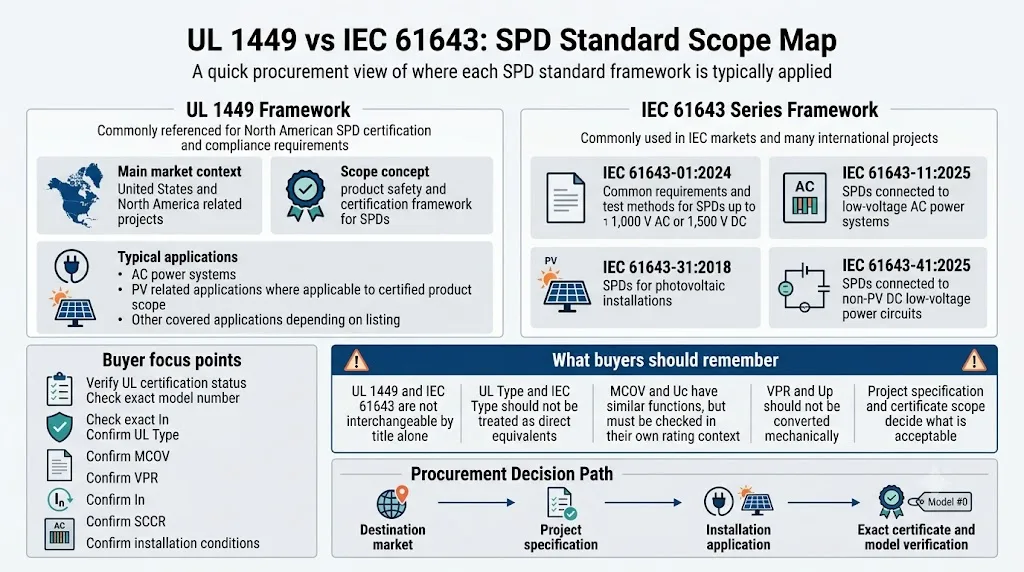
UL 1449 and the IEC 61643 series both address surge protective devices, but they use different classification, testing, rating and certification frameworks.
This guide helps importers, distributors, panel builders, engineering buyers and OEM customers determine which standard and product documents should be required for a specific market or project.
UL 1449 and IEC 61643 are not interchangeable SPD standards.
UL 1449 is primarily used for SPD certification in the United States. The IEC 61643 series is used in many IEC-based markets and international projects.
A UL Type 2 SPD is not automatically equivalent to an IEC Type 2 SPD. Likewise, MCOV should not be treated as a direct replacement for Uc, and VPR should not be converted mechanically to Up.
Buyers should approve an SPD only after checking the destination market, project specification, installation application, exact model and certificate scope.
What is the main difference between UL 1449 and IEC 61643?
The two frameworks address similar surge protection risks, but they do not classify, test or certify products in exactly the same way.
UL 1449 is part of the U.S. product safety and certification system. Buyers normally verify an exact product through its official UL certification record.
The IEC 61643 series provides international product requirements for different SPD applications, including AC power, photovoltaic DC, other DC power and signal networks.
Verify the exact UL-certified model and its published ratings.
Confirm the Canadian certification scope rather than assuming a U.S. listing is sufficient.
Use the application-specific standard part and confirm national requirements.
A standard name on a catalogue page is not complete certification evidence.
| Buyer question | UL 1449 framework | IEC 61643 framework | Procurement rule |
|---|---|---|---|
| Primary market context | Primarily used for U.S. SPD product certification. | Used in many IEC-based countries and international projects. | Check the final installation country and written project requirements. |
| Standard structure | A product certification framework covering complete SPDs, assemblies and components. | A standards series with common and application-specific requirements. | Request the complete standard number and edition. |
| Type classification | Connected to the UL product category, installation position and certification conditions. | Connected to defined test duties, surge waveforms and coordinated applications. | Do not approve an SPD from the Type number alone. |
| Continuous operating voltage | MCOV | Uc or Ucpv | Check the voltage, circuit mode and system configuration. |
| Voltage limitation | VPR | Up | Do not use a fixed VPR-to-Up conversion. |
| Surge current ratings | May include In and other product-specific values. | May include In, Imax and Iimp according to the SPD Type. | Compare each rating within its own standard test programme. |
| Short-circuit performance | SCCR is an important certification value. | Review short-circuit behaviour, disconnection and backup protection. | Confirm compatibility with the available fault current. |
| Evidence to verify | Official record, exact model, Type, modes and certified ratings. | Certificate, annex, report, standard edition and declared ratings. | A datasheet statement alone is not enough. |
This table is a procurement orientation tool. It is not a UL-to-IEC certification conversion table.
IEC 61643 is a standards series, not one universal SPD standard
Buyers should not ask only whether a product complies with “IEC 61643”.
The quotation and product documents should identify the part that applies to the actual circuit.
Common SPD requirements and test methods.
Applies to SPDs connected to circuits or equipment rated up to 1,000 V AC or 1,500 V DC. It is used with relevant application-specific parts.
AC low-voltage power systems.
Applies to SPDs connected to AC power circuits and equipment rated up to 1,000 V RMS.
Photovoltaic DC installations.
Applies to SPDs connected to the DC side of photovoltaic installations rated up to 1,500 V DC.
Non-PV DC power systems.
Applies to SPDs connected to other DC power circuits and equipment rated up to 1,500 V DC. PV applications remain under IEC 61643-31.
Telecommunications and signalling networks.
Applies to SPDs used on signal and communication lines, including lines that also carry power, such as Power over Ethernet.
Buyer warning: an AC SPD certificate should not be used to approve a PV DC, non-PV DC or signal SPD.
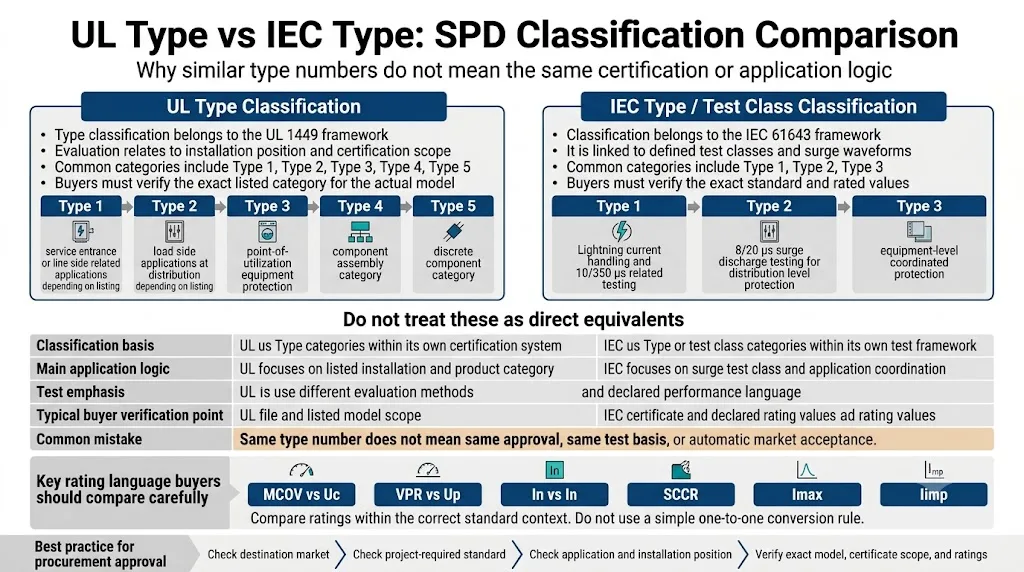
Why UL Type and IEC Type must not be treated as direct equivalents
UL and IEC both use Type numbers. This similarity can be misleading.
The Type number belongs to the classification logic of its own standard framework.
UL Type classification
UL classification considers the product category, intended installation position and the conditions stated in the certification record.
UL also distinguishes complete SPDs from component assemblies and discrete surge components.
IEC Type classification
IEC Type classification is linked to defined test duties, surge waveforms and coordinated installation.
Type 1 is associated with lightning impulse current testing. Type 2 is commonly associated with 8/20 μs surge current testing.
Do not write “UL Type 2 = IEC Type 2”. The two products may have a similar application position, but this does not prove equivalent testing, certification or market acceptance.
MCOV vs Uc, VPR vs Up and other ratings buyers must understand
The abbreviations used in UL and IEC documents may look comparable.
Buyers should compare their electrical purpose and test context, not only the letters or numbers.
Example: an SPD with a high surge current value is not automatically suitable if its continuous operating voltage is incorrect or its certificate does not cover the quoted model.
Which SPD standard should your project require?
Begin with the final project requirement rather than the supplier’s preferred catalogue wording.
Identify the destination market
Confirm where the completed panel, inverter, cabinet or electrical system will be installed.
Read the written project specification
Look for UL, CSA, IEC, EN, CB Scheme, national certification or approved-vendor requirements.
Define the application
Confirm whether the SPD protects an AC power circuit, PV DC system, other DC circuit or signal line.
Confirm the installation position
Identify whether the SPD is installed at service equipment, a main distribution board, a sub-distribution board, an inverter, a combiner box or near protected equipment.
Verify the exact model
Match the quoted catalogue number with the certificate, annex, report, product marking and installation instructions.
Important: the buyer’s office location does not decide the required standard. The final installation market and project approval rules are what matter.
How should buyers verify an SPD certificate?
A supplier statement such as “designed according to UL” or “complies with IEC” is not enough for project approval.
The strongest evidence connects an exact product model to an active certification record, certificate annex or technical report.
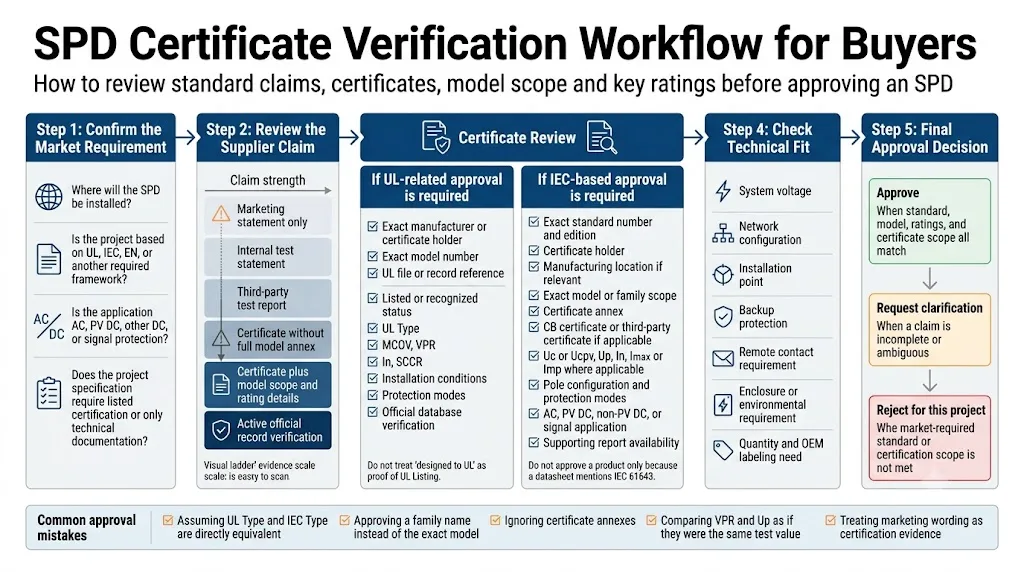
If UL or Canadian certification is required
- Certificate holder or manufacturer
- Exact catalogue number and suffix
- UL or CSA certification category
- Listed product or Recognized Component status
- Applicable standard and edition
- SPD Type
- System voltage and protection modes
- MCOV and VPR
- In and SCCR
- Environmental and enclosure conditions
- Required external protection
- Active official database record
If IEC-based documentation is required
- Full IEC or EN standard number
- Edition, amendment and corrigendum
- Certificate holder
- Exact model or product-family scope
- Certificate annex
- CB Test Certificate where applicable
- CB Test Report or third-party report
- AC, PV DC, other DC or signal scope
- Uc or Ucpv
- Up, In, Imax or Iimp
- Pole configuration and modes
- Backup protection requirements
CB certificates, CE marking and UL Listing are different forms of evidence. An IECEE CB Test Certificate may support national certification processes. CE marking is the manufacturer’s declaration that applicable EU legal requirements have been met. Neither automatically replaces a specified UL or Canadian certification.
How LEEYEE applies these rules to real SPD procurement
LEEYEE is a specialized surge protection and low-voltage protection supplier for solar PV, power distribution, telecom, industrial and OEM applications.
CNSPD is LEEYEE’s surge protection-focused platform for global buyers.
For an IEC-based order, LEEYEE reviews the product application before recommending a model or document set.
For an AC distribution SPD in the LY1-C40 family, buyers should confirm the exact model, Uc, In, Imax, Up, pole arrangement, protection modes and current document scope.
For an IEC Type 1+2 application, LEEYEE reviews Uc, Iimp, In, Up, network configuration, installation position and the required backup protection.
For an LY1-C40PV series application, buyers should confirm Ucpv, maximum array Voc, temperature conditions, In, Imax or Iimp, Up and the IEC 61643-31 document scope.
Product pages and catalogues support initial selection. Final approval should use the current certificate, annex, test report and exact ordered catalogue number.
Review available LEEYEE documentation on the certificates and patents page.
Certification boundary: LEEYEE does not present an IEC-based SPD as automatically equivalent to a UL Listed or Canadian-certified SPD.
If a project specifically requires UL or Canadian certification, the exact product record must be verified before approval.
Built to Protect. Trusted to Last.
Common UL and IEC SPD procurement mistakes
Assuming a UL Type 2 SPD is automatically equivalent to an IEC Type 2 SPD.
Approving a product family name without checking the exact model suffix.
Ignoring the certificate annex that lists included models and rating differences.
Converting VPR directly to Up through a fixed numerical ratio.
Using an AC SPD certificate to approve a photovoltaic DC product.
Treating CE marking as a third-party IEC product certificate.
Selecting an SPD only because it has the largest Imax value.
Assuming a U.S. UL Listing automatically satisfies Canadian certification requirements.
UL 1449 vs IEC 61643 FAQ
Is an IEC Type 2 SPD the same as a UL Type 2 SPD?
No. The two Type 2 classifications belong to different testing and certification frameworks. The exact standard, model, ratings and installation conditions must be verified.
Can an IEC 61643 SPD be described as UL Listed?
Not from IEC testing alone. A UL Listing claim must be supported by an applicable official UL certification record covering the exact product model.
Is MCOV the same as Uc?
They serve a similar product-selection purpose, but they belong to different standard frameworks. Check the voltage, circuit mode, network and certificate conditions.
Can VPR be converted directly to Up?
No fixed conversion should be used. VPR and Up are determined under different standardised evaluation conditions.
Does UL 1449 automatically cover a Canadian project?
No. Canadian projects may require an applicable CSA C22.2 No. 269 certification or a Canadian certification scope shown in the official product record.
Do CE marking or a CB certificate replace UL Listing?
No. They serve different conformity purposes. Neither automatically replaces a project requirement for UL or Canadian product certification.
Which IEC 61643 part applies to my SPD?
IEC 61643-11 applies to AC power SPDs, IEC 61643-31 to PV DC SPDs, IEC 61643-41 to other DC power SPDs and IEC 61643-21 to telecommunications and signalling SPDs.
Continue your SPD specification review
References
Standards and certification requirements can change. Confirm the applicable edition, national adoption and local project requirements when approving an order.
- International Electrotechnical Commission: IEC 61643-01:2024 — General requirements and test methods .
- International Electrotechnical Commission: IEC 61643-11:2025 — SPDs connected to AC low-voltage power systems .
- International Electrotechnical Commission: IEC 61643-31:2018 — SPDs for photovoltaic installations .
- International Electrotechnical Commission: IEC 61643-41:2025 — SPDs connected to DC low-voltage power systems .
- International Electrotechnical Commission: IEC 61643-21:2025 — Telecommunications and signalling network SPDs .
- UL Solutions: Surge Protection Device Testing and Certification Services .
- UL Solutions: Product iQ certification database .
- CSA Group: CSA C22.2 No. 269 series for surge protective devices .
- IECEE: IECEE CB Scheme overview .
- European Commission: Official CE marking guidance .
Need help reviewing an IEC-based SPD requirement?
Send LEEYEE the destination market, application, system voltage, required SPD Type and document requirements. We can help identify the parameters and evidence that still need confirmation before quotation or sample approval.