
Choosing an automatic transfer switch instead of a manual transfer switch is not simply a question of buying the more advanced device. For a generator panel, commercial building, factory, control cabinet or OEM project, the real question is whether transfer can safely and practically depend on a qualified operator being available when the normal source fails.
An automatic transfer switch (ATS) uses source sensing and control logic to initiate transfer automatically when the required conditions are satisfied. A manual transfer switch (MTS) relies on manual operation as its normal transfer method. IEC 60947-6-1:2026 formally distinguishes automatic transfer switching equipment (ATSE) from manually operated transfer switching equipment (MTSE). [1]
Índice
Automatic Transfer Switch vs Manual Transfer Switch: What Is the Real Difference?
The main difference is not whether a switch has a manual handle. The key difference is how source transfer is normally initiated.
An ATS is designed around automatic source monitoring and automatic transfer control. An MTS normally depends on a qualified operator to initiate the transfer. Some ATS products also provide a manual operating mode; that does not by itself make the product an MTS.
| Factor de decisión | Interruptor de Transferencia Automático | Interruptor de Transferencia Manual |
|---|---|---|
| Normal transfer initiation | Automatic sensing and control logic | Qualified operator |
| Source monitoring | Typically handled by the ATS controller | Operator-dependent |
| Manual operating capability | May be provided on some ATS products | Manual operation is the normal transfer method |
| Operator required during outage | Normally not for the automatic sequence | Sí |
| Typical fit | Unattended or continuity-sensitive systems | Attended, interruption-tolerant systems |
Significado para el comprador: “manual mode” and “manual transfer switch” are not the same thing. Check whether automatic source sensing and transfer logic are part of the equipment's intended function.
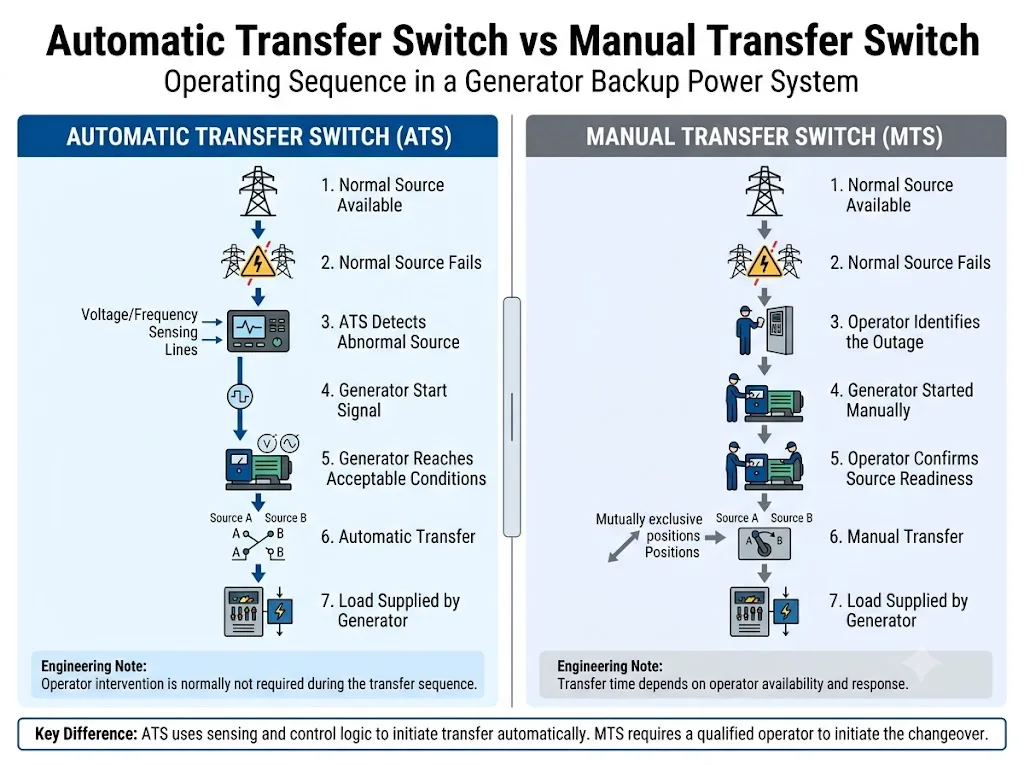
What Actually Changes Between Automatic and Manual Transfer?
Both systems transfer a load between power sources. The important difference is how the transfer decision is normally initiated and executed.
For an ATS, a controller can monitor source conditions such as voltage and frequency and initiate a predefined transfer sequence when the required conditions are satisfied. [2]
For an MTS, the normal operating process depends on manual intervention. IEC 60947-6-1:2026 identifies MTSE and ATSE as distinct transfer-switching-equipment categories. [1]
Normal source fails → source condition is detected → standby source becomes available → controller verifies acceptable source conditions → load transfers → normal source later recovers → retransfer occurs according to configured logic.
Automatic does not automatically mean uninterrupted. Generator starting, source acceptance and intentional delays can still produce an interruption. Open-transition and closed-transition operation are separate technical considerations and must be confirmed from the actual equipment and project requirements. [1] [2]
Does Manual Mode Make an ATS a Manual Transfer Switch?
N.º. A manual operating mode on an ATS should not be confused with a true manual transfer switch.
The LEEYEE ATS-63 is published as an Interruptor de Transferencia Automático. The 2P product shown below includes Auto and Manual operating controls, while the equipment remains an ATS because automatic source monitoring and transfer control are part of its intended function. [6]
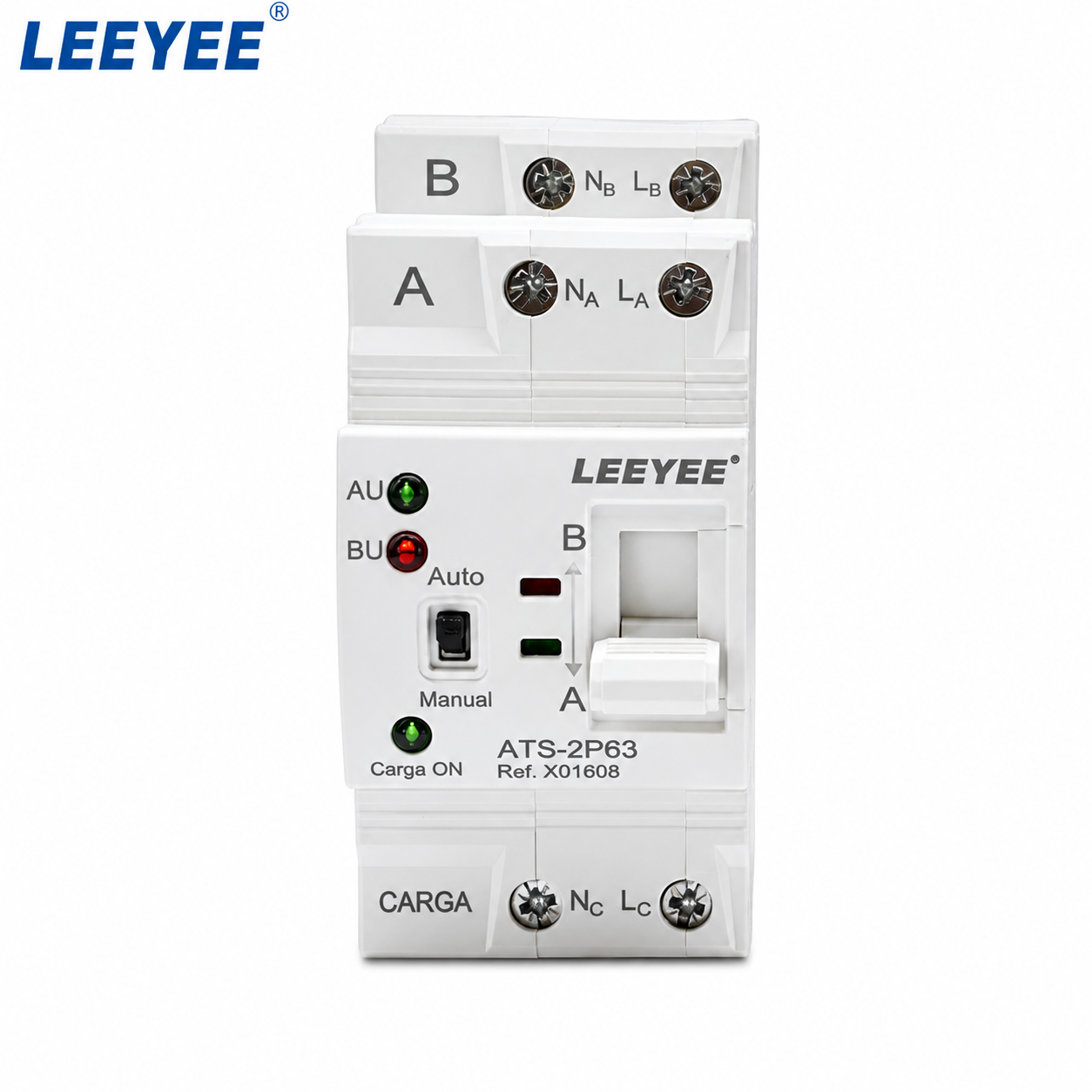
- ATS with manual operating capability: automatic source monitoring and transfer remain part of the equipment's intended operating function.
- MTS: operator action is the normal method used to initiate or perform source transfer.
The ATS-63 shown here is a compact ATS example. It should not be interpreted as suitable for every factory, high-current system or critical facility. Final suitability must be checked against the exact voltage, current, pole configuration, fault conditions, transfer requirements and installation environment. [6]
The Six Questions That Should Decide ATS or MTS
1. Can the Site Depend on a Person Being Available?
If the facility can be empty, remote or difficult to access during an outage, manual transfer introduces dependence on someone detecting the event, reaching the equipment and carrying out the operating procedure.
2. What Happens While the Load Waits?
Loss of a non-essential auxiliary load may be acceptable. Loss of process controls, refrigeration, pumping, communications or production equipment can have a much larger operational consequence.
3. Can the Alternate Source Become Available Automatically?
An ATS cannot create automation that the alternate source does not support. A generator or second source must have the appropriate interface and operating capability for the intended automatic sequence.
4. How Important Is Predictable Restoration?
An ATS follows configured sensing and timing logic. Manual restoration depends more heavily on operator availability and response. Total restoration can include sensing delay, generator starting, source acceptance and transfer time. [2]
5. How Much Automation Does the Project Actually Need?
Automatic systems can add sensing, timing, generator interfaces, alarms, status contacts and communication functions. These features reduce dependence on personnel but also increase specification and commissioning requirements.
6. What Is the Consequence of Delayed Restoration?
For B2B procurement, compare more than switch price. Equipment cost should be considered together with staffing, commissioning, maintenance and the operational consequence of downtime.
Is an Automatic Transfer Switch Always Better?
N.º. ATS is not automatically the correct choice for every backup-power project.
A manual transfer arrangement may be reasonable when the supported load is non-critical, trained personnel are reliably available and the load can tolerate the restoration delay.
ATS becomes more valuable when the site is unattended, the alternate source supports automatic operation or delayed recovery has meaningful operational consequences.
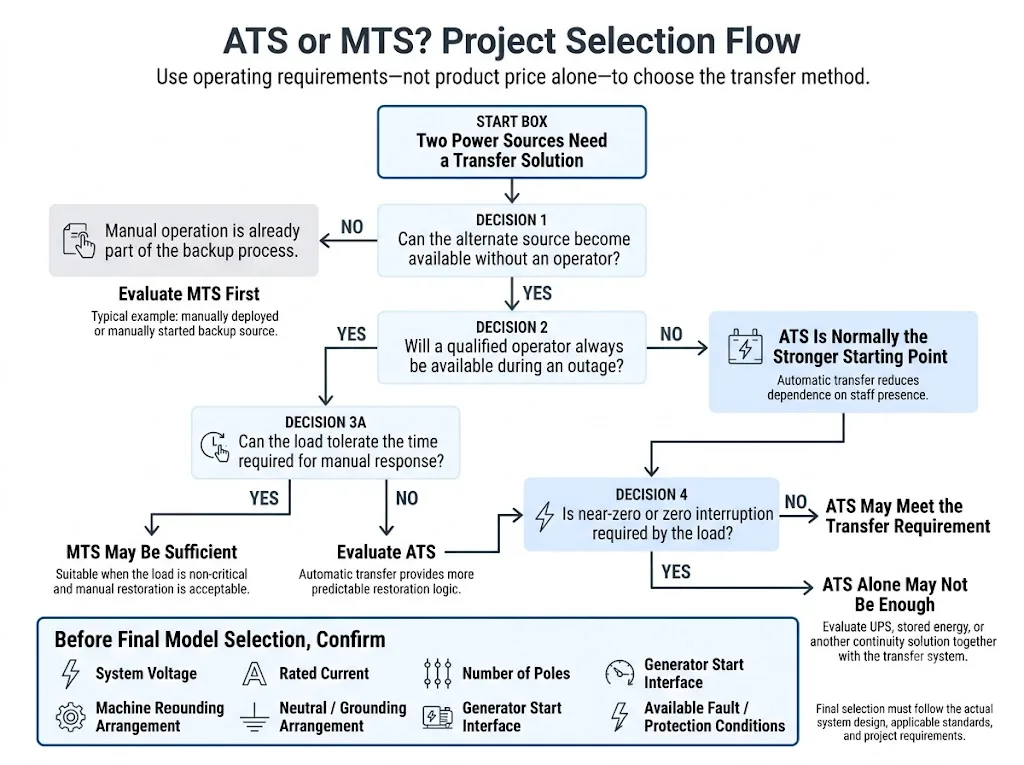
How to Use the Decision Flow in a Real Project
Start with the alternate source. If the backup source itself requires manual preparation, an MTS may fit the actual operating process better.
If the alternate source can become available automatically, ask whether a qualified operator can reliably be present for every outage. If not, ATS normally becomes the more practical starting point.
If the load cannot tolerate the complete source-start and transfer period, ATS alone may still be insufficient. A UPS, stored-energy system or another continuity solution may also be required.
This flow is an engineering-screening tool. Final selection must follow the applicable electrical code, system drawings, protection requirements, manufacturer documentation and project specification.
Need Help Confirming the Transfer Architecture?
Send the source arrangement, voltage, current, pole configuration, generator information and acceptable interruption requirement for technical review.
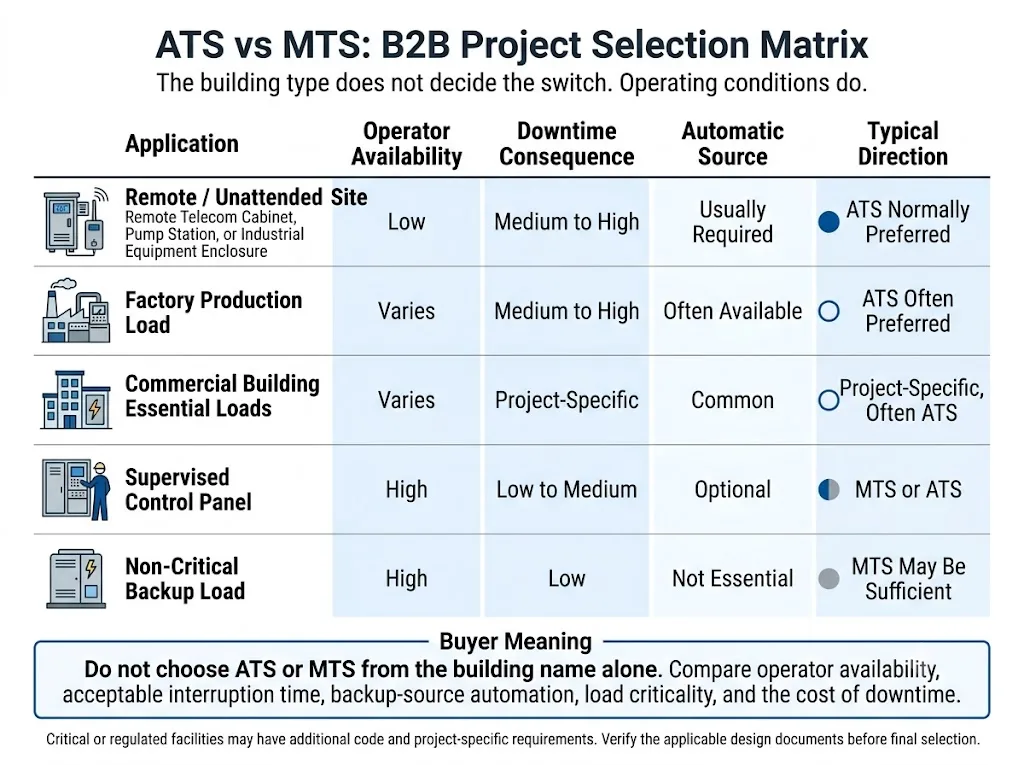
Typical Direction for Commercial and Industrial Applications
| Situación del Proyecto | Dirección de inicio típica | Main Reason to Check |
|---|---|---|
| Remote or unattended site | ATS normally preferred | Transfer should not depend on staff presence |
| Factory production load | Often ATS | Production consequence and restart requirements |
| Commercial building essential loads | Project-specific, often ATS | Load classification and applicable requirements |
| Supervised control panel | MTS or ATS | Operator availability and process consequence |
| Non-critical backup load | MTS may be sufficient | Whether manual restoration delay is acceptable |
| Near-zero interruption load | ATS alone may not be sufficient | Possible UPS or continuity requirement |
What Does IEC 60947-6-1:2026 Add to the Comparison?
IEC 60947-6-1:2026 is the current fourth edition covering transfer switching equipment within its stated scope. It applies to transfer switching equipment used to transfer a load between power-supply sources at rated voltages not exceeding 1,000 V AC or 1,500 V DC. [1]
- MTSE — manually operated transfer switching equipment;
- RTSE — remotely operated transfer switching equipment;
- ATSE — automatic transfer switching equipment;
- stand-alone ATS controllers;
- bypass/isolation transfer switching equipment; and
- ATSE with closed-transition capability.
Significado para el comprador: manual and automatic are recognised transfer-equipment distinctions. Model-specific compliance documentation must still be verified before project approval.
ATS or MTS Is Only the First Selection Decision
After deciding whether automatic or manual transfer fits the operating plan, the equipment still has to match the electrical system.
If automatic transfer has already been confirmed, continue with LEEYEE's automatic transfer switch selection guide.
- normal and alternate source arrangement;
- rated voltage and frequency;
- single-phase or three-phase;
- continuous load current;
- number of poles;
- neutral and grounding arrangement;
- generator start/control interface;
- available fault-current and protection conditions;
- load characteristics;
- installation environment; and
- standard and certificate requirements.
A correctly automated ATS with unsuitable voltage, current, pole configuration or fault characteristics is still the wrong project solution. Automation does not replace electrical coordination.
Do You Need a 3-Pole or 4-Pole Transfer Switch?
This cannot be decided from “ATS vs MTS” alone.
Neutral switching depends on source grounding and bonding, transfer-switch configuration, protection design and applicable project requirements. [5]
Se requiere confirmación del proyecto: do not copy a 3P or 4P arrangement from another installation without checking the actual generator neutral, grounding, protection and transfer-switch documentation.
What Should You Send Before Requesting an ATS or MTS Recommendation?
Confirm the Transfer Architecture Before Choosing the Model
Send LEEYEE the source arrangement, voltage, current, phase, pole requirement, generator information, grounding arrangement and expected transfer behaviour.
Preguntas frecuentes
Does Manual Mode on an ATS Make It an MTS?
No. Some ATS products include manual operating controls. The important distinction is whether automatic source monitoring and transfer control are part of the intended function.
Is an Automatic Transfer Switch Better Than a Manual Transfer Switch?
Not in every project. ATS reduces dependence on human response, while MTS can be appropriate where qualified personnel are available and manual restoration is acceptable.
Do I Need an ATS for a Standby Generator?
Not every generator installation requires automatic transfer. If unattended automatic backup is required, evaluate an ATS together with the generator's documented control interface.
Does an ATS Provide Uninterrupted Power?
No general assumption should be made. Generator starting, source acceptance and transfer can create an interruption. Loads requiring continuous supply may need additional continuity equipment.
Can a Manual Transfer Switch Be Used in an Industrial Project?
Yes, when manual operation matches the operating plan and applicable project requirements.
Referencias
- International Electrotechnical Commission (IEC), IEC 60947-6-1:2026 — Low-voltage switchgear and controlgear — Part 6-1: Multiple function equipment — Transfer switching equipment. Official IEC source.
- Eaton, Fundamentals of Automatic Transfer Switches (ATS). Eaton technical source.
- Schneider Electric / ASCO Power Technologies, ASCO SERIES 300 Manual Transfer Switch. Schneider Electric source.
- Schneider Electric / ASCO Power Technologies, How to Conduct Generator Test With Load Transfer for a 165 Series ATS? Schneider Electric ATS source.
- Schneider Electric / ASCO Power Technologies, Configuraciones neutras en interruptores de transferencia. ASCO technical bulletin.
- LEEYEE, ATS-63 Automatic Transfer Switch Technical Data and Product Information. LEEYEE product source.
Confirm the applicable standard edition, exact product model, certificate scope and project-specific electrical requirements before final approval or procurement.