
Perlindungan lonjakan menara komunikasi harus mencakup seluruh situs radio, bukan hanya satu SPD di dalam lemari luar. Prinsip tingkat situs yang sama berlaku untuk perlindungan lonjakan situs seluler, perlindungan petir menara telekomunikasi, dan banyak instalasi stasiun pangkal radio.
Struktur menara, pasokan AC, pengumpan DC −48 V, antarmuka antena, jalur data tembaga, lemari peralatan, dan jaringan pentanahan situs harus bekerja sebagai satu sistem perlindungan yang terkoordinasi.
Daftar Isi
Jawaban cepat
Situs menara komunikasi biasanya memerlukan empat fungsi terkoordinasi: sistem perlindungan petir eksternal, sistem pentanahan situs, pengikatan equipotensial, dan SPD yang dipilih dengan benar pada jalur daya dan sinyal konduktif.[1][2]
Daya AC, DC −48 V, pengumpan RF atau koaksial, Ethernet, PoE dan jalur kontrol memerlukan perangkat perlindungan yang berbeda. Setiap SPD harus sesuai dengan sirkuit nyata, batas instalasi, dan eksposur lonjakan yang diharapkan.
Makna pembeli: kirimkan kepada pemasok arsitektur situs, tegangan operasi, pengaturan pentanahan, antarmuka kabel, dan posisi SPD yang diusulkan. Permintaan hanya untuk “satu SPD untuk menara komunikasi” tidak cukup untuk pemilihan yang dapat diandalkan.
Bagaimana Perlindungan Petir dan Lonjakan Menara Komunikasi Bekerja Bersama?
Sebuah sambaran langsung dapat mengirimkan arus melalui struktur menara, jaringan bumi, pelindung kabel, dan layanan yang terhubung. Peralatan elektronik dapat terakibat kerusakan meskipun petir tidak menyambar port peralatan secara langsung.
ITU-T K.112 menyediakan prosedur praktis untuk perlindungan petir, penanaman tanah, dan pengikatan di stasiun pangkal radio mandiri dan atap.[2] ITU-T K.119 menilai empat bagian yang terhubung dari sistem perlindungan.[3]
Terminasi udara dan jalur arus
Sistem eksternal mencegat sambaran petir langsung dan menyediakan jalur yang dirancang menuju tanah.
Sistem penanaman tanah lokasi
Menara, tempat perlindungan, dan struktur terkait terhubung ke jaringan terminasi tanah yang terkoordinasi.
Pengikatan equipotential
Struktur logam, pelindung kabel, bingkai peralatan, dan konduktor pelindung terkoordinasi untuk membatasi perbedaan potensial.
Perangkat pelindung lonjakan
SPD membatasi lonjakan yang dihantarkan pada AC, DC, RF, data, dan sirkuit kontrol di batas yang relevan.
Apa Saja yang Termasuk dalam Arsitektur Perlindungan Situs Menara yang Lengkap?
Mulailah dengan situs fisik daripada katalog produk. Lacak jalur arus petir yang diharapkan, identifikasi setiap kabel konduktif yang melintasi batas perlindungan, dan tetapkan fungsi perlindungan yang tepat untuk lokasi tersebut.
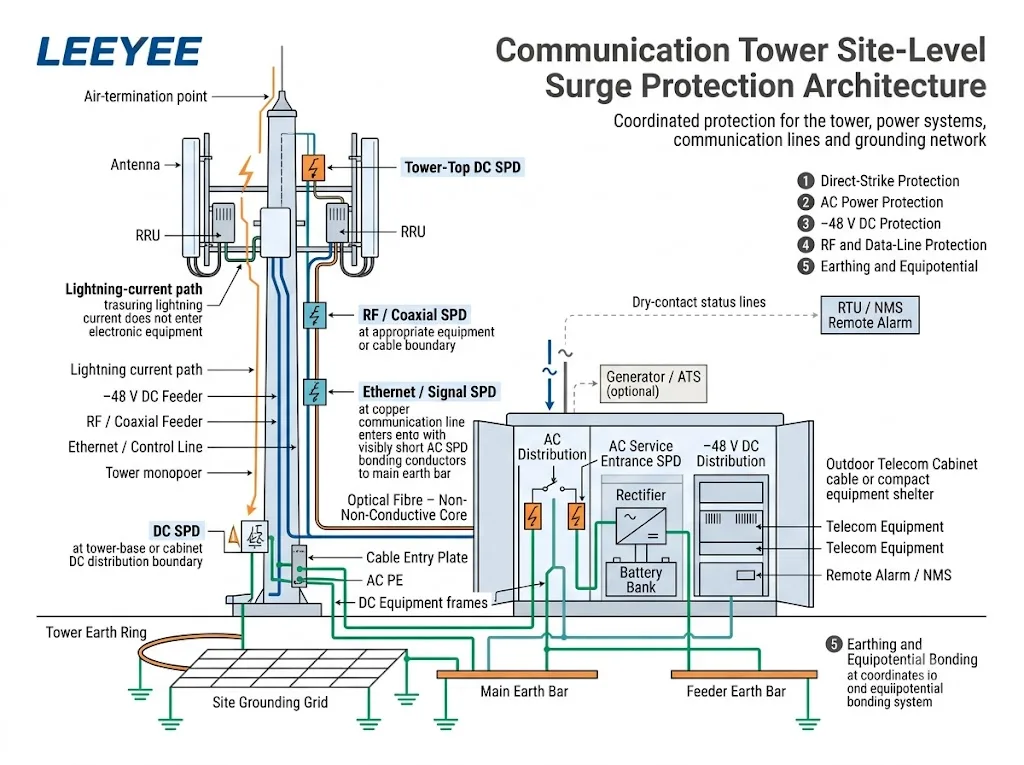
- Taksir menara dan eksposurnya terhadap petir. Konfirmasi apakah instalasi merupakan menara mandiri, lokasi atap, monopole, tiang penyiaran, atau stasiun nirkabel jarak jauh. IEC 62305-2 menyediakan prosedur manajemen risiko untuk memilih langkah-langkah perlindungan yang sesuai.[5]
- Tentukan sistem perlindungan petir eksternal. Konfirmasi pengaturan penghentian udara, jalur arus, penghentian tanah, persyaratan pemisahan, dan perlindungan terhadap tegangan sentuh dan langkah.[6]
- Tetapkan konsep pengikatan lokasi. Identifikasi struktur baja menara, lemari, tempat perlindungan, pelat masuk kabel, batang tanah feeder, PE AC, bingkai peralatan DC, dan rak peralatan radio.
- Pemetakan setiap layanan konduktif. Sertakan AC utilitas, generator, −48 V DC, feeder koaksial, Ethernet, PoE, RS485, AISG, saluran alarm, sensor, dan sirkuit pencahayaan menara.
- Tandai setiap batas perlindungan. Identifikasi di mana kabel masuk atau keluar dari area equipotential dan di mana peralatan sensitif terhubung.
- Pilih dan koordinasikan SPD. Gunakan standar SPD AC, DC, atau telekomunikasi yang berlaku dan verifikasi parameter yang diperlukan di setiap posisi.[8][9][11][12]
- Plan commissioning and maintenance. Keep indicators, remote contacts, bonding points and replaceable modules accessible for inspection.
Di Mana Lonjakan Dapat Masuk ke Situs Menara Komunikasi?
The tower is the most visible exposure point, but it is not the only path. Every conductive connection between outdoor equipment, the tower, the power source, the cabinet and sensitive electronics requires review.
| Entry path | Typical exposure | Protection function | Buyer must confirm |
|---|---|---|---|
| Tower or mast | Direct strike and lightning-current flow through the structure | External LPS, current path, earth termination and bonding | Tower type, height, layout, risk assessment and LPS design |
| AC supply | Utility line, overhead section, generator, ATS or site distribution | AC SPD coordinated with the supply and lightning exposure | Voltage, phases, earthing system, Uc, Iimp or In, Up and backup protection |
| −48 V DC feeder | Long copper feeder between rectifier, DC distribution and tower-mounted radio | Low-voltage DC SPD at the required protection boundaries | Maximum bus voltage, polarity, bonding, protection modes and SPD positions |
| RF or coaxial line | Metallic antenna feeder, connector and cable shield | RF SPD and shield bonding at the designed boundary | Connector, impedance, frequency, RF power, insertion loss and VSWR |
| Ethernet or PoE | Outdoor copper network cable between different equipment areas | Data-line SPD matched to Ethernet and PoE performance | Data rate, PoE type, power, protected pairs and shielding |
| Control or alarm line | RS485, AISG, sensor, dry-contact or navigation-light circuit | Signal SPD selected for the real operating circuit | Voltage, protocol, pair count, current and terminal arrangement |
An all-dielectric optical fibre does not conduct surge current through the glass fibre. Metallic armour, strength members, hybrid power conductors, equipment housings and associated copper circuits still require assessment.
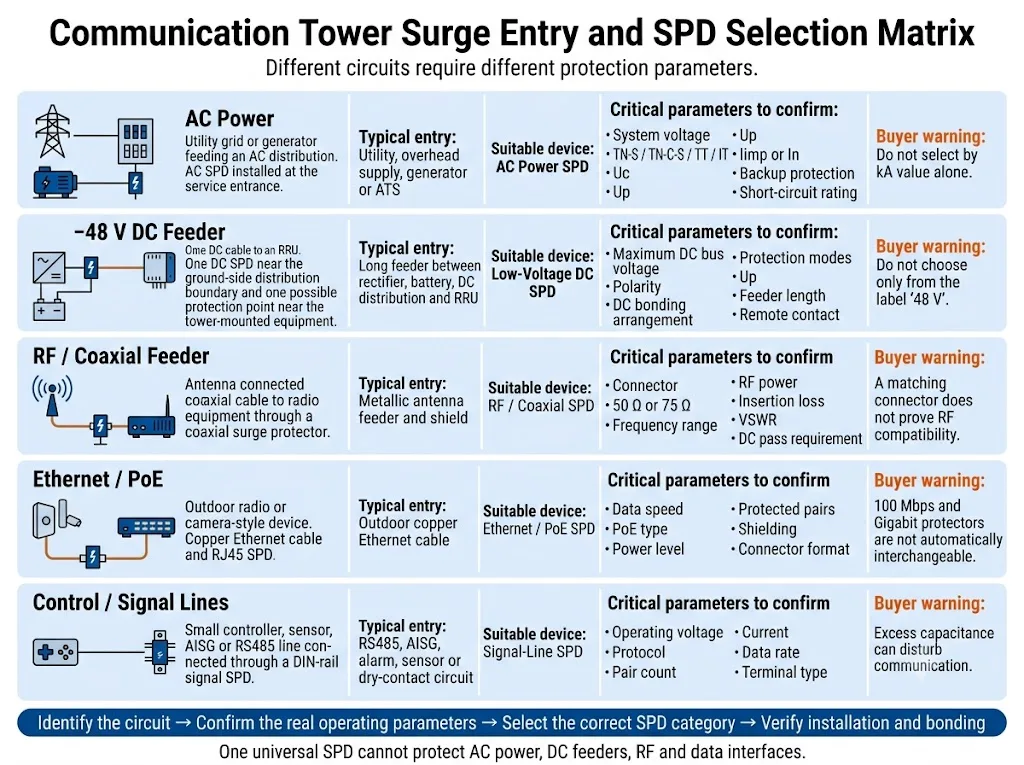
Kesimpulan pengadaan: identify the circuit before comparing discharge-current ratings. A high kA value or matching connector does not prove compatibility with the operating voltage, protection mode, frequency or data performance.
Bagaimana Input AC Harus Dilindungi?
The AC protection arrangement depends on the tower exposure, incoming supply, external lightning protection system and upstream distribution.
A stand-alone tower with an exposed incoming service can require a different solution from rooftop equipment supplied through a protected building distribution system.
IEC 61643-11:2025 specifies requirements and test methods for SPDs connected to AC low-voltage power systems.[9] IEC 61643-12:2020 addresses AC SPD selection, operation, location and coordination.[10]
Confirm these AC parameters
- System voltage and Uc: use the real maximum continuous operating voltage, not only the nominal network label.
- Earthing system: TN-S, TN-C-S, TT and IT arrangements can require different protection modes.
- Lightning-current exposure: confirm whether Type 1, Type 1+2 or another coordinated arrangement is required.
- Voltage protection level: coordinate Up with the equipment withstand level and downstream protection.
- Discharge parameters: confirm Iimp, In or Imax according to the SPD classification and project requirement.
- Short-circuit conditions: verify prospective short-circuit current, SPD short-circuit capability and backup protection.
- Alternative power paths: include generators, ATS circuits and any other connected source.
- Connection path: keep the complete SPD connection short and direct because conductor inductance adds voltage during a fast surge.
Bagaimana Pengumpan DC −48 V Harus Dilindungi?
Radio sites commonly use rectifiers and batteries to supply tower-mounted radio equipment through long copper DC feeders. A transient can enter from the tower side or appear through a potential difference between tower equipment and ground-level equipment.
IEC 61643-41:2025 applies to SPDs connected to DC power circuits and equipment rated up to 1,500 V DC.[11] The selected device must still be designed and rated for the actual low-voltage telecom circuit.
Do not select from the label “48 V” alone
The DC bus can rise above its nominal value during rectifier operation, battery charging or system adjustment. Confirm the highest continuous operating voltage before fixing the SPD voltage rating.
| DC question | Mengapa ini penting | Information to provide |
|---|---|---|
| Maximum bus voltage | An unsuitable continuous voltage can cause premature ageing or an inappropriate protection level. | Rectifier range, battery float voltage, charging voltage and abnormal operating limits. |
| DC bonding arrangement | Protection modes depend on the relationship between DC+, return, DC− and PE. | Single-line diagram and the project bonding or earthing arrangement. |
| Feeder exposure | A long feeder crossing different equipment areas can require coordinated protection at more than one boundary. | Feeder length, route, tower height, radio locations and proposed SPD positions. |
| Status monitoring | A fault at an unmanned site can remain unnoticed without a remote signal. | Required NO, NC or changeover contact and the RTU or NMS alarm logic. |
Bagaimana Garis RF, Ethernet, dan Kontrol Harus Dilindungi?
Each protector must preserve the normal performance of its circuit while limiting transient voltage. A device can fit mechanically and still be electrically unsuitable.
RF and coaxial feeders
Confirm the connector type, characteristic impedance, operating frequency, RF power, insertion loss, return loss or VSWR, DC-pass requirement and environmental rating.
The cable shield and RF protector should be bonded at the position required by the site design. Protection or bonding at both ends can be appropriate in some architectures, but it is not a universal rule.
Ethernet and PoE
IEC 61643-21:2025 covers SPDs for telecommunications and signalling networks, including networks that provide power on the same line, such as PoE.[12]
Confirm the Ethernet speed, PoE type, maximum power, protected pairs, shielding and acceptable insertion performance. A device designed for 100 Mbps or lower-power PoE should not be assumed suitable for Gigabit Ethernet or higher-power PoE.
RS485, AISG, alarm and sensor circuits
Match the SPD to the operating voltage, maximum signal level, number of conductors, current, data rate, reference conductor and terminal arrangement.
Excess capacitance or an unsuitable protection level can disturb communication even when the SPD itself remains operational.
Mengapa Penjagaan Tanah dan Pengikatan Equipotensial Menentukan Hasil?
An SPD diverts surge current into the bonding and earthing network. If that path is long, indirect, corroded or poorly coordinated, the voltage at the protected equipment can be significantly higher than the SPD datasheet Up value.
Site bonding is not simply a collection of earth rods. Its purpose is to reduce dangerous potential differences between the tower, cabinet, shelter, cable shields, AC PE, DC equipment and other conductive systems during a lightning event.[2][7]
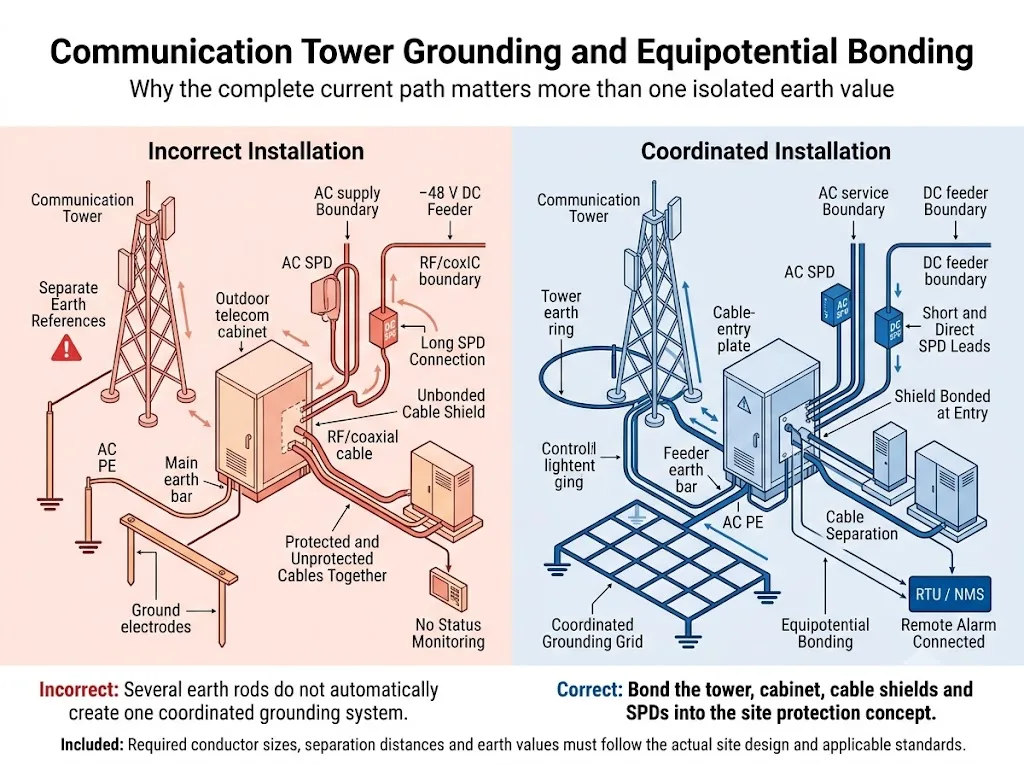
One earth-resistance value is not the complete answer
Earth resistance is important, but the result also depends on conductor routes, inductance, network geometry, soil conditions, current sharing, connection quality, corrosion and bonding position.
Do not promise that every tower is protected when the measured resistance is below one fixed value. Acceptance criteria must follow the site specification, local regulations, measurement method and qualified lightning-protection design.
Bonding points that normally require review
- Tower steelwork, monopole or mast base.
- External down-conductors where separately installed.
- Tower-base earth bar and equipment-room main bonding bar.
- Outdoor cabinet frame, door, cable-entry plate and internal PE bar.
- Coaxial cable shields and feeder earth bars.
- AC PE, generator earthing and ATS-related bonding.
- Rectifier, battery rack, DC distribution and telecommunications racks.
- Metallic cable trays, fences and auxiliary tower equipment where required by the design.
Mengapa Batas Menara ke Lemari Sangat Penting?
The point where cables leave the tower and enter an outdoor cabinet or shelter combines exposed conductors, cable shields, bonding connections and sensitive electronic ports.
- Place the correct SPD close to the relevant cable-entry or equipment boundary.
- Bond cable shields at the feeder earth bar or entry point defined by the site design.
- Use short, direct SPD bonding conductors.
- Separate protected and unprotected cable sections to reduce surge re-coupling.
- Avoid unnecessary loops, sharp routing changes and excess conductor length.
- Integrate the tower, cabinet and shelter into the coordinated site bonding system.
- Keep indicators, replaceable modules and remote terminals accessible after installation.
Bagaimana Alarm Jarak Jauh dan Pemeliharaan Harus Direncanakan?
Many communication towers are remote or unmanned. A failed module, disconnected bonding conductor or corroded connection can remain unnoticed until another surge event.
ITU-T K.119 addresses visual inspection, measurement, analysis and other methods used to assess the reliability of radio base station lightning protection and earthing systems.[3] IEC 62305-4 also covers inspection, maintenance and testing of surge protection measures.[7]
Remote monitoring can report
- Normal or failed SPD module status.
- Module removal where the SPD mechanism supports it.
- NO, NC or changeover dry-contact state.
- An alarm input to an RTU, PLC, cabinet controller or network-management system.
Remote indication supports maintenance, but it does not replace physical inspection. Corrosion, loose conductors, enclosure damage and incorrect replacement modules may not be detected by one auxiliary contact.
Inspect the protection system
- During initial commissioning and acceptance.
- At the scheduled preventive-maintenance interval.
- After a recorded lightning event or unexplained equipment fault.
- After adding antennas, radios, power equipment or another cabinet.
- After grounding work, civil work or cable-route changes.
- When an SPD indicator or remote alarm changes state.
Bagaimana Jenis Situs Mengubah Keputusan Perlindungan?
Stand-alone ground tower
This site normally has its own tower, earth network, utility or generator supply, equipment enclosure and several exposed copper conductors. It can require direct-strike protection plus coordinated AC, DC, RF and signal-line SPDs.
Rooftop radio installation
Rooftop equipment shares the building lightning protection system, main earthing terminal and electrical distribution. The designer must review separation distance, protection zones and coordination with existing building SPDs.
Remote microwave or monitoring site
This site may use batteries, solar power, a small AC source, long Ethernet or control lines and limited maintenance access. The selection must follow the real conductive interfaces and power architecture.
Kesimpulan rekayasa: “communication tower” does not identify one universal SPD package. The physical site and cable architecture determine which protection functions are required.
Bagaimana Pembeli Harus Memverifikasi Paket SPD yang Diusulkan?
Diagrams explain the protection concept, but they are not product approvals. Before approving a tower-site package, verify each proposed model against the circuit it will protect.
Request model-specific evidence
LEEYEE is a specialized surge protection and low-voltage protection supplier. CNSPD is LEEYEE’s surge protection-focused platform for global technical buyers.
A certificate for one series or configuration must not be treated automatically as approval for every voltage, pole arrangement, connector or OEM variant. Confirm the exact document scope before project submission.
Apa yang Harus Dikonfirmasi Sebelum Memesan?
Prepare the following information before requesting model recommendations, samples, technical files or an OEM quotation.
Minta Tinjauan Konfigurasi SPD Menara Komunikasi
Share the site single-line diagram, tower and cabinet layout, AC supply details, maximum DC bus voltage, cable interfaces and grounding drawing with LEEYEE.
Proposed models and installation positions must be confirmed against the actual equipment instructions, local electrical rules, project specification and qualified lightning-protection design.
Pertanyaan Umum tentang Perlindungan Lonjakan Menara Komunikasi
Can one AC SPD protect the complete communication tower site?
Does every communication tower require a Type 1 SPD?
Where should the −48 V DC SPD be installed?
Can a PV DC SPD be used for a 48 V telecom system?
Does optical fibre remove the need for surge protection?
Should an RF surge protector be installed at both cable ends?
Is a low grounding-resistance value enough?
Is remote alarm useful at a tower site?
Which documents should an OEM buyer request?
Referensi
- International Telecommunication Union, ITU-T K.56 (05/2021), Protection of radio base stations against lightning discharges. Official ITU publication.
- International Telecommunication Union, ITU-T K.112 (05/2021), Lightning protection, earthing and bonding: Practical procedures for radio base stations. Official ITU publication.
- International Telecommunication Union, ITU-T K.119 (12/2016), Conformance assessment of radio base stations regarding lightning protection and earthing. Official ITU publication.
- International Electrotechnical Commission, IEC 62305-1:2024, Protection against lightning – Part 1: General principles. Official IEC publication.
- International Electrotechnical Commission, IEC 62305-2:2024, Protection against lightning – Part 2: Risk management. Official IEC publication.
- International Electrotechnical Commission, IEC 62305-3:2024, Protection against lightning – Part 3: Physical damage to structures and life hazard. Official IEC publication.
- International Electrotechnical Commission, IEC 62305-4:2024, Protection against lightning – Part 4: Electrical and electronic systems within structures. Official IEC publication.
- International Electrotechnical Commission, IEC 61643-01:2024, Low-voltage surge protective devices – Part 01: General requirements and test methods. Official IEC publication.
- International Electrotechnical Commission, IEC 61643-11:2025, Low-voltage surge protective devices – Part 11: Surge protective devices connected to AC low-voltage power systems – Requirements and test methods. Official IEC publication.
- International Electrotechnical Commission, IEC 61643-12:2020, Low-voltage surge protective devices – Part 12: Surge protective devices connected to low-voltage power systems – Selection and application principles. Official IEC publication.
- International Electrotechnical Commission, IEC 61643-41:2025, Low-voltage surge protective devices – Part 41: Surge protective devices connected to DC low-voltage power systems – Requirements and test methods. Official IEC publication.
- International Electrotechnical Commission, IEC 61643-21:2025, Low-voltage surge protective devices – Part 21: Surge protective devices connected to telecommunications and signalling networks – Requirements and test methods. Official IEC publication.
- International Electrotechnical Commission, IEC 61643-31:2018, Low-voltage surge protective devices – Part 31: Requirements and test methods for SPDs for photovoltaic installations. Official IEC publication.