
An outdoor telecom cabinet normally requires more than one SPD. Protect each conductive AC, DC, Ethernet and signal line according to its actual voltage, interface, installation position and grounding arrangement.
Table of Contents
What surge protection does an outdoor telecom cabinet need?
Start by identifying every conductive cable entering or leaving the enclosure. Do not start by selecting one general-purpose SPD.
AC power, low-voltage DC power and telecommunications or signalling circuits are covered by different SPD requirements and test frameworks. [1] [2] [3]
AC input
Protects the utility supply, AC distribution and rectifier input.
48V / −48V DC
Protects the rectifier output, battery bus and DC distribution.
Ethernet
Protects copper data lines while supporting the required speed and PoE arrangement.
RS485 and sensors
Protects monitoring, alarm, control and environmental sensor circuits.
Remote alarm
Reports an SPD status change to the cabinet monitoring system.
Outdoor telecom cabinet surge protection architecture
Review every conductive line crossing the cabinet boundary. Place the relevant SPD close to the cable entry or distribution point.
The SPDs, cabinet enclosure and relevant cable shields should be integrated into the project earthing and bonding design. [5] [6]

Outdoor telecom cabinet SPD selection matrix
Define the protected circuit before comparing supplier models. Products that fit the same DIN rail may still serve completely different applications.
| Cabinet interface | Typical SPD category | Equipment protected | Parameters to confirm | Common purchasing error |
|---|---|---|---|---|
| AC utility input | Type 1+2 or Type 2 AC SPD according to the project design | AC distribution, rectifier, fan, heater and auxiliary AC loads | Voltage, phases, earthing system, Uc, Iimp where required, In, Imax, Up, poles and backup protection | Selecting only from the nominal AC voltage |
| 48V / −48V DC bus | Low-voltage DC SPD suitable for the actual telecom DC system | Rectifier output, battery bus, DC distribution and telecom loads | Maximum continuous voltage, polarity, bonded conductor, Uc, discharge ratings, Up and pole arrangement | Selecting only from the nominal “48V” description |
| RJ45 Ethernet | RJ45 data-line SPD | Ethernet switch, router, gateway, camera, radio and controller | Data speed, cable category, shield, protected pairs, connector arrangement and insertion loss | Assuming every RJ45 SPD supports Gigabit Ethernet |
| PoE line | RJ45 SPD compatible with the required PoE arrangement | Outdoor camera, wireless access point and PoE-powered device | PoE method, power, powered pairs, current, speed and shielding | Assuming every data SPD supports the required PoE power |
| RS485, sensor or alarm | Signal-line SPD matched to the interface | RTU, controller, sensor, door alarm and remote I/O | Signal voltage, current, pair count, protocol, transmission rate, shield and terminals | Replacing a signal SPD with a DC power SPD |
| SPD status output | SPD with potential-free remote contact | NMS, PLC, RTU or cabinet alarm controller receives the signal | COM, NO and NC logic, contact rating and normal/failure state | Ordering a standard version without remote signalling |
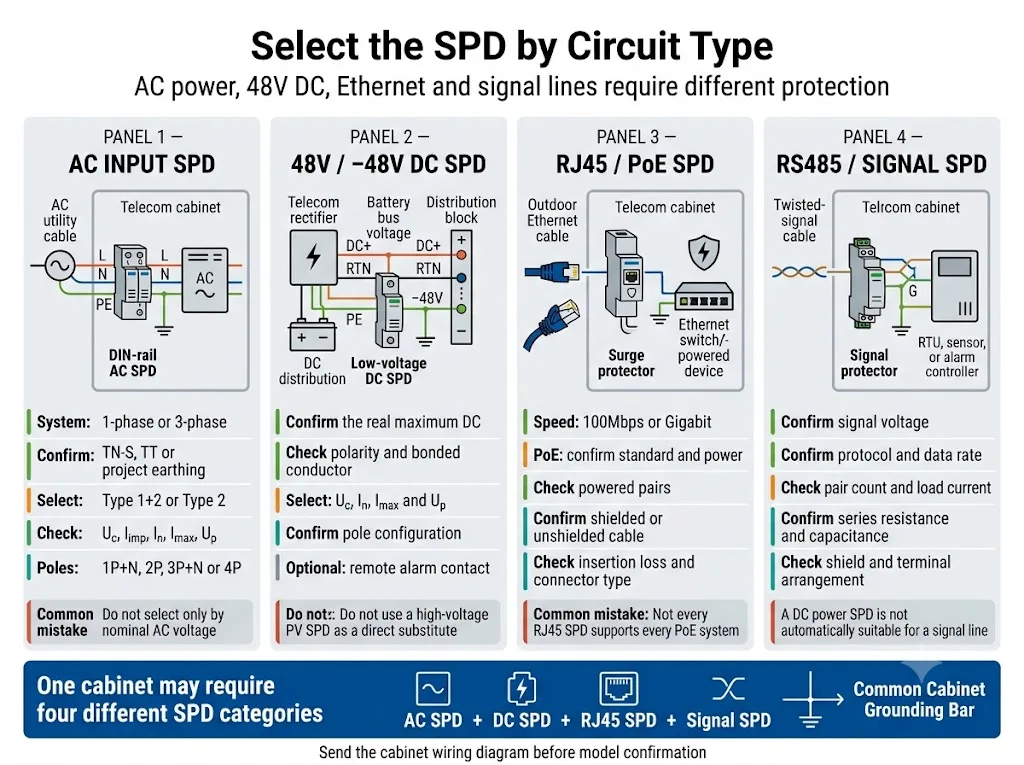
AC input SPD selection
The AC SPD protects the incoming utility supply and the AC side of the rectifier. Selection and coordination should follow the actual AC system, installation position and project protection concept. [1] [8]
48V / −48V DC SPD selection
“48V” is a nominal system description. The real DC bus voltage may be higher during rectifier operation and battery charging.
Select the SPD from the highest continuous DC voltage, polarity, bonded conductor, protection modes and installation position. IEC 61643-41:2025 provides the test framework for SPDs connected to low-voltage DC circuits. [2]
Confirm voltage
Provide nominal voltage, rectifier range, battery charging range and the highest continuous voltage.
Confirm polarity
Identify DC+, RTN, DC− or −48V, PE and the conductor bonded to the cabinet earth.
Confirm location
State whether the SPD is at the incoming feeder, rectifier output, battery bus or DC distribution unit.
Confirm maintenance
Specify visual indication, replaceable modules and remote signalling where required.
Read the detailed 48V / −48V DC SPD for telecom guide for the complete voltage and protection-mode process.
RJ45 and PoE surge protection
An RJ45 connector does not define the complete technical requirement.
IEC 61643-21:2025 covers telecommunications and signalling network SPDs, including networks carrying power on the same line, such as Power over Ethernet. [3]
Continue with the RJ45 surge protector selection guide and the PoE surge protection guide .
RS485, sensor and monitoring line protection
Outdoor telecom cabinets often contain door alarms, environmental sensors, battery monitoring and remote-control interfaces.
Select the signal SPD from the protocol, voltage, pair count, current, transmission requirement and terminal arrangement.
RS485 communication
Confirm signal voltage, pair count, data rate, current and cable shielding.
Door and alarm lines
Review door contacts, security wiring and any control conductor extending outside the cabinet.
Environmental sensors
Match the SPD to the sensor supply, output signal, conductor number and grounding method.
See the RS485 surge protector selection guide for protocol-specific guidance.
Remote alarm contact for SPD status
A visual indicator requires a site visit. An optional potential-free contact allows the monitoring system to receive an SPD status change remotely.
Define the logic
Confirm which contact state represents normal operation, module removal or SPD failure.
Check the rating
Verify that the controller input voltage and current are within the contact rating.
Test commissioning
Verify the complete alarm path from the SPD to the remote monitoring platform.
See the SPD remote alarm and PLC wiring guide .
Grounding and bonding affect the protection achieved
The internal cabinet grounding bar must be integrated into the wider site earthing and bonding system.
ITU-T K.56 and K.112 provide telecommunications-sector guidance related to lightning protection, earthing and bonding for radio base station environments. [5] [6]
Use coordinated bonding
Integrate the SPDs, metal enclosure and relevant cable shields into the project bonding design.
Keep paths short
Avoid long conductors, unnecessary loops and indirect routes between the SPD and grounding bar.
Separate cable routes
Avoid routing incoming unprotected conductors beside protected outgoing conductors.
Connect to site earth
An internal copper bar cannot replace a complete site earthing system.
Related resources: SPD connection cable length and SPD grounding requirements .
IP rating and condensation are different questions
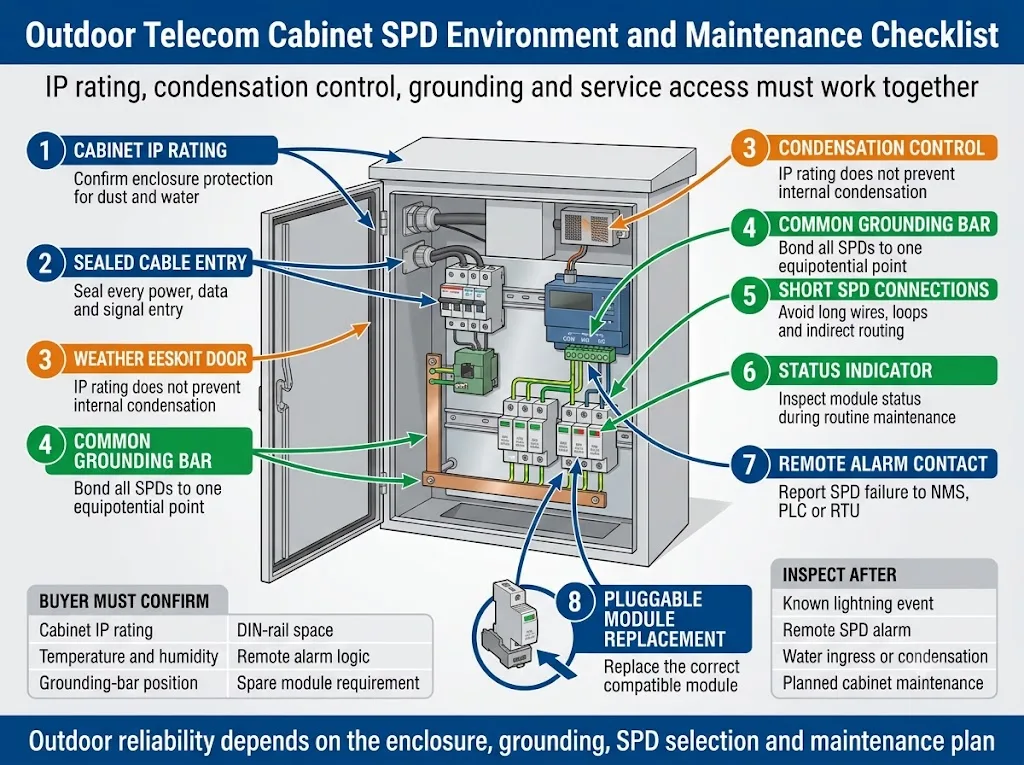
An IP-rated enclosure can protect against defined dust and water ingress conditions. It does not automatically solve internal condensation.
IEC 60529 defines enclosure degrees of protection using the IP Code. The classification does not define the complete internal temperature, humidity or condensation-control strategy. [7]
External ingress control
- Cabinet IP classification
- Door seals and gaskets
- Cable glands and entry plates
- Rain hood and drainage design
- Corrosion-resistant materials
- UV, salt-air and pollution exposure
Internal climate control
- Day and night temperature changes
- Humidity and dew-point conditions
- Heating or dehumidification
- Ventilation or heat exchanger
- Cold surfaces and thermal bridges
- Moisture and corrosion inspection
Typical LEEYEE product families for telecom cabinets
This mapping helps buyers identify the likely product family. It is not a universal model-substitution table.
What buyers should verify beyond the datasheet
A technically suitable SPD still needs product documentation, manufacturing control and sample confirmation before bulk ordering.
Component and product testing
LEEYEE testing capability includes MOV and GDT testing, impulse equipment, thermal stability testing and combination-wave testing. Applicable tests depend on the product category and test plan.
Document-scope confirmation
Confirm that the datasheet, certificate or report applies to the exact model, voltage, pole arrangement and declared ratings being ordered.
Sample approval
Verify terminal arrangement, DIN-rail space, remote contact, labels and replacement modules before bulk production.
SPD Maintenance and Module Replacement
Plan routine inspections, remote alarm tests and compatible module replacement without rebuilding the cabinet distribution section.
IEC 61643-22 addresses selection, location, coordination and operational considerations for telecommunications and signalling network SPDs. [4]
Routine Inspection
Check status indicators, terminals, wiring, overheating, contamination, moisture and corrosion.
Remote Alarm Test
Verify that the monitoring system receives the intended normal and failure states.
Module Replacement
Use the compatible replacement cartridge specified for the installed base, voltage and protection characteristics.
Post-Surge Check
Inspect the SPDs, terminals, grounding conductors and protected equipment after a known severe surge event.
Information to send before requesting a quotation
These details allow the supplier to compare the same engineering requirement and reduce model-selection errors.
Need an initial SPD recommendation?
Send the cabinet drawing, AC input, highest continuous DC voltage, RJ45 or PoE requirements, signal-line list, grounding layout and expected quantity.
Support for telecom cabinet OEM and project supply
LEEYEE is a specialized surge protection and low-voltage protection supplier, trusted for solar PV, power distribution, telecom, industrial and OEM applications.
CNSPD is LEEYEE’s surge protection-focused brand platform, built to help global buyers source reliable SPDs and related low-voltage protection products.
Built to Protect. Trusted to Last.
Available B2B support
- AC, DC and signal SPD parameter confirmation
- Cabinet interface and DIN-rail space review
- Remote alarm contact configuration
- Datasheet and document-scope confirmation
- OEM label and private-label discussion
- Sample evaluation before bulk production
- Replaceable-module and spare-parts planning
Outdoor telecom cabinet SPD FAQ
What SPDs are normally required in an outdoor telecom cabinet?
A cabinet may require an AC input SPD, a 48V or −48V DC SPD, RJ45 or PoE protection, signal-line SPDs and remote alarm contacts. The exact combination depends on the conductive lines entering and leaving the cabinet.
Can one SPD protect the complete telecom cabinet?
Usually not. AC power, DC power, Ethernet, PoE and signal circuits have different operating voltages, interfaces and performance requirements.
Where should the AC SPD be installed?
It is commonly installed near the AC cable entry or within the AC distribution section before the rectifier and sensitive AC loads. The final location must follow the project design.
How should a −48V telecom SPD be selected?
Confirm the highest continuous voltage, polarity, bonded conductor, protection modes, discharge ratings, voltage protection level and grounding arrangement.
Can a PV DC SPD be used for a 48V telecom cabinet?
It should not be treated as a direct substitute. A high-voltage photovoltaic circuit and a low-voltage telecom DC bus have different system conditions.
Does every RJ45 SPD support PoE and Gigabit Ethernet?
No. Confirm the data rate, PoE arrangement, powered pairs, current, cable category, shielding and insertion-loss requirements.
Does an IP65 cabinet prevent internal condensation?
No. An IP classification addresses defined enclosure-ingress conditions. Internal condensation can still occur when temperature and humidity change.
Is remote alarm useful for an outdoor telecom cabinet SPD?
It is useful for remote and unattended cabinets. A potential-free contact can report a status change to an NMS, PLC, RTU or alarm controller.
Why should SPD grounding conductors be short?
Fast surge current can create additional voltage across the inductance of long conductors. Short, direct routing reduces unnecessary added voltage.
What should a cabinet OEM send before requesting a quote?
Send the electrical drawing, AC input, maximum DC voltage, grounding layout, Ethernet and PoE requirements, signal list, remote-alarm logic, mechanical space, environment, documents and quantity.
Standards and technical reference framework
- IEC 61643-11:2025 — Low-voltage surge protective devices connected to AC low-voltage power systems: requirements and test methods. IEC publication
- IEC 61643-41:2025 — Surge protective devices connected to DC low-voltage power systems: requirements and test methods. IEC publication
- IEC 61643-21:2025 — Surge protective devices connected to telecommunications and signalling networks: requirements and test methods, including networks carrying power on the same line such as Power over Ethernet. IEC publication
- IEC 61643-22:2015 — Selection and application principles for surge protective devices connected to telecommunications and signalling networks. IEC publication
- ITU-T K.56:2021 — Protection of radio base stations against lightning discharges. ITU-T recommendation
- ITU-T K.112:2021 — Lightning protection, earthing and bonding: practical procedures for radio base stations. ITU-T recommendation
- IEC 60529:1989+A1:1999+A2:2013 — Degrees of protection provided by enclosures, IP Code. IEC publication
- IEC 61643-12:2020 — Selection and application principles for SPDs connected to AC low-voltage power systems. IEC publication
- IEC 62305-4:2024 — Protection against lightning: electrical and electronic systems within structures. IEC publication