Ein SPD kann einen sehr hohen Blitzimpuls überstehen, aber bei einer viel niedrigeren Spannung, die für Sekunden oder länger anhält, versagen. Diese längere anomale Spannung wird als eine vorübergehende Überspannung oder TOV bezeichnet..
Für OEM-Käufer und Schaltschrankbauer ist die TOV-Beständigkeit ein Beschaffungsrisikoparameter. Sie hilft zu bestimmen, ob ein SPD stabil bleiben, kontrolliert trennen oder ernsthafte Schäden erleiden kann, wenn die Systemspannung über den vorgesehenen kontinuierlichen Betriebsbereich hinaus ansteigt.
Inhaltsübersicht
Was ist die SPD TOV-Beständigkeit?
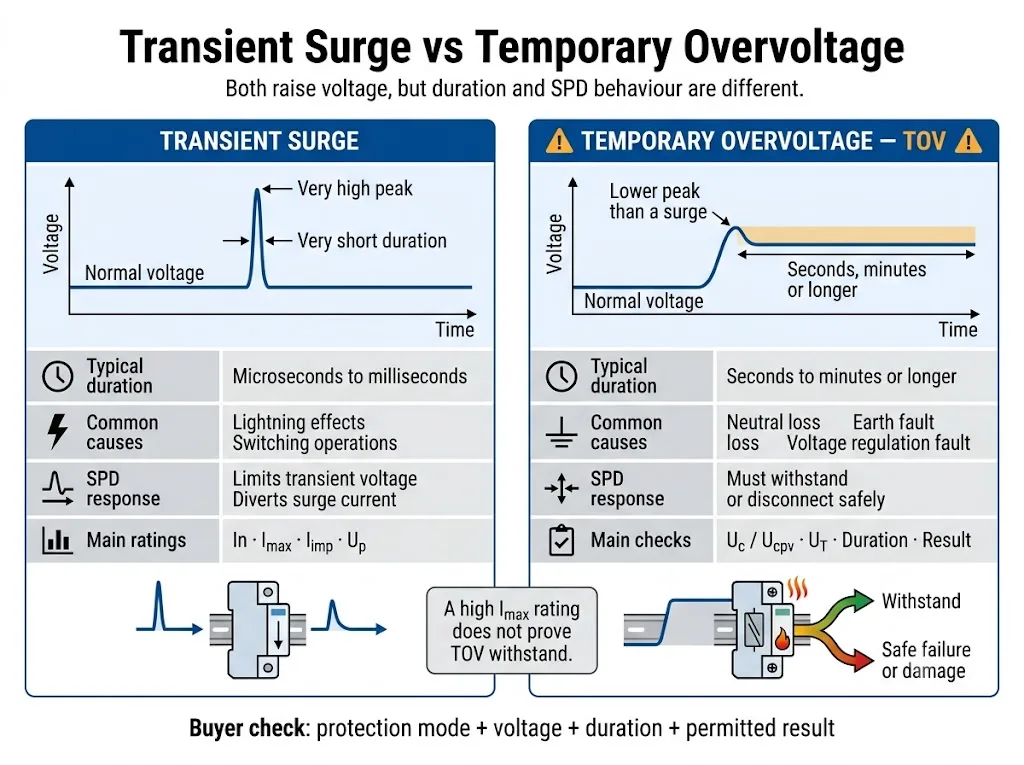
Ein Überspannung ist ein kurzes transienten Ereignis, das ein SPD begrenzen soll. Eine TOV ist eine abnormale Netzfrequenz- oder Gleichspannung, die lange genug anliegt, um dauerhafte elektrische und thermische Belastungen zu erzeugen.[1][2][4]
TOV-Beständigkeit ist keine eigenständige Spannungszahl. Eine aussagekräftige Erklärung muss den Schutzmodus, die angelegte Spannung, die Dauer und das erwartete Ergebnis identifizieren.
- Uc oder Ucpv deckt die Dauerspannung ab. Die tatsächliche Betriebs- spannung muss innerhalb der angegebenen Nennwerte bleiben.
- UT beschreibt eine definierte abnormale Bedingung. Es muss zusammen mit Dauer und Testergebnis gelesen werden.
- Niedriges Uc kann die TOV-Sensibilität erhöhen. Langandauernde MOV-Leitung kann zu Erwärmung und Trennung führen.
- Hoher Imax beweist nicht die TOV-Stärke. Impulse-Strom- und Langspannungsrisiken sind unterschiedlich.
Schnelle Genehmigungsentscheidung für Käufer
Verwenden Sie diese Tabelle, bevor Sie eine Probe, ein BOM-Element oder ein Private-Label-Modell genehmigen. Es ist ein Screening-Tool, kein Ersatz für die Projekttechnik.
| Entscheidung | Feststellung | Erforderliche Aktion |
|---|---|---|
| Genehmigen | Die genauen Modell-Daten entsprechen der Systemspezifikation, dem Schutzmodus, den TOV-Bedingungen und den Anforderungen an Kurzschlüsse. | Fahren Sie mit der Genehmigung des Musters oder der Stückliste fort, vorbehaltlich der vollständigen Projektprüfung. |
| Halten | UT wird ohne Dauer angezeigt, das Ergebnis bei sicherem Ausfall ist unklar oder der Umfang des Zertifikats identifiziert nicht das genaue Modell. | Fordern Sie die fehlende Prüfvoraussetzung, den Berichtsumfang und die Installationsinformationen an. |
| Ablehnen | Die normale maximale Spannung überschreitet Uc oder Ucpv, der Anwendungstyp ist falsch oder der erforderliche Schutzmodus wird nicht unterstützt. | Wählen Sie ein anderes Modell oder korrigieren Sie die Systemspezifikation, bevor Sie bestellen. |
Ein Produkt sollte nicht nur aufgrund eines Frontetiketts, eines Imax-Wertes oder einer allgemeinen “TOV-beständigen” Aussage genehmigt werden.
- TOV versus Überspannungsimpuls
- Wie man eine TOV-Bewertung liest
- Uc, Ucpv und UT
- Warum TOV einen SPD beschädigt
- Unterschiede zwischen den Schutzmodi
- Risiken in der AC-Verteilung
- Beispiel aus dem Datenblatt
- Grenze zwischen DC und PV
- OEM-Verifizierungsablauf
- Prüfungen nach einem TOV-Ereignis
- FAQ für Käufer
TOV und Surge sind unterschiedliche elektrische Ereignisse
Beide Ereignisse erhöhen die Spannung über ihr normales Niveau. Die wichtigen Unterschiede sind die Dauer, die Energiequelle und die Art, wie der SPD reagiert.
| Vergleich | Transienter Überspannungsimpuls | Temporäre Überspannung |
|---|---|---|
| Art | Ein kurzer Spannungs- oder Stromimpuls mit hohem Spitzenwert. | Eine abnorme AC-Effektivspannung oder DC-Spannung, die weiterhin anliegt. |
| Mögliche Ursachen | Blitzeinwirkungen, Schaltvorgänge und Unterbrechung induktiver Lasten. | Neutralleiterunterbrechung, Erdschlüsse, schlechte Regelung, falsche Versorgungsspannung oder Quellfehler. |
| SPD-Funktion | Begrenzt transiente Spannung und leitet Impulsstrom ab. | Muss stabil bleiben oder in den angegebenen kontrollierten End-of-Life-Zustand übergehen. |
| Hauptkennwerte | In, Imax, Iimp und Up. | Uc oder Ucpv, UT, Schutzmodus, Dauer und Ergebnis. |
| Hauptschutzrisiko | Übermäßige Impulsenergie oder kumulative Überspannungsbeanspruchung. | Dauerhafte Leitfähigkeit, Erwärmung, thermisches Durchgehen oder Nachstrom bei Fehlerstrom. |
Der anwendbare Standard und die Produktdokumentation bestimmen die genaue Dauer des TOV-Tests. Wenden Sie keinen einheitlichen Zeitgrenzwert auf jedes System oder jeden SPD an.
Vier Bereiche sind erforderlich, um eine TOV-Bewertung zu verstehen
Aussagen wie “hohe TOV-Beständigkeit” oder “TOV-sicherer SPD” sind keine vollständigen technischen Angaben. Käufer benötigen vier spezifische Felder.
| Erforderliches Feld | Was es bedeutet | Beschaffungsrelevanz |
|---|---|---|
| Schutzmodus | Die beiden Leiter, zwischen denen die abnormale Spannung angelegt wird. | L-N-, L-PE- und N-PE-Pfade können unterschiedlichen Fehler-/Störspannungen ausgesetzt sein. |
| Angelegte Spannung | Die festgelegte AC-RMS- oder DC-TOV-Prüfspannung, häufig als UT gekennzeichnet. | Vergleichen Sie sie mit der plausiblen abnormalen Spannung im tatsächlichen System. |
| Dauer | Wie lange die abnormale Spannung während des angegebenen Zustands angelegt wird. | Ein SPD kann einer Spannung kurzzeitig standhalten, sich jedoch bei längerer Einwirkung trennen. |
| Ergebnis | Das erforderliche Verhalten nach oder während des Tests. | Bestimmen, ob das SPD funktionsfähig bleibt, sich trennt oder ersetzt werden muss. |
Uc, Ucpv und UT bedeuten nicht dasselbe
Uc ist die maximale dauerhafte Betriebsspannung, die kontinuierlich auf den angegebenen SPD-Schutzmodus angelegt werden darf. Ucpv ist der entsprechende Parameter für photovoltaische SPDs.[1][2][6]
UT beschreibt das Verhalten während eines festgelegten vorübergehenden abnormalen Spannungszustands. Uc oder Ucpv und UT stehen in Beziehung zueinander, können einander jedoch nicht ersetzen.
| Parameter | Frage beantwortet | Freigaberisiko |
|---|---|---|
| Un oder Uo | Wie hoch ist die Nennspannung des Systems oder die Spannung zwischen Phase und Neutralleiter? | Dies ist ein Ausgangspunkt, nicht der endgültige Wert für die SPD-Spannungsauswahl. |
| Uc | Kann der SPD bei dieser Spannung dauerhaft angeschlossen bleiben? | Ein zu niedriger Wert kann Leckstrom, Erwärmung und vorzeitige Trennung erhöhen. |
| Ucpv | Kann der PV-SPD bei der berechneten maximalen Strangspannung angeschlossen bleiben? | Die normale Betriebsspannung des Wechselrichters allein reicht nicht aus. |
| UT | Was geschieht bei der angegebenen anomalen Spannung und Dauer? | Ein Spannungswert ohne Dauer und Ergebnis ist unvollständig. |
| Nach oben | Welcher Schutzpegel wird während des spezifizierten Stoßstromtests deklariert? | Ein höherer Uc bietet nicht automatisch die am besten geeignete Schutzkoordination. |
Warum kann ein niedriger Uc zu einem Ausfall führen?
Die meisten spannungsbegrenzenden AC-Überspannungsschutzgeräte verwenden einen oder mehrere Metalloxid-Varistoren (MOV). Bei normaler Spannung führt ein MOV nur einen geringen Leckstrom.
Wenn die angelegte Spannung über den stabilen Betriebsbereich der Komponente hinaus ansteigt, kann der MOV-Strom stark ansteigen. Wenn die anomale Spannung bestehen bleibt, wird elektrische Energie in Wärme umgewandelt, anstatt als kurzer Stoßimpuls abgeleitet zu werden.[9]
Ist ein höherer Uc immer besser?
Nein. Ein höherer Uc kann die Reserve für die Dauerspannung erhöhen, aber der gewählte SPD muss dennoch einen geeigneten Up, Schutzmodus und eine Koordination mit den zu schützenden Geräten bieten.
Die richtige Wahl ist nicht einfach der höchstmögliche Uc. Es ist ein Bemessungswert, der die tatsächliche maximale Betriebsspannung und glaubhafte Fehlerzustände sicher abdeckt und gleichzeitig das erforderliche Schutzniveau erfüllt.[3]
Wie kann TOV einen SPD erhitzen, trennen oder verbrennen?
Die genaue Reaktion hängt von der SPD-Technologie, dem internen Aufbau und dem Systemfehler ab. Eine häufige, auf MOV basierende Ausfallsequenz ist unten dargestellt.
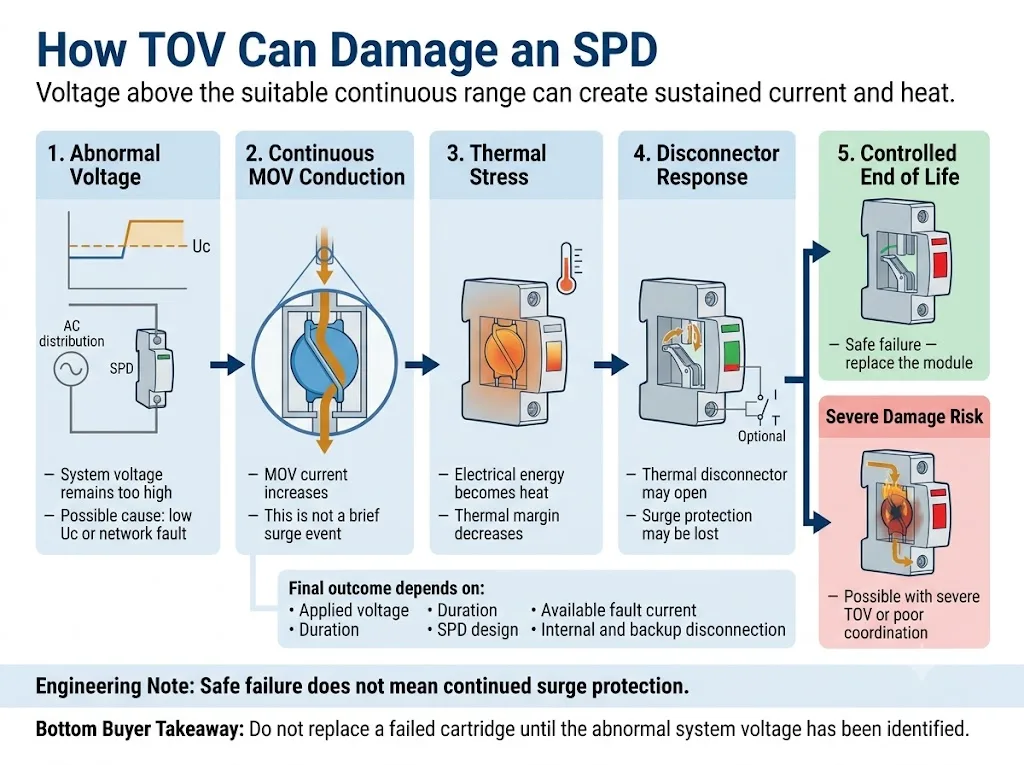
- Die angelegte Spannung überschreitet den zulässigen Dauerbereich. Dies kann aus einer zu niedrigen Uc-Auswahl oder einem anormalen Systemzustand resultieren.
- Die spannungsbegrenzende Komponente leitet kontinuierlich. Der SPD zieht netzfrequenten Strom oder Gleichstrom, anstatt nur einen kurzen Impuls abzuleiten.
- Die Innentemperatur steigt an. Kontinuierliche Energiezufuhr verringert die verbleibende thermische Reserve.
- Der thermische Trennschalter kann auslösen. Eine kontrollierte Trennung kann die beanspruchte Komponente isolieren und die Statusanzeige ändern.
- Schwere Schäden bleiben dennoch möglich. Eine schwere TOV, ein hoher verfügbarer Fehlerstrom oder eine unzureichende Trennung können den Defekt vergrößern.
Vom NIST durchgeführte TOV-Untersuchungen ergaben, dass die Reaktionen von SPDs bei anhaltender anormaler Spannung von „kein Schaden“ bis hin zur „vollständigen Zerstörung“ reichen können. Das Papier identifiziert die maximale Dauerspannung (Uc) und das Ansprechverhalten des Trennschalters als wichtige Faktoren für die TOV-Anfälligkeit.[9]
TOV muss für jeden Schutzmodus überprüft werden
Ein mehrpoliger SPD ist nicht einer einzigen Spannung ausgesetzt. Jedes Schutzelement sieht die Spannung zwischen den beiden Leitern, die mit diesem Schutzpfad verbunden sind.
| Schutzmodus | Frage zur regulären Auswahl | Zu bestätigendes TOV-Risiko |
|---|---|---|
| L-N | Wie hoch ist die maximale Dauerspannung zwischen Phase und Neutralleiter? | Neutralleiterverlust, mangelhafte Neutralleiterverbindung und Lastunsymmetrie. |
| L-PE | Welche Spannung kann zwischen dem Außenleiter und Erde auftreten? | Erdschlüsse, Sternpunktverschiebung und Verhalten des Erdungssystems. |
| N-PE | Welche N-PE-Schutztechnologie und welches Nennvermögen werden verwendet? | Vorübergehende Spannung zwischen Neutralleiter und Erde bei bestimmten Erdschlussbedingungen. |
| Gleichstrom +/− | Wie hoch ist die maximale DC-Spannung zwischen den Polen? | Ladespannung, Regelfehler und falsche Schaltungskonfiguration. |
| DC Pol-PE | Wie ist das DC-System geerdet? | Ein Erdschluss kann die Spannung über einen Pol-zu-Erde-Schutzpfad verschieben. |
Warum ist der Verlust des Neutralleiters ein kritisches AC TOV-Szenario?
In einem intakten 230/400-V-Drehstromnetz (Vierleitersystem) liegt an einem L-N-Schutzpfad normalerweise eine Spannung von ca. 230 V an.
Wenn der Neutralleiter unterbrochen wird oder eine hohe Impedanz aufweist, ist der Sternpunkt nicht mehr stabil. Bei unsymmetrischen einphasigen Lasten können einige L-N-Spannungen sinken, während eine andere erheblich ansteigt und sich der verketteten Spannung von 400 V nähern kann.[4][9]
Intaktes Netz gegenüber Neutralleiterverlust
Ein SPD mit einer Uc von 275 V kann für einen stabilen 230-V-L-N-Stromkreis geeignet sein, wenn die Anforderungen an das Gesamtsystem und das Produkt erfüllt sind.
Wenn ein Neutralleiterverlust dazu führt, dass derselbe Schutzpfad einer wesentlich höheren Dauerspannung ausgesetzt ist, kann der SPD beginnen, kontinuierlich zu leiten. Ob er dies aushält, sicher abschaltet oder beschädigt wird, muss anhand der TOV-Daten des jeweiligen Modells überprüft werden.
Dieses Beispiel beweist nicht, dass jedes Neutralleiterverlustereignis exakt 400 V erzeugt. Die tatsächliche Spannung hängt von den angeschlossenen Lasten, der Netzkonfiguration und dem Fehlerzustand ab.
Erdfehler und Erdungskonfiguration
TN-S-, TN-C-S-, TT- und IT-Systeme können unterschiedliche temporäre Spannungen an den L-N-, L-PE- und N-PE-Schutzpfaden erzeugen. Die tatsächliche Belastung hängt von der Installationskonfiguration und dem Fehlerzustand ab.[3][4]
Dies ist besonders wichtig beim Vergleich von 4+0- und 3+1-Schaltungen. Die L-N-Module und das N-PE-Element erfüllen unterschiedliche Funktionen; es sollte nicht davon ausgegangen werden, dass sie ein identisches TOV-Verhalten aufweisen.
Generatoren, Transformatoren und instabile Netze
Regelungsfehler bei Generatoren, Fehler bei Transformator-Stufenschaltern, Lastabwurf, Ferroresonanz und mangelhafte Netzregulierung können zu anhaltenden, anomalen Spannungen führen.
Fordern Sie für solche Projekte Messprotokolle der Spannung oder die Auslegungstoleranz der Spannung an. Die Nennspannung allein reicht für eine endgültige Uc-Zulassung nicht aus.
Anforderungen auf Installationsebene und systemabhängige TOV-Bedingungen sollten gemäß der jeweils geltenden Ausgabe der IEC 60364 und den lokalen elektrischen Vorschriften geprüft werden. Der zugehörige Installationsleitfaden für SPD nach IEC 60364-5-534 erläutert die umfassenderen Installationsprüfungen.
Wie liest man einen echten TOV-Datenblatt-Eintrag?
Das folgende Beispiel verwendet Werte, die in einem technischen Leitfaden eines Drittanbieters veröffentlicht wurden. Es erläutert lediglich die Lesemethode. Es handelt sich nicht um eine Empfehlung für ein LEEYEE-Modell und darf nicht ohne Überprüfung auf ein anderes Produkt übertragen werden.[10]
| Veröffentlichter Eintrag | Korrekte Interpretation | Zu vermeidende falsche Annahme |
|---|---|---|
| Uc 275 V | Die deklarierte maximale Dauerspannung für den angegebenen Schutzmodus. | Das Produkt kann bei jeder Spannung unterhalb seines höchsten UT-Werts dauerhaft betrieben werden. |
| UT 337 V / 5 s | Ein kurzzeitiger TOV-Zustand mit dem in der jeweiligen Produktdokumentation angegebenen Ergebnis. | 337 V ist ein weiterer Wert für die Dauerspannung. |
| UT 442 V / 120 min | Ein Zustand längerer Dauer, der mit einem deklarierten sicheren Ausfallergebnis verbunden ist. | Der SPD schützt für zwei Stunden bei 442 V weiterhin normal. |
| Separater N-PE-Wert | Ein TOV-Zustand, der speziell für das N-PE-Schutzelement angegeben ist. | Derselbe Wert gilt automatisch für L-N- und L-PE-Elemente. |
Was sollte bei einem LEEYEE-Modell überprüft werden?
Gehen Sie nicht davon aus, dass ein Beispiel eines Drittanbieters ein LEEYEE-Produkt repräsentiert. Fordern Sie für die Projektbestätigung das exakte Datenblatt des LEEYEE-Modells, den Anschlussplan sowie den anwendbaren Prüf- oder Zertifikatsumfang an.
Modellspezifische Nachweise, die angefordert werden sollten
- Exakte Produkt- und Kartuschenbeschriftung
- Uc oder Ucpv für den angegebenen Schutzmodus
- UT-Spannung, Dauer und erklärtes Ergebnis
- Funktion des optischen Statusfensters
- Informationen zum Fernmeldekontakt
- Anforderungen an die interne und externe Trennung
- Isccr- oder ISCPV-Bemessung, sofern zutreffend
- Anforderungen an die Vorsicherung oder den Leitungsschutzschalter (MCB)
- Installations- und Verdrahtungsanweisungen
- Modellspezifischer Prüfbericht oder Zertifikatsumfang
- OEM-Etikett und Zeichnung zur Verpackungsfreigabe
- Prüf- und Zulassungsnachweis der Muster
Nachweise sollten auf Ebene des exakten Modells geprüft werden. Es darf nicht davon ausgegangen werden, dass ein Zertifikat, ein Bericht oder ein Datenblatt für eine Spannungsversion oder Polkonfiguration auch eine andere abdeckt.
Gilt die AC TOV-Schlussfolgerung direkt für DC oder PV SPDs?
Nein. Allgemeine Gleichstrom- und Solar-PV-Stromkreise erfordern separate Spannungsberechnungen, Schutzmodi und Produktnormen.
IEC 61643-41:2025 deckt SPDs ab, die an allgemeine DC-Niederspannungsstromkreise angeschlossen sind. PV-SPDs fallen weiterhin unter die IEC 61643-31, wobei die Auswahlprinzipien in der IEC 61643-32 behandelt werden.[5][6][7]
Verwenden Sie den separaten Auswahlleitfaden für DC- und PV-SPD Ucpv für den vollständigen PV-Spannungsauswahlprozess.
SPD TOV Überprüfungsworkflow für OEM-Genehmigung
Überprüfen Sie das elektrische System, bevor Sie den SPD freigeben. Der unten aufgeführte Arbeitsablauf hält Systemdaten, Produktbewertungen und Zulassungsdokumente miteinander verbunden.
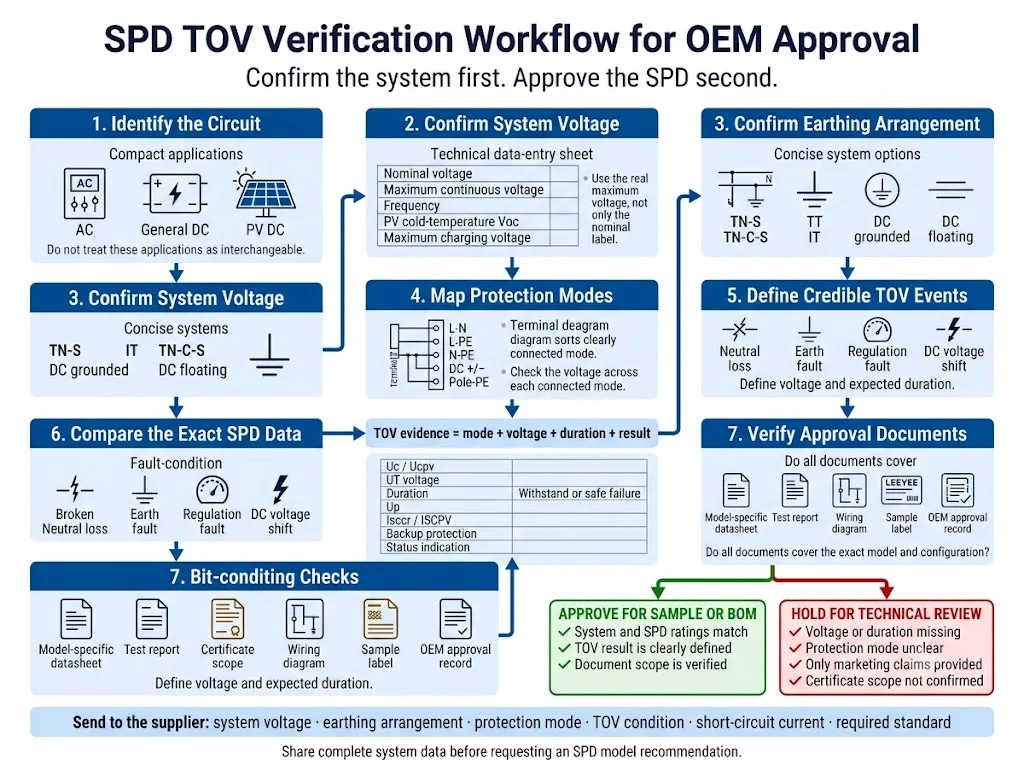
- Identifizieren Sie den Stromkreis. Trennen Sie AC-Netz-, allgemeine DC- und Solar-PV-Anwendungen. Ähnliche Gehäuse machen die Produkte nicht untereinander austauschbar.
- Bestätigen Sie die tatsächliche maximale Betriebsspannung. Berücksichtigen Sie die Versorgungstoleranz, das Verhalten von Generatoren oder Transformatoren, die Ladespannung oder die PV-Spannung bei Kälte.
- Bestätigen Sie das Erdungssystem. Erfassen Sie TN-S, TN-C-S, TT, IT oder das relevante DC-Erdungsverfahren.
- Bilden Sie jeden Schutzmodus ab. Überprüfen Sie die L-N-, L-PE-, N-PE-, Pol-zu-Pol- und Pol-zu-Erde-Pfade, sofern zutreffend.
- Definieren Sie plausible TOV-Ereignisse. Überprüfen Sie Neutralleiterunterbrechungen, Erdschlüsse, Regelungsfehler und quellenspezifische anormale Bedingungen.
- Vergleichen Sie die vollständigen SPD-Daten. Überprüfen Sie Uc oder Ucpv, UT, Dauer, Ergebnis, Up, Kurzschlussfestigkeit und Trennvorrichtung.
- Überprüfen Sie den Geltungsbereich der Zulassungsunterlagen. Bestätigen Sie, dass das Datenblatt, der Bericht und das Zertifikat genau für die bestellte Spannungsausführung, Polkonfiguration und das Modell gelten.
Informationen, die vor der Anforderung einer Modell-Empfehlung zu senden sind
- Nennsystemspannung
- Maximale Dauerbetriebsspannung
- AC, allgemeine DC- oder PV-Anwendung
- Systemfrequenz, sofern zutreffend
- Erdungssystem
- Erforderliche Schutzmodi
- Neutralleiterunterbrechung oder Erdschlussszenario
- Zu berücksichtigendes Uc oder Ucpv
- Erforderliche TOV-Spannung und -Dauer
- Erforderliches Ergebnis für Widerstandsfähigkeit oder sicheres Versagen
- Zukünftiger Kurzschlussstrom
- Informationen zur Vorsicherung oder zum Leitungsschutzschalter (MCB)
- Erforderlicher Standard oder Zertifikat
- Anforderung an Fernsignalisierung
- Anzahl und Installationsposition
- Anforderung an OEM-Etikett oder Verpackung
Bestätigen Sie die TOV-Daten, bevor Sie das SPD-Modell genehmigen
Senden Sie die Systemspannung, das Erdungssystem, die Schutzmodi und plausible anormale Spannungszustände. LEEYEE kann dabei helfen, zu bestimmen, welche Uc-, Ucpv- und TOV-Daten vor der Freigabe von Mustern oder Stücklisten (BOM) überprüft werden sollten.
CNSPD ist die auf Überspannungsschutz spezialisierte Plattform von LEEYEE für technische Einkäufer weltweit. Entwickelt, um zu schützen. Vertraut, um zu halten.
Teilen Sie Ihre Systemdetails zur Prüfung mitWas sollte nach einem vermuteten TOV-Ereignis überprüft werden?
Installieren Sie keine Ersatzkartusche, bevor die ursprüngliche anormale Spannung identifiziert wurde. Ein neues SPD könnte erneut ausfallen, wenn der Systemfehler weiterhin besteht.
- Trennen Sie den Stromkreis gemäß den elektrischen Sicherheitsvorschriften des Standorts.
- Erfassen Sie die SPD-Anzeige, den Fernmeldekontakt und das vollständige Produktetikett.
- Messen Sie die L-N-, L-L-, L-PE-, N-PE- oder DC-Polspannungen, sofern zutreffend.
- Überprüfen Sie den Neutralleiterdurchgang, die Erdung und das aktuelle einpolige Schaltbild.
- Überprüfen Sie Kartusche, Basis, Leiter, Anschlüsse und den Backup-Schutz.
- Überprüfen Sie Aufzeichnungen von Generatoren, Transformatoren, Wechselrichtern, Relais und Netzereignissen.
- Bestätigen Sie die Uc-, Ucpv-, TOV-Daten und die Schutzkonfiguration für den Austausch.
Für einen umfassenderen Diagnoseprozess nutzen Sie den zugehörigen Leitfaden zu Ursachen von SPD-Ausfällen.
Häufig gestellte Fragen zur SPD TOV-Beständigkeit
Kann ein SPD Geräte vor temporären Überspannungen schützen?
Ein SPD ist primär dazu bestimmt, transiente Überspannungen zu begrenzen. Normalerweise regelt oder beseitigt es keine anhaltende anormale Systemspannung. Während einer TOV kann es stabil bleiben oder seinen definierten kontrollierten End-of-Life-Zustand einnehmen.
Kann TOV dazu führen, dass ein SPD brennt?
Ja. Anhaltende Leitungszustände können zu Erwärmung, thermischem Durchgehen, Trennung oder schwerwiegenden Schäden führen. Das Ergebnis hängt von Spannung, Dauer, SPD-Design, verfügbarem Fehlerstrom und der Koordination der Schutzeinrichtungen ab.
Verbessert ein größerer Imax die TOV-Festigkeit?
Nicht unbedingt. Imax ist ein Stoßstromparameter. Die TOV-Eignung hängt von der dauerhaften Betriebsspannung, dem Schutzmodus, dem definierten TOV-Verhalten und dem Trennkonzept ab.
Verhindert ein höheres Uc jeden TOV-Ausfall?
Nein. Ein höheres Uc kann den Spielraum bei der Dauerspannung erhöhen, aber Dauer, Schutzmodus, SPD-Technologie und Trennverhalten beeinflussen das Ergebnis dennoch.
Kann ein Neutralleiterverlust ein 275-V- oder 320-V-SPD beschädigen?
Das kann er. Eine Neutralpunktverschiebung in einem Dreiphasen-Vierleitersystem kann die Spannung über einem L-N-Schutzpfad weit über den Normalwert anheben. Das Ergebnis hängt von der tatsächlichen Spannung, der Dauer und dem modellspezifischen TOV-Verhalten ab.
Was bedeutet „sicheres Versagen“?
Es bedeutet, dass eine kontrollierte Trennung oder ein kontrolliertes Ende der Lebensdauer unter den angegebenen Testbedingungen zulässig sein kann. Es bedeutet nicht, dass das Modul weiterhin Überspannungsschutz bietet.
Ist Ucpv das Gleiche wie die Nennspannung eines PV-Systems?
Nein. Ucpv ist die für das PV-SPD deklarierte maximale Dauerspannung. Sie muss gegen die für das tatsächliche PV-Array und die Schutzkonfiguration berechnete maximale Spannung geprüft werden.
Welche TOV-Dokumente sollte ein OEM-Einkäufer anfordern?
Fordern Sie das Datenblatt für das exakte Modell, das Schutzmodus-Diagramm, Uc oder Ucpv, UT-Spannung, Dauer, Ergebnisdefinition, Kurzschlussfestigkeit, Anforderungen an den Backup-Schutz, Installationsanleitungen und den Zertifikatsumfang an.
Referenzen
- Internationale elektrotechnische Kommission, IEC 61643-01:2024 — Überspannungsschutzgeräte für Niederspannung — Teil 01: Allgemeine Anforderungen und Prüfverfahren. Offizielle IEC-Veröffentlichungsseite.
- Internationale elektrotechnische Kommission, IEC 61643-11:2025 — Überspannungsschutzgeräte für Niederspannung — Teil 11: Überspannungsschutzgeräte, die an AC-Niederspannungsstromversorgungssysteme angeschlossen sind — Anforderungen und Prüfverfahren. Offizielle IEC-Veröffentlichungsseite.
- Internationale elektrotechnische Kommission, IEC 61643-12:2020 — Überspannungsschutzgeräte für Niederspannung — Teil 12: Überspannungsschutzgeräte für den Anschluss an Niederspannungssysteme — Auswahl- und Anwendungsprinzipien. Offizielle IEC-Veröffentlichungsseite.
- Internationale elektrotechnische Kommission, IEC 60364-4-44:2024 — Errichten von Niederspannungsanlagen — Teil 4-44: Schutzmaßnahmen — Schutz bei Störspannungen und elektromagnetischen Störgrößen. Offizielle IEC-Veröffentlichungsseite.
- Internationale elektrotechnische Kommission, IEC 61643-41:2025 — Überspannungsschutzgeräte für Niederspannung — Teil 41: Überspannungsschutzgeräte für den Anschluss an Gleichstrom-Niederspannungssysteme — Anforderungen und Prüfungen. Offizielle IEC-Veröffentlichungsseite.
- Internationale elektrotechnische Kommission, IEC 61643-31:2018 und Corrigendum 1:2022 — Anforderungen und Prüfungen für Überspannungsschutzgeräte für Photovoltaikanlagen. Offizielle IEC-Veröffentlichungsseite.
- Internationale elektrotechnische Kommission, IEC 61643-32:2017 und Corrigendum 1:2019 — Überspannungsschutzgeräte für den Anschluss an die Gleichstromseite von Photovoltaikanlagen — Auswahl- und Anwendungsprinzipien. Offizielle IEC-Veröffentlichungsseite.
- Internationale elektrotechnische Kommission, IEC 60364-7-712:2025 — Errichten von Niederspannungsanlagen — Solar-Photovoltaik-(PV)-Stromversorgungssysteme. Offizielle IEC-Veröffentlichungsseite.
- D. Kladar, F. Martzloff und D. Nastasi, TOV-Auswirkungen auf Überspannungsschutzgeräte, Eaton Electrical und EPRI Solutions, bereitgestellt durch das U.S. National Institute of Standards and Technology. Von NIST bereitgestelltes technisches Dokument.
- ABB Furse, Produktleitfaden für die Überspannungsschutzgeräte der Serien ESP Typ 1 und Typ 2, einschließlich modellspezifischer Daten zu Uc, UT, Stehvermögen und sicherem Ausfall. Offizieller technischer Leitfaden von ABB.