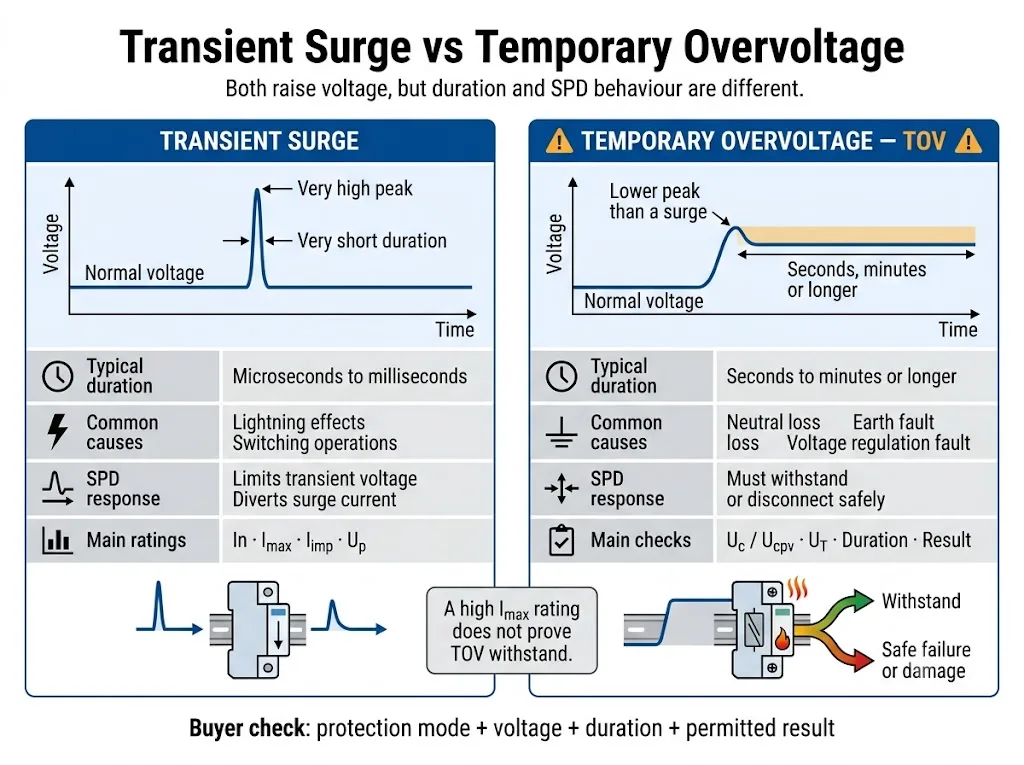
Un SPD puede sobrevivir a un impulso de rayo muy alto pero fallar durante un voltaje mucho más bajo que permanece durante segundos o más. Este voltaje anormal más prolongado se llama un sobretensión temporal, o TOV.
Para compradores de OEM y constructores de paneles, la resistencia al TOV es un parámetro de riesgo de adquisición. Ayuda a determinar si un SPD puede permanecer estable, desconectarse de manera controlada o sufrir daños graves cuando el voltaje del sistema supera su rango de operación continuo previsto.
Índice
¿Qué es la resistencia TOV de SPD?
Una sobretensión es un evento transitorio corto que un SPD está diseñado para limitar. Un TOV es un voltaje de frecuencia de alimentación anormal o de cc que permanece el tiempo suficiente para crear estrés eléctrico y térmico sostenido.[1][2][4]
La resistencia TOV no es un solo número de voltaje aislado. Una declaración significativa debe identificar el modo de protección, el voltaje aplicado, la duración y el resultado esperado.
- Uc o Ucpv cubre voltaje continuo. El voltaje de operación real debe mantenerse dentro de la calificación declarada.
- UT describe una condición anormal definida. Debe leerse junto con la duración y el resultado de la prueba.
- Un Uc bajo puede aumentar la sensibilidad TOV. La conducción sostenida de MOV puede causar calentamiento y desconexión.
- Un Imax alto no prueba la resistencia TOV. Los riesgos de corriente de impulso y voltaje sostenido son diferentes.
Decisión de aprobación rápida para compradores
Utilice esta tabla antes de aprobar una muestra, un artículo de BOM o un modelo de marca privada. Es una herramienta de cribado, no un substituto para la ingeniería de proyectos.
| Decisión | Hallazgo | Acción requerida |
|---|---|---|
| Aprobar | Los datos exactos del modelo coinciden con el voltaje del sistema, el modo de protección, la condición TOV y los requisitos de cortocircuito. | Proceder a la aprobación de la muestra o del BOM, sujeto a la revisión completa del proyecto. |
| Sostener | El UT se muestra sin duración, el resultado de fallo seguro no es claro, o el alcance del certificado no identifica el modelo exacto. | Solicitar la condición de prueba faltante, el alcance del informe e información de instalación. |
| Rechazar | La tensión máxima normal excede Uc o Ucpv, el tipo de aplicación es incorrecto o el modo de protección requerido no es compatible. | Seleccionar otro modelo o corregir la especificación del sistema antes de realizar el pedido. |
Un producto no debe ser aprobado solo por una etiqueta frontal, valor de Imax o una declaración general de “resistente a TOV”.
- TOV versus sobretensión
- Cómo leer una clasificación TOV
- Uc, Ucpv y UT
- Por qué el TOV daña un SPD
- Diferencias entre modos de protección
- Riesgos en la distribución de CA
- Ejemplo de hoja de datos
- Límite entre CC y FV
- Flujo de verificación OEM
- Comprobaciones después de un evento TOV
- Preguntas frecuentes del comprador
TOV y sobrevoltaje son eventos eléctricos diferentes
Ambos eventos elevan el voltaje por encima de su nivel normal. Las diferencias importantes son la duración, la fuente de energía y la forma en que responde el SPD.
| Comparación | Sobretensión transitoria | Sobretensión temporal |
|---|---|---|
| Naturaleza | Un impulso breve de voltaje o corriente con un pico alto. | Un voltaje RMS de CA o CC anómalo que permanece presente. |
| Posibles causas | Efectos de rayo, conmutación e interrupción de cargas inductivas. | Pérdida de neutro, fallas a tierra, mala regulación, voltaje de alimentación incorrecto o fallas de la fuente. |
| Función del SPD | Limita el voltaje transitorio y desvía la corriente de impulso. | Debe permanecer estable o entrar en la condición controlada de fin de vida declarada. |
| Clasificaciones principales | In, Imax, Iimp y Up. | Uc o Ucpv, UT, modo de protección, duración y resultado. |
| Riesgo principal | Energía de impulso excesiva o estrés acumulado por sobretensión. | Conducción continua, calentamiento, fuga térmica o seguimiento de corriente de falla. |
La norma aplicable y la documentación del producto determinan la duración exacta de la prueba de TOV. No aplique un único umbral de tiempo a todos los sistemas o SPD.
Se necesitan cuatro campos para entender una calificación de TOV
Afirmaciones como “alta resistencia a TOV” o “SPD a prueba de TOV” no constituyen datos de ingeniería completos. Los compradores necesitan cuatro campos específicos.
| Campo obligatorio | Lo que significa | Impacto en la adquisición |
|---|---|---|
| Modo de protección | Los dos conductores entre los que se aplica la tensión anómala. | Los trayectos L-N, L-PE y N-PE pueden experimentar distintas tensiones de falla. |
| Tensión aplicada | La tensión de prueba TOV en CA RMS o CC especificada, a menudo identificada como UT. | Compárela con la tensión anómala creíble en el sistema real. |
| Duración | Cuánto tiempo se aplica la tensión anómala durante la condición indicada. | Un SPD puede soportar una tensión brevemente pero desconectarse durante una exposición más prolongada. |
| Resultado | El comportamiento requerido después o durante la prueba. | Determinar si el SPD sigue funcionando, se desconecta o requiere reemplazo. |
Uc, Ucpv y UT no significan lo mismo
Uc es la tensión máxima continua de funcionamiento que puede aplicarse de forma continua al modo de protección del SPD indicado. Ucpv es el parámetro correspondiente utilizado para los SPD fotovoltaicos.[1][2][6]
UT describe el comportamiento durante una condición anormal de sobretensión temporal especificada. Uc o Ucpv y UT están relacionados, pero uno no puede sustituir al otro.
| Parámetro | Pregunta respondida | Riesgo de aprobación |
|---|---|---|
| Un o Uo | ¿Cuál es la tensión nominal del sistema o de fase a neutro? | Es un punto de partida, no el valor final de selección de tensión del SPD. |
| Uc | ¿Puede el SPD permanecer conectado continuamente a esta tensión? | Un valor demasiado bajo puede aumentar la corriente de fuga, el calentamiento y la desconexión prematura. |
| Ucpv | ¿Puede el SPD para FV permanecer conectado a la tensión máxima calculada del arreglo? | La tensión de funcionamiento normal del inversor por sí sola no es suficiente. |
| UT | ¿Qué sucede bajo la tensión y duración anormales indicadas? | Un valor de tensión sin duración y resultado es incompleto. |
| Arriba | ¿Qué nivel de protección de tensión se declara durante la prueba de sobretensión especificada? | Un valor de Uc más alto no proporciona automáticamente la coordinación de protección más adecuada. |
¿Por qué un valor de Uc bajo puede causar un fallo?
La mayoría de los SPD de limitación de tensión para alimentación de CA utilizan uno o más varistores de óxido metálico (MOV). Bajo tensión normal, un MOV solo transporta una pequeña corriente de fuga.
Cuando la tensión aplicada supera el rango de funcionamiento estable del componente, la corriente del MOV puede aumentar bruscamente. Si la tensión anormal persiste, la energía eléctrica se convierte en calor en lugar de manejarse como un impulso corto de sobretensión.[9]
¿Es siempre mejor un valor de Uc más alto?
No. Un valor de Uc más alto puede aumentar el margen de tensión continua, pero el SPD seleccionado debe proporcionar aun así un nivel de protección (Up) adecuado, el modo de protección correcto y la coordinación con el equipo protegido.
La elección correcta no es simplemente el valor de Uc más alto disponible. Se trata de una clasificación que cubre de forma segura la tensión máxima de funcionamiento real y las condiciones de fallo creíbles, cumpliendo al mismo tiempo con el nivel de protección requerido.[3]
¿Cómo puede TOV hacer que un SPD se calienta, desconecte o se queme?
La respuesta exacta depende de la tecnología del SPD, la construcción interna y el fallo del sistema. A continuación se muestra una secuencia de fallo típica basada en MOV.
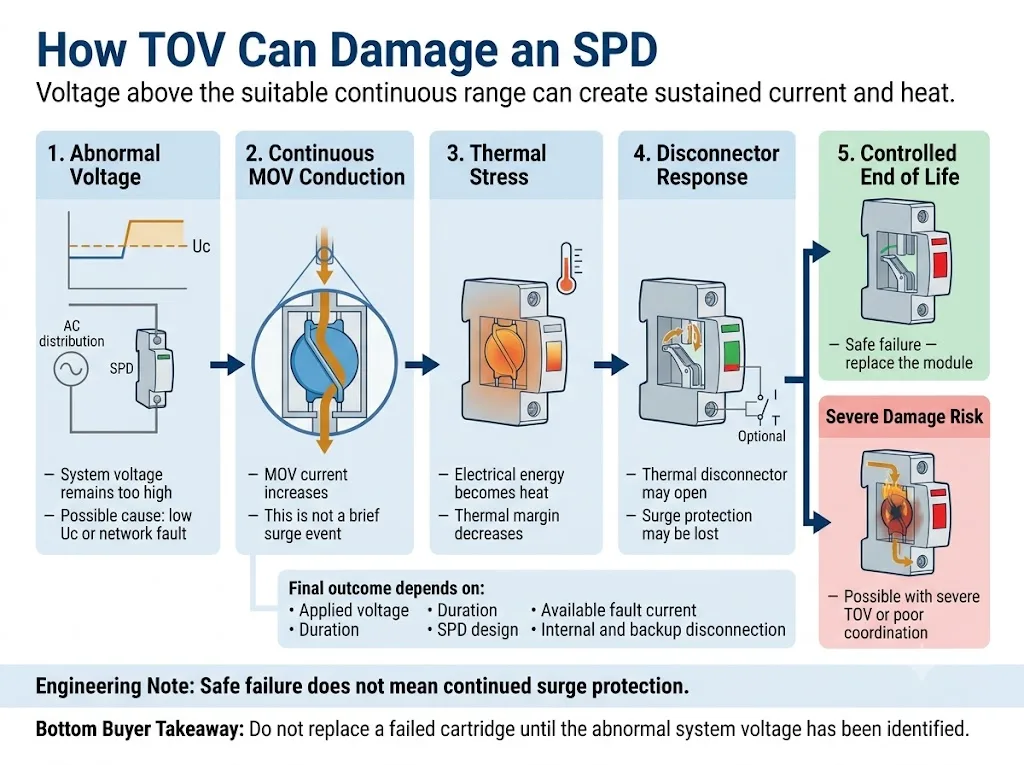
- La tensión aplicada excede el rango continuo adecuado. Esto puede ser el resultado de una selección de Uc baja o de una condición anormal del sistema.
- El componente de limitación de tensión conduce continuamente. El SPD está consumiendo corriente de frecuencia industrial o CC en lugar de manejar un solo impulso corto.
- La temperatura interna aumenta. La entrada continua de energía reduce el margen térmico restante.
- El desconectador térmico puede abrirse. Una desconexión controlada puede aislar el componente sometido a esfuerzo y cambiar el indicador de estado.
- Aún es posible que se produzcan daños graves. Una TOV severa, una alta corriente de falla disponible o una desconexión inadecuada pueden ampliar el fallo.
La investigación sobre TOV realizada por el NIST descubrió que las respuestas de los SPD bajo tensión anormal sostenida pueden variar desde la ausencia de daños hasta la destrucción total. El documento identifica la tensión máxima de funcionamiento continuo y la respuesta del desconectador como factores importantes en la susceptibilidad a las TOV.[9]
TOV debe ser verificado para cada modo de protección
Un SPD multipolar no está expuesto a una única tensión. Cada elemento de protección observa la tensión entre los dos conductores conectados a esa ruta de protección.
| Modo de protección | Pregunta de selección normal | Riesgo de TOV a confirmar |
|---|---|---|
| L-N | ¿Cuál es la tensión máxima continua fase-neutro? | Pérdida de neutro, conexión de neutro deficiente y desequilibrio de carga. |
| L-PE | ¿Qué tensión puede aparecer entre el conductor de fase y tierra? | Fallas a tierra, desplazamiento de neutro y comportamiento del sistema de puesta a tierra. |
| N-PE | ¿Qué tecnología de protección N-PE y valor nominal se utilizan? | Tensión temporal neutro-tierra durante ciertas condiciones de falla a tierra. |
| CC +/− | ¿Cuál es la tensión máxima de CC polo a polo? | Tensión de carga, fallos de regulación y configuración incorrecta del circuito. |
| CC polo-PE | ¿Cómo se referencia el sistema de CC a tierra? | Una falla a tierra puede desplazar la tensión a través de una ruta de protección polo a tierra. |
¿Por qué la pérdida de neutro es un escenario crítico de TOV en CA?
En un sistema trifásico de cuatro hilos de 230/400 V en buen estado, una ruta de protección L-N observa normalmente unos 230 V.
Si el conductor neutro se abre o desarrolla una alta impedancia, el punto neutro deja de ser estable. Con cargas monofásicas desequilibradas, algunas tensiones L-N pueden disminuir mientras que otras aumentan sustancialmente y pueden acercarse a la tensión de línea a línea de 400 V.[4][9]
Suministro en buen estado frente a la condición de pérdida de neutro
Un SPD con Uc de 275 V puede ser adecuado para un circuito L-N estable de 230 V cuando se cumplen los requisitos completos del sistema y del producto.
Si la pérdida de neutro provoca que la misma ruta de protección experimente una tensión sostenida mucho mayor, el SPD puede empezar a conducir continuamente. Si resiste, se desconecta de forma segura o sufre daños debe confirmarse con los datos de TOV del modelo exacto.
Este ejemplo no prueba que cada evento de pérdida de neutro produzca exactamente 400 V. La tensión real depende de las cargas conectadas, la disposición de la red y la condición de falla.
Fallas a tierra y esquema de puesta a tierra
Los sistemas TN-S, TN-C-S, TT e IT pueden generar diferentes tensiones temporales en las rutas de protección L-N, L-PE y N-PE. El esfuerzo real depende del esquema de instalación y de la condición de falla.[3][4]
Esto es especialmente importante al comparar circuitos 4+0 y 3+1. Los módulos L-N y el elemento N-PE realizan funciones distintas y no debe asumirse que tienen un comportamiento TOV idéntico.
Generadores, transformadores y redes inestables
Las fallas en la regulación del generador, los errores en los taps del transformador, el rechazo de carga, la ferroresonancia y una regulación deficiente de la red eléctrica pueden generar tensiones anormales sostenidas.
Para estos proyectos, solicite los registros de tensión medidos o la tolerancia de tensión de diseño. La tensión nominal por sí sola no es suficiente para la aprobación final de Uc.
Los requisitos a nivel de instalación y las condiciones de TOV específicas del sistema deben verificarse de acuerdo con la edición aplicable de la norma IEC 60364 y el código eléctrico local. El relacionado Guía de instalación de SPD según IEC 60364-5-534 explica las comprobaciones de instalación más amplias.
Cómo leer una entrada de hoja de datos de TOV real
El siguiente ejemplo utiliza valores publicados en la guía técnica de un fabricante externo. Explica solo el método de lectura. No es una recomendación para un modelo LEEYEE y no debe trasladarse a otro producto sin verificación.[10]
| Entrada publicada | Interpretación correcta | Suposición errónea a evitar |
|---|---|---|
| Uc 275 V | La máxima tensión de funcionamiento continuo declarada para el modo de protección indicado. | El producto puede funcionar de forma continua a cualquier tensión inferior a su valor UT más alto. |
| UT 337 V / 5 s | Una condición de TOV de corta duración con el resultado indicado en la misma documentación del producto. | 337 V es otro valor nominal de tensión de funcionamiento continuo. |
| UT 442 V / 120 min | Una condición de mayor duración asociada con un resultado de falla segura declarado. | El SPD sigue protegiendo normalmente durante dos horas a 442 V. |
| Valor N-PE independiente | Una condición TOV declarada específicamente para el elemento de protección N-PE. | El mismo valor se aplica automáticamente a los elementos L-N y L-PE. |
¿Qué debe verificarse en un modelo LEEYEE?
No asuma que un ejemplo de un tercero representa un producto LEEYEE. Solicite la hoja de datos exacta del modelo LEEYEE, el esquema de conexión y el alcance de la prueba o certificado aplicable para la confirmación del proyecto.
Evidencia específica del modelo que se debe solicitar
- Producto exacto y etiqueta del cartucho
- Uc o Ucpv para el modo de protección indicado
- Tensión UT, duración y resultado declarado
- Operación de la ventana de estado visual
- Información de contacto de señalización remota
- Requisitos de desconexión interna y externa
- Clasificación Isccr o ISCPV cuando corresponda
- Requisitos de fusibles de respaldo o MCB
- Instrucciones de instalación y cableado
- Alcance del informe o certificado específico del modelo
- Dibujo de aprobación de etiqueta y embalaje OEM
- Registro de inspección y aprobación de muestras
La evidencia debe revisarse a nivel del modelo exacto. No debe asumirse que un certificado, informe u hoja de datos para una versión de voltaje o configuración de polos cubre otra distinta.
¿Las conclusiones de TOV en CA se aplican directamente a SPDs de CC o PV?
No. Los circuitos generales de CC y fotovoltaicos solares requieren cálculos de voltaje, modos de protección y normas de producto independientes.
La norma IEC 61643-41:2025 cubre los SPD conectados a circuitos de alimentación de baja tensión de CC general. Los SPD fotovoltaicos permanecen bajo la norma IEC 61643-31, con principios de selección abordados por la norma IEC 61643-32.[5][6][7]
Utilice la guía de selección de Ucpv para SPD de CC y PV por separado para el proceso completo de selección de voltaje fotovoltaico.
Flujo de trabajo de verificación de SPD TOV para aprobación de OEM
Confirme el sistema eléctrico antes de aprobar el SPD. El flujo de trabajo a continuación mantiene conectados los datos del sistema, las clasificaciones de los productos y los documentos de aprobación.
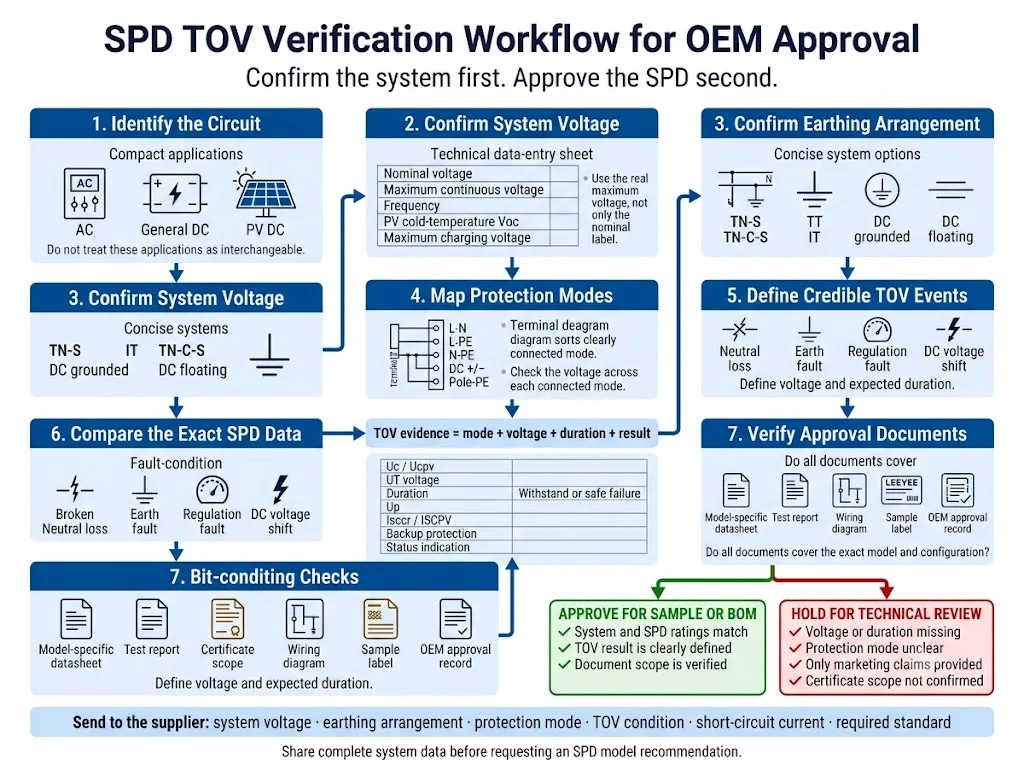
- Identifique el circuito. Separe las aplicaciones de red de CA, CC general y energía solar fotovoltaica. Las carcasas similares no hacen que los productos sean intercambiables.
- Confirme el voltaje operativo máximo real. Incluya la tolerancia de suministro, el comportamiento del generador o transformador, el voltaje de carga o el voltaje de temperatura fría fotovoltaica.
- Confirme la disposición de la puesta a tierra. Registre TN-S, TN-C-S, TT, IT o el método de conexión a tierra de CC pertinente.
- Mapee cada modo de protección. Compruebe las rutas L-N, L-PE, N-PE, polo a polo y polo a tierra según corresponda.
- Defina eventos TOV creíbles. Revise la pérdida de neutro, fallas a tierra, fallas de regulación y condiciones anormales específicas de la fuente.
- Compare los datos completos del SPD. Revise Uc o Ucpv, UT, duración, resultado, Up, clasificación de cortocircuito y disposición de desconexión.
- Verifique el alcance del documento de aprobación. Confirme que la ficha técnica, el informe y el certificado se aplican exactamente a la versión de voltaje, la configuración de polos y el modelo solicitados.
Información a enviar antes de solicitar una recomendación de modelo
- Voltaje nominal del sistema
- Voltaje máximo continuo
- Aplicación de CA, CC general o FV
- Frecuencia del sistema, cuando proceda
- Disposición de puesta a tierra o conexión a tierra
- Modos de protección requeridos
- Escenario de pérdida de neutro o fallo a tierra
- Uc o Ucpv a considerar
- Voltaje y duración de TOV requeridos
- Resultado requerido de resistencia o fallo seguro
- Corriente de cortocircuito prospectiva
- Información sobre el fusible de respaldo o el MCB
- Estándar o certificado requerido
- Requisito de señalización remota
- Cantidad y posición de instalación
- Requisito de etiqueta OEM o embalaje
Confirmar los datos de TOV antes de aprobar el modelo SPD
Envíe el voltaje del sistema, la disposición de la puesta a tierra, los modos de protección y las condiciones de voltaje anormales creíbles. LEEYEE puede ayudar a identificar qué datos de Uc, Ucpv y TOV deben verificarse antes de la aprobación de la muestra o la lista de materiales (BOM).
CNSPD es la plataforma de LEEYEE centrada en protección contra sobretensiones para compradores técnicos globales. Construido para Proteger. Confiable para Durar.
Comparta los detalles de su sistema para revisión¿Qué se debe revisar después de un evento sospechoso de TOV?
No instale un cartucho de repuesto antes de identificar el voltaje anormal original. Un nuevo SPD podría volver a fallar si el fallo del sistema persiste.
- Aísle el circuito de acuerdo con el procedimiento de seguridad eléctrica del sitio.
- Registre el indicador del SPD, la alarma remota y la etiqueta completa del producto.
- Mida los voltajes L-N, L-L, L-PE, N-PE o de polos de CC según corresponda.
- Compruebe la continuidad del neutro, la puesta a tierra y el diagrama unifilar actual.
- Inspeccione el cartucho, la base, los conductores, los terminales y la protección de respaldo.
- Revise los registros de generadores, transformadores, inversores, relés y eventos de la red eléctrica.
- Confirme los datos de Uc, Ucpv, TOV y la configuración de protección del repuesto.
Para un proceso de diagnóstico más amplio, utilice la guía de causas de fallo de SPD.
Preguntas frecuentes sobre la resistencia de SPD TOV
¿Puede un SPD proteger los equipos contra una sobretensión temporal?
Un SPD está diseñado principalmente para limitar las sobretensiones transitorias. Normalmente no regula ni elimina un voltaje anormal sostenido del sistema. Durante una TOV, puede permanecer estable o entrar en su condición declarada de fin de vida útil controlada.
¿Puede la TOV provocar que un SPD se queme?
Sí. La conducción sostenida puede provocar calentamiento, embalamiento térmico, desconexión o daños graves. El resultado depende de la tensión, la duración, el diseño del SPD, la corriente de falla disponible y la coordinación de los dispositivos de protección.
¿Un Imax mayor mejora la resistencia a las TOV?
No necesariamente. Imax es un parámetro de corriente de impulso. La idoneidad frente a TOV depende de la tensión de funcionamiento continuo, el modo de protección, el comportamiento definido ante TOV y el diseño de desconexión.
¿Una Uc más elevada evita cualquier fallo por TOV?
No. Una Uc más elevada puede aumentar el margen de tensión continua, pero la duración, el modo de protección, la tecnología del SPD y el comportamiento de desconexión siguen afectando al resultado.
¿Puede la pérdida del neutro dañar un SPD de 275 V o 320 V?
Puede hacerlo. El desplazamiento del neutro en un sistema trifásico de cuatro hilos puede elevar la tensión en una trayectoria de protección L-N muy por encima de lo normal. El resultado depende de la tensión real, la duración y el comportamiento ante TOV específico del modelo.
¿Qué significa fallo seguro?
Significa que puede permitirse una desconexión controlada o el fin de la vida útil bajo las condiciones de ensayo establecidas. No significa que el módulo continúe proporcionando protección contra sobretensiones.
¿Es la Ucpv lo mismo que la tensión nominal de un sistema fotovoltaico?
No. Ucpv es la tensión máxima de funcionamiento continuo declarada para el SPD fotovoltaico. Debe comprobarse frente a la tensión máxima calculada para la configuración real de la matriz fotovoltaica y la protección.
¿Qué documentos sobre TOV debería solicitar un comprador OEM?
Solicite la hoja de datos del modelo exacto, el diagrama del modo de protección, la Uc o Ucpv, la tensión UT, la duración, la definición del resultado, el valor nominal de cortocircuito, los requisitos de protección de reserva, las instrucciones de instalación y el alcance del certificado.
Referencias
- Comisión Electrotécnica Internacional, IEC 61643-01:2024 — Dispositivos de protección contra sobretensiones de baja tensión — Parte 01: Requisitos generales y métodos de ensayo. Página de publicación oficial de la IEC.
- Comisión Electrotécnica Internacional, IEC 61643-11:2025 — Dispositivos de protección contra sobretensiones de baja tensión — Parte 11: Dispositivos de protección contra sobretensiones conectados a sistemas de alimentación de baja tensión de CA — Requisitos y métodos de ensayo. Página de publicación oficial de la IEC.
- Comisión Electrotécnica Internacional, IEC 61643-12:2020 — Dispositivos de protección contra sobretensiones de baja tensión — Parte 12: Dispositivos de protección contra sobretensiones conectados a sistemas de potencia de baja tensión — Principios de selección y aplicación. Página de publicación oficial de la IEC.
- Comisión Electrotécnica Internacional, IEC 60364-4-44:2024 — Instalaciones eléctricas de baja tensión — Parte 4-44: Protección para la seguridad — Protección contra perturbaciones de tensión y perturbaciones electromagnéticas. Página de publicación oficial de la IEC.
- Comisión Electrotécnica Internacional, IEC 61643-41:2025 — Dispositivos de protección contra sobretensiones de baja tensión — Parte 41: Dispositivos de protección contra sobretensiones conectados a sistemas de potencia de baja tensión de CC — Requisitos y métodos de ensayo. Página de publicación oficial de la IEC.
- Comisión Electrotécnica Internacional, IEC 61643-31:2018 y Corrigendum 1:2022 — Requisitos y métodos de ensayo para SPD para instalaciones fotovoltaicas. Página de publicación oficial de la IEC.
- Comisión Electrotécnica Internacional, IEC 61643-32:2017 y Corrigendum 1:2019 — Dispositivos de protección contra sobretensiones conectados al lado de CC de instalaciones fotovoltaicas — Principios de selección y aplicación. Página de publicación oficial de la IEC.
- Comisión Electrotécnica Internacional, IEC 60364-7-712:2025 — Instalaciones eléctricas de baja tensión — Instalaciones de suministro de energía solar fotovoltaica. Página de publicación oficial de la IEC.
- D. Kladar, F. Martzloff y D. Nastasi, Efectos de las TOV en dispositivos de protección contra sobretensiones, Eaton Electrical y EPRI Solutions, organizado por el Instituto Nacional de Estándares y Tecnología de los EE. UU. (NIST). Documento técnico organizado por el NIST.
- ABB Furse, Guía de productos de la serie de protección contra sobretensiones ESP Tipo 1 y Tipo 2, que incluye datos específicos del modelo sobre Uc, UT, resistencia y fallo seguro. Guía técnica oficial de ABB.