
No estoy seguro si ordenar un 3P+N SPD o un SPD 4P para un tablero de distribución trifásico?
Esta es una pregunta común para los fabricantes de paneles, distribuidores eléctricos, compradores de OEM e ingenieros de proyectos. Los dos productos pueden parecer similares desde el exterior. Ambos pueden tener cuatro módulos. Ambos pueden ser utilizados en sistemas trifásicos con neutro.
Pero internamente, pueden usar diferentes estructuras de protección. La clave diferencia no es solo el número de polos. La clave diferencia a menudo es el camino de protección entre neutro y tierra, también llamado protección N-PE.
Índice
Respuesta Rápida: ¿Cuál es la diferencia entre SPD 3P+N y SPD 4P?
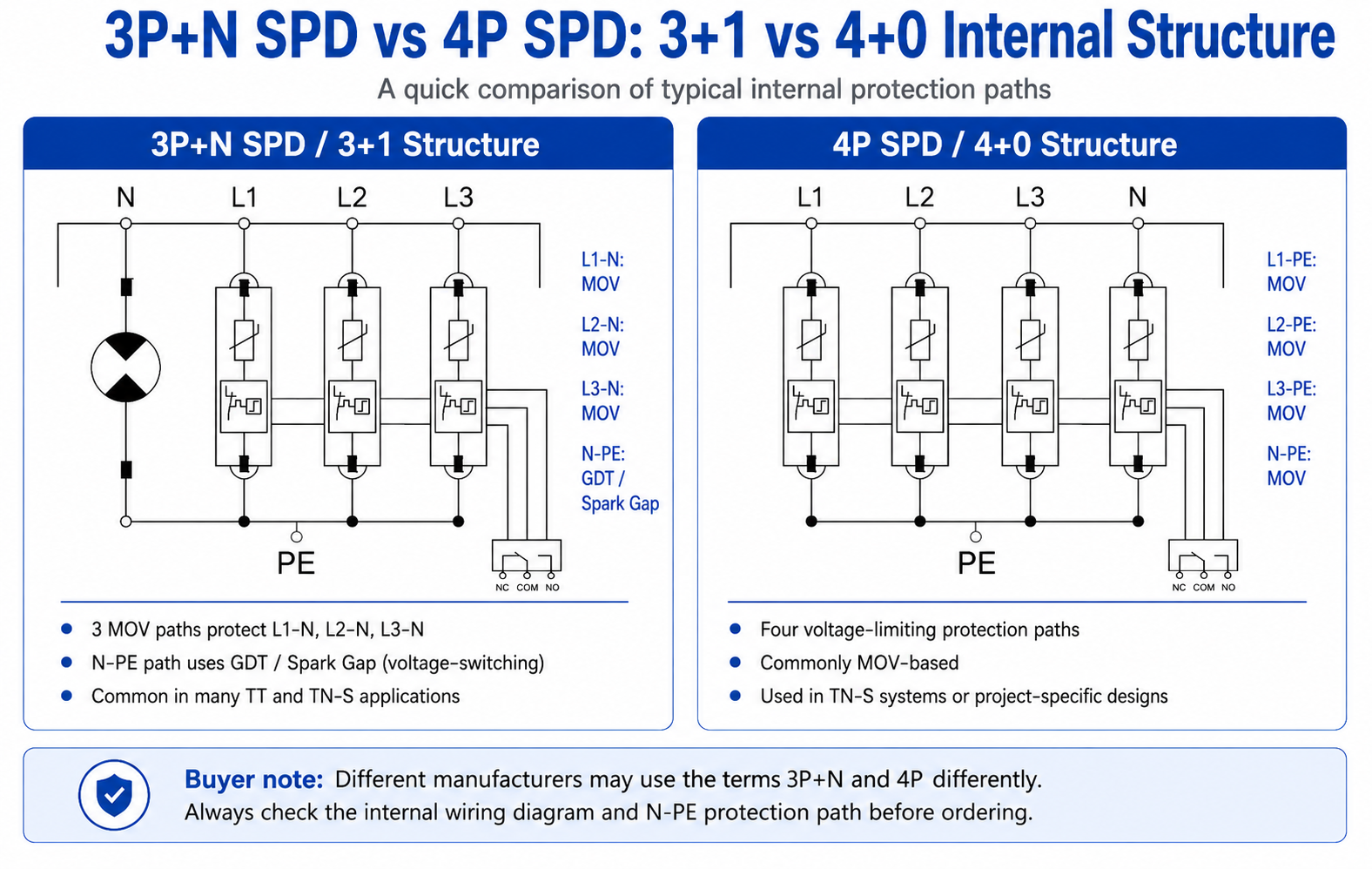
A SPD 4P generalmente se refiere a una estructura 4+0.. En este diseño, los caminos de protección L1-PE, L2-PE, L3-PE y N-PE son comúnmente caminos limitadores de voltaje, a menudo basados en MOV.
A 3P+N SPD generalmente se refiere a una estructura 3+1.. En este diseño, L1-N, L2-N y L3-N utilizan caminos de protección MOV, mientras que el camino N-PE a menudo utiliza un componente de conmutación de voltaje como un GDT o espacio de chispa..
| Artículo | 3P+N SPD | SPD 4P |
|---|---|---|
| Estructura común | 3+1 | 4+0 |
| Protección de fase | Caminos MOV L1-N, L2-N, L3-N | Caminos limitadores de voltaje L1-PE, L2-PE, L3-PE |
| protección N-PE | Generalmente GDT / brecha de chispa | Generalmente basado en MOV, dependiendo del diseño |
| Uso común | TT, TN-S, TN-C-S después de la separación de PEN | Diseños TN-S o específicos del proyecto |
| Advertencia al comprador | Confirme el tipo de módulo N-PE | Confirme el diagrama de cableado interno |
Regla simple: no elija solo por las palabras “3P+N” o “4P” en el nombre del producto. Siempre verifique el sistema de tierra y el diagrama de cableado del fabricante.
¿Qué significa SPD 3P+N?
A 3P+N SPD se utiliza comúnmente para sistemas de energía trifásicos con neutro.
También se le llama SPD 3PN, SPD 3+1, SPD trifásico con neutro, o SPD con protección N-PE.
En un diseño típico 3+1, el SPD protege:
- L1 a N
- L2 a N
- L3 a N
- N a PE
Los caminos de fase generalmente están protegidos por componentes limitadores de voltaje como MOVs. El camino N-PE a menudo está protegido por un componente de conmutación de voltaje como un GDT o una brecha de chispa.
Este diseño es importante porque el conductor neutro puede elevarse en potencial durante condiciones de sobretensión o falla. El módulo N-PE ayuda a descargar esta sobreintensidad a tierra durante eventos de sobretensión.
¿Qué significa SPD 4P?
A SPD 4P significa dispositivo de protección contra sobretensiones de cuatro polos.
En muchas gamas de productos, un SPD 4P se refiere a un. estructura 4+0.. Utiliza cuatro caminos de protección limitadores de voltaje, comúnmente basados en MOV.
Un SPD 4P puede proteger cuatro conductores en un sistema trifásico con neutro. Pero el nombre solo no es suficiente.
Diferentes fabricantes pueden usar “4P” de manera diferente. Algunos proveedores usan 4P para una estructura 4+0. Algunos compradores usan 4P para referirse a cualquier SPD de cuatro módulos. En algunos mercados, un producto 3P+N también puede llamarse SPD de cuatro polos porque tiene cuatro módulos físicos.
Nota del comprador: antes de hacer un pedido, verifica el diagrama de circuito interno. Esto es más confiable que el nombre del polo.
3P+N vs 4P SPD: Comparación Principal
| Punto de selección. | 3P+N SPD | SPD 4P |
|---|---|---|
| También llamado | SPD 3PN, SPD 3+1 | SPD de 4 polos, SPD 4+0 |
| Concepto interno | Tres caminos fase-neutro más un camino N-PE | Cuatro caminos de protección de limitación de voltaje |
| protección N-PE | Normalmente interruptor de voltaje | Normalmente limitador de voltaje, dependiendo del diseño |
| Componente típico N-PE | GDT o espacio de chispa. | MOV, dependiendo del diseño del fabricante |
| Sistemas de aterrizaje comunes | TT, TN-S, TN-C-S después de la separación de PEN | Sistemas TN-S o específicos del proyecto |
| Mejor para | Sistemas donde la protección neutro-tierra es importante | Sistemas donde el esquema requiere protección 4+0 |
| Riesgo principal si se selecciona incorrectamente | Diseño de protección N-PE incorrecto | Conexión a tierra incorrecta o estructura interna inadecuada |
| El comprador debe confirmar | Tipo de módulo N-PE | Diagrama de circuitos y sistema de aplicación |
Por qué importa la ruta de protección N-PE
La diferencia más importante es el Camino N-PE.
En un sistema trifásico con neutro, la sobretensión puede aparecer no solo entre fase y neutro. También puede aparecer entre neutro y tierra de protección.
Esto es especialmente importante en sistemas TT y algunas instalaciones TN-S o TN-C-S.
Un SPD 3P+N normalmente utiliza un módulo N-PE especial. Este módulo a menudo es un gap de chispa o GDT. Permanece aislado durante el funcionamiento normal y conduce durante eventos de sobretensión.
Esto ayuda a reducir la corriente de fuga durante el funcionamiento normal. También ayuda a manejar la sobretensión de neutro a tierra durante condiciones de sobretensión.
Un SPD 4P puede usar protección basada en MOV en los cuatro caminos. Esto puede ser adecuado para algunos sistemas, pero no es automáticamente mejor.
La pregunta real es sencilla:
¿Qué necesita su sistema entre N y PE?
¿Es el SPD 3P+N lo mismo que el SPD 4P?
No, no siempre.
Pueden parecer similares. Ambos pueden tener cuatro módulos. Ambos pueden ser instalados en un cuadro de distribución trifásico con neutro.
Pero eléctricamente, pueden ser diferentes.
A 3P+N SPD normalmente significa un circuito 3+1. A SPD 4P normalmente significa un circuito 4+0.
La diferencia es la cuarta ruta de protección.
En un SPD 3P+N, la cuarta ruta suele ser la protección N-PE con un componente de conmutación. En un SPD 4P, la cuarta ruta suele ser otra ruta de protección de limitación de voltaje.
No preguntar solo: “¿”Tienen SPD 4P?”
Preguntar en su lugar: “¿”¿Es este un SPD 4+0, o es un SPD 3P+N / 3+1 con protección de chispa N-PE?”
¿Qué SPD debe usarse en sistemas TT?
Para muchos sistemas TT trifásicos, un SPD 3P+N / SPD 3+1 es comúnmente preferido.
En los sistemas TT, el neutro y la tierra protectora son separados. La ruta N-PE puede volverse importante durante eventos de sobretensión.
Un diseño 3+1 proporciona protección específica contra sobretensiones entre el neutro y la tierra.
Para un tablero de distribución TT 230/400V, los compradores a menudo preguntan por:
- SPD 3P+N Tipo 2
- SPD 3P+N Tipo 1+2
- 275V, 320V, o 385V Uc dependiendo del voltaje del sistema y la condición de la red
- Contacto de señal remota si es necesario
- Montaje en riel DIN
- Cumplimiento de IEC 61643-11
Para sistemas TT, no elija un SPD de 4P solo porque tiene cuatro módulos. Confirme si el diseño es adecuado para el uso en TT y si la ruta N-PE es correcta.
¿Qué SPD debe usarse en sistemas TN-S?
En sistemas TN-S, el neutro y el PE son conductores separados.
Tanto las configuraciones 3P+N como 4P pueden aparecer en el mercado. La elección correcta depende del diseño del proyecto, la práctica local y el diagrama de circuito del SPD.
Para muchos compradores, un SPD 3P+N es una elección común cuando la placa tiene L1, L2, L3, N y PE.
Pero un SPD de 4P también puede ser especificado en algunos tableros de distribución TN-S.
El punto importante es este:
TN-S no significa automáticamente 4P. TN-S tampoco significa automáticamente 3P+N.
Necesita confirmar si el proyecto requiere una estructura 3+1 o 4+0.
¿Qué SPD debe usarse en sistemas TN-C-S?
Los sistemas TN-C-S necesitan más atención.
En un sistema TN-C-S, el PEN se combina en una parte del sistema y se separa en PE y N en otro punto.
Antes de la separación del PEN, no hay neutro independiente ni PE. Después de la separación del PEN, el sistema se comporta más como una sección TN-S.
Por lo tanto, la selección del SPD depende del punto de instalación.
| Punto de instalación | Elección común de SPD | Razón |
|---|---|---|
| Antes de la separación del PEN | SPD de 3P | L1, L2 y L3 están protegidos hasta el PEN. N y PE aún no están separados. |
| Después de la separación del PEN | SPD de 3P+N o 4P | N y PE están disponibles como conductores separados. Trate esta sección más como TN-S. |
| Dentro del tablero de distribución final | Confirmar el dibujo del proyecto | La estructura correcta depende del camino N-PE, la disposición RCD y los requisitos del proyecto. |
Esta es una fuente común de errores. Un comprador puede decir: “Mi sistema es TN-C-S, por favor, deme 4P SPD.” Pero el proveedor aún necesita saber dónde se instalará el SPD.
¿Qué SPD debe usarse en sistemas TN-C?
En un sistema TN-C, el neutro y la tierra de protección se combinan como PEN.
No hay un conductor N y PE separado en el punto de instalación.
Por esta razón, un SPD de tres polos se utiliza comúnmente para la protección de L1, L2 y L3 hacia PEN.
Un SPD 3P+N normalmente no se usa antes de la separación de PEN porque no hay un camino N-PE separado.
Tabla de Selección: TT vs TN-S vs TN-C-S vs TN-C
| Sistema de puesta a tierra | ¿Neutro disponible? | ¿PE separado? | Elección común de SPD | Nota del Comprador |
|---|---|---|---|---|
| TT | Sí | Sí | 3P+N / 3+1 | La protección contra sobretensiones N-PE es importante |
| TN-S | Sí | Sí | 3P+N o 4P | Verificar el diseño 3+1 o 4+0 |
| TN-C-S antes de la separación de PEN | Sin N/PE separado | No | 3P | Proteger L1, L2, L3 a PEN |
| TN-C-S después de la separación de PEN | Sí | Sí | 3P+N o 4P | Tratar como sección TN-S |
| TN-C | Solo PEN | No | 3P | No asumir que se necesita 4P |
| TI | Depende | Depende | Específico del proyecto | Preguntar al ingeniero o proveedor |
Diferencia de Cableado: SPD 3P+N vs SPD 4P
Para este tema, el diagrama de cableado es muy importante.
Una explicación en texto no es suficiente para muchos compradores. Un fabricante de paneles necesita ver las verdaderas rutas de protección.
Concepto Típico SPD 3P+N
Una estructura SPD común 3P+N / 3+1 utiliza:
- L1 a N
- L2 a N
- L3 a N
- N a PE
Los primeros tres caminos suelen estar basados en MOV. El camino N-PE a menudo se basa en GDT o en un espacio de chispa.
Concepto típico 4P SPD
Una estructura común de 4P / 4+0 SPD utiliza cuatro rutas de protección de limitación de voltaje.
La ruta de cableado real depende del diseño del producto y del diagrama de circuito del fabricante.
Por eso, el dibujo debe ser verificado antes de hacer el pedido.
Aplicaciones Comunes
Los SPDs 3P+N y 4P se usan ampliamente en sistemas de distribución trifásicos de baja tensión.
| Aplicación | Requisito común |
|---|---|
| Cuadro de distribución principal | Tipo 1+2 o Tipo 2 SPD dependiendo del riesgo de rayos |
| Cuadro de subdistribución | DOCUP de tipo 2 |
| Panel de edificio comercial | 3P+N o 4P dependiendo del sistema de puesta a tierra |
| Gabinete de control industrial | SPD Tipo 2 con diagrama de cableado claro |
| Panel eléctrico OEM | Confirmar 3+1 o 4+0 antes de la producción |
| Combinador de AC solar / lado de distribución de AC | Confirmar sistema de red y tipo de SPD |
| Panel de sala de telecomunicaciones o de equipos | A menudo requiere contacto de señal remoto |
Errores Comunes al Comprar
Error 1: Pensar que 4P es siempre mejor que 3P+N
Más polos no siempre significan mejor protección.
Un SPD 4P puede ser correcto para un sistema. Un SPD 3P+N puede ser mejor para otro.
La elección correcta depende del sistema de puesta a tierra y del circuito interno.
Error 2: Tratar 3P+N y 4P como el mismo producto
Ambos pueden tener cuatro módulos. Pero la estructura de protección puede ser diferente.
Un SPD 3P+N a menudo tiene un módulo N-PE especial. Un SPD 4P puede no tenerlo.
Siempre revisa el diagrama del circuito.
Error 3: Ignorar las diferencias TT / TN-S / TN-C-S
Un producto que funciona en TN-S puede no ser la mejor opción para TT.
Un producto seleccionado después de la separación de PEN puede no ser correcto antes de la separación de PEN.
El sistema de puesta a tierra no es un pequeño detalle. Decide la estructura del SPD.
Error 4: Elegir solo por el voltaje Uc
Uc es importante. Pero Uc por sí solo no decide si necesitas un 3P+N o un 4P.
Por ejemplo, los SPDs de 275V, 320V y 385V pueden existir en diferentes configuraciones de polos.
Necesita confirmar tanto la clasificación eléctrica como la estructura del cableado interno.
Error 5: No confirmar la posición del RCD
En algunas instalaciones, la coordinación del RCD puede afectar la selección de SPD y el cableado.
Esto es especialmente importante en sistemas TT.
Antes de realizar el pedido, confirme si el RCD está aguas arriba o aguas abajo del SPD. Si no está seguro, envíe el plano del panel al proveedor.
Cómo Elegir: Proceso de Decisión Simple
Paso 1: Confirmar el sistema de puesta a tierra
Verifique si el sistema es TT, TN-S, TN-C-S, TN-C o IT. No adivine.
Paso 2: Confirmar N y PE
Verifique si el neutro y PE son separados, o si PEN sigue estando combinado.
Paso 3: Confirmar el circuito
Pregunte si el proyecto requiere 3+1, 4+0, espacio de chispa N-PE, u otra estructura.
Paso 4: Confirmar el tipo de SPD
Elija el tipo 1+2 o el tipo 2 de acuerdo con la posición de instalación y los requisitos del proyecto.
Selección Recomendada para Compradores
Para la mayoría de los compradores B2B, el nombre del producto no es suficiente.
Un mejor formato de consulta es:
Necesitamos un SPD para un tablero de distribución trifásico.
Sistema: TT / TN-S / TN-C-S.
Voltaje: 230/400V.
Configuración requerida: 3P+N / 3+1 o 4P / 4+0.
Tipo de SPD: Tipo 2 o Tipo 1+2.
Uc: 275V / 320V / 385V.
Señal remota: sí / no.
Por favor, recomiende un SPD adecuado para riel DIN con diagrama de cableado.
Esto le da al proveedor suficiente información para recomendar el modelo correcto.
Lista de Verificación Antes de Pedir
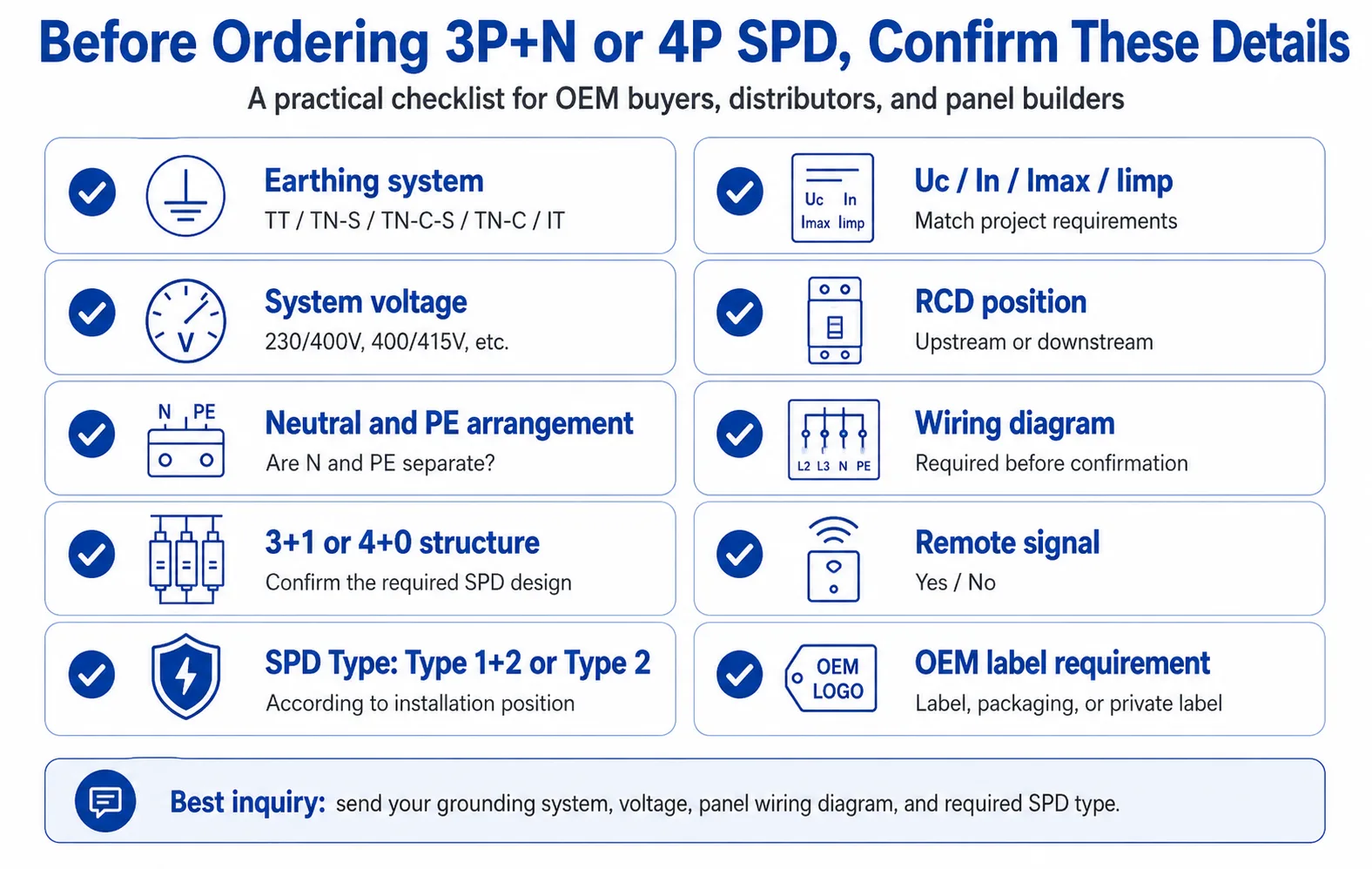
Antes de elegir un SPD 3P+N o 4P, confirme estos detalles:
- Sistema de puesta a tierra: TT, TN-S, TN-C-S, TN-C o IT
- Si hay neutro disponible
- Si el PE está separado del neutro
- Si el PEN ya se ha dividido
- Posición de instalación en el panel
- Tipo de SPD: Tipo 1, Tipo 1+2 o Tipo 2
- Estructura requerida: 3+1 o 4+0
- Requerimiento de protección N-PE
- Voltaje Uc
- Clasificación In, Imax e Iimp
- Requerimiento de fuse de respaldo
- Contacto de señal remota
- Posición del RCD
- Espacio en riel DIN
- Estándar o certificado requerido
- Requerimiento de etiqueta OEM o etiqueta privada
Dirección de Recomendación de Producto
Opción 1: SPD Tipo 2 3P+N
Adecuado para muchos cuadros de distribución TT y TN-S donde se requiere protección Tipo 2.
Común en cuadros de distribución comerciales, paneles de subdistribución, paneles eléctricos OEM y distribución de energía en edificios.
Opción 2: SPD Tipo 1+2 3P+N
Adecuado para instalaciones con mayor exposición a rayos o cuadros de distribución principal donde se requiere capacidad de descarga de corriente de rayo.
Común en paneles de entrada principal, edificios con protección externa contra rayos, suministro de línea aérea y distribución de energía industrial.
Opción 3: SPD Tipo 2 4P
Adecuado donde el plano del proyecto especifica un diseño de 4 polos / 4+0.
Común en cuadros de distribución TN-S, diseños de paneles específicos de proyectos y mercados donde SPD 4P es la práctica estándar de nomenclatura.
Opción 4: SPD 3P
Adecuado para sistemas TN-C o TN-C-S antes de la separación de PEN.
Común para sistemas trifásicos sin neutro separado, L1/L2/L3 a protección PEN, y tableros industriales con PEN combinado en el punto de instalación.
PREGUNTAS FRECUENTES
¿Es el SPD 3P+N lo mismo que el SPD 4P?
No. Pueden parecer similares, pero pueden tener diferentes circuitos internos. Un SPD 3P+N suele significar un diseño 3+1 con un módulo de protección N-PE especial. Un SPD 4P suele significar un diseño 4+0 con cuatro caminos de protección limitadores de voltaje. Siempre verifique el diagrama de cableado.
¿Cuál es la diferencia entre 3+1 y 4+0 SPD?
Un SPD 3+1 generalmente tiene tres rutas de protección fase-neutro y una ruta de conmutación de voltaje N-PE. Un SPD 4+0 generalmente tiene cuatro rutas de protección limitadora de voltaje. La mayor diferencia es cómo se maneja la protección neutro-tierra.
¿Qué SPD debo usar para un sistema TT?
Para muchos sistemas trifásicos TT, se selecciona comúnmente un SPD 3P+N / 3+1 porque la protección contra sobretensiones N-PE es importante. Sin embargo, la elección final debe seguir el diseño del proyecto, el estándar local y el diagrama de cableado del fabricante.
¿Qué SPD debo usar para un sistema TN-S?
Para sistemas TN-S, se pueden utilizar configuraciones de 3P+N y 4P dependiendo del diseño. El comprador debe confirmar si el proyecto requiere un circuito 3+1 o un circuito 4+0.
¿Puedo usar SPD de 4P en lugar de SPD de 3P+N?
No siempre. Un SPD 4P puede no tener la misma estructura de protección N-PE que un SPD 3P+N. Si el proyecto requiere protección 3+1, no lo reemplace por un SPD 4P sin verificar el diagrama de circuito.
¿Es mejor el SPD de 4P que el SPD de 3P+N?
El No. 4P no es automáticamente mejor. 3P+N y 4P son estructuras diferentes para sistemas diferentes. La mejor opción depende del sistema de puesta a tierra, la disposición del neutro y los requisitos de cableado.
¿Qué debo enviar al proveedor antes de hacer un pedido?
Envíe el sistema de toma de tierra, el voltaje del sistema, el diagrama de cableado del panel, el tipo de SPD, el voltaje Uc, la clasificación de corriente de descarga, los requisitos de señal remota y si necesita servicio de etiqueta de fabricante u opción de etiqueta privada.
¿Necesita Ayuda para Elegir entre SPD 3P+N o 4P?
Si no está seguro de qué estructura de SPD es adecuada para su tablero de distribución trifásico, envíenos el voltaje de su sistema, el sistema de puesta a tierra y el diagrama de cableado del panel.
LEEYEE puede ayudar a recomendar una configuración de SPD adecuada para tableros de distribución, paneles eléctricos OEM y pedidos de SPD de marca privada.