
Compara los dispositivos de protección contra sobretensiones Tipo 1, Tipo 2 y Tipo 3 por posición de instalación, forma de onda de prueba, clasificación de corriente y función de protección.
Índice
Encuentra la información que necesitas
Comparación rápida de SPD Tipo 1, Tipo 2 y Tipo 3
La forma más fácil de entender los tres tipos de SPD es conectar cada tipo con su posición normal en la instalación eléctrica.
| Tipo de SPD | Posición típica | Rol principal de protección | Deber de prueba principal | Clasificación clave común |
|---|---|---|---|---|
| Tipo 1 | Tablero de origen o de entrada principal | Descargas de corriente parcial de rayos de alta energía | Corriente de impulso de 10/350 μs | Iimp |
| Tipo 2 | Tablero principal o de subdistribución | Limita los picos de rayos inducidos y los sobrevoltajes por conmutación | Corriente de descarga de 8/20 μs | In e Imax |
| Tipo 3 | Cerca de equipos terminales sensibles | Limita la sobrevoltaje residual restante | Prueba de onda de combinación | Uoc y Up |
¿Qué es un Dispositivo de Protección contra Sobretensiones Tipo 1?
Un SPD Tipo 1 está diseñado para ser instalado donde la corriente parcial de rayos puede entrar en el sistema eléctrico de baja tensión.
Se considera comúnmente en el origen de una instalación, particularmente donde el edificio tiene un sistema de protección contra rayos externo o donde el arreglo del suministro de entrada crea una exposición significativa a la corriente de rayos.
¿Qué hace un SPD Tipo 1?
Un SPD Tipo 1 desvía la corriente de impulso de alta energía hacia el sistema de conexión a tierra y de equipotencialidad. Su función principal es prevenir que la corriente de rayos pase de manera incontrolada a través de la instalación eléctrica interna.
Forma de onda de prueba Tipo 1
Los SPDs Tipo 1 se prueban utilizando un impulso de corriente de 10/350 μs..La clasificación principal asociada con esta prueba es Iimp, o corriente de descarga de impulso.
Iimp no debe compararse directamente con el valor de Imax de un SPD Tipo 2 porque las dos clasificaciones utilizan formas de onda diferentes y representan diferentes obligaciones de prueba.
¿Dónde se instala un SPD Tipo 1?
- Entrada de servicio;
- Tablero principal de baja tensión;
- Origen de la instalación eléctrica;
- Transición de zona de protección contra rayos donde se espera corriente parcial de rayos.
¿Cuándo se debe considerar el Tipo 1?
- El edificio tiene un sistema de protección contra rayos externo;
- El suministro entrante está expuesto a la entrada de corriente de rayo;
- Una evaluación de riesgos del proyecto identifica corriente de rayo parcial;
- Las normas nacionales de instalación especifican protección tipo 1;
- La instalación es infraestructura crítica con un concepto de protección contra rayos definido.
¿Qué es un Dispositivo de Protección contra Sobretensiones Tipo 2?
Un SPD tipo 2 es el dispositivo de protección contra sobretensiones a nivel de distribución más común en instalaciones eléctricas de baja tensión.
Limita las sobretensiones transitorias causadas por efectos indirectos de rayos, operaciones de conmutación y energía residual de sobretensión de una etapa de protección ascendente.
¿Qué fuentes de sobretensión aborda el tipo 2?
- Efectos indirectos de rayos;
- Operaciones de conmutación;
- Motores y transformadores;
- Perturbaciones de la red de servicios públicos;
- Energía residual de sobretensión después de un SPD ascendente.
Forma de onda de prueba tipo 2
Los SPD tipo 2 se prueban utilizando la forma de onda de corriente de 8/20 μs..Clasificaciones importantes incluyen En, Imax, Arriba y Uc.
¿Dónde se instala un SPD tipo 2?
- Tableros de distribución principales;
- Tableros de subdistribución;
- Armarios de control de máquinas;
- Paneles industriales;
- Paneles eléctricos comerciales;
- Paneles de distribución de inversores solares de CA.
¿Cuándo puede ser suficiente el Tipo 2?
Un SPD de Tipo 2 puede ser suficiente en el origen de algunas instalaciones donde no se espera que el sistema soporte corriente de rayo parcial.
Esto puede incluir ciertas instalaciones con:
- Suministro de entrada subterráneo;
- Sin sistema de protección contra rayos externo;
- Exposición evaluada de corriente de rayo más baja;
- No se requiere un deber de tipo 1 aguas arriba.
¿Qué es un Dispositivo de Protección contra Sobretensiones Tipo 3?
Un SPD de tipo 3 proporciona protección en el punto de uso para equipos terminales sensibles. Limita el voltaje residual de sobretensión que queda después de la protección aguas arriba o que se desarrolla a lo largo de los conductores aguas abajo.
¿Dónde se instala el tipo 3?
El tipo 3 se instala cerca del equipo protegido, incluyendo:
- PLC;
- Servidores;
- Sistemas de control;
- Equipo de comunicación;
- Equipo médico;
- Suministros de energía sensibles;
- Equipo electrónico doméstico.
La protección tipo 3 puede estar integrada en tomas de corriente, regletas de alimentación, módulos de protección de equipos, dispositivos de panel de control o unidades de protección terminal.
Método de prueba del tipo 3
Los dispositivos de tipo 3 se evalúan comúnmente con un generador de onda de combinación que produce una forma de onda de voltaje de circuito abierto de 1.2/50 μs y una forma de onda de corriente de cortocircuito de 8/20 μs. Las calificaciones relevantes pueden incluir Uoc y Arriba.
¿Puede usarse el tipo 3 solo?
Normalmente no se debe esperar que el tipo 3 descargue la alta energía de sobretensión presente en la entrada de servicio o en el nivel de distribución principal.
Comparación Técnica: Tipo 1 vs Tipo 2 vs Tipo 3
| Elemento de comparación | DOCUP de tipo 1 | DOCUP de tipo 2 | DOCUP de tipo 3 |
|---|---|---|---|
| Rol principal | Descarga de corriente de rayos | Limitación de sobretensión a nivel de distribución | Protección del equipo final |
| Posición típica | Tablero de origen o de entrada principal | Tablero principal o de subdistribución | Cerca del equipo terminal |
| Clase de prueba | Clase I | Clase II | Clase III |
| Onda principal | 10\/350 μs | 8/20 μs | Onda combinada |
| Clasificación importante | Iimp | In e Imax | Uoc |
| También evaluar | Comportamiento de Uc, Up y fallos | Clasificación de Uc, Up y cortocircuito | Compatibilidad de Up y carga |
| Entorno típico de sobretensión | Corriente parcial de rayos | Transitorios inducidos por rayos y conmutación | Tensión de pulso residual |
| ¿Puede proteger la instalación completa por sí sola? | No necesariamente | No necesariamente | No |
| Tecnología común | Espacio de chispa, MOV o tecnología combinada | Tecnología basada en MOV o combinada | Protección compacta basada en MOV, GDT o filtro |
10/350 μs vs 8/20 μs: Por qué importa la forma de onda de prueba
Un valor de corriente mostrado en kiloamperios solo es significativo cuando la forma de onda y la definición de clasificación asociadas también se conocen.
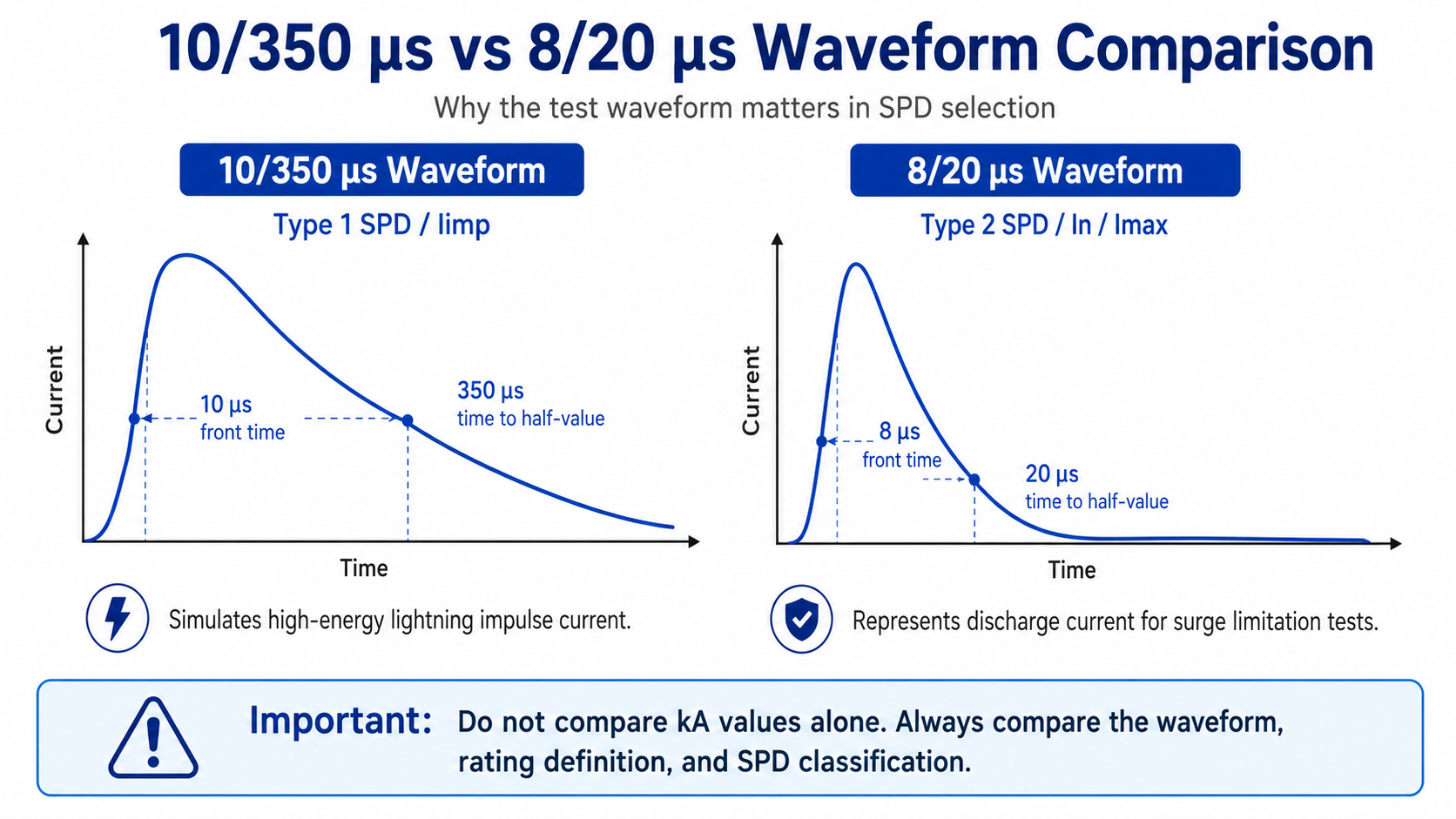
Iimp frente a In frente a Imax frente a Uoc
Estos valores describen diferentes pruebas y no deben ser tratados como versiones intercambiables de la misma calificación actual.
Otros valores importantes incluyen Uc, Up, calificación de corriente de cortocircuito y requisitos de protección de respaldo.
Cómo trabajan juntos los SPDs Tipo 1, Tipo 2 y Tipo 3
La protección efectiva contra sobretensiones se basa en etapas de protección coordinadas, no simplemente en la instalación del SPD con la mayor calificación de corriente.
Un concepto típico puede usar:
- Tipo 1 en el origen para descargar la corriente parcial de rayos;
- Tipo 2 en un tablero de distribución aguas abajo para limitar la sobretensión restante;
- Tipo 3 cerca de equipos sensibles para reducir la tensión residual de sobretensión final.
Esto no significa que cada edificio deba usar tres SPDs separados. Las alternativas posibles incluyen SPDs combinados Tipo 1+2, SPDs combinados Tipo 2+3, o protección Tipo 2 en el origen donde la función Tipo 1 no es necesaria.
No se debe aplicar una regla única de distancia de cable a cada combinación de SPD. La coordinación requerida depende de la tecnología de SPD, la coordinación probada por el fabricante, la disposición de los conductores, los niveles de protección y el equipo protegido.
¿Qué es un SPD combinado Tipo 1+2?
Un SPD Tipo 1+2 se prueba tanto para las funciones Tipo 1/Class I como para las funciones Tipo 2/Class II. Combina la descarga de corriente de impulso de rayos y la limitación de sobretensión a nivel de distribución.
Un SPD Tipo 1+2 puede ser útil donde:
- Se requieren ambas funciones de protección en un punto de instalación;
- El espacio en el cuadro de distribución es limitado;
- Sería difícil coordinar SPDs separados;
- Se prefiere una solución compacta coordinada internamente.
Para obtener pautas completas de selección de tipo 1+2, consulte el dedicado Guía de SPD de tipo 1+2.
¿Qué tipo de SPD necesitas?
La siguiente tabla proporciona una dirección inicial. La selección final debe seguir el diseño real del sistema y los requisitos aplicables.
| Situación del proyecto | Dirección de selección inicial |
|---|---|
| El edificio tiene un sistema de protección contra rayos externo | Considere el tipo 1 o tipo 1+2 |
| Una corriente parcial de rayo puede ingresar a la instalación | Se requiere servicio de tipo 1 |
| Protección general del panel principal sin servicio de tipo 1 | Tipo 2 |
| Subdistribución o panel de control de máquinas | Tipo 2 |
| Equipo terminal sensible | Tipo 3 cerca del equipo |
| Se requieren servicios de tipo 1 y tipo 2 en una tabla principal | Tipo 1+2 |
| El equipo está alejado del SPD principal | Considere protección adicional de tipo 2 o tipo 3 |
| Se requiere protección contra sobretensiones en un circuito de CC de PV solar | Utilice un SPD de CC específico para PV |
Cómo seleccionar el tipo de SPD correcto
- Identifique la posición de instalación. ¿Está instalado el SPD en el origen, panel de distribución, panel de máquina o equipo terminal?
- Evalúe la exposición a rayos. Verifique el sistema de protección contra rayos externo, la alimentación entrante y las zonas de protección contra rayos.
- Confirme la aplicación de CA o CC. No utilice un SPD de CA normal en el lado de CC de un sistema fotovoltaico.
- Confirme el sistema de puesta a tierra. Identifique el arreglo de puesta a tierra TN-S, TN-C, TT, IT o el correspondiente de CC.
- Verifique la calificación total establecida. Revise Uc, Up, Iimp, In, Imax, Uoc, calificación de cortocircuito y protección secundaria.
- Verifique la coordinación. Verifique la relación entre la protección aguas arriba, los SPDs aguas abajo y el equipo protegido.
Errores comunes en la selección de SPDs
- Elegir solo por el mayor valor de kA. Un número de corriente más grande no corrige la forma de onda incorrecta, la clasificación de voltaje o la configuración del circuito.
- Comparando Iimp directamente con Imax. Estos valores representan diferentes deberes de prueba y diferentes formas de onda.
- Usando el Tipo 3 como el SPD principal de construcción. El Tipo 3 está destinado a la protección de equipos finales, no a la corriente de sobretensión de entrada de alta energía.
- Asumiendo que el Tipo 1 protege cada carga. El voltaje residual y los efectos del conductor aguas abajo pueden requerir protección adicional.
- Usando una regla fija de 10 metros. La coordinación debe seguir las tecnologías SPD seleccionadas y la documentación del fabricante.
- Ignorando Uc y Up. La capacidad de corriente por sí sola no determina la compatibilidad de voltaje ni la protección del equipo.
- Usando un SPD de CA en DC fotovoltaico. Los circuitos DC fotovoltaicos requieren características de voltaje y desconexión específicas para la aplicación.
- Ignorando la coordinación de cortocircuito. El SPD, el fusible de respaldo y la corriente de cortocircuito prospectiva deben ser compatibles.
Los tipos de SPD de IEC y UL no son definiciones idénticas
Los sistemas IEC y UL utilizan ambos la terminología Tipo 1, Tipo 2 y Tipo 3, pero las clasificaciones no deben tratarse como completamente intercambiables.
Bajo el marco IEC, los tipos están estrechamente asociados con las clases de prueba, formas de onda y deberes de protección. Bajo UL 1449, los tipos de SPD están fuertemente relacionados con la ubicación de conexión permitida y la instalación en relación con el equipo de servicio y la protección contra sobrecorriente.
Para proyectos en América del Norte, confirmar:
- Listado UL;
- Tipo de SPD;
- Corriente nominal de descarga;
- Clasificación de protección de voltaje;
- Clasificación de corriente de cortocircuito;
- Ubicación de conexión permitida.
Tipo 1 vs Tipo 2 vs Tipo 3 FAQ de SPD
¿Cuál es la principal diferencia entre el SPD Tipo 1, Tipo 2 y Tipo 3?
El Tipo 1 gestiona la obligación de corriente de rayo en el origen, el Tipo 2 proporciona protección contra sobretensiones a nivel de distribución, y el Tipo 3 limita el voltaje residual de sobretensión cerca de equipos sensibles.
¿Es el Tipo 1 mejor que el Tipo 2?
No. Desempeñan roles diferentes. El Tipo 1 maneja la carga de corriente de rayo, mientras que el Tipo 2 limita el sobrevoltaje transitorio en el sistema de distribución eléctrica.
¿Se puede instalar el Tipo 2 en el cuadro de distribución principal?
Sí. El Tipo 2 se instala comúnmente en tableros de distribución principales y secundarios donde no se requiere la función de corriente de rayos del Tipo 1 o donde ya existe una etapa de Tipo 1 aguas arriba.
¿Necesita cada instalación un SPD de Tipo 1?
No. La necesidad de Tipo 1 depende de la exposición a corrientes de rayo, la protección externa contra rayos, la disposición del suministro entrante y los requisitos del proyecto aplicables.
¿Se puede usar el SPD tipo 3 sin el tipo 1 o el tipo 2?
El tipo 3 no debería ser normalmente considerado como la única protección donde puedan ingresar ráfagas de alta energía a la instalación. Está destinado principalmente como protección de terminal coordinada.
¿Es el Tipo 1+2 lo mismo que el Tipo 1 y el Tipo 2?
Un SPD de Tipo 1+2 se prueba para deberes tanto de Tipo 1 como de Tipo 2 dentro de un mismo producto. Los dispositivos de Tipo 1 y Tipo 2 separados pueden proporcionar las mismas etapas, pero su coordinación debe ser verificada.
¿Cuál es la diferencia entre Iimp e Imax?
Iimp está asociado con la prueba de corriente de impulso Tipo 1 de 10/350 μs. Imax está asociado con la prueba de corriente de descarga máxima Tipo 2 de 8/20 μs.
¿Puede LEEYEE ayudar a seleccionar el tipo de SPD correcto?
Sí. Proporcione el voltaje del sistema, aplicación de CA o CC, disposición de conexión a tierra, posición de instalación, polos, calificaciones requeridas y cantidad del proyecto.
Guías relacionadas de protección contra sobretensiones
¿Necesitas ayuda para seleccionar el tipo de SPD correcto?
Envíe la aplicación de CA o CC, el voltaje del sistema, el arreglo de aterrizaje, la posición de instalación, los polos requeridos, las clasificaciones de corriente y la cantidad del proyecto. LEEYEE ayudará a identificar una configuración adecuada de protección contra sobretensiones.