
A CB Class automatic transfer switch is defined by more than automatic source transfer. Its key engineering distinction is the ability to make and break short-circuit current within its assigned ratings.
This guide explains what CB Class means, how it differs from PC Class, and how a buyer should determine whether a project actually requires a breaker-based CB Class solution rather than a compact transfer switch.
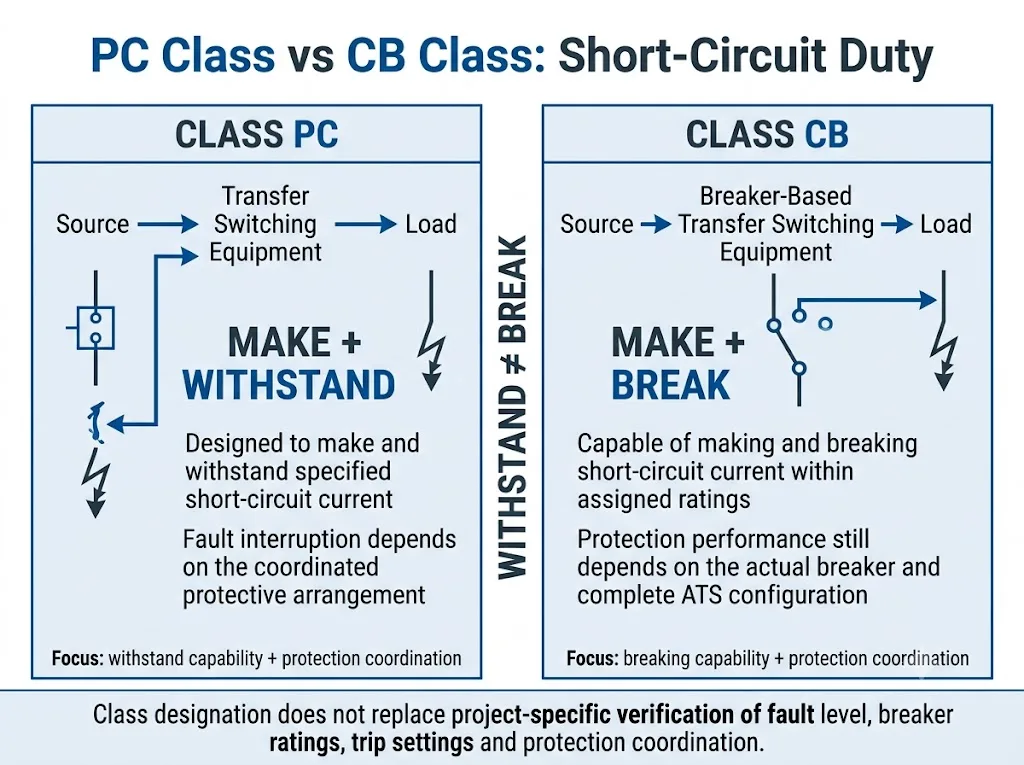
Under the IEC 60947-6-1 transfer-switching framework, Class CB transfer switching equipment can make and break short-circuit current. Class PC equipment can make and withstand short-circuit current under its assigned conditions, but short-circuit interruption is not its defining function.[1][3]
If a project explicitly specifies Class CB, do not assume that any compact ATS meets that requirement. Confirm the equipment class, short-circuit ratings, breaker arrangement and manufacturer documentation for the exact model.
LEEYEE's current compact ATS-63 range is presented for automatic source transfer in small backup-power and distribution applications. The current public product guidance lists 2P / 4P versions and 6A–63A current options and states that the ATS does not replace breakers, fuses, SPDs or the wider protection design.[6]
This article does not present LEEYEE ATS-63 as a Class CB product. A Class CB designation should only be used where model-specific manufacturer documentation explicitly supports that classification and its assigned short-circuit ratings.
Índice
What Is a CB Class Automatic Transfer Switch?
IEC 60947-6-1 covers transfer switching equipment used to transfer a load between power supply sources. The current 2026 edition applies to systems with rated voltage not exceeding 1,000 V AC or 1,500 V DC and covers manually operated, remotely operated and automatic transfer switching equipment, together with other defined configurations.[1]
For Class CB equipment, the important distinction is its short-circuit switching duty. In practical terms, Class CB transfer equipment is designed to make and break short-circuit current within its assigned capability.[3]
This is more accurate than saying “PC has no protection and CB has protection.” Real switchboards require a broader protection study. The class designation alone does not tell an engineer the breaker frame, trip settings, available breaking capacity, selectivity or complete fault-clearing behaviour of the installation.
How Does a Breaker-Based CB Class ATS Work?
Many practical CB Class transfer systems use circuit breakers as their main switching devices. A typical arrangement can include a normal-source breaker, standby-source breaker, mechanical and/or electrical interlocking, operating mechanisms and an ATS controller. Siemens, for example, documents Class CB arrangements using motor-operated circuit breakers with automatic transfer control.[4]
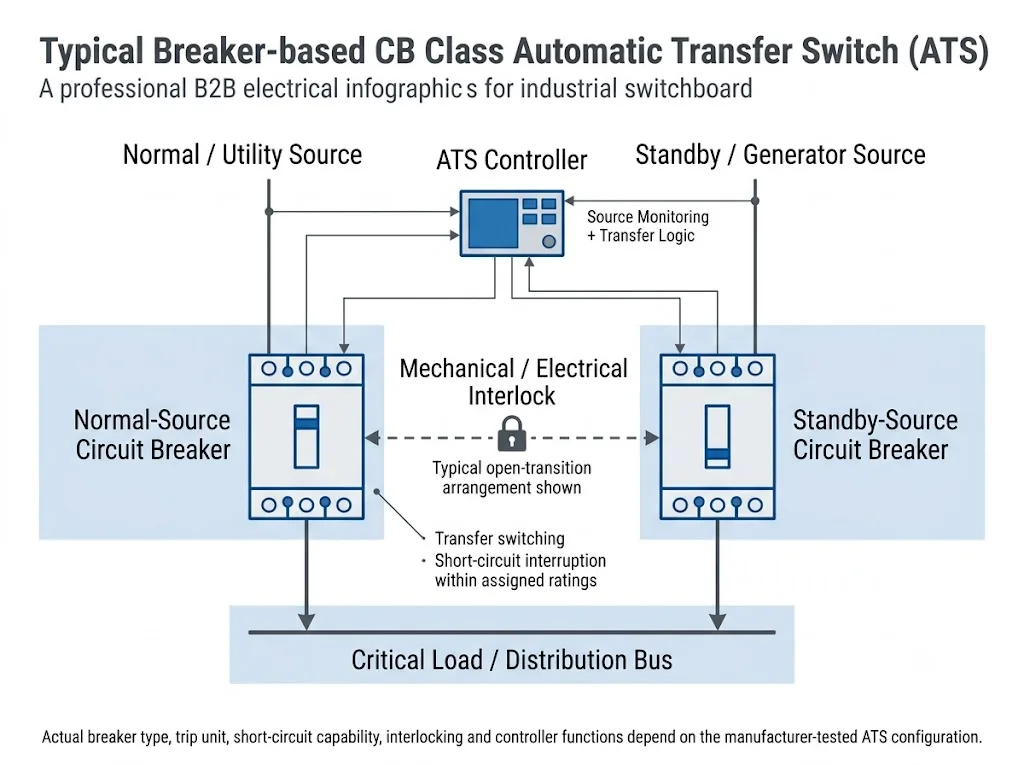
The controller monitors the available sources and commands transfer according to the configured logic. In an open-transition arrangement, the connected source is opened before the alternative source is closed.
CB Class Does Not Simply Mean “ATS With Protection”
The phrase “CB Class ATS with protection” is commonly used, but several engineering functions need to be separated.
Transfer Function
The ATS transfers the load between two power sources according to its control logic.
Short-Circuit Breaking Capability
Class CB identifies the ability to make and break short-circuit current within the equipment's assigned ratings.[3]
Protección contra sobrecorriente
If the CB Class design uses circuit breakers with overcurrent releases, the actual breaker and trip unit may provide overload and short-circuit protective functions. The functions available depend on the exact breaker configuration.
Coordinación de la protección
The ATS breaker still has to work correctly with upstream and downstream protective devices. ABB's IEC-market ATS guidance highlights selectivity and coordination considerations when Class CB equipment forms part of the distribution protection system.[3]
CB Class vs PC Class ATS: What Is the Real Difference?
The most useful comparison is not which class is “better.” The real question is what the transfer equipment is designed to do under short-circuit conditions.
| Engineering Question | CB Class ATS | PC Class ATS |
|---|---|---|
| Transfers between sources | Sí | Sí |
| Short-circuit making capability | Yes, within assigned ratings | Yes, within assigned ratings |
| Resistencia al cortocircuito | Depends on assigned equipment characteristics | Core part of Class PC duty |
| Short-circuit breaking | Yes, within assigned capability | Not the defining Class PC function |
| Typical switching basis | Often circuit-breaker based | Often dedicated transfer / switch based |
| Main protection focus | Breaking capability, trip functions and coordination | Withstand capability and coordinated external protection |
Procurement conclusion: neither class is universally superior. The correct choice depends on the single-line diagram, fault level, protection architecture and project specification.
Is LEEYEE ATS-63 a CB Class Automatic Transfer Switch?
Do not classify it as Class CB from appearance, current rating or the ATS-63 model name alone.
LEEYEE's current public ATS guidance describes ATS-63 as a compact automatic source-transfer product available in 2P / 4P and 6A–63A versions. It also states that an ATS does not replace breakers, fuses, SPDs or grounding within the wider protection design.[6]
That public information does not, by itself, establish the Class CB short-circuit breaking classification discussed in this article.
When Is a Compact ATS Different From a CB Class Solution?
| Pregunta del proyecto | Compact ATS-63 Type Application | Class CB Project Requirement |
|---|---|---|
| Primary purpose | Automatic transfer between two available AC sources | Transfer plus assigned short-circuit breaking capability |
| Current range | LEEYEE public guidance lists 6A–63A[6] | Depends on the selected manufacturer and breaker platform |
| Breaker replacement | No — wider circuit protection remains separate[6] | Protective functions depend on actual breaker and trip configuration |
| Short-circuit breaking claim | Do not assume without model-specific documentation | Must be supported by assigned equipment ratings |
| Typical decision driver | Voltage, current, poles, source type and transfer requirement | Fault current, breaker capability, trip unit and protection coordination |
Does a CB Class ATS Provide Short-Circuit Protection?
A Class CB ATS has short-circuit breaking capability within its assigned ratings. However, that does not mean any Class CB ATS can safely interrupt any prospective fault current.
The engineer still needs to compare the equipment ratings with the prospective short-circuit conditions at the installation point.
Where IEC 60947-2 circuit breakers form part of the arrangement, relevant characteristics can include applicable breaking capacities and, where assigned, short-time withstand characteristics. Use the data for the exact breaker at the actual system voltage.[2]
Does a CB Class ATS Also Provide Overload Protection?
It can, depending on the actual circuit breaker and trip unit.
A thermal-magnetic or electronic release may provide different protection functions and adjustment ranges. Those characteristics belong to the selected breaker, not simply to the words “CB Class.”
This distinction is particularly important when comparing a breaker-based Class CB system with a compact ATS such as ATS-63. A compact source-transfer device should not be assumed to perform the same protective role unless its model-specific documentation explicitly states that capability.
Which Parameters Matter Most in a Class CB Project?
| Parameter to Confirm | Por qué es Importante |
|---|---|
| Tensión nominal de funcionamiento | The complete transfer equipment must match the system voltage. |
| Corriente nominal | Confirms continuous-load suitability but does not define fault capability. |
| Corriente de cortocircuito prospectiva | Determines the fault level the proposed equipment must be evaluated against. |
| Breaker family / frame | Different breaker platforms can have different short-circuit characteristics. |
| Capacidad de ruptura | Must be suitable for the installation fault level and voltage. |
| Trip-unit type | Determines available protection functions and settings. |
| Protection coordination | Helps ensure the intended protective device clears a fault. |
| Poles and neutral arrangement | Must match the system architecture and project requirements. |
Why Protection Coordination Still Matters
Consider a fault on one downstream feeder. The protection design may require the downstream feeder breaker to operate while the incoming transfer equipment remains in service.
If protective devices are not coordinated correctly, a local fault may disconnect a larger part of the distribution system than intended.
A Class CB project can therefore require review of:
- corriente de cortocircuito presunta;
- upstream protective devices;
- ATS breaker time-current characteristics;
- downstream breaker or fuse characteristics;
- instantaneous and short-time settings where applicable;
- selectivity requirements;
- generator-side fault behaviour where a generator is one source.
When Does a Project Actually Need Class CB?
A Class CB solution can be appropriate when fault interruption is intentionally integrated at the transfer point and the project specifies breaker-based protection characteristics.
Breaker-Based Source Incomers
If both source incomers are designed around MCCBs or ACBs and the transfer point also performs defined protective duties, a Class CB architecture may be appropriate.
Projects With Explicit Short-Circuit Requirements
If the consultant or panel specification calls for a defined breaker breaking capacity, trip unit or selectivity requirement at the transfer point, the transfer equipment has to be evaluated against those requirements.
Larger Engineered Distribution Systems
Industrial or project switchboards may use breaker-based transfer as part of the wider distribution protection scheme. The final configuration still depends on the project single-line diagram and coordination study.
When Is LEEYEE ATS-63 the More Relevant Product Type?
LEEYEE ATS-63 is positioned as a compact transfer switch for applications where the main requirement is automatic changeover between two AC sources rather than integrated Class CB fault interruption.
Current LEEYEE public guidance lists:
- 2P and 4P configurations;
- 6A, 10A, 16A, 20A, 25A, 32A, 40A, 50A and 63A current options;
- AC110V, AC220V and AC400V configurations;
- 50/60Hz configurations;
- manual and automatic operation;
- compact backup-source switching applications.[6]
For these applications, the ATS should still be used together with the necessary breakers, fuses, SPDs, grounding and cable protection required by the complete electrical system.[6]
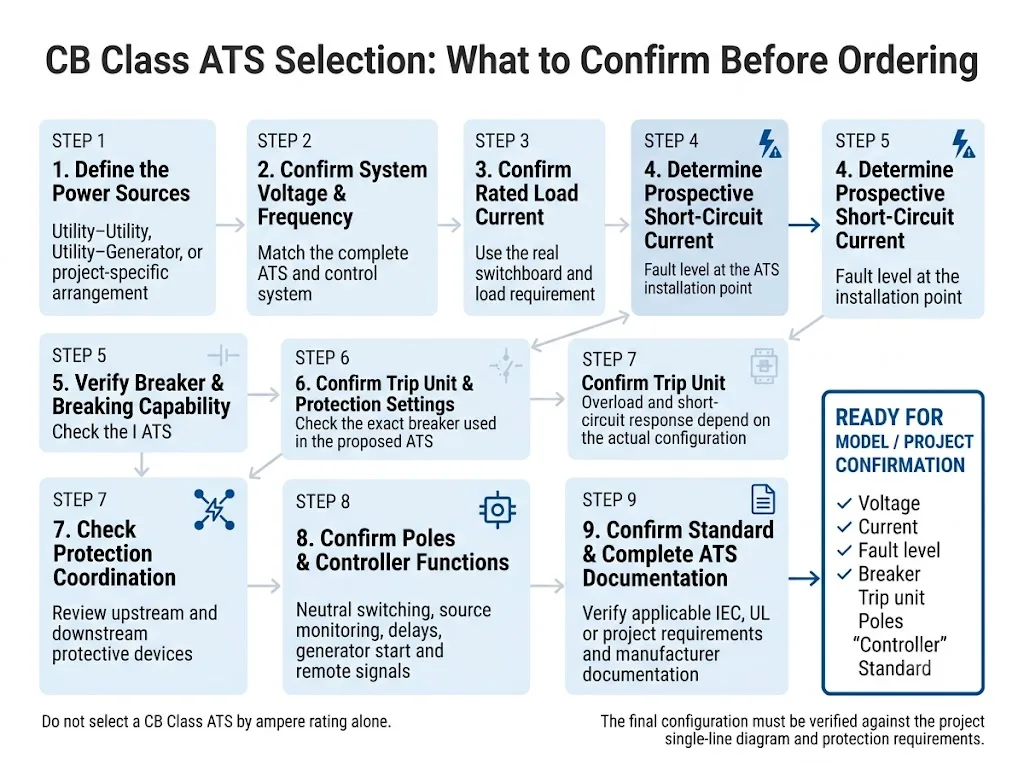
How to Decide: Compact ATS or Class CB?
| Pregunta | Selection Meaning |
|---|---|
| Do you mainly need automatic transfer between two AC sources? | A compact ATS may be suitable if its voltage, current, poles and application conditions match. |
| Does the specification explicitly require Class CB? | Use equipment with model-specific documentation supporting the required Class CB classification. |
| Must the transfer equipment itself interrupt short-circuit current? | A breaker-based Class CB architecture may be required. |
| Are external breakers already defined? | Review whether a compact transfer switch can work within the existing protection architecture. |
| Is the available fault current known? | For a Class CB project, this is essential for verifying short-circuit suitability. |
What to Send Before ATS Selection
- Voltaje y frecuencia del sistema
- Monofásico o trifásico
- Corriente nominal de carga
- 2P or 4P requirement
- Normal source type
- Backup source type
- Prospective fault current, if known
- Project-required ATS class
- Norma o certificación exigida
- Single-line diagram, if available
Check Whether LEEYEE ATS-63 Fits Your Project
Send your system voltage, load current, pole requirement, normal and backup source information, and any project specification that mentions PC Class, CB Class or short-circuit performance.
LEEYEE can review whether the current ATS-63 compact transfer-switch range matches the application. If the specification requires a different transfer architecture, that requirement should be identified before model approval.
Preguntas frecuentes
What is a CB Class automatic transfer switch?
A CB Class automatic transfer switch is transfer switching equipment whose assigned capability includes making and breaking short-circuit current. The exact short-circuit ratings still have to be checked for the selected equipment.[3]
Is LEEYEE ATS-63 a CB Class ATS?
Do not make that classification from the product appearance or ATS-63 model name alone. The current public LEEYEE ATS information describes a compact 2P / 4P, 6A–63A transfer product and states that the ATS does not replace the wider breaker and protection design.[6] A Class CB claim requires model-specific supporting documentation.
What is the main difference between CB Class and PC Class?
The key distinction is short-circuit duty. Class PC is associated with making and withstanding short-circuit current under assigned conditions, while Class CB includes short-circuit breaking capability within assigned ratings.[3]
Does CB Class mean overload protection is always included?
No. Available overload and short-circuit protection functions depend on the actual breaker and trip unit used in the complete transfer equipment.
Can a compact 63A ATS replace a Class CB transfer switch?
Not simply because both products have a similar normal-current rating. If the project requires Class CB short-circuit breaking capability, the selected equipment must have documentation supporting that classification and the required ratings.
When is ATS-63 a more relevant choice?
ATS-63 is relevant when the project needs compact automatic transfer between two compatible AC sources within its documented voltage, pole and current range, while circuit protection is provided as part of the wider electrical design.[6]
Can two motorized breakers automatically be called a Class CB ATS?
Not automatically. IEC 60947-6-1:2026 excludes transfer-switch configurations that are not fully manufacturer type-tested or marked according to the document as a complete transfer switch.[1]
Should IEC Class CB terminology be used for a US project?
IEC Class CB and UL 1008 belong to different standards frameworks. For a North American project, confirm the required UL 1008 listing and project-specific short-circuit and installation requirements separately.[5]
Referencias
- International Electrotechnical Commission (IEC), IEC 60947-6-1:2026 — Low-voltage switchgear and controlgear — Part 6-1: Multiple function equipment — Transfer switching equipment, Fourth Edition, published 2 April 2026. Página de publicaciones oficiales de la IEC.
- International Electrotechnical Commission (IEC), IEC 60947-2:2024 — Low-voltage switchgear and controlgear — Part 2: Circuit-breakers, Sixth Edition. Página de publicaciones oficiales de la IEC.
- ABB, How to Select an Automatic Transfer Switch Class — A Guide for IEC Markets. Technical guidance covering Class PC, Class CB, short-circuit performance and selectivity considerations. ABB technical white paper.
- Siemens, 3KC ATC6300 Transfer Control Device — Equipment Manual. Technical information for automatic transfer control and Class CB arrangements using motor-operated circuit breakers. Siemens equipment manual.
- UL Standards & Engagement, UL 1008 — Transfer Switch Equipment, Edition 9. UL Standards official page.
- LEEYEE / CNSPD, ¿Qué es un conmutador automático de transferencia? Cómo funciona un ATS y cómo elegirlo. Current public guidance for the LEEYEE ATS-63 compact transfer-switch range, including 2P / 4P versions, 6A–63A current options and the requirement for separate system protection. LEEYEE ATS technical guide.